The Phone Before the Fire: Tan Mu's Minneapolis and the Instinct to Record
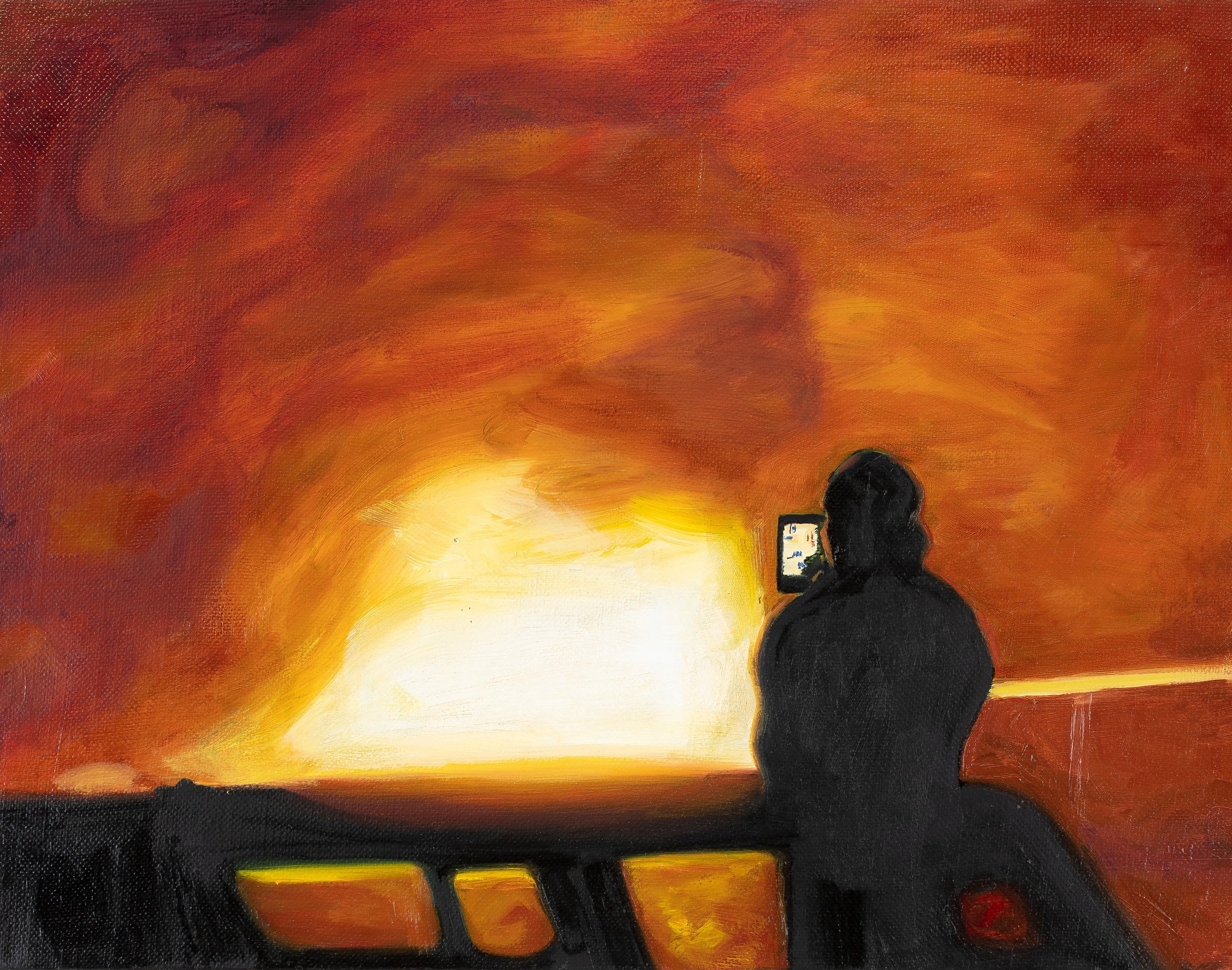
There is a figure in the foreground of Minneapolis, 2020, leaning out of a car window, holding a phone toward the burning scene ahead. The figure is a silhouette, sharp-edged and dark against the luminous blur of the background, and the phone in their hand is the only element in the composition that is rendered with comparable clarity. The car, the fire, the street, the buildings, all of these are painted in a blurred, horizontal drag of pigment that suggests motion, instability, and the imperfect resolution of an image that has been captured in a moment of chaos and has not had time to settle into focus. The phone is not blurred. The phone is sharp. The arm that holds it is sharp. The gesture of extending the device toward the event, of pointing it at the fire, of orienting the body so that the screen can capture what the eyes are seeing, this gesture is the most precise and legible element in a painting that is otherwise dissolving into heat and motion and the visual noise of a city in crisis. The figure is not trying to put out the fire. The figure is not calling for help. The figure is recording. The instinct to record has replaced the instinct to act, and the painting places this replacement at the exact center of its composition, in the foreground, in the sharpest focus, in the most undeniable position on the canvas, as though to say: this is what we do now. We do not run toward the fire to extinguish it. We hold up our phones and we record it, and the recording is not a secondary act, an afterthought, a supplement to the real response. The recording is the response. It is the first thing we do, and in some cases it is the only thing we do, and the painting makes this sequence of priorities visible by rendering the phone in focus and the fire in blur, by giving the recording device a sharper edge than the event it is recording.
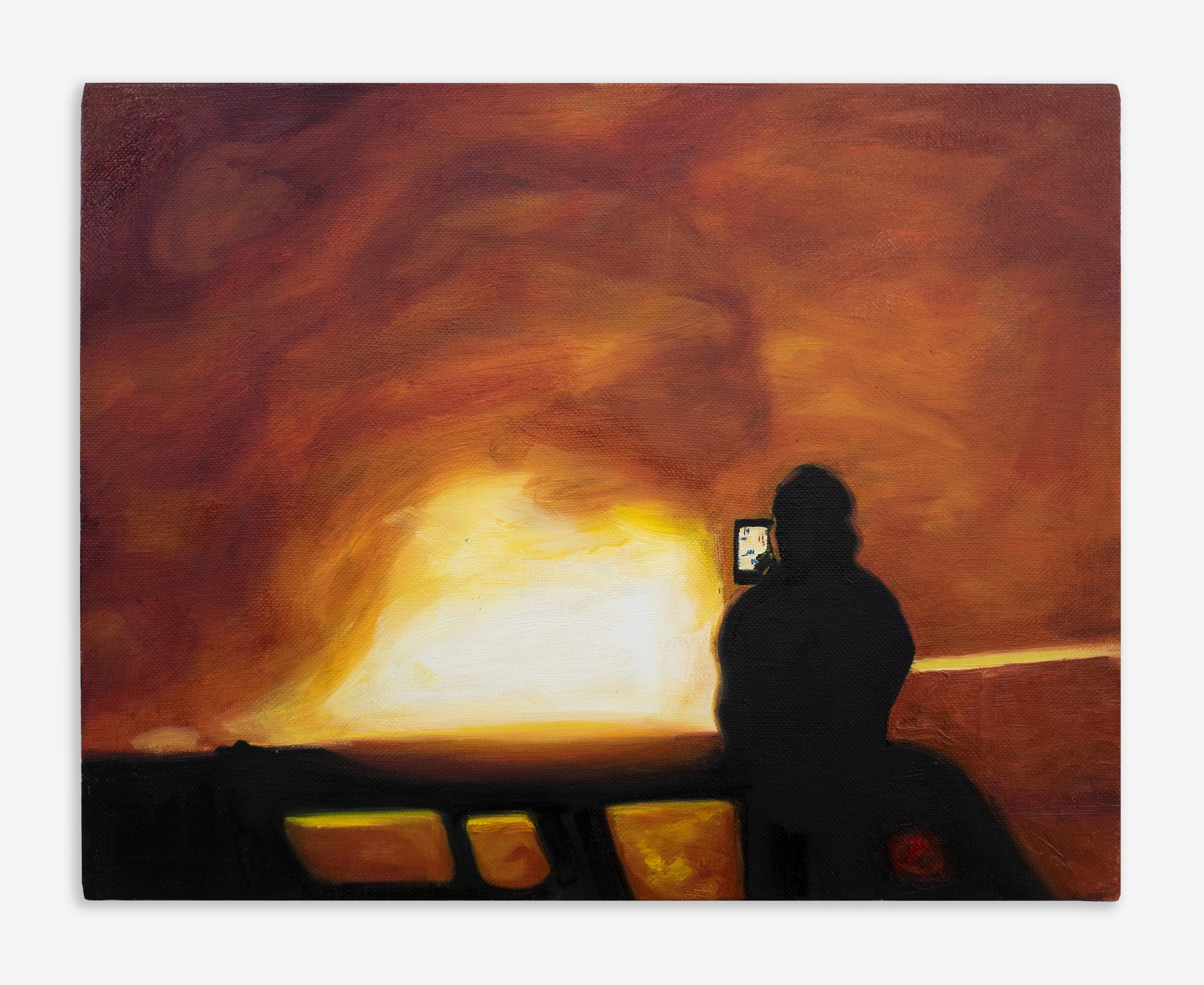
Minneapolis, 2020, is oil on linen, 27.9 x 35.6 cm (11 x 14 in). The format is small, intimate, the scale of a photograph that could be held in one hand, and the scale is part of the argument. This is not a painting that fills a wall. It is a painting that could be held at arm's length, like a phone, like a screen, like the device that the figure in the foreground is holding toward the fire. The small format replicates the scale of the phone screen, the scale at which most people experienced the events of 2020, not from the street, not from the burning car, but from a screen held at arm's length, a rectangle of light and color and motion that delivered the crisis in a resolution that was always slightly too low, always slightly too compressed, always slightly too delayed to feel like being there. The painting is the size of that screen, and the viewer who stands before it occupies the same position as the figure who holds the phone: close enough to see the image, too far away to intervene in the event.
The background is a field of horizontal strokes, warm and luminous, in which the forms of buildings, a street, and an overturned vehicle are partially legible through the blur. The predominant colors are amber, orange, and a deep, sooty red that reads as flame against the darker tones of the urban fabric. The blur is not an accident. It is a technique that Tan Mu has employed consistently across the works that address events mediated through screens, and she has described its logic with precision. "Blurred cityscapes and horizontal brushstrokes suggest motion, instability, and the multiple layers of mediation an image undergoes." The horizontal stroke is the stroke of a screen scrolling, of a video playing at low resolution, of a photograph captured in motion and transmitted through a compressed format before it has had time to resolve into clarity. The blur is the visual equivalent of the pixelation that occurs when a video is streamed over a limited bandwidth, or the motion blur that appears when a camera is moved too quickly for the sensor to register a clean frame. The painting does not depict the event. It depicts the image of the event as it appeared on a screen, and the blur is the signature of that mediation, the visual marker that distinguishes the experience of watching a crisis on a phone from the experience of being present at the crisis itself. The foreground figure, by contrast, is painted in sharp focus, a dark silhouette with clean edges, because the figure is not part of the blur. The figure is the one who is holding the device that is producing the blur, and the sharpness of the figure against the blur of the background enacts the same division that the phone itself enacts: the person holding the camera is not in the image. The person holding the camera is outside the frame, looking in, recording what is happening to someone else, and the painting gives this position, the position of the recorder, the position of the witness who is not acting but watching, the clearest and most legible place in the composition.
Andy Warhol's Race Riot (1964) is a silkscreen painting that reproduces a news photograph of the Birmingham campaign protests of 1963, in which police dogs were set on peaceful demonstrators by order of Public Safety Commissioner Eugene Connor. The photograph, taken by a news photographer and distributed by the Associated Press, shows a police dog lunging at a young Black man while a police officer holds the leash. Warhol copied the photograph four times across the canvas in a grid, varying the tonal register from bright to dark, and he left the imperfections of the silkscreen process, the uneven ink distribution, the slight misalignment between layers, as visible features of the image rather than defects to be corrected. The result is a painting that looks like a newspaper page, or more precisely, like a newspaper page that has been enlarged to the scale of a gallery wall, where the halftone dots and the registration errors and the limited tonal range of newsprint become the visual language through which the event is rendered. Warhol was not interested in the event itself. He was interested in the image of the event, and specifically in the way that the image, once it had been reproduced in a newspaper, had become a commodity, an object that could be copied, distributed, and consumed alongside the other commodities that filled the pages of the daily press. The silkscreen process was his way of making this commodity status visible. A silkscreen is a reproduction technique. It produces multiple copies of the same image from the same screen. The four repetitions of the Birmingham photograph across the surface of Race Riot are not four different photographs. They are four copies of the same photograph, and the fact that they are copies, that they are mechanically reproduced rather than individually composed, is the content of the painting. The content is not the police dog or the demonstrator or the officer holding the leash. The content is the reproducibility of the image, the fact that the photograph, once taken, can be printed an infinite number of times in an infinite number of newspapers, and that each printing reduces the event by one degree, carrying it further from the street where it happened and closer to the breakfast table where it is consumed with coffee and forgotten by noon.
Tan Mu's Minneapolis occupies the same position that Warhol's Race Riot occupied in 1964: the position of the artist who is not at the event but at the screen, who is experiencing the crisis through the mediation of the image rather than through the direct experience of the street, and who is making a painting about that mediation, not about the event itself. The difference is the medium of mediation. Warhol's mediation was the newspaper. Tan Mu's mediation is the phone. The newspaper, in 1964, was a mass-produced, daily, disposable object that delivered the image once, in a single printing, on a single day, and then disappeared into the recycling bin or the bottom of a birdcage. The phone, in 2020, is a device that delivers the image continuously, in real time, in video rather than still photography, and it delivers it not to a mass audience of anonymous readers but to a network of individual followers, each of whom is holding a screen of their own, each of whom is watching the same event from a different angle, and each of whom is potentially recording it again, adding their own footage to the stream, amplifying the image by retransmitting it, so that the event does not recede with each reproduction, as it did in the newspaper, but accumulates, growing louder and more present with each cycle of capture and retransmission, until the event and the image of the event are no longer distinguishable, and the people on the street are performing for the phone as much as they are protesting against the police, and the phone is recording the performance, and the performance is being watched by people on other phones, who are holding their phones up to record the screen on which the event is playing, and the recording of the recording is being uploaded and streamed and shared and watched again, and the blur in the painting is the blur of all of these mediations happening at once, the layering of screen upon screen upon screen, each one adding its own compression, its own pixelation, its own delay, until the original event, the burning car, the overturned vehicle, the street in crisis, is buried under so many layers of mediation that it can only be seen through the blur, and the only element in the composition that is not blurred is the phone itself, the device that is creating the blur, the instrument that is converting the event into the image, the tool that has replaced the fire extinguisher as the first object that a person reaches for when they see a fire.
Tan Mu has identified this replacement as the painting's central observation. "A striking observation within this work," she writes, "is the shift in human instinct: the primal drive to extinguish a fire has been replaced by the modern reflex to record it on a smartphone and share it on social media." The phrasing is careful. She does not say that the instinct to record has replaced the instinct to help. She says that the instinct to record has replaced the instinct to extinguish. The specificity matters. The fire is not a metaphor for every kind of crisis. It is a literal fire, a burning car, an overturned vehicle, the kind of fire that a person might once have tried to put out with a blanket or a bucket of water or a fire extinguisher pulled from the wall of a nearby building. The shift she identifies is not a general shift from action to observation. It is a specific shift from one action, putting out the fire, to another action, recording it, and the shift is not a moral decline or a technological failure. It is a change in the instinct itself, in the first reflex that the body enacts when it encounters a crisis, and the painting renders this change visible by placing the phone in the sharpest focus and the fire in the blur, by giving the recording device the visual clarity that the event itself has lost, by making the instrument of mediation more legible than the event it is mediating. This is not a judgment. The painting does not say that recording is worse than extinguishing. It says that recording has become the instinct, and that this instinct, which is so automatic that it occurs before conscious thought can intervene, has fundamentally altered the relationship between the witness and the event, and that this alteration, this shift from the hand that reaches for the extinguisher to the hand that reaches for the phone, is the defining gesture of the era.
Danni Shen, writing in Emergent Magazine about Tan Mu's practice, observes that her works "serve as a kind of witness to human socio-technological histories," and the word "witness" is the precise term, because a witness is not a participant. A witness stands at a distance from the event and records what they see, and the distance is not physical distance, or not only physical distance, but the distance that the screen introduces between the body and the event, the distance that the phone creates when it is held up between the eyes and the world, the distance that converts the experience of being present at a crisis into the experience of watching a crisis on a device that is also a camera, a screen, and a transmitter, all at once. The painting places the viewer in the position of the witness. The small format, the intimate scale, the blur of the background that makes it impossible to read the details of the event with the clarity that the foreground figure demands: all of these formal decisions replicate the experience of watching a crisis on a phone, and they place the viewer in the same relation to the painting that the figure holds to the event, which is the relation of the witness who is not acting but watching, the relation of the camera to the fire, the relation of the screen to the street, the relation of the recording to the event that it is recording, and this relation, this distance, this mediation, is what the painting makes visible, not by depicting it as an idea but by enacting it as a formal structure, a structure in which the sharpest element in the composition is not the event but the device that is recording the event, and the event itself, the fire, the car, the street, the buildings, are all blurred, all mediated, all seen through the screen that the phone has placed between the witness and the world.
The painting was made during the COVID-19 pandemic, a period when the instinct to record was not merely a cultural reflex but the only available form of participation. Tan Mu had moved her practice from her studio in New York back to her home, experiencing isolation while witnessing collective upheaval through screens. "I had moved my painting practice from my studio in New York back to my home, experiencing isolation while witnessing collective upheaval through screens," she says. "Some people took to the streets, setting cars on fire and using torches as expressions of anger and resistance. The contrast between enforced isolation and mass protest revealed a deep sense of unease and disorientation within society during this period." The contrast is not incidental. It is structural. The isolation and the protest are two responses to the same crisis, and they are connected by the screen. The isolated person watches the protest on the screen. The protesting person is recorded by the screen. The screen is the medium through which the isolated person becomes a witness to the protest, and it is also the medium through which the protest becomes visible to the isolated person, and the result is a feedback loop in which the protest is performed for the screen, the screen records the protest, the recording is transmitted to the isolated person, the isolated person watches the recording, and the watching becomes a form of participation that does not require being present on the street, a form of participation that is mediated through the same device that the figure in the painting is holding toward the fire. The painting holds this entire loop in a single composition: the fire, the figure with the phone, and the viewer who is looking at the painting, which is also a screen, which is also a rectangle of light and color and motion that delivers the crisis in a resolution that is always slightly too low to feel like being there, and which places the viewer in the same position as the figure, which is the position of the witness who is watching the event through a device, and who is aware, in the moment of watching, that watching is what they are doing, that recording is what the figure is doing, and that the device that makes the recording possible has become the instrument through which the event is experienced, which is the same instrument that has replaced the extinguisher, and that has replaced it not because the people who hold it are indifferent to the fire but because the instinct has shifted, the body has learned a new reflex, and the reflex is to reach for the phone, not the fire extinguisher, and the phone, once reached for, converts the event into an image, and the image, once made, is shared, and the sharing, once begun, is irreversible, and the event, once recorded and shared, belongs to the network in a way that it never belonged to the street, and the painting, by giving the phone the sharpest focus and the fire the blur, places this entire sequence of substitutions in a single frame, and the frame is the size of a phone screen, and the viewer holds it at arm's length, and the distance between the viewer and the painting is the same distance that the screen has placed between the witness and the event, and the painting, by making this distance visible, makes it unavoidable, and what is unavoidable is not the fire but the phone, not the crisis but the recording, not the thing that is burning but the thing that is being held up to capture the burning, which is the thing that we reach for first, which is the thing that has become the instinct, which is the thing that replaced the extinguisher, and which, in the painting, is the only thing that is in focus.