The Shell That Holds the Sun: Tan Mu's Dyson Sphere and the Architecture of Infinite Want
Nick Koenigsknecht, writing in the BEK Forum catalog, asks a question that most critics of Tan Mu's work have avoided. "While observing technology, are we not looking at ourselves?" The question is usually quoted for its second clause, the observation that her paintings function as "self-portraits" of technology rather than depictions of it. But the first clause is the one that matters here. "While observing technology, are we not looking at ourselves?" The Dyson Sphere is not a technology. It has never been built. It has no blueprints, no engineering specifications, no construction timeline, no budget. It exists as a paragraph in a 1960 paper by the physicist Freeman Dyson, published in the journal Science, in which he argued that a sufficiently advanced technological civilization would inevitably surround its host star with a shell of energy-harvesting devices, because the star's radiation, which currently disperses into empty space, represents a waste of resources that no civilization capable of capturing it would tolerate. The paragraph is three sentences long. It contains no diagrams. It proposes no materials. It makes no claims about feasibility. It is a thought experiment, an exercise in extrapolation, a statement about what a civilization would do if it could, not a statement about what any civilization has done or will do. And yet this paragraph, this three-sentence speculation about a structure that no one has ever built and no one can currently build, has produced more visual representations than most technologies that actually exist. The Dyson Sphere has been illustrated, modeled, animated, and imagined across every visual medium available to the culture that produced it, and the reason is not that the structure is real but that the desire it encodes is real: the desire for unlimited energy, the desire to exceed the limits of a planet, the desire to capture the output of a star and hold it in a shell built by human hands. The Dyson Sphere is not a technology. It is a want. And the painting, by rendering that want in gold on a six-foot canvas, makes it visible as a want, not as a plan.
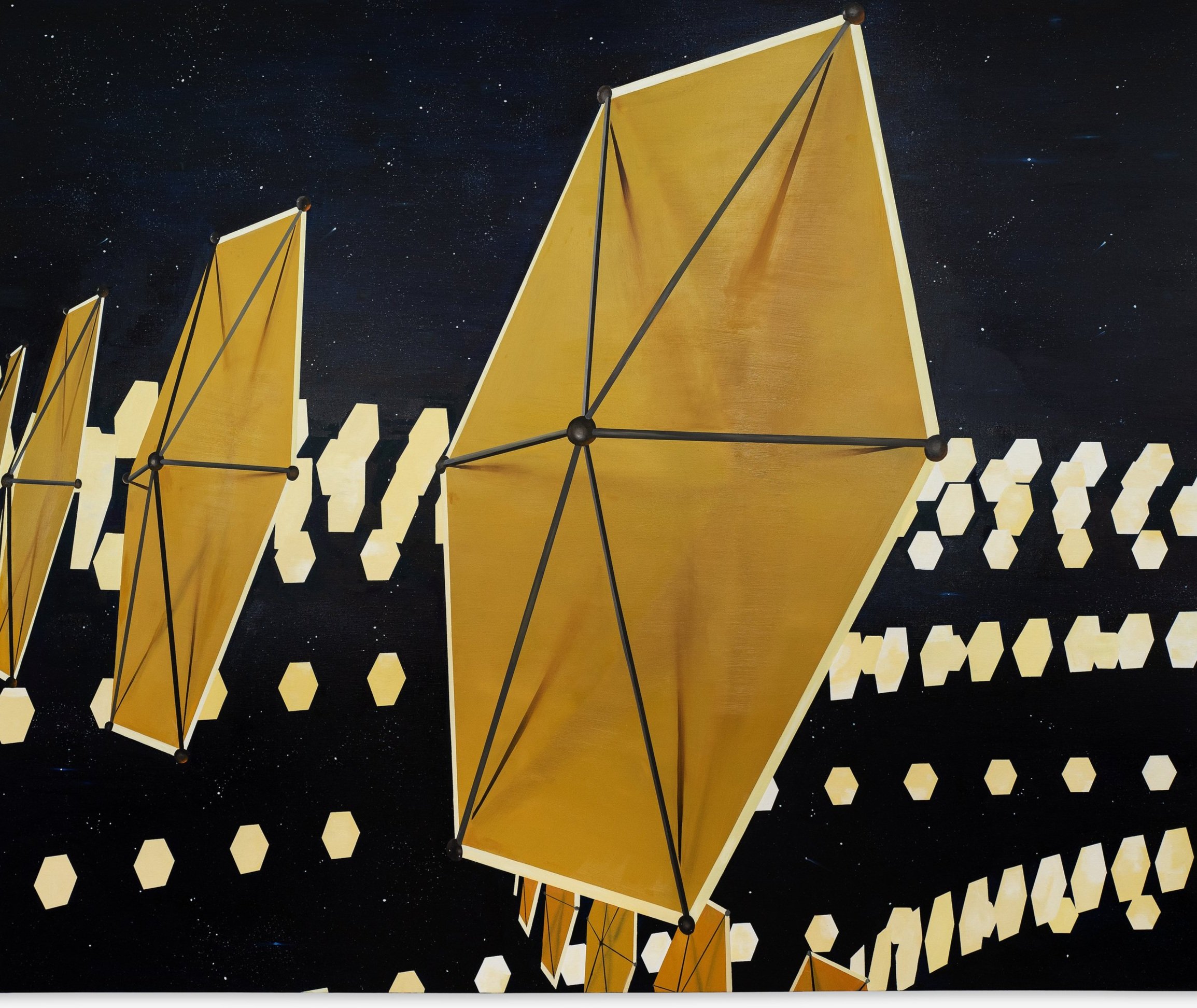
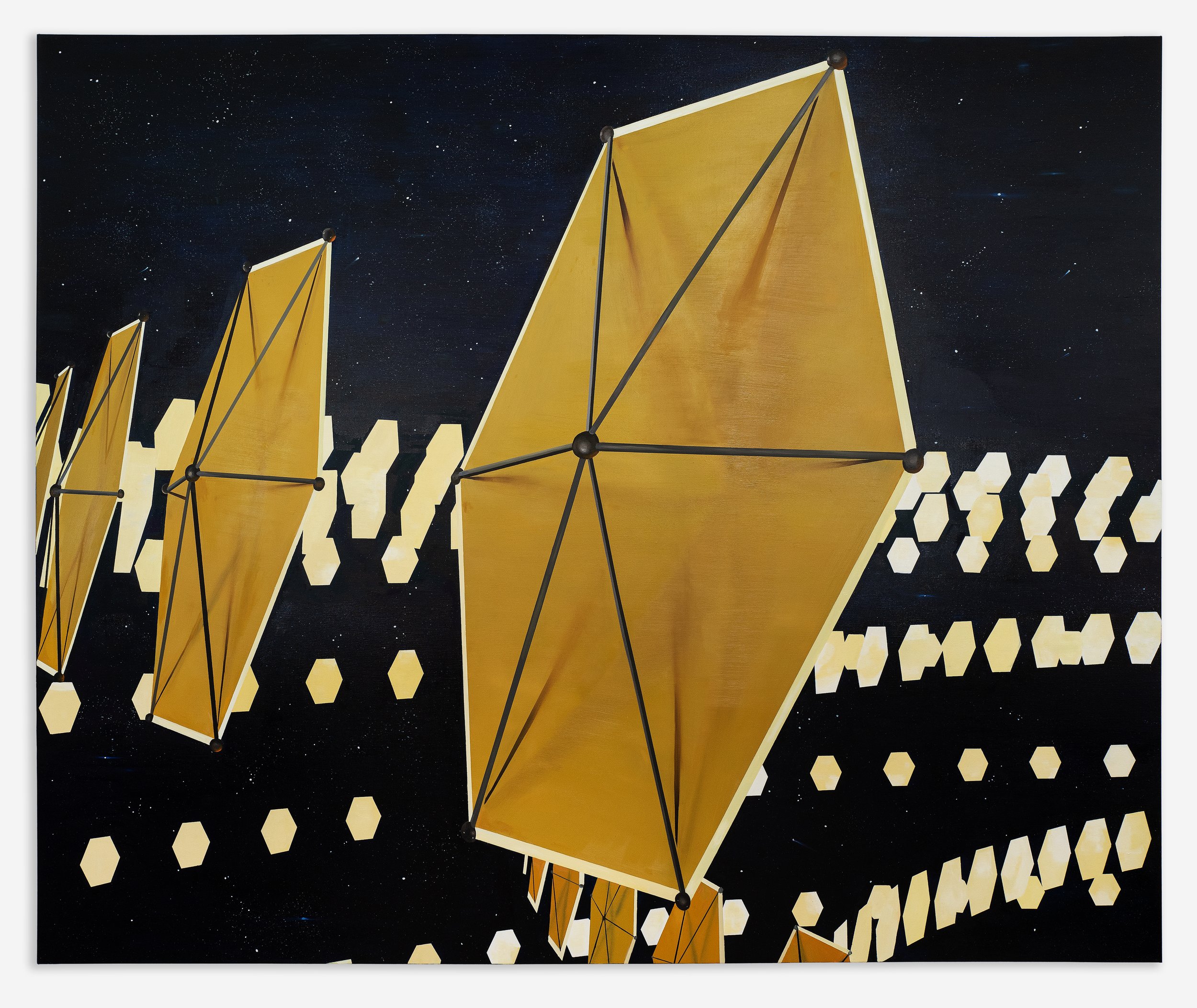
Dyson Sphere, 2023, is oil on linen, 152 x 183 cm (60 x 72 in). The format is large, the scale of a painting that the viewer enters rather than holds. The composition is divided into two zones. The upper register is a field of deep, saturated gold, modulated across its surface from bright amber at the center to a deeper, cooler gold at the edges, where the tones shift toward ochre and raw sienna. This golden field is traversed by curved lines that suggest the orbital paths of panels or collectors arranged around a central point, and the curves are rendered with a fluid, gestural quality that distinguishes them from the hard-edged geometry of an engineering diagram. The lower register is a field of dark blue, close to black, densely populated with small dots of varying size and brightness that represent the starry sky as seen from within the sphere, looking outward through the gaps between the orbital panels. The boundary between the gold and the dark blue is not a straight line. It is an irregular, curved edge that follows the arc of the orbital paths, creating the impression that the golden panels are rotating, that the boundary between the illuminated interior and the dark exterior is in motion, and that the viewer is seeing the sphere at an instant when the rotation has carried some panels across the field of vision and left others still approaching.
The gold is the painting's most immediately commanding visual element, and Tan Mu has discussed its function with precision. "I used a field of golden tones to depict energy collection panels orbiting a star. The flowing gradients suggest light being reflected, absorbed, and transformed, while the rotating posture of the panels evokes continuous motion and accumulation." The gold is not decorative. It is the color of the energy that the Dyson Sphere is designed to capture. A star radiates across the full electromagnetic spectrum, but the peak of its output, for a star like the Sun, falls in the visible range, and the dominant impression of sunlight, to a human eye adapted to that output, is gold. The painting assigns this color to the panels because the panels are designed to receive it, and the luminosity of the gold, which seems to emanate from the surface of the paint rather than being reflected from it, enacts the function that the panels are meant to perform: it captures the light and holds it. The paint handling supports this reading. The gold is built up in thin, translucent layers over a warmer ground, each layer shifting the value slightly, producing a depth that reads as the depth of a manufactured surface, a panel that has been polished or coated to maximize its reflectivity. The brushstrokes follow the curved paths of the orbits, laid down in long, flowing passes that suggest the trajectory of an object moving through space, and the slight variation in the width and opacity of each stroke registers the change in the panel's angle relative to the star as it moves along its orbit, catching more light when it faces the star directly and less when it begins to turn away.
Olafur Eliasson's The Weather Project (2003) installed an artificial sun in the Turbine Hall of Tate Modern. A semi-circular array of mono-frequency sodium lamps, backed by a ceiling of mirrored panels that doubled the semi-circle into a full circle, produced a vast, glowing orb that filled the upper half of the hall with an amber light that was identical in color temperature to the light of the Sun at the horizon. The mirrored ceiling reflected the visitors below, and the visitors, looking up, saw themselves suspended in the reflected space above the artificial sun, floating in a hall that had been converted into a sky. The installation was a technological construction: lamps, mirrors, aluminum frames, and a ventilation system that dispersed a fine mist of sugar solution into the air to create the hazy, atmospheric quality of the light. It was also a devotional construction. The visitors who lay on the floor of the Turbine Hall and stared up at the artificial sun were performing the same gesture that a worshipper performs before an altar: they were orienting their bodies toward a source of light that they knew was manufactured and that they responded to as though it were real. The light was not real. It was sodium vapor, not hydrogen fusion. But the response was real. The warmth on the skin, the dilation of the pupils, the involuntary feeling of well-being that a golden light produces in a body that has evolved to associate that wavelength with the presence of the Sun: these responses were real, and the installation's argument was that the distinction between a manufactured sun and a real one, at the level of the body's response, does not exist. The body does not know that the light is artificial. The body responds to the wavelength.
Tan Mu's Dyson Sphere occupies the same register. The gold in the painting is not sunlight. It is oil paint. But the body does not know this. The body responds to the luminosity of the gold, the warmth of the amber tones, the glow that seems to emanate from the surface rather than being reflected from it, and the response is the same response that the visitors to The Weather Project experienced in the Turbine Hall: a feeling of warmth, a feeling of being in the presence of a source of light, a feeling that is not cognitive but physical, not interpretive but automatic. The painting uses this response to make an argument about the Dyson Sphere itself. The Sphere, in Dyson's original formulation, is a structure that captures the output of a star and converts it into usable energy. The painting captures the viewer's automatic response to the color gold and converts it into an experience of that capture. The viewer who stands before the painting and feels the warmth of the golden field is experiencing, at the level of the body, what the Dyson Sphere is designed to produce: the conversion of stellar radiation into a form that can be received, held, and used. The painting does not depict this conversion. It performs it. And the performance depends on the same mechanism that Eliasson exploited in the Turbine Hall: the body's inability to distinguish between a manufactured source of light and a real one, between oil paint that looks like sunlight and sunlight itself, between the representation of a star and the experience of being in its presence. This inability is not a failure of perception. It is the condition that makes the Dyson Sphere desirable in the first place. The Sphere is desirable because the body wants the light, and the body wants the light because the body was evolved by the light, and the painting, by producing the light, activates the want that the Dyson Sphere was designed to satisfy, and in activating the want, it makes the want visible, and what is visible is not the structure but the desire for the structure, not the technology but the need.
The Dyson Sphere, as Freeman Dyson formulated it in his 1960 paper "Search for Artificial Stellar Sources of Infrared Radiation," is not a solid shell. It is a swarm, a cloud of independent solar collectors, each one orbiting the star at a distance that optimizes its energy absorption, each one transmitting its harvested power to a storage or distribution system that routes the energy to wherever it is needed. The total surface area of the swarm, if it were arranged in a shell at the radius of Earth's orbit, would be roughly six hundred million times the surface area of the Earth. This is the scale that makes the Dyson Sphere a thought experiment rather than a construction project. No civilization that has ever existed has had access to the materials, the manufacturing capacity, or the launch infrastructure required to place six hundred million Earth-surface-equivalents of solar collectors in orbit around a star. The calculation is not a plan. It is a measure of the distance between what we have and what we would need to have in order to stop wasting the output of the Sun. Dyson's argument was that any civilization that survived long enough to develop the capacity for large-scale space construction would inevitably build a Dyson Sphere, because the waste of stellar radiation is a waste that no efficient system can tolerate, and the survival of the civilization depends on the efficiency of its energy use. The Sphere is not an ambition. It is a logical consequence of survival. If you want to survive, you capture the energy that your star is currently wasting. If you capture it, you build the Swarm. If you build the Swarm, you become a Type II civilization on the Kardashev scale, a civilization that commands the entire energy output of its star. The painting does not depict this logic. It depicts the want that the logic encodes, the desire for more energy than a planet can provide, the ambition to exceed the carrying capacity of the world that produced the species, and the gold that fills the canvas is the visual equivalent of that want, the color of the energy that the species does not yet have and cannot yet capture but can already imagine.
Tan Mu has described the relationship between energy and computation as a central theme of her practice. "Energy and computation are deeply interconnected," she says. "As computational systems become faster and more complex, their demand for energy increases dramatically. Data centers, quantum computers, and global digital networks rely on continuous and large-scale energy flows." The observation connects the Dyson Sphere to the Signal series and to the broader body of work that addresses the infrastructure of digital civilization. The submarine cables of the Signal series carry data. The data centers that terminate those cables consume energy. The quantum computers that process the data require cooling systems that consume more energy. The global digital network that connects all of these systems runs on electricity, and the demand for electricity is growing faster than the supply, because each new generation of computational hardware requires more power than the last, and the total energy consumption of the global internet now exceeds the total energy consumption of many nation-states. The Dyson Sphere is the logical endpoint of this trajectory. If computational demand continues to grow, and if the energy supply cannot keep pace, then at some point the civilization that depends on computation will need to find a new source of energy, and the only source that exceeds the demand by a sufficient margin is the Sun, and the only way to capture the full output of the Sun is to surround it with a shell of collectors, and the shell, once built, will provide virtually unlimited energy, and unlimited energy will support virtually unlimited computation, and the loop closes: computation demands energy, the Dyson Sphere supplies it, and the Sphere, which was conceived as a solution to an energy crisis, becomes the infrastructure of a civilization that has been entirely absorbed into its own computational processes, a civilization that has converted its star into a power supply for its servers, a civilization that has surrounded the Sun with machines, a civilization that has, in the act of capturing the light, become indistinguishable from the shell that holds it.
Koenigsknecht's question returns with a different inflection. "While observing technology, are we not looking at ourselves?" The Dyson Sphere is a technology that has not been built, and the painting of it is a painting of a technology that does not exist. But the want that the technology encodes exists, and the want is not the property of the technology. It is the property of the species that imagines the technology. The Dyson Sphere is not a machine. It is a mirror. It reflects the civilization that conceived it, and what it reflects is a civilization that has calculated the total energy output of its star and found it insufficient, a civilization that has looked at the Sun and seen not a source of life but a source of power, a civilization that has measured the waste of stellar radiation and found it intolerable, not because the waste harms anyone but because the waste represents energy that the civilization could use if it could capture it, and the desire to capture it, the refusal to accept that the Sun's energy is dispersing into empty space where no one can use it, is the desire that the painting makes visible in the golden field that fills its upper register, the golden field that the viewer experiences as warmth and luminosity and the bodily memory of being in sunlight, and the warmth that the viewer feels is not the warmth of the Sun. It is the warmth of the want, the warmth of the desire for more energy than a planet can provide, the warmth of the ambition that has led the species from fire to electricity to nuclear fission to solar panels to the theoretical construction of a shell that would surround a star, and the shell, in the painting, is not a structure. It is a surface of gold that produces warmth in the body of the viewer, and the warmth is the argument, and the argument is that the Dyson Sphere, for all its theoretical grandeur, for all its scale, for all its promise of unlimited energy, is not a vision of the future. It is a portrait of the present, a portrait of a civilization that looks at its star and sees a power supply, and that paints that star in gold, and that hangs the gold on a wall, and that stands before it and feels the warmth, and that calls the warmth progress.