The Edge That Is Not a Line: Tan Mu's Horizons 06 and the Planet Seen from Inside Its Own Atmosphere
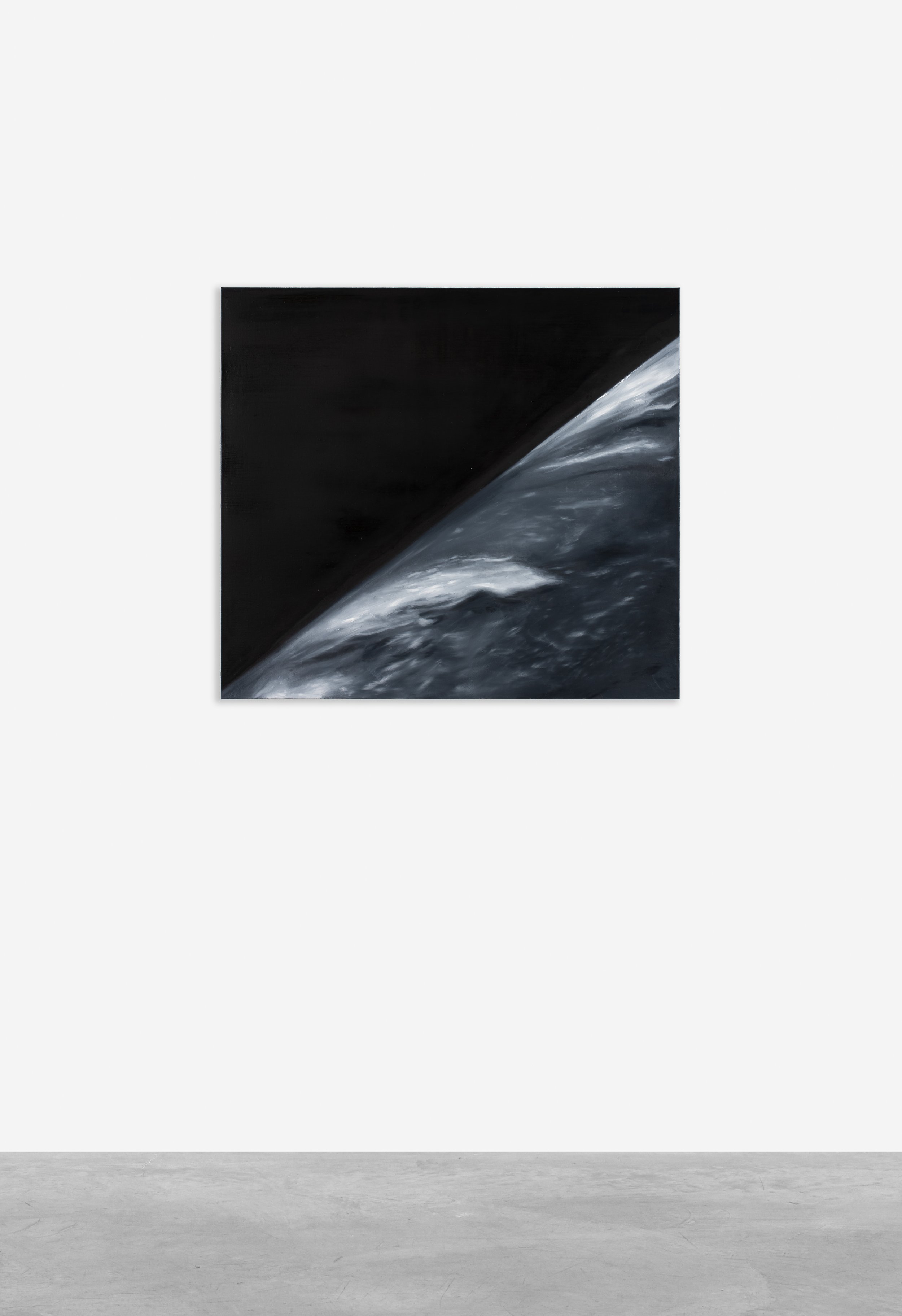
On October 24, 1946, a V-2 rocket launched from the White Sands Proving Ground in New Mexico carried a 35-millimeter motion picture camera to an altitude of sixty-five miles, and the camera, pointing downward, photographed the Earth against the black of space. The frame that returned, developed at the Army's film laboratory, showed the curved limb of the planet, a thin arc of blue and white light at the boundary between the atmosphere and the void, and below that arc, the brown and gray surface of the New Mexico desert, rendered in the low resolution of military film stock. It was the first photograph of Earth taken from beyond its atmosphere. It was not beautiful. It was grainy, low-contrast, and technically compromised by the vibration of the rocket and the limitations of the camera. But it showed something that no human eye had ever seen: the edge of the planet, the boundary where the atmosphere ends and space begins, rendered as a line of light against the dark, a line that is not a line but a gradient, a transition zone roughly sixty miles thick in which the density of gas molecules decreases by orders of magnitude until the medium that supports life gives way to the vacuum that does not. Tan Mu has cited this photograph as the conceptual origin of the Horizons series. The horizon, in these paintings, is not the line where the sea meets the sky. It is the edge of the planet itself, seen from the altitude at which the planet becomes an object, and the object, seen from that altitude, becomes a body.
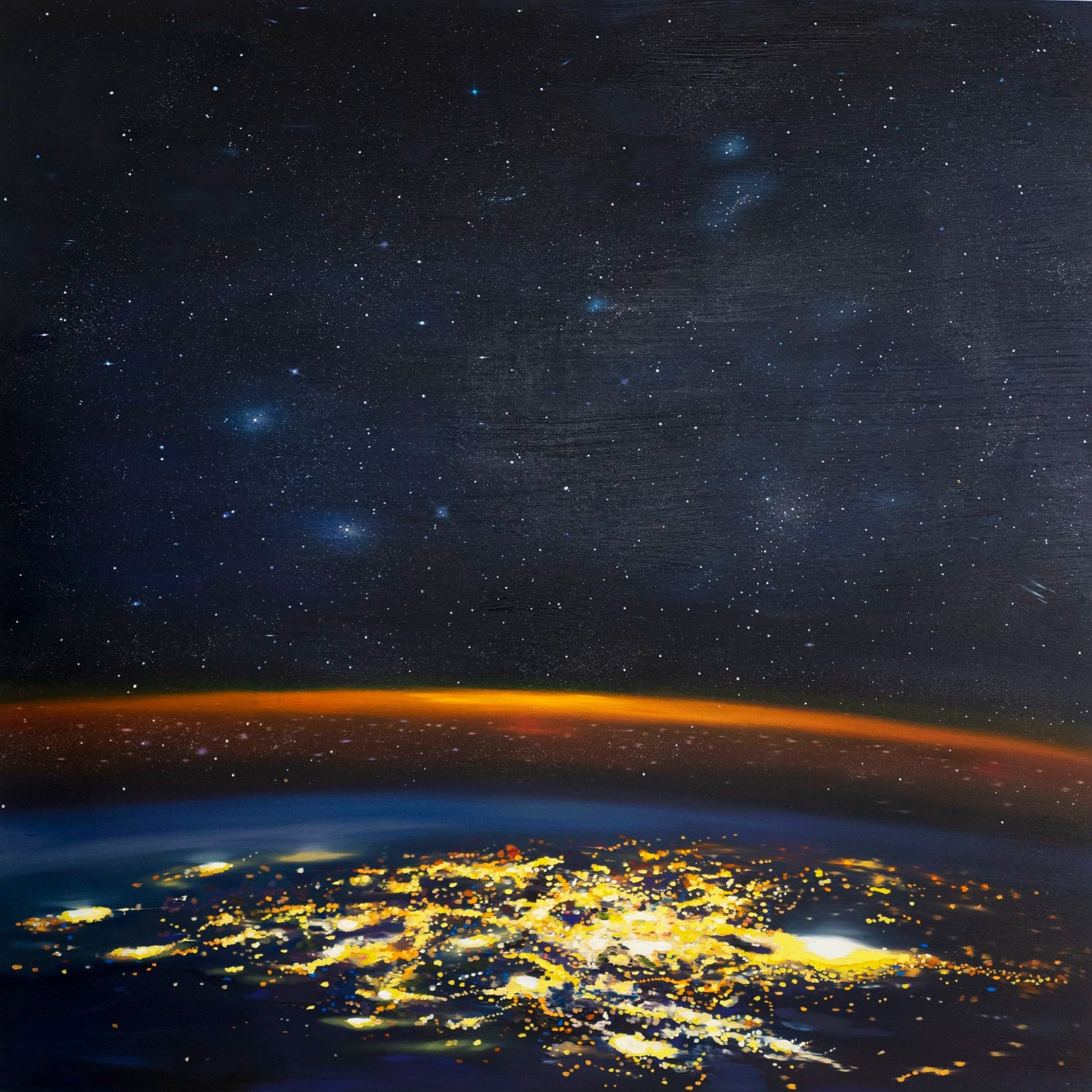
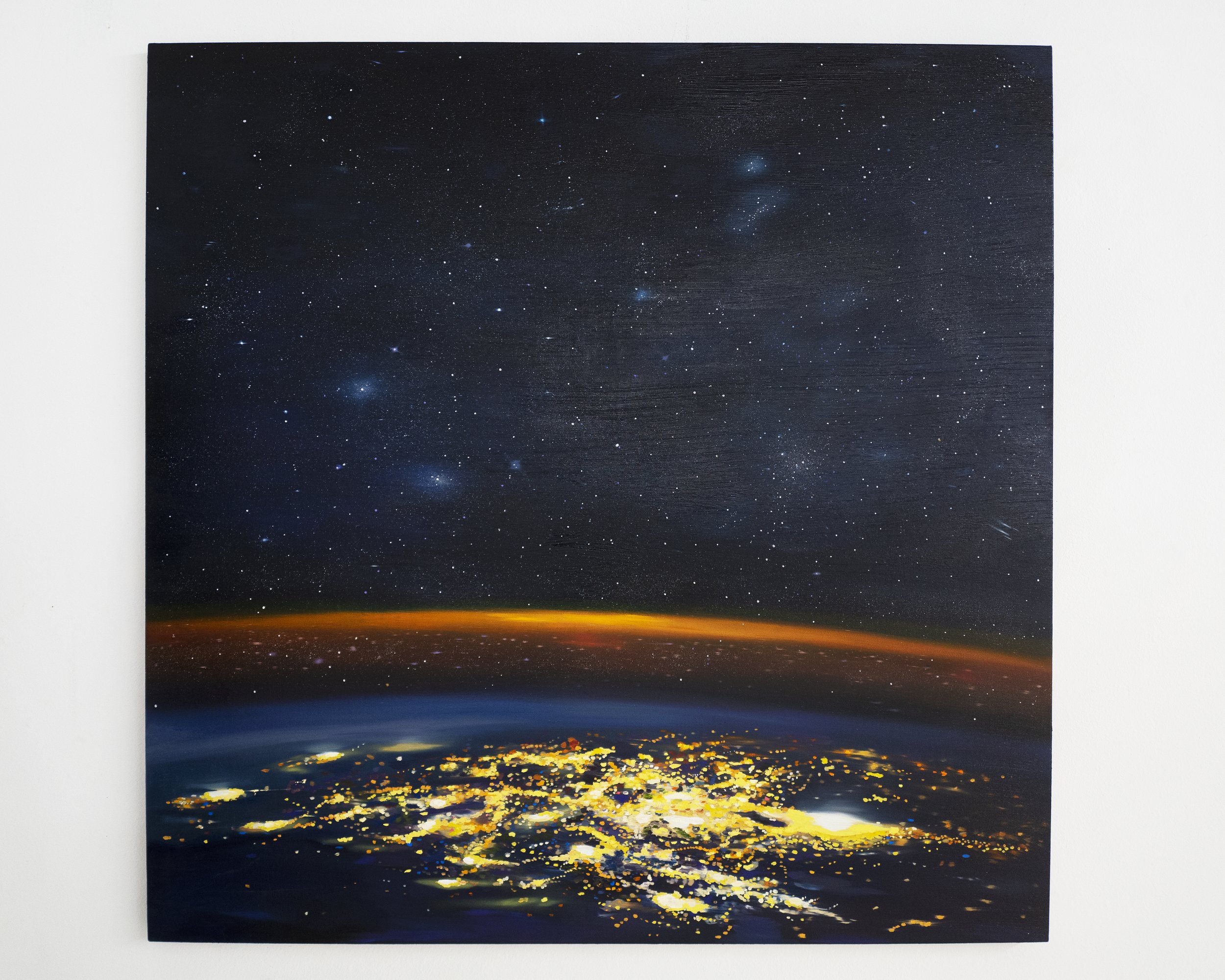
Horizons 06, 2024, is oil on linen, 122 x 122 cm (48 x 48 in). The format is square, which is the format of a view that has no preferred orientation. A landscape is wider than it is tall because the viewer stands on the ground and looks outward toward a horizon that stretches across the field of vision. A portrait is taller than it is wide because the viewer stands before another person and looks at a body that occupies a vertical field. The square is neither. It is the format of a view that is not oriented toward a horizon but suspended above one, a view in which the ground is not below the viewer but beneath the viewer, and the sky is not above but all around, and the distinction between up and down, which organizes every terrestrial visual experience, has been abolished by the altitude from which the image was made. The square canvas approximates the field of vision of a satellite looking directly downward, and the image it contains is the image that the satellite returns: the surface of the planet, seen from above, rendered as a field of color and light that extends equally in all directions, without a horizon, without a preferred edge, without the orientation that the horizon provides.
The composition is organized around a band of atmospheric glow that curves across the surface, dividing the planet from the darkness of space. This band is the horizon that gives the series its name, but it is not a line. It is a gradient, a zone of transition in which the blue of the atmosphere deepens from the pale, almost white luminosity of the upper stratosphere through layers of increasing density and warmth toward the deeper blue of the lower atmosphere, where the scattering of sunlight by nitrogen and oxygen molecules produces the color that we recognize, from the ground, as the blue of the sky. Below the atmospheric band, the surface of the planet is visible through the translucent veil of air, rendered in patches of warm amber, green, and brown that suggest landmasses and terrain without specifying continents or countries. Above the band, the field is black, populated by small, irregularly spaced dots of varying brightness that represent the star field visible from the satellite's altitude, beyond the scattering layer of the atmosphere. The stars are not decorative. They are the same dots that populate the Signal series and the Dyson Sphere, and in the context of the Horizons series, they serve the same function: they mark the boundary between the planet and the void, and they populate the void with the points of light that a civilization capable of building satellites has also, in its imagination, populated with destinations.
Vija Celmins has spent decades painting the night sky. Her Night Sky series, which she began in the early 1990s and has continued to the present, consists of paintings and prints that reproduce, with painstaking fidelity, the appearance of the star field as photographed by a camera pointed upward into the atmosphere. The stars in a Celmins painting are small dots of paint, applied individually, one by one, across a dark ground, and their distribution across the surface corresponds, with a precision that can be verified against the astronomical record, to the distribution of actual stars in a specific region of the sky at a specific time. The fidelity is not photographic in the sense that the painting resembles a photograph. It is photographic in the sense that the painting has been constructed from a photograph, using the photograph as a record of the positions and magnitudes of the stars, and the construction has been carried out with a patience that converts the photographic record into a surface of paint that has the same density of information as the photograph but none of its mechanical characteristics. A Celmins star field does not look like a photograph. It looks like a painting that knows exactly where every star is. The difference matters, because the photograph, which captures the star field in an instant of exposure, registers the stars as points of light on a photosensitive emulsion, and the painting, which builds the star field dot by dot across weeks or months, registers the stars as acts of attention, each one a separate decision, each one a separate moment of looking, and the cumulative effect of these decisions is a surface that vibrates with a temporal density that the photograph, made in a fraction of a second, cannot contain. The photograph captures the sky at an instant. The painting accumulates the sky over time, and the accumulation, which is the time of the painting's making, becomes part of the work's content.
Tan Mu's Horizons 06 shares Celmins's commitment to the point-by-point construction of the stellar field, but the orientation is inverted. Celmins looks up. Tan Mu looks down. Celmins's stars are above the atmosphere, in the vacuum of space, visible through the transparent medium of the air. Tan Mu's stars are also above the atmosphere, in the same vacuum, but they are visible from within it, from the orbital altitude of a satellite that has risen above the scattering layer and can see the stars without the interference of the atmosphere's diffuse light. The inversion produces a fundamental shift in the relationship between the viewer and the field. In a Celmins painting, the viewer is on the ground, looking up, and the star field is above, at an infinite distance. In Horizons 06, the viewer is in orbit, looking outward, and the star field surrounds the viewer, extending in every direction, including the direction from which they have just come, the direction of the planet, which now occupies a portion of the field rather than the entirety of the ground. The stars are no longer above. They are around. The planet is no longer below. It is in the way. It occupies part of the field that the stars would otherwise fill, and its presence, its atmosphere, its gravity, its life, blocks the view of the stars behind it, creating a zone of occlusion in the field that is the planet itself, seen not as the ground from which we look up but as the object that interrupts our view of the infinite. This is the satellite perspective's most disorienting perceptual effect: the planet, which has always been the ground beneath our feet, becomes an object in the field, and the stars, which have always been above, become the medium through which we see it.
The clusters of light on the planet's surface are the painting's most distinctive feature, and Tan Mu has described their logic with characteristic precision. "City lights play an important role in this process. They form intricate patterns that resemble neural networks or biological systems, suggesting that human activity mirrors natural structures. These luminous clusters symbolize communication, energy, and collective presence." The city lights are painted in warm gold, a luminous amber that reads, from the satellite's altitude, as the glow of sodium vapor street lamps, incandescent windows, and the diffuse scatter of artificial light that rises from every urban center on the planet and illuminates the atmosphere from below. They are distributed across the surface in patterns that do not correspond to the political boundaries of nations but to the geographic and economic logics of settlement: coasts, river valleys, trade routes, and the corridors of agricultural productivity that support the populations that generate the light. The gold of the city lights is the same gold that Tan Mu uses in the Dyson Sphere for the energy collection panels, the same gold that she uses in The Wave 03 for the propeller, and in each context, the gold carries the same symbolic charge: it marks the presence of energy, of technological activity, of the conversion of natural resources into luminous output. Here, the gold marks the conversion of fossil fuel and nuclear fission and solar radiation into visible light, and the pattern of that conversion, as seen from orbit, resembles a neural network because a neural network is also a pattern of energy distribution, a system of nodes connected by pathways that carry signals from one point to another, and the city lights, connected by roads and power lines and communication cables, form a network that is structurally indistinguishable from a neural network, not because the analogy is decorative but because the structure is the same: a distributed system of energy flows, operating at a scale that exceeds the capacity of any single node to comprehend.
Tan Mu's grandfather was a meteorologist. He taught her to read weather patterns, understand atmospheric movement, and observe the Earth from an analytical distance. These lessons, which she received as a child, planted the foundation for the satellite perspective that the Horizons series occupies. Later, during her time at Alfred University, she lived near the Stull Observatory and had access to telescopes. "The first time I saw the moon through a telescope was a profound moment for me," she says. "It fundamentally shifted my perception of scale and distance, and it altered how I understood humanity's position within the universe." The telescope, like the satellite, is a technology that extends the body's perceptual range beyond the limits of its biological equipment. The eye, evolved to focus on objects at distances between a few inches and a few miles, cannot resolve the surface of the moon without a lens that gathers and concentrates the light that the moon reflects. The satellite, like the telescope, is a lens, but it operates in the opposite direction: instead of gathering light from a distant object and concentrating it for a near eye, it carries a near eye to a distant position and looks back at the object that the eye normally inhabits. The satellite is a telescope pointed inward, at the planet that made it, and the image it returns is the image of the planet as seen by an eye that has left the planet and is now looking back at it from the distance that the telescope normally bridges. The painting occupies this position. It looks back at Earth from the altitude at which Earth becomes an object, and it renders that object not as a map, which is a flat representation of a curved surface designed for navigation, but as a body, which is a curved surface that the viewer is inside, even as they look at it from outside, and the atmospheric band that curves across the square canvas is the edge of that body, the boundary where the inside ends and the outside begins, and the boundary, which is not a line but a gradient, is the horizon of the series' title, the horizon that is not a line.
Li Yizhuo, writing in the BEK Forum catalog about the Horizons series, identifies the panoramic gaze as "not only a visual framework, but also an ethical one," and the ethical dimension of the satellite perspective is the dimension that distinguishes the Horizons series from the other series in Tan Mu's practice. The Signal series addresses the infrastructure that connects the planet. The Wave series addresses the propellers that move goods across it. The Dyson Sphere addresses the energy that the planet does not yet have. The Horizons series addresses the planet itself, and the ethical content of the satellite view is the recognition that the planet, seen from the altitude at which it becomes an object, is a single entity, not a collection of nations, not a map of borders and territories, not a political arrangement of states and alliances, but a body, a continuous surface of atmosphere and ocean and land that sustains the life that has, for a few centuries, been building the technologies that allow it to see itself from above. The satellite view reveals that the borders that organize the political surface of the planet are invisible from orbit. The atmosphere does not respect them. The ocean does not respect them. The clouds that move across the surface in the satellite's continuous video feed do not stop at national boundaries to show their passports. The city lights that glow on the night side of the planet cluster along coasts and rivers, not along the lines that treaty and war have drawn across the terrain, and the patterns of their clustering, which resemble neural networks, which resemble biological systems, are the patterns of a species that is distributed across the surface of a planet according to the logic of water, food, and shelter, not according to the logic of sovereignty, and the satellite view, by making these patterns visible as patterns rather than as political arrangements, makes the claim that the species is a single system, a neural network distributed across a planetary surface, and that the divisions that the species imposes on itself are not visible from the altitude at which the species becomes most legible as a presence.
The square format of Horizons 06 enforces this reading. A square has no top and no bottom, no left and no right, no preferred orientation that would allow the viewer to locate themselves within the image by reference to the direction of gravity. The square is the format of a view that has been freed from the ground, and the freedom from the ground is the freedom from the orientation that the ground imposes, the orientation that tells you where you are by telling you which way is down. In orbit, there is no down. There is only the planet, which is always below you regardless of which way you turn, and the stars, which are always around you regardless of which way you look, and the painting, by adopting the square format, places the viewer in this orbital position, where the planet is not the ground but the object, and the object is not the world but the body, and the body is the thing that the city lights illuminate from within, the way that bioluminescence illuminates the body of a deep-sea organism from within, a glow that says: something lives here, something is awake, something is burning fuel and generating light and sending signals through a network that extends across the surface of the planet, and the network, seen from above, is not a collection of cities but a single system of light, a single neural network, a single presence, and the presence is the species, and the species is the glow, and the glow is the gold, and the gold is the painting, and the painting is the view from the altitude at which the glow becomes visible as what it is: not the light of a city, not the light of a nation, not the light of a hemisphere, but the light of a planet, seen from the edge that is not a line, seen from the horizon that is not a horizon, seen from the atmosphere that is not a boundary but a gradient, a transition, a band of blue light that curves across the surface of the canvas and curves away from it at the same time, carrying the viewer with it, out of the atmosphere and into the dark, where the stars are, and where the planet, seen from that distance, is not the ground but a point of gold, a single node in a network that extends, as the city lights on its surface suggest, in every direction that light can travel, and that does not stop at the horizon because the horizon, from the satellite's altitude, is not a line. It is the curve of a body, and the body is the planet, and the painting holds it.