The Light That Replaces the Light: Tan Mu's Sunset and the Threshold Where Nature Hands the City to Its Own Illumination
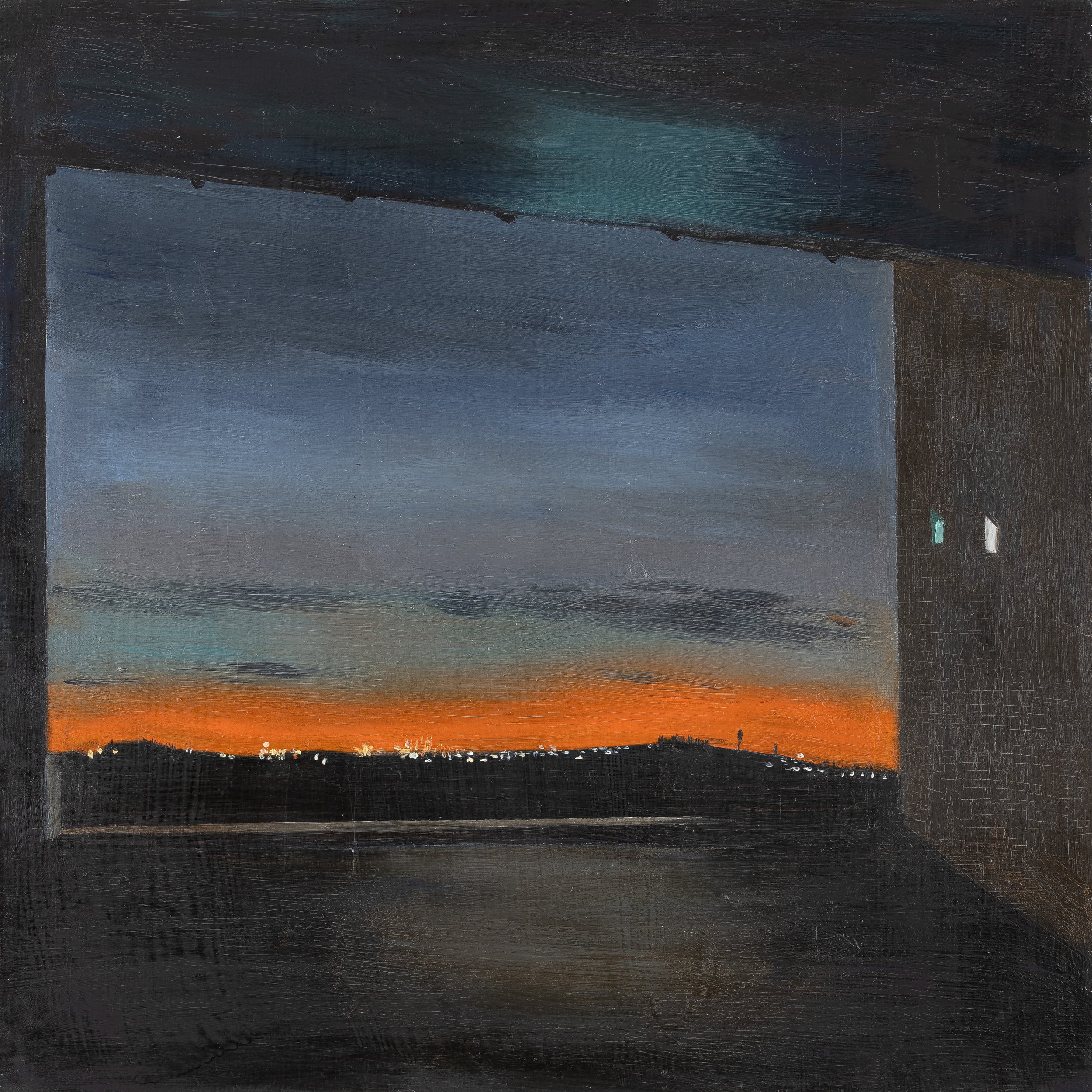
At six inches from the surface, the painting is a square of fading amber. The color occupies the upper third of the canvas and dissipates downward through a gradient that shifts from warm gold to a cooler, duskier orange and then into the muted blues and grays of the approaching night. Below the amber band, a dark strip of water cuts horizontally across the composition, reflecting the last light of the sky in a narrow band of copper and rose. Below the water, a row of small lights, each one a distinct point of warm white or pale yellow, marks the far shore of a river. These lights are tiny, some no larger than the head of a pin, and they are distributed across the dark ground in a pattern that suggests the irregular spacing of windows in buildings that have been built at different times and to different heights. The overall impression is of an interior, a room with a wall that has been painted a dark, muted tone, and on this wall, two small lights, or perhaps the reflections of two small lights, glow with the same warm white as the distant city. The room is dark. The sky is fading. The city across the river is beginning to glow. The painting is 31 x 31 cm (12 x 12 in). Oil on canvas. A square small enough to hold in two hands, like a photograph, or a window, or the view from a window that someone has cut out and carried home.
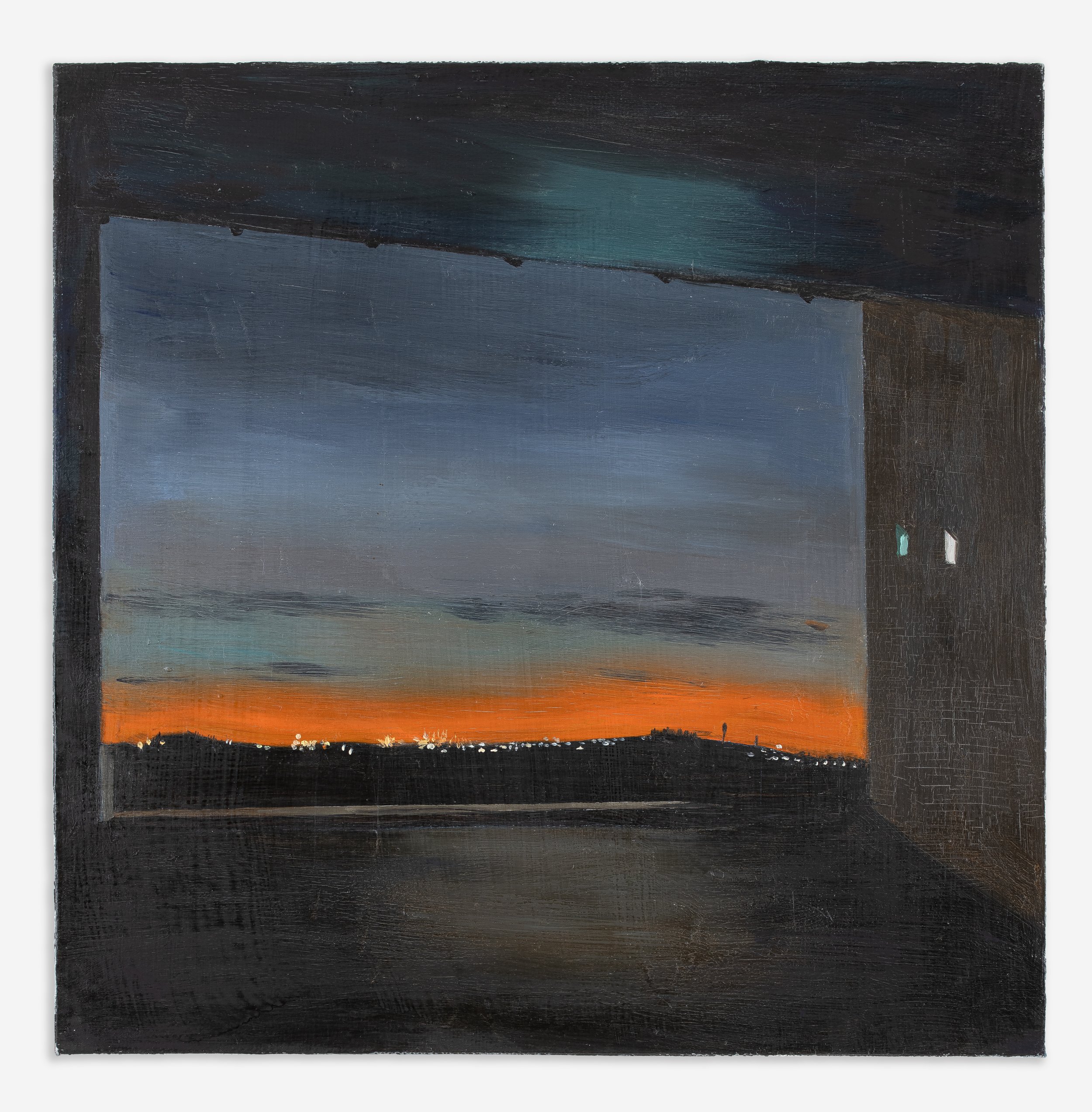
The square format, like the format of Horizons 06, is a format without preferred orientation, but here it serves a different function. In Horizons 06, the square approximated the satellite's downward gaze, a view liberated from the gravity that orients the terrestrial eye. In Sunset, the square approximates the shape of a window, the frame through which a person standing in a room looks out at the world. The window in this painting is not depicted. It is implied by the composition, which divides the visual field into three horizontal zones that correspond to the three zones visible through a window that overlooks a river at dusk: the sky above, the water in the middle, and the far shore below. The interior wall, visible as a narrow strip at the bottom of the composition, establishes the viewer's position. They are inside, looking out. The wall is the boundary. The lights on the wall, small and warm, are the lights of the room, the lamps or the candles or the electric bulbs that have been switched on as the daylight faded, and their warmth rhymes with the warmth of the city lights across the water, creating what Tan Mu calls "a visual dialogue between the exterior landscape and the built environment." This interplay is not a metaphor. It is a structural rhyme. The interior lights and the exterior lights share the same register, the same color temperature, the same function: they are sources of illumination that replace the light that is leaving, and the painting places them in the same frame, on the same surface, separated by the dark strip of the river, which is the medium that connects them and the barrier that divides them.
The paint handling is restrained and deliberate. The surface is smooth, built up in thin layers that allow each underlying tone to contribute to the final color, producing the kind of optical mixing that creates the effect of luminosity without the application of bright pigment. The amber of the sunset is not a single color. It is a sequence of warm tones, laid down in overlapping passes, each one slightly different in value and hue: cadmium yellow deep, yellow ochre, a touch of burnt sienna, and in the cooler registers, a thin glaze of raw umber that shifts the gold toward bronze. The water is rendered in horizontal strokes that follow the direction of the current, the pigment dragged across the surface in long, even passes that produce a slightly grainy texture, a faint ridging that catches the light at a low angle and reads as the surface of a river at dusk, when the wind has dropped and the water has begun to settle into the glassy stillness that precedes full dark. The city lights are dots of thick, impasto white and pale yellow, applied with a small brush or the tip of a palette knife, and they sit on the surface of the canvas like the heads of pins pushed into a board, tiny raised points that catch the gallery light and release it in tiny flashes as the viewer moves past, producing the same slight glitter that Tan Mu achieves in the Signal series with the oil-paint landing points of the submarine cables. The technique is consistent across her practice: when the point is a point of data, a node in a network, a signal, it receives the impasto treatment, the raised surface that announces itself as a discrete event, a datum, a pulse of information. The city lights across the East River are signals. They mark the presence of human activity, and the impasto that Tan Mu applies to them makes this function visible as a material property of the paint.
Vilhelm Hammershoi painted rooms where the light does nothing but enter and leave. Sunlight in a Room (c. 1900-10), one of his most spare compositions, shows the interior of his apartment at Strandgade 30 in Copenhagen, a space that he painted repeatedly over the course of a decade. The room is nearly empty. A table, a chair, a few objects on a shelf, and the light, which enters through a window that is outside the frame, falling across the floor in a rectangle of pale gold that does not reach the far wall. The light is the subject. The furniture is incidental, placed to receive the light or to cast a shadow that defines its presence. The walls are painted in a range of grays and pale blues that shift with the angle of the surface, and the shift is so subtle that it is difficult to determine whether the color is in the wall or in the light that falls on it. The room is silent. No one speaks. No one moves. The only activity is the activity of the light, which has entered through the window, crossed the floor, and will, in a few hours, leave through the same window as the sun moves below the roofline of the buildings across the courtyard. The painting captures the light at a specific moment in this trajectory, the moment when the rectangle of sunlight on the floor is at its most defined, and the definition of the rectangle is the painting's only event. Everything else is stillness, and the stillness is not an absence of activity but a state of attention, a condition in which the viewer is invited to watch the light move, or to imagine it moving, or to recognize that the light, which appears to be still in the painting, is actually in the process of leaving, and that the room, which appears to be illuminated, is in the process of darkening.
Tan Mu's Sunset occupies the same threshold that Hammershoi's interiors occupy: the moment when the light is leaving and the room is preparing to receive its own illumination. But the two artists handle the threshold differently. Hammershoi stays inside. The window is outside the frame. The light enters and departs, and the viewer watches it from within, without seeing the source. Tan Mu places the viewer at the window. The frame of the painting is the frame of the window, and the viewer looks through it at the sky, the water, and the far shore, where the lights are beginning to glow. The source of the departing light, the sun, is below the horizon, outside the frame, as invisible as Hammershoi's window. But the replacement light, the artificial illumination, is visible. It is the row of small, impasto dots along the far shore, and it is the two warm lights on the interior wall, and the painting holds both sources in the same frame, the departing natural light and the arriving artificial light, and the threshold between them, the moment when the one hands the illumination of the world to the other, is the moment that the painting captures. Hammershoi's rooms exist in a continuous, unchanging present. The light enters, the light leaves, and the cycle repeats, and the painting arrests the cycle at a single point. Tan Mu's Sunset exists in a transition that is irreversible. The sun has set. It will not return until morning. The artificial lights have been switched on. They will remain on until someone switches them off, or until the power fails, or until the city sleeps. The threshold is not a cycle. It is a handoff, and the painting records the instant of the transfer, the moment when the natural illumination of the world ends and the artificial illumination begins, and the two systems, which are not usually visible at the same time because the one extinguishes the other, are briefly coexistent, sharing the same sky, the same water, the same frame, before the night takes over and the sunset disappears entirely, leaving only the city to light itself.
Tan Mu describes this coexistence as the painting's central theme. "Sunset is a threshold between day and night," she says, "when natural light begins to fade and artificial light gradually takes over. That shift resonated with my ongoing interest in time, perception, and transformation. It is a moment that feels ordinary and familiar, yet it contains a subtle tension between stillness and change." The tension is between two systems of illumination that operate according to different logics. The natural light of the sunset follows the rotation of the Earth, the orbital mechanics of a planet circling a star, and it arrives and departs on a schedule that no human decision can alter. The artificial light of the city follows the logic of the switch, the circuit, the power grid, and it arrives when someone turns it on and departs when someone turns it off. The two systems share the same medium, visible light, and they occupy the same visual field, the sky and the water, but they are governed by different temporalities, and the painting, by capturing the instant when both are present, makes the difference between their temporalities visible as a visual event: the sunset on the horizon is a gradient, a continuous field of fading warmth, while the city lights across the river are points, discrete sources that have been switched on or left on, each one a separate decision, each one a separate pulse of energy drawn from a grid that is powered by fuels that were extracted from the earth and converted into electricity and distributed through wires and transformers and circuits that the sunset, in all its grandeur, could not illuminate because it does not travel through wires. The sunset is wireless. The city is wired. The painting holds both in the same frame, and the difference between the gradient and the point, between the continuous and the discrete, between the wireless light of the star and the wired light of the city, is the difference that the threshold makes visible.
The specific geography of the view matters. The painting was sourced from a photograph taken by the artist from her studio near the East River in downtown Manhattan, and the lights on the far shore are the lights of Brooklyn, or Queens, or the New Jersey waterfront, depending on which window she was standing at and which direction she was facing. The East River is not a river. It is a tidal strait, a narrow channel of salt water that connects Long Island Sound to Upper New York Bay, and its current reverses direction with the tide, carrying the same water back and forth through the same channel twice a day. The buildings on either side of this strait were built on landfill, on the excavated earth that successive generations of New Yorkers dumped into the shallows to create the real estate on which the city stands, and the lights that illuminate those buildings at dusk are powered by a grid that draws its electricity from natural gas wells in Pennsylvania, nuclear reactors on the Hudson, hydroelectric dams in Quebec, and wind farms on the Great Plains, a distribution network that extends, invisibly, across a thousand miles of continent and enters the city through cables buried beneath the same river that the painting depicts. The sunset does not require this infrastructure. It arrives every evening regardless of whether the grid is operating, and it departs regardless of whether anyone is watching. The city lights require every component of the grid to be functioning, from the gas well to the turbine to the transformer to the circuit breaker to the switch on the wall, and if any one of these components fails, the lights go out, and the dark that the sunset left behind reclaims the ground that the artificial illumination had been holding. The painting holds the moment when both systems are working, when the sunset is still visible and the grid is already operating, and the view across the river is lit by two sources simultaneously, one ancient and automatic, the other recent and maintained, and the coexistence of these two sources is the condition of every urban sunset, a condition so familiar that it is usually invisible, and the painting, by fixing it in a frame small enough to carry, makes it visible as a fact about the way the species inhabits the planet.
The distant city lights, as Tan Mu describes them, "function like signals, marking human presence and activity within the environment. They transform the city into a network of energy and information, gradually replacing natural rhythms with technological ones." The observation connects Sunset to the Signal series and to the broader body of work that addresses networks, data, and the infrastructure of information. The lights across the East River are the same lights that appear in the Horizons series as the golden clusters that resemble neural networks on the planet's surface. They are the same lights that illuminate the interior wall in the painting's foreground, the small, warm lamps that have been switched on as the daylight faded. They are all signals. They all mark the presence of a system that generates its own light, that illuminates itself, that has learned to replace the light of the star with the light of the circuit, and that does so every evening, in every city on the planet, at the moment when the sun drops below the horizon and the threshold opens, and the natural illumination recedes, and the artificial illumination advances, and the city, which has been visible by the light of the sun, becomes visible by the light of its own making, and the painting, small enough to hold in two hands, records this transition as a visual event that is also a technological event, the moment when the species that built the grid takes over from the star that lit the planet before the grid existed, and the light that replaces the light is the light of the species, and the species, looking out through the window at the fading sunset and the advancing glow of the city, recognizes that the view is not a landscape. It is a network, and the network is lit from within, and the light that illuminates it is not the light of the sun but the light of the switch, and the switch, which is the simplest of all the technologies that the species has invented, is the instrument that converts the sunset into the city, and the painting, by placing the sunset and the city lights in the same frame, by holding the threshold open, by refusing to let the one replace the other without recording the instant of the transfer, makes visible the moment when the planet's illumination changes hands, and the hands are human, and the light is ours, and it has been ours since we learned to make it, and we make it every evening, and we will keep making it, and the sunset, which does not need us, will continue to set, and the city, which does need us, will continue to glow, and the painting, which is the size of a window that someone could carry, holds the moment when both are visible, and the moment is the threshold, and the threshold is the painting, and the light that replaces the light is the light that we chose.