The Heat That Stays: Tan Mu's Touch and the Body the Screen Could Not Hold
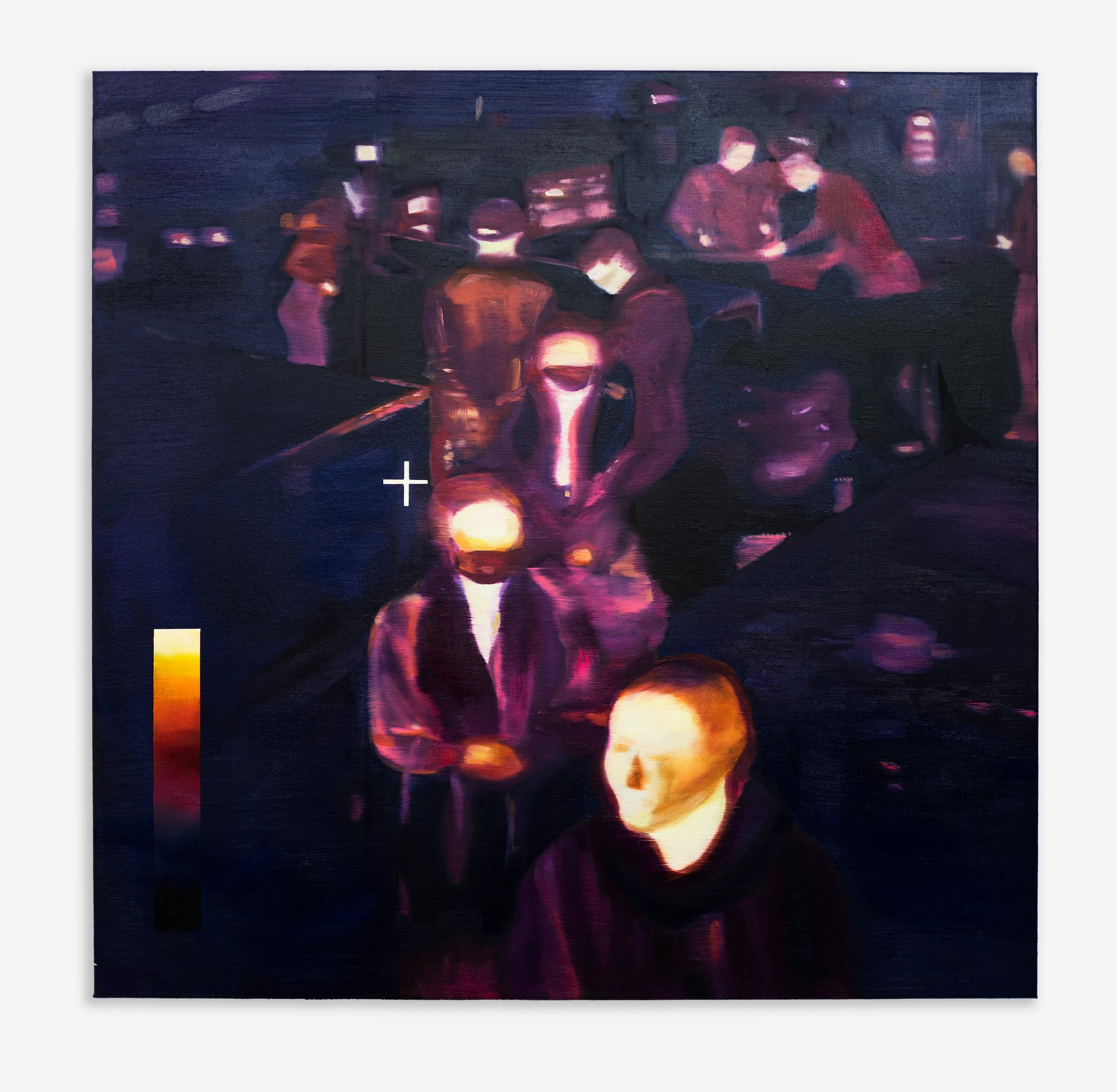
A thermal camera does not see surfaces. It sees the radiation that surfaces emit. A wall, a window, a hand, a face: each object in the camera's field of view broadcasts infrared radiation at a wavelength proportional to its temperature, and the camera, which is built around an array of microbolometers that absorb this radiation and convert it into electrical signals, assigns a color to each temperature range and produces an image in which the hottest things glow yellow and orange and white, the coolest settle into blue and violet, and the intermediate temperatures spread across a gradient that the human eye reads as a map of heat. The camera was designed for military and industrial applications, for finding heat leaks in buildings and exhaust plumes from engines, for identifying human bodies in darkness and detecting intruders across a perimeter. In March 2020, when airports and office buildings and train stations around the world installed thermal cameras at their entrances and began scanning every person who walked through, the camera's original purpose, which was to detect, was overlaid with a new purpose, which was to admit or deny, to sort the body into the category of safe or the category of suspect on the basis of the temperature of its skin, and the scan, which took less than a second and produced a reading that was displayed on a screen that the person being scanned could not see, reduced the body to a single datum, a number in degrees Celsius or Fahrenheit, and if the number was above the threshold, the body was stopped, pulled aside, subjected to further examination, and the examination, which began with a temperature reading and ended with a swab in the nostril, was a process of converting the body into data, of translating the warmth that the thermal camera had detected into information that could be recorded, transmitted, compared, and stored, and the person who had been stopped stood in the corridor with a mask on their face and waited for the result of a test that would determine whether they were permitted to proceed or required to isolate, and in that moment, the thermal camera, which had been designed to see what the eye could not, had become an instrument of separation, a technology that interposed itself between one body and another and decided, on the basis of the heat that the body was emitting, whether touch was possible or forbidden.
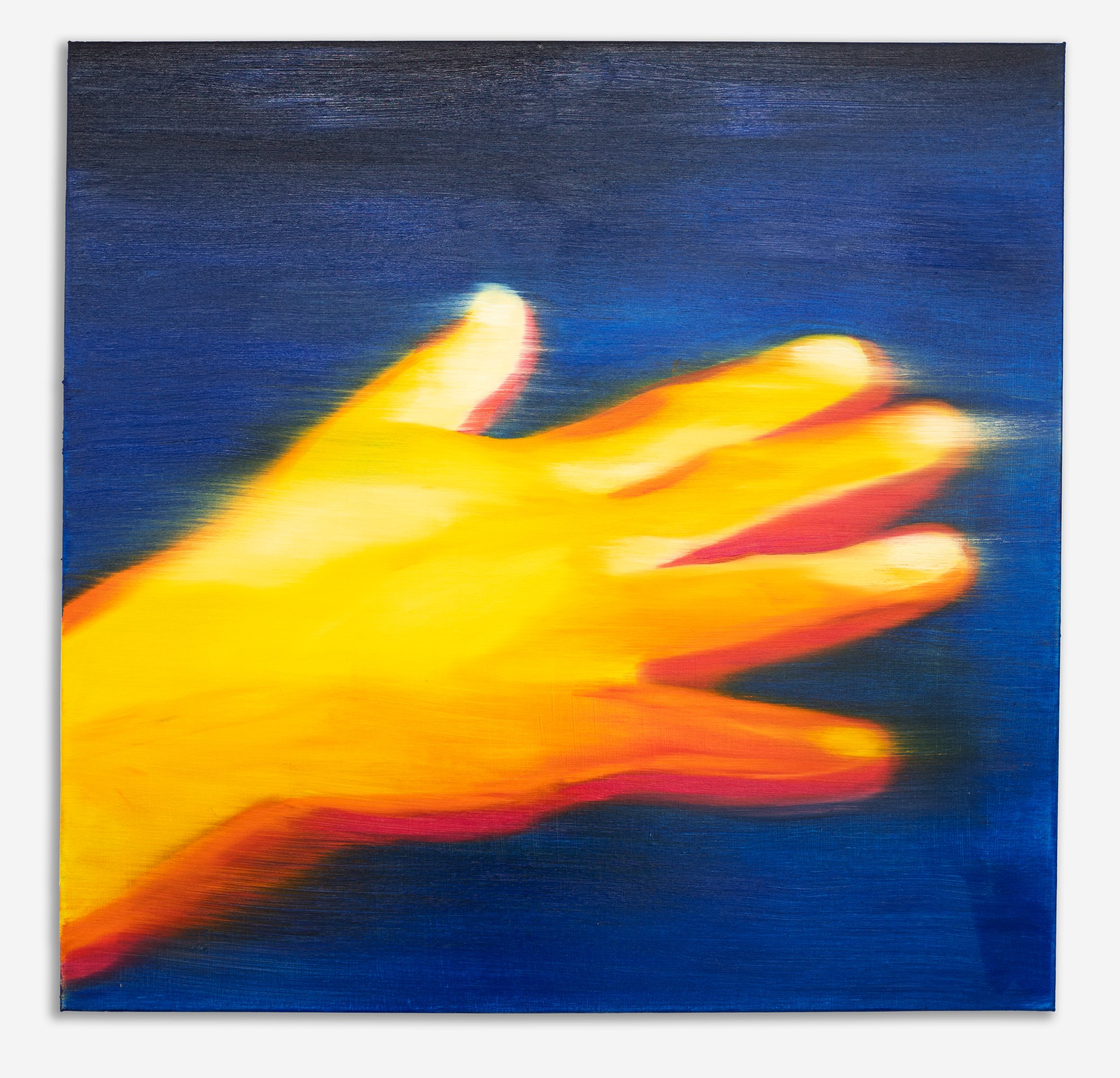
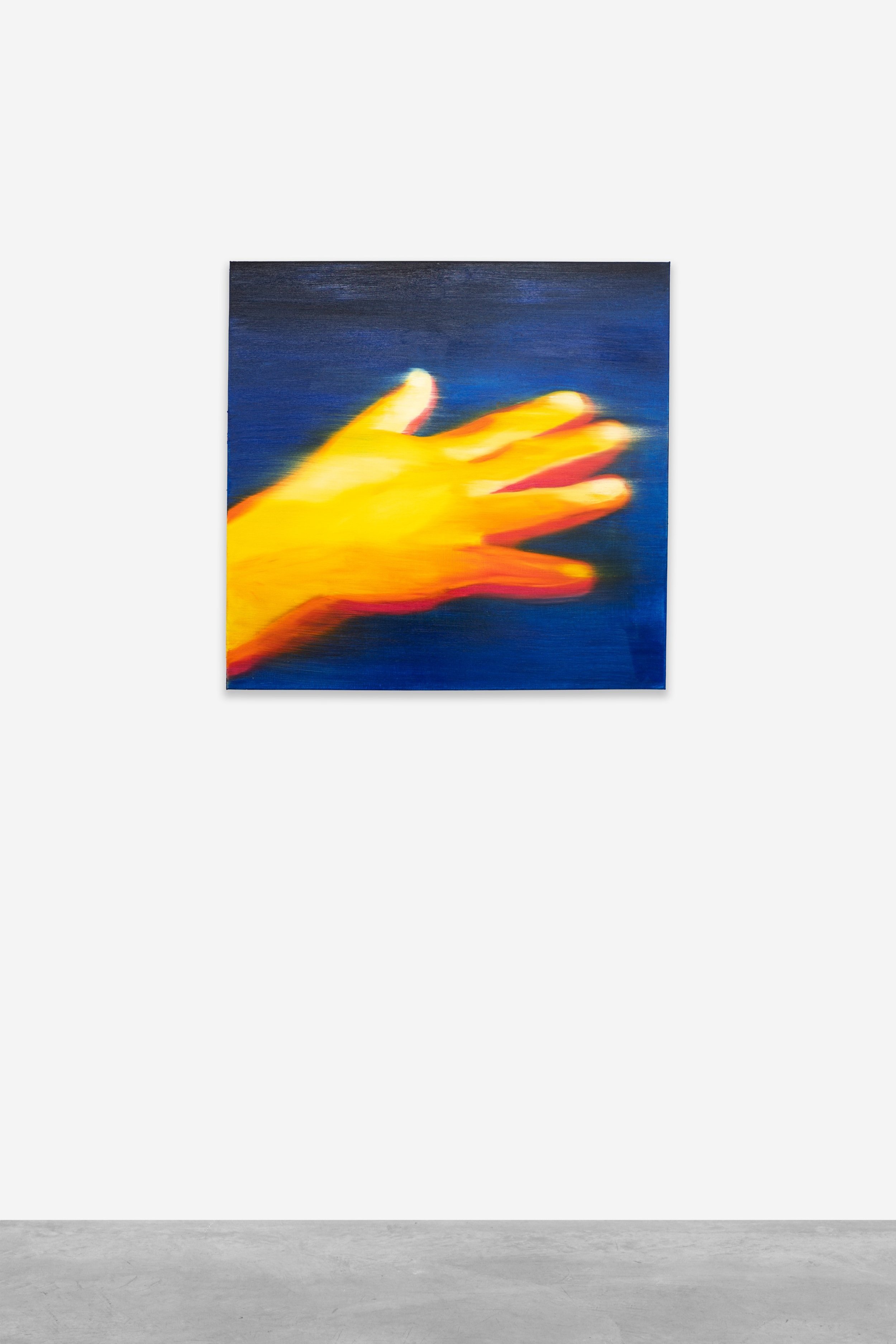
Tan Mu's Touch (2022) is a painting of a thermal image of a hand. The hand floats against a field of deep blue, rendered in the warm yellows and oranges that a thermal camera assigns to human skin at its surface temperature. The edges of the hand are soft, dissolving into the background, not because the hand is out of focus but because the heat that the body radiates does not stop at the boundary of the skin. Heat radiates outward from the surface in every direction, and the thermal camera, which registers the radiation as a gradient that fades from the core temperature of the body to the ambient temperature of the surrounding air, produces an image in which the boundary between the body and its environment is not a line but a gradient, a field of diminishing warmth that extends beyond the skin and into the space around it. The painting reproduces this gradient with precision. The hand is warmest at its center, where the yellows are most saturated, and the warmth diminishes toward the fingers and the edges of the palm, where it shifts into orange and then into a cooler, duskier tone that blends, by imperceptible degrees, with the blue that surrounds it, and the blue, which in a thermal image represents the ambient temperature of the environment, is not flat but modulated, streaked with variations that suggest the presence of air currents and temperature differentials in the space that the hand occupies, a space that the thermal camera renders visible because the camera, unlike the eye, can see heat, and heat, unlike light, does not require an external source. The body is its own source. The body emits its own radiation. The body, in the vocabulary of the thermal camera, illuminates itself, and the painting, by translating this self-illumination into the language of oil paint, makes the hand into a source of light in a dark field, a warm body in a cool environment, a presence that registers its own temperature on the surface that contains it.
The painting is oil on linen, 76 x 76 cm (30 x 30 in). The square format, which Tan Mu has used across multiple works in the Signal series and related paintings, here serves a specific function: the square eliminates the orientation that a rectangle imposes, the implication that the image has a top and a bottom that correspond to the vertical axis of the standing body. A thermal image, captured by a camera mounted at any angle, has no inherent orientation. The hand could be reaching upward, downward, sideways. The square holds this ambiguity. The linen support, visible at the edges where the paint thins, gives the surface a faint texture that the thermal image, which is a digital file, does not possess, and this texture, the weave of the fabric beneath the pigment, is the painting's reminder that the image it reproduces, which was generated by a microbolometer array and displayed on a screen, has been transferred, by the labor of the artist's hand, onto a surface that was woven on a loom and stretched over a wooden frame, and the transfer, which is also a translation, from the language of digital heat mapping into the language of oil paint, is the painting's central act, the act that gives it its argument: the heat that the camera detects and the paint that the hand applies are both produced by bodies, and the body that applies the paint is doing, with its hand, what the thermal camera does with its sensor: it is registering the presence of warmth and converting that registration into a visual record, a trace, an image that says, here, at this location, at this temperature, a body was present.
Ana Mendieta's Silueta series (1973-1981) is a body of work in which the artist pressed her body into the earth and then removed it, leaving behind an imprint, a silhouette, a trace of her presence in the material she had displaced. In Silueta de Arena (1978), she lay on a beach and then stood up, leaving the concave form of her body in the sand, which the tide would eventually erase. In Imagen de Yagul (1973), she lay in a pre-Columbian tomb and covered her body with white flowers, merging her form with the stone and the vegetation until the distinction between the body and its context dissolved. In Volcán (1979), she burned gunpowder in the shape of her silhouette on a patch of earth, and the charred outline, smoking and cooling, was both a trace of her presence and a record of the heat that had been applied to the ground, a thermographic image made by combustion rather than by a camera, a body that had been converted from flesh into fire and from fire into a mark on the surface of the earth. Mendieta called these works "earth-body" sculptures, a term that locates the body not as an object placed on a surface but as a material that merges with the material it touches, and the merging is the content of the work, the argument that the body and the earth are not separate entities but participants in a continuous exchange of substance, and the silhouette that remains after the body has departed is not a representation of the body but a trace of the contact between the body and the earth, a record of the moment when two surfaces met and one left an impression on the other.
The connection between Mendieta's siluetas and the handprints in Argentina's Cueva de las Manos, which Tan Mu cites as the direct inspiration for Touch, is the connection between two acts of contact that produce the same kind of trace. The handprints in the Cueva de las Manos, which date to approximately 7300 BCE and possibly earlier, were made by a stencil process: a hand was placed against the rock face, and pigment, mixed from local minerals and applied by blowing through a hollow reed or by spraying from the mouth, was directed around the hand, leaving a negative image, an outline of the hand in pigment against the natural color of the rock, and when the hand was removed, what remained on the wall was the shape of the hand, not the hand itself but the space the hand had occupied, not a portrait but an imprint, not a depiction of the hand but the trace of the hand's contact with the surface, and the trace, because it was made by blowing pigment around the hand, contains more information than a drawn outline could convey: the width of the fingers, the angle of the thumb, the size of the palm relative to the fingers, the slight variations in pressure that produced denser pigment in some areas and thinner pigment in others, all of which are preserved in the mineral deposit on the rock face with a fidelity that is comparable, in its own medium, to the fidelity of the thermal camera, which also records not the hand but the radiation the hand emits, not the shape of the skin but the temperature of the skin at every point across its surface, and both records, the stencil and the thermal scan, are traces of contact, evidence that a body was present and that it touched, or approached, or radiated heat toward, the surface that received the trace.
Tan Mu has described the impulse that connects these two forms of imagery. "The handprints in the Cueva de las Manos are among the earliest traces of human presence," she says. "Created through a stencil process, they record the physical act of placing a hand against a surface and leaving behind a negative image. These marks preserve a moment of touch across thousands of years. To me, they represent a timeless human impulse to connect, to assert presence, and to be remembered." And of the thermal image: "Thermographic imaging visualizes heat without touch, presence without proximity. Temperature mapping becomes a stand-in for emotional distance, revealing how technology mediates and reshapes our most fundamental human experiences." The two statements, taken together, describe the arc of the painting's argument: the hand that left its trace on the cave wall and the hand that emits radiation into the lens of a thermal camera are the same hand, performing the same act of contact, separated by nine thousand years of technology but united by the same impulse, the impulse to leave a trace, to make presence visible, to convert the warmth of the body into a record that outlasts the moment of contact.
The science of thermographic imaging, which the painting engages at the level of its source image, operates by detecting radiation in the infrared band of the electromagnetic spectrum, typically in the range of 9,000 to 14,000 nanometers, which corresponds to the peak emission of objects at temperatures between roughly minus 40 and plus 500 degrees Celsius. The human body, which maintains a core temperature of approximately 37 degrees Celsius and a skin surface temperature that varies between roughly 30 and 35 degrees depending on blood flow, ambient temperature, and the thickness of the subcutaneous fat layer beneath the skin, emits infrared radiation at a wavelength that falls within this detectable range, and the thermal camera converts this radiation into a visual image by assigning colors to temperature values: the standard palette runs from blue, representing the coolest temperatures, through green, yellow, and orange, to white, representing the hottest. The resulting image is not a photograph of the body. It is a photograph of the radiation that the body emits, and the distinction matters, because the radiation that the body emits is not contained by the skin. It radiates outward, in all directions, at the speed of light, and it continues to radiate as long as the body maintains its temperature, which is to say as long as the body is alive, which is to say as long as metabolic processes are converting chemical energy into thermal energy and releasing it through the surface of the skin, and the thermal image, which captures this radiation at a single moment, is a record of a process, not a state, a snapshot of a continuous emission that does not begin when the camera is pointed and does not end when the camera is withdrawn, and the hand in Tan Mu's painting, rendered in the yellows and oranges that the thermal palette assigns to human skin temperature, is depicted in the act of radiating, in the continuous present tense of the body's thermal output, and the soft edges of the hand, where the warm colors dissolve into the blue of the background, are not a failure of focus but an accurate representation of the physics of heat: the boundary of the body, in thermal terms, is not a line but a gradient, and the painting, by reproducing this gradient, makes the physics of the body's thermal presence visible as a visual fact, a fact that the eye cannot see but the thermal camera can, and that the painting, by translating the camera's image into the language of oil paint, makes available to the eye that the eye, without the mediation of the camera and the canvas, could not perceive.
The context in which Tan Mu encountered thermal imaging during the pandemic is the context that gives the painting its specific charge. In March 2020, as she describes, temperature became a central marker of health, and thermal imaging cameras were deployed in airports, office buildings, train stations, and other public spaces to screen individuals for elevated body temperature, one of the primary symptoms of COVID-19 infection. The camera, positioned at an entrance or mounted on a tripod, scanned each person who walked past, and the image it produced, which was displayed on a monitor visible to the operator but not to the person being scanned, reduced the body to a thermal profile, a distribution of colors across a shape that corresponded to the outline of a human head and torso, and the operator, looking at the monitor, could see at a glance whether the colors were in the normal range or whether an area of elevated temperature, typically around the forehead or the temples, indicated a possible fever, and the determination was made in seconds, by a person looking at a screen, and the person whose temperature was being measured was not consulted, was not spoken to, was not touched, was not approached, was simply scanned and sorted into the category of safe or the category of suspect, and the category determined whether they could proceed through the door or were diverted to a side corridor for further examination, and the entire process, from the initial scan to the determination, was a process of reducing the body to data, of converting the warmth of the skin into a number, and of making a decision about the body on the basis of that number, without touching the body, without speaking to the person, without making any contact beyond the optical contact of the camera and the skin, and this, Tan Mu says, is what the painting is about: "In this context, thermographic imaging became a powerful metaphor. It visualizes heat without touch, presence without proximity."
Saul Appelbaum, writing in his essay "Dreaming in Public" (2025) about the Signal series and the accompanying performance "Everything on the Line," describes Tan Mu's practice as a process of arbitration, in which the artist mediates between input and output, between the data that enters the system and the form that the system produces, and the mediation, Appelbaum argues, is not a transparent transfer but an interpretive act, a decision about what to preserve and what to discard, what to emphasize and what to suppress, and the result is not a copy of the source but a transformation of it, a new system of relations generated by the act of translation. Appelbaum's concept of arbitration, which he draws from his thesis "Architectonic Silence: Arbitrating Noise," is useful here because it describes exactly the process that produces Touch: the thermal camera, which converts the radiation of the body into a color map, has already performed one arbitration, deciding that the body's warmth should be rendered as a gradient of yellows, oranges, and blues, and the painting, which translates this color map into oil paint on linen, performs a second arbitration, deciding that the gradient should be rendered with soft edges and modulated color rather than the hard boundaries and uniform saturation of a digital display, and the decision, in both cases, is a decision about what kind of trace the body should leave, what kind of record the warmth should produce, what kind of image the contact between the body and the surface should generate, and the trace, in the painting, is warmer, softer, more intimate than the trace in the thermal camera's display, because the painting has been made by a hand, by the same organ that the painting depicts, by the same instrument that made the handprints on the cave wall, and the circularity of this arrangement, in which the hand that paints the hand has performed the same act of contact that the hand in the painting is performing, is the painting's deepest argument: the hand, whether it is pressing pigment around itself on a rock face or applying oil paint to a linen canvas or radiating infrared energy into the lens of a thermal camera, is always doing the same thing, which is leaving a trace of its presence on a surface, and the trace, whether it is made of mineral pigment or infrared radiation or linseed oil and pigment, is the same trace, a record of warmth, a record of contact, a record of the body's insistence on being present in a world that is, at the moment the trace is made, trying to keep bodies apart.
The pandemic, Tan Mu says, "felt like an enclosed space, almost like a cave," and the comparison between the lockdown apartment and the cave at Río Pinturas is not decorative. The Cueva de las Manos, which is located in the canyon of the Pinturas River in Santa Cruz province, Argentina, is a rock shelter, a cavity in the cliff face that provides protection from wind and rain, and the people who made the handprints there, who also painted hunting scenes and geometric designs on the walls of the cave, lived in and around the shelter for thousands of years, and the handprints they left behind, which number in the hundreds and which are scattered across the walls and ceiling of the cave in clusters and patterns that suggest not a single moment of creation but a continuous process of marking that was renewed by each generation, are a record of occupation, a record of the fact that people were there, in the cave, in the shelter, in the enclosed space, and that they wanted others to know it, and the handprints, which are the most common motif in the cave, outnumber the hunting scenes and the geometric designs by a wide margin, suggest that the act of leaving a trace of the hand was more important than the act of depicting any particular activity, and the reason, or one reason, is that the hand is the instrument by which the trace is made, and the trace of the hand is the trace of the instrument of tracing, a self-referential mark that says, "I was here, and the proof is that I made this mark with the same hand whose mark it is," and this circularity, this self-referential quality, is what Tan Mu means when she says that "the hand remains central to how we experience the world" and that "the dialogue between these images reflects what it means to be human: our enduring need to touch, to feel, and to leave traces of ourselves, even as the tools we use continue to evolve."
The painting's palette reinforces the argument that its content makes at the level of its imagery. The warm yellows and oranges of the hand are not the yellows and oranges of sunlight, of flowers, of any external source of warmth. They are the yellows and oranges of the thermal palette, the colors that the camera assigns to the temperature range of human skin, and they are, in the vocabulary of the thermal camera, the colors of life, the colors that indicate that the body in the frame is warm because it is alive, because its metabolic processes are producing heat, because its blood is circulating, because its cells are converting nutrients into energy, because it is, in the most literal sense, radiating, and the blue that surrounds the hand is the blue of the temperature range that the camera assigns to the ambient environment, the background, the air that is not being warmed by a body, the space in which no one is present, the void, and the contrast between the two temperature ranges, the warm body and the cool background, is the contrast between presence and absence, between the living and the inert, between the hand that is there and the space in which nothing is there, and the gradient at the edge of the hand, where the warm colors dissolve into the cool, is the boundary between the two, not a sharp line but a gradual transition, the way that the warmth of the body actually dissipates into the surrounding air, in a halo of infrared radiation that extends beyond the skin, and the painting, by rendering this halo in oil paint, by making the dissipation visible as a visual event, as a field of color that fades from yellow to orange to blue, transforms the physics of thermal radiation into a visual experience that is also an emotional experience, because the warmth of the hand, seen against the cold of the background, produces in the viewer a response that is not purely optical, a feeling of recognition, a feeling of identification with the warmth, a feeling that the hand is alive and the space around it is not, and this feeling, which is the feeling of wanting to be near the warmth, of wanting to close the distance between the body that is radiating and the body that is receiving the radiation, is the feeling that the pandemic made impossible, the feeling that the thermal camera, by visualizing the warmth of the body without permitting the touch that the warmth implies, both invoked and denied.
The soft edges of the hand in the painting, the dissolving contours that separate the warm colors from the cool, are the painting's most formally distinctive feature, and they are also its most consequential argument. A hand that is drawn with sharp contours is a hand that can be grasped, a hand that can be held, a hand that has a boundary that another hand can close around. A hand that dissolves at its edges, that sends its warmth outward into the space that surrounds it, that radiates beyond the line where the skin ends and the air begins, is a hand that cannot be held, because its boundary is not a line but a gradient, and the gradient extends outward in every direction, and the warmth that it radiates can be felt at a distance, by another body, by another hand, by another set of thermoreceptors in the skin, without the two bodies ever touching, and this, the warmth that can be felt without contact, is what the thermal camera detected at the airport entrance, and it is what the painting renders visible as the central fact of the image: the hand is warm, and the warmth is radiating outward, and the space around the hand is receiving the radiation, and the radiation is a form of contact that does not require touch, that does not require the closing of a hand around another hand, that does not require the two bodies to be in the same place, and this form of contact, which is the contact of radiation, of heat transfer, of thermodynamic exchange, is the only form of contact that was available during the pandemic, when touch was forbidden, when the hand could not close around another hand, when the body was reduced to a temperature reading on a screen, and the painting, by making this form of contact visible, by rendering the thermal radiation of the hand as a visual field of dissolving warmth, argues that the contact is real, that the warmth is real, that the radiation is real, that the body, even when it cannot touch, is still radiating, still reaching, still sending its warmth outward into the space that surrounds it, and the space, which in the painting is cold and blue and empty, is still receiving that warmth, still being altered by it, still carrying the trace of the body's presence in the form of a slight elevation in the temperature of the air that is closest to the skin, and this slight elevation, which is invisible to the eye but visible to the thermal camera and visible, now, in the painting, is what remains when touch is impossible: not the hand itself, not the contact of skin on skin, not the pressure of a grip or the interlacing of fingers, but the warmth that the hand emits, the radiation that the body produces, the trace that the presence leaves in the medium that surrounds it, and the trace, which the painting renders with a tenderness that the thermal camera does not possess, is the painting's answer to the pandemic's prohibition on touch: the warmth is still there, the hand is still radiating, and the space, even when it is empty, is still warm from the body that has passed through it.
The hand, as Tan Mu describes it, "is one of the most direct extensions of human presence. It is how we touch, create, communicate, and understand the world. Even a simple gesture, such as a handshake, carries deep social meaning." The handshake, which is the most conventional form of touch between strangers, is a mutual acknowledgment: each hand closes around the other, each skin meets skin, each body registers the warmth of the other, and the contact, which lasts only a second or two, is a form of recognition that does not require language, that does not require sight, that does not require anything beyond the pressure of one palm against another and the warmth that passes between them, and the warmth, in the handshake, is the confirmation that the other body is alive, that it is present, that it is there, and the handshake, during the pandemic, was forbidden, and the thermal camera, which took its place at the entrance to every public building, was a handshake performed by a machine, a form of contact that registered the warmth of the body without touching it, without closing around it, without the pressure of skin on skin, and the machine, which detected the warmth and recorded it and sorted the body into the category of safe or suspect, performed the handshake's function of recognition but stripped it of its reciprocity, because the machine did not offer its own warmth in return, did not close its own hand around the hand it was scanning, did not reciprocate the contact that it was initiating, and the one-sidedness of the thermal scan, the fact that the machine took the body's warmth without giving any warmth of its own, is the condition that the painting both depicts and reverses, because the painting, unlike the machine, does give warmth, does give the viewer something to look at that is warm, that glows, that radiates, that produces in the eye, through the medium of oil paint on linen, the same feeling of recognition that the handshake produces through the medium of skin on skin, and the feeling, in both cases, is the feeling of being in the presence of a living body, a body that is warm because it is alive, a body that is radiating because it is metabolizing, a body that is reaching, through the medium of whatever is available, whether that medium is air, or infrared radiation, or oil paint, or the weave of a linen canvas, toward another body, another warmth, another presence, and the reaching, which the painting makes visible as a field of dissolving color, is the reaching that the pandemic interrupted, the reaching that the thermal camera replaced with a scan, the reaching that the hand, even when it cannot touch, continues to perform, because the hand, as Tan Mu says, "carries knowledge forward and leaves marks that outlast the moment of their creation," and the mark that the hand leaves in the painting, the warmth that the hand radiates across the surface of the canvas, is the mark that the cave painters left on the rock face, and it is the mark that the thermal camera recorded on its screen, and it is the mark that the pandemic, by forbidding touch, made more visible than it had ever been, because the absence of touch revealed the warmth that touch conceals, the radiation that contact obscures, the gradient that the handshake, by pressing one palm against another, collapses into a single point of temperature, a single datum, a single moment of contact, and the painting, by separating the warmth from the contact, by rendering the radiation without the touch, by showing the hand at the moment when it is reaching but not yet touching, makes visible the condition that the pandemic imposed on every body, which is the condition of radiating without being received, of warming without being touched, of leaving a trace that no other hand is there to acknowledge, and the trace, in the painting, is the warmth itself, the yellow and orange that dissolves into the blue at the edge of the hand, and it is also the trace of the artist's hand, the hand that painted the hand, the hand that applied the pigment to the linen, the hand that performed, in the act of painting, the same gesture that the cave painters performed, the same gesture that the thermal camera performed, the gesture of registering the warmth of a body and converting it into a trace that outlasts the moment of contact, and the trace, in all three cases, is the heat that stays after the hand has withdrawn, after the body has moved on, after the camera has been turned off, after the pandemic has ended, after the cave has been empty for nine thousand years, the heat that stays on the surface where the hand was, the warmth that the rock still holds, the warmth that the screen still displays, the warmth that the linen still radiates, the warmth that the painting, by the simple act of rendering it in oil paint, preserves.