The Command That Stayed: Tan Mu's Play and the Word That Made Us Watch
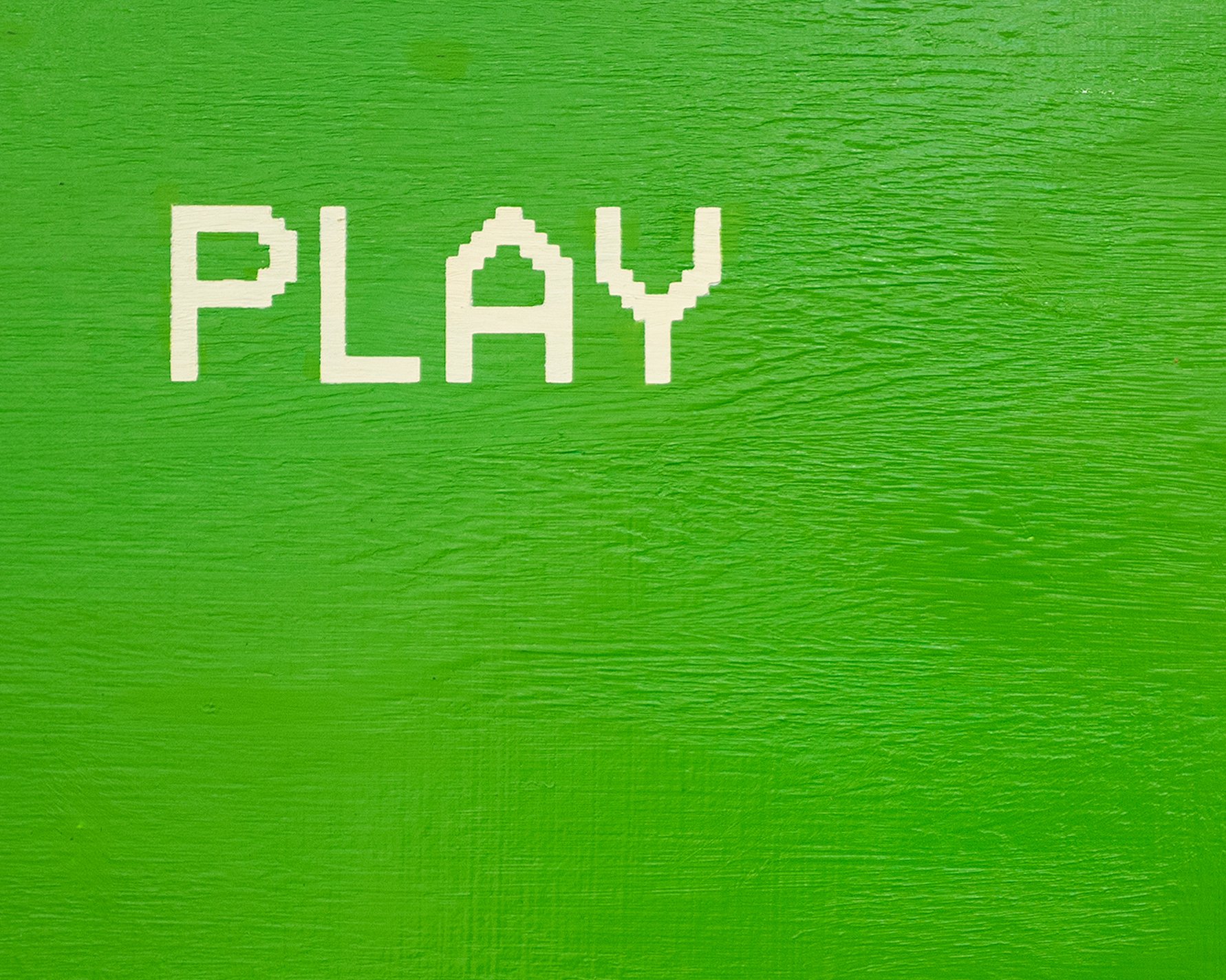
The word arrived on a green screen. In the early 1980s, when a household in China or the United States or anywhere the VCR had penetrated the domestic interior pressed the button on the remote or the cassette deck that initiated playback, the television screen, which until that moment had been displaying static or a blue field or the test pattern that broadcast engineers used to calibrate the color and geometry of the image, switched to a solid green, and in the center of that green, rendered in the blocky, low-resolution characters that the VCR's on-screen display generator was capable of producing, the word "PLAY" appeared, and it remained on the screen for as long as the tape was running, a permanent fixture of the viewing experience, a label that told the viewer that the machine was doing what it had been told, that the cassette was spooling, that the magnetic tape was passing across the read head at a speed of 33.35 millimeters per second, and that the images and sounds that the viewer was watching were being decoded from a signal stored on a ribbon of polyethylene terephthalate coated with iron oxide and suspended between two reels inside a plastic shell. The word was a command. It was also a status indicator. It was also, and this is what Tan Mu's painting makes visible, a cultural condition, a single English word that described the posture of the viewer who sat before the screen and received the images that the machine delivered, a posture of receptivity, of attention surrendered to the flow of recorded content, of time organized around the schedule of the cassette rather than the schedule of the viewer, and the word, which was displayed in a typeface that no one had chosen for its beauty or its legibility, a typeface that was generated by a character generator chip that was manufactured in Japan and installed in VCRs around the world, was the most widely seen word in the domestic visual environment of the late twentieth century, more widely seen than any headline, any advertisement, any brand name, because it appeared on every screen in every household that owned a VCR, which by the mid-1980s was the majority of households in the developed world, and it appeared not once but every time a tape was played, and it remained on the screen for the duration of the viewing session, which could last for hours, and during those hours the viewer sat in the green light of the word and watched the images that the machine was delivering, and the word "PLAY," which hovered above the images like a caption or a label or a command that the viewer was unconsciously obeying, organized the experience of viewing into a condition of play, a condition in which the viewer was not watching critically or thinking independently or responding to the content with the rigor that a printed argument would demand but was instead receiving, absorbing, being entertained by, and ultimately being shaped by a medium that, as Neil Postman argued in Amusing Ourselves to Death (1985), had transformed every form of public discourse, from news to religion to politics, into a form of entertainment, and the word that sat on the screen and told the viewer that they were playing, not watching, not thinking, not deliberating, but playing, was the word that gave that condition its name.
Tan Mu's Play (2022) is a painting of this word, on this screen, in this green. The painting is oil on linen, 41 x 51 cm (16 x 20 in), a small rectangle, not quite square, proportioned to match the landscape orientation of a television monitor. The composition is divided into two zones: a broad expanse of green that fills the interior of the screen, and a narrow border of black that frames the green on all four sides, mimicking the plastic bezel of a cathode-ray tube. The green is not a single flat color. It is built up from a black underpainting that Tan Mu laid down first and allowed to dry completely before applying the green layers on top, and the black, which is visible at the edges where the green thins and in the gaps between the horizontal strokes that form the scan lines, gives the green its depth and its density, the feeling that the color is not sitting on the surface of the canvas but glowing from within it, as though the linen had been replaced by phosphor and the paint by an electron beam. The scan lines, which are the painting's most immediately recognizable reference to the CRT screen, are rendered as horizontal bands of green that alternate with thinner bands of darker green or near-black, where the underlying black underpainting shows through, and these bands run across the entire surface of the screen, from left to right, with a regularity that mimics the regularity of the horizontal scan lines that a cathode-ray tube produces when it draws an image by sweeping an electron beam across the phosphor coating on the inside of the glass, one line at a time, from top to bottom, at a rate that in the NTSC standard was 525 lines per frame and 30 frames per second, and the painting, by reproducing these lines in oil paint, translates the temporal process of the scan, the sweep of the beam, into a spatial fact, a pattern of horizontal stripes that the viewer can see all at once, as a surface, rather than as the rapid succession of lines that the CRT actually produced, and this translation, from time to surface, from sweep to pattern, from process to image, is the same translation that the painting performs on the word "PLAY" itself, which in its original context was a temporal event, a word that appeared when the tape started and disappeared when the tape stopped, and in the painting has become a spatial fact, a word that is permanently visible, frozen in the moment of its appearance, suspended between the command that initiated the playback and the command that would end it, caught, as Tan Mu describes it, "between pause and play."
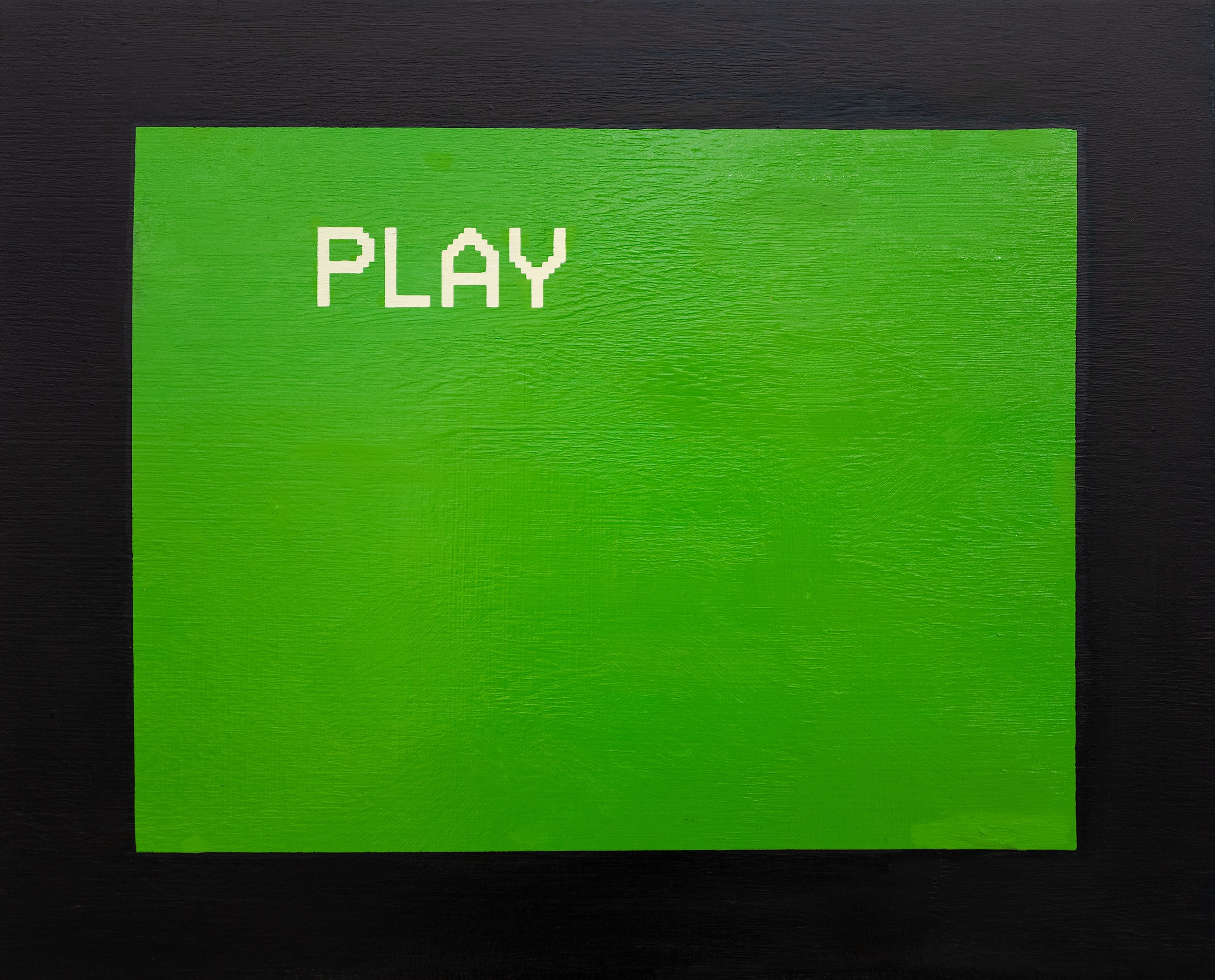
The word "PLAY" is rendered in the blocky, squared-off characters of the VCR's on-screen display, each letter a collection of straight segments and right angles, the kind of characters that a character generator chip produces when it is asked to display text on a screen that has a resolution of perhaps 240 lines and a color depth of perhaps 8 bits, a screen that can show green, and shades of green, and not much else, and the letters, in their blocky simplicity, have a visual authority that a more elegant typeface would lack, because they are the product of a machine that was designed to display information, not to embellish it, and the information they display is the information that the machine needs the viewer to have, which is that the machine is playing, that the tape is running, that the content is being delivered, and the authority of the characters, their blunt legibility, their refusal to be anything other than what they are, which is functional text generated by a functional chip for a functional purpose, is the authority of the command, and the command, in the context of the VCR, is the authority that the viewer obeys, not because the viewer has chosen to obey it but because the command has already been executed by the time it appears on the screen, the machine has already started playing, the tape is already running, the content is already flowing, and the word "PLAY" is not an invitation but an announcement, a declaration that the condition of viewing has been entered and that the viewer, who pressed the button that initiated the sequence, is now in the state that the word describes, the state of playing, which is the state of receiving, which is the state of being entertained, which is the state that Postman identified as the dominant mode of public discourse in the age of television, a mode in which everything, including the news, including politics, including religion, including education, is presented as entertainment, and the viewer, who is in the state of play, receives all of these forms of content in the same posture, the posture of entertainment, the posture of watching, the posture of absorption, and the word "PLAY," which is always visible on the screen when the content is flowing, is the label for this posture, the name for this condition, the command that has already been obeyed.
Ed Ruscha's OOF (1962) is a painting of a word, or more precisely, of a sound, the sound that a comic book makes when a fist meets a jaw, or a body meets a wall, or a car meets a tree, the sound of impact, of collision, of force meeting resistance, rendered in three capital letters on a monochrome ground. The letters are yellow with a blue outline, and they float against a background that is the same blue as the outline, a deep, saturated blue that pushes the yellow forward and makes the letters vibrate against it, and the vibration, which is the optical effect that the complementary colors produce when they are placed adjacent to each other on the surface of a painting, is the content of the work, because the sound that "OOF" represents is also a vibration, a sudden, percussive event that happens in the body and then dissipates, and the painting, by rendering the sound as a visual event, a pattern of yellow letters on a blue ground that vibrates when the eye encounters it, performs the same kind of translation that Tan Mu performs in Play, the translation of an auditory or, in Tan Mu's case, a technological event into a visual one, and the translation, in both cases, is not a passive recording but an active transformation, a decision about what to preserve and what to discard, what to emphasize and what to suppress, and the result, in both cases, is not a copy of the source but a new object that carries the source within it as a structural principle, as a set of constraints and possibilities that the painting has inherited from the medium it is translating and that it has converted into the terms of its own medium, which is oil paint on linen.
Ruscha made OOF in 1962, at the beginning of a decade in which he produced a series of paintings that consist of single words or short phrases rendered in typefaces that mimic the typefaces of commercial signage, advertising, and comic books, and the words he chose, words like "OOF," "BOSS," "GAS," "NOISE," "SMASH," are words that are designed to be seen rather than read, words that function as visual events before they function as linguistic units, words whose meaning is inseparable from their appearance on the page or the billboard or the side of the building, and the paintings, by isolating these words on monochrome grounds and rendering them in the crisp, flat style of commercial art, make the viewer aware of the word as a visual object, a shape made of lines and curves and spaces that the eye processes before the mind processes the meaning, and the awareness that the painting produces, the awareness that the word is a visual object before it is a linguistic one, is the awareness that Tan Mu's Play also produces, because the word "PLAY" on the VCR screen, like the word "OOF" on Ruscha's canvas, is a word that the viewer sees before they read, a word that enters the visual field as a shape, as a pattern of straight lines and right angles, as a configuration of illuminated pixels on a phosphor screen, and the shape, which is the shape of the command, which is the shape of the interface, which is the shape of the machine telling the viewer what it is doing, is the content of the painting, not the meaning of the word "play" in the English language, but the visual fact of the word as it appears on the screen, in the typeface that the machine has chosen, in the color that the machine is capable of producing, in the position that the machine assigns to it, and the painting, by rendering this visual fact in oil paint, makes it available to the kind of attention that the VCR screen, with its constant stream of content and its ever-present label, does not permit, because the VCR screen is designed to be watched, not looked at, and the painting is designed to be looked at, and the difference between watching and looking is the difference between the state of play, in which the viewer receives what the machine delivers, and the state of attention, in which the viewer examines what the painter has made.
The science of the CRT display, which the painting references at the level of its surface, is a science of controlled electron emission. A cathode-ray tube produces an image by heating a filament at the back of the tube until it emits electrons, accelerating those electrons through a series of electrostatic lenses that focus them into a narrow beam, deflecting that beam horizontally and vertically across the front of the tube by means of electromagnets that vary the beam's path in a precise pattern, and directing the beam at a screen coated with phosphor compounds that emit light when struck by electrons. The phosphor compounds that produce the green color characteristic of early monochrome monitors, and of the VCR on-screen display that Tan Mu references in Play, are typically based on zinc sulfide doped with copper, a formulation that emits light in the green portion of the visible spectrum, at a wavelength of approximately 530 nanometers, when excited by an electron beam. The beam sweeps across the screen in a pattern of horizontal lines, 525 lines per frame in the NTSC standard, 30 frames per second, and each line is drawn by the beam as it moves from left to right across the phosphor surface, lighting up the phosphor dots that correspond to the image being displayed and leaving dark the phosphor dots that correspond to the background, and the persistence of the phosphor, which continues to emit light for a few milliseconds after the beam has passed, bridges the gap between one frame and the next, creating the illusion of a continuous image rather than a rapid sequence of individual lines. The painting translates this temporal process into a spatial fact. The horizontal scan lines, which in the CRT are produced by the beam sweeping across the screen at a rate that is too fast for the eye to perceive as individual lines, are rendered in the painting as visible stripes, bands of lighter green alternating with bands of darker green or near-black, where the underlying black underpainting shows through, and the stripes are not perfectly regular. They waver slightly, they vary in width and intensity, they show the hand of the painter in the way that the electron beam, which is controlled by a circuit and follows a predetermined path, does not, and this variation, which is the evidence of the painter's touch, is the painting's insistence on its own materiality, its own status as an object made by a hand, not by a machine, and the hand, in this context, is the hand of the painter who is painting a machine that was designed to replace the hand, to automate the production of images, to eliminate the need for a person to draw or paint or write each line individually, and the painting, by reproducing the lines of the machine with the strokes of a brush, by making the scan lines by hand, by painting the pixels that the machine generated with the phosphor that the painter mixed on a palette, reverses the direction of the translation, converting the machine's output back into the input that the machine was designed to replace, and the reversal, which is the painting's central gesture, is the gesture of the hand reclaiming the territory that the machine has occupied, the territory of the image, the territory of the screen, the territory of the word that commands the viewer to play.
Tan Mu describes the green tone and horizontal scan line texture as "direct references to early television displays," and her account of the painting process clarifies the material logic of the reference: "In the painting process, I began with a black base layer and allowed it to fully dry before applying layers of green oil paint. The word 'Play' was added afterward as the final visual anchor. The green pigment was applied thickly, creating a dense, tactile surface. I used horizontal brush movements to form ripple-like stripes that mimic scan lines and the refresh behavior of CRT screens. This method allowed the surface of the painting to echo the technical characteristics of television imagery, translating a screen-based experience into a physical and material form." The description makes the translation explicit: the black underpainting is the equivalent of the dark screen, the green layers are the equivalent of the phosphor emission, the horizontal brushstrokes are the equivalent of the scan lines, and the word "PLAY" is the equivalent of the on-screen display, and the equivalence is not a copy but a transformation, a conversion from one medium to another, from the temporal medium of the electron beam to the spatial medium of the oil paint, from the instantaneous medium of the phosphor to the permanent medium of the linen canvas, from the medium that produces the image by sweeping across the surface at 30 frames per second to the medium that produces the image by applying pigment to a surface and allowing it to dry, and the drying, which takes hours or days, is the antithesis of the scanning, which takes milliseconds, and the painting, by substituting the slow process of drying for the fast process of scanning, by replacing the ephemeral glow of the phosphor with the permanent color of the pigment, by converting the temporal into the spatial and the electronic into the material, performs the act that Postman, in his critique, did not imagine, which is the act of stopping the flow, of arresting the scan, of freezing the image at the moment when the word "PLAY" appears on the screen and the viewer is about to enter the state of play, and the freezing, which is what the painting does, is the act of refusing to play, of declining the command, of looking at the word instead of obeying it, of examining the command instead of entering the state that the command prescribes, and this refusal, this examination, is the act of criticism, the act of stepping outside the flow of entertainment and looking at the mechanism that produces it, and the mechanism, in the painting, is the green screen, the scan lines, the blocky characters, the word "PLAY," the whole apparatus of the VCR on-screen display, rendered in oil paint on a surface that does not glow and does not refresh and does not emit electrons, a surface that sits still and waits for the viewer to look at it, and the viewer, who is accustomed to looking at screens that refresh 30 or 60 times per second, encounters a surface that refreshes zero times per second, a surface that is permanent, that does not change, that does not scroll, that does not update, and the encounter, between the viewer who is accustomed to the flow and the surface that refuses to flow, is the encounter that the painting stages, the encounter between the state of play and the state of attention, between the command and the examination, between the word that tells the viewer to watch and the painting that invites the viewer to look.

Li Yizhuo, writing in "Constellations" (2025), the catalog essay for the BEK Forum exhibition, observes that Tan Mu's paintings "do not aim at diagnosing the modern spectacles from a distance. They conjure up a kind of vitality and depth of their own." The observation, which was made about the Signal series but applies with equal force to Play, identifies the distinction that separates Tan Mu's practice from the mode of critique that Postman's book exemplifies. Postman diagnosed television from a distance. He analyzed its effects on public discourse, its transformation of news into entertainment, its erosion of the habits of sustained attention that print culture had cultivated, and his analysis, which was lucid and prophetic, was an analysis conducted from outside the medium, by a writer who was trained in the conventions of print and who understood television as a threat to the kind of thinking that print had made possible. Tan Mu, by contrast, does not diagnose. She paints. She takes the screen, the command, the interface, the visual language of the medium, and she translates it into oil paint, and the translation is not an analysis but a transformation, a conversion that preserves the visual characteristics of the source while changing its medium, its temporality, its mode of address, and the result is not a critique of television from the outside but an engagement with television from the inside, an engagement that proceeds by making the screen's visual language available to a kind of attention that the screen itself does not permit, the kind of attention that a painting demands, the slow, sustained, material attention that the VCR, with its constant flow of content and its ever-present label, was designed to prevent, and the prevention, which Postman described as the transformation of all discourse into entertainment, is reversed by the painting, which transforms the entertainment back into the kind of looking that entertainment was designed to replace, and the reversal, which is the painting's argument, is not stated in words but enacted in material, not argued in prose but performed in pigment, and the performance, which takes hours to execute and requires the viewer to stand still and look, is the antithesis of the state of play, which takes milliseconds to initiate and requires the viewer to sit back and receive, and the painting, by placing the command to play inside a frame that demands attention rather than surrender, makes the command visible as a command, makes the state of play visible as a state, makes the green screen, which was the most ordinary and unremarkable visual fact of the domestic interior in the late twentieth century, into an object that can be looked at, examined, and understood, not as a neutral feature of the technology but as the label of a condition, the condition of being entertained, the condition of being told to play, the condition of being in a state that the word on the screen names and the painting reveals.
The painting's scale, 41 x 51 cm, is smaller than the screen it depicts. A typical cathode-ray tube monitor in the 1980s and 1990s had a diagonal measurement of 19, 25, or 32 inches, and the screen area was large enough to fill a significant portion of the viewer's field of vision when they were seated at the typical viewing distance of six to eight feet that the domestic interior imposed. The painting, at roughly 16 by 20 inches, occupies a fraction of that area, and the reduction in scale is not a limitation but a decision, because the smaller format requires the viewer to approach, to lean in, to bring the painting close enough to see the scan lines and the brushstrokes and the variations in the green that the larger format would make visible from a distance, and the act of approaching, of leaning in, of bringing the face close to the surface, is the act that the television screen, which was designed to be watched from across the room, does not require and does not invite, and the painting, by reducing the scale to a size that demands proximity, converts the act of watching, which is the act of receiving content at a distance, into the act of looking, which is the act of examining a surface at close range, and the conversion, which is the same conversion that the painting performs on the scan lines and the green color and the word "PLAY," is the conversion from the passive reception of the screen to the active examination of the painting, from the state of play to the state of attention, from the word that commands to the surface that invites, and the invitation, which is extended by a painting that is small enough to hold in the hands and close enough to see the brushstrokes, is the invitation to stop playing and start looking, to stop watching and start seeing, to stop receiving and start examining, and the examining, which the painting makes possible by translating the screen into paint and the command into a surface, is the act that Postman advocated when he argued that the culture of print, which required the reader to follow an argument from beginning to end, to hold multiple propositions in mind simultaneously, to assess the logic of a sequence of claims, was a culture that trained the habits of sustained attention and critical thinking that the culture of television, which required no such sequence, no such logic, no such sustained attention, was in the process of dismantling, and the painting, which requires the viewer to stand still and look at a surface that does not change, that does not refresh, that does not scroll, that does not flow, is a training in the habits that the screen was designed to eliminate, the habits of attention, of patience, of looking closely at something that does not demand attention but rewards it, and the reward, which is the discovery of the scan lines and the brushstrokes and the black underpainting and the thick green pigment and the blocky characters that spell the word that the viewer has been told to obey, is the discovery that the command, which appeared on the screen as a neutral piece of information, a status indicator, a functional label, is in fact the name of the condition that the screen imposes, the condition of play, the condition of being told to watch, the condition of being in a state of entertainment that does not require and does not invite the kind of thinking that the painting, by demanding attention, by rewarding looking, by refusing to refresh, makes possible, and the word, which on the screen was a command that the viewer obeyed by watching, becomes in the painting a word that the viewer examines by looking, and the examination, which is the act of reading the command as a command, of seeing the word as the label of a condition, of understanding the green screen as the environment of a state that the viewer has entered without realizing it, is the act of waking up from the state of play, and the painting, which has frozen the word on the surface and refused to let it scroll away, is the alarm that wakes the viewer, not by making a sound, which the screen could do but the painting cannot, but by making a surface, which the painting can do and the screen, which is designed to change, which is designed to refresh, which is designed to flow, cannot, and the surface, which is permanent, which is still, which is green and black and painted and small and close, is the surface that the viewer looks at when they are no longer playing, when they have stopped receiving, when they have stepped out of the flow and into the stillness that the painting provides, and the stillness, which is the condition of looking at a painting, which is the condition of standing in front of a surface and examining it, which is the condition that Postman identified as the condition of print culture and that the painting, by translating the screen into a surface, restores.
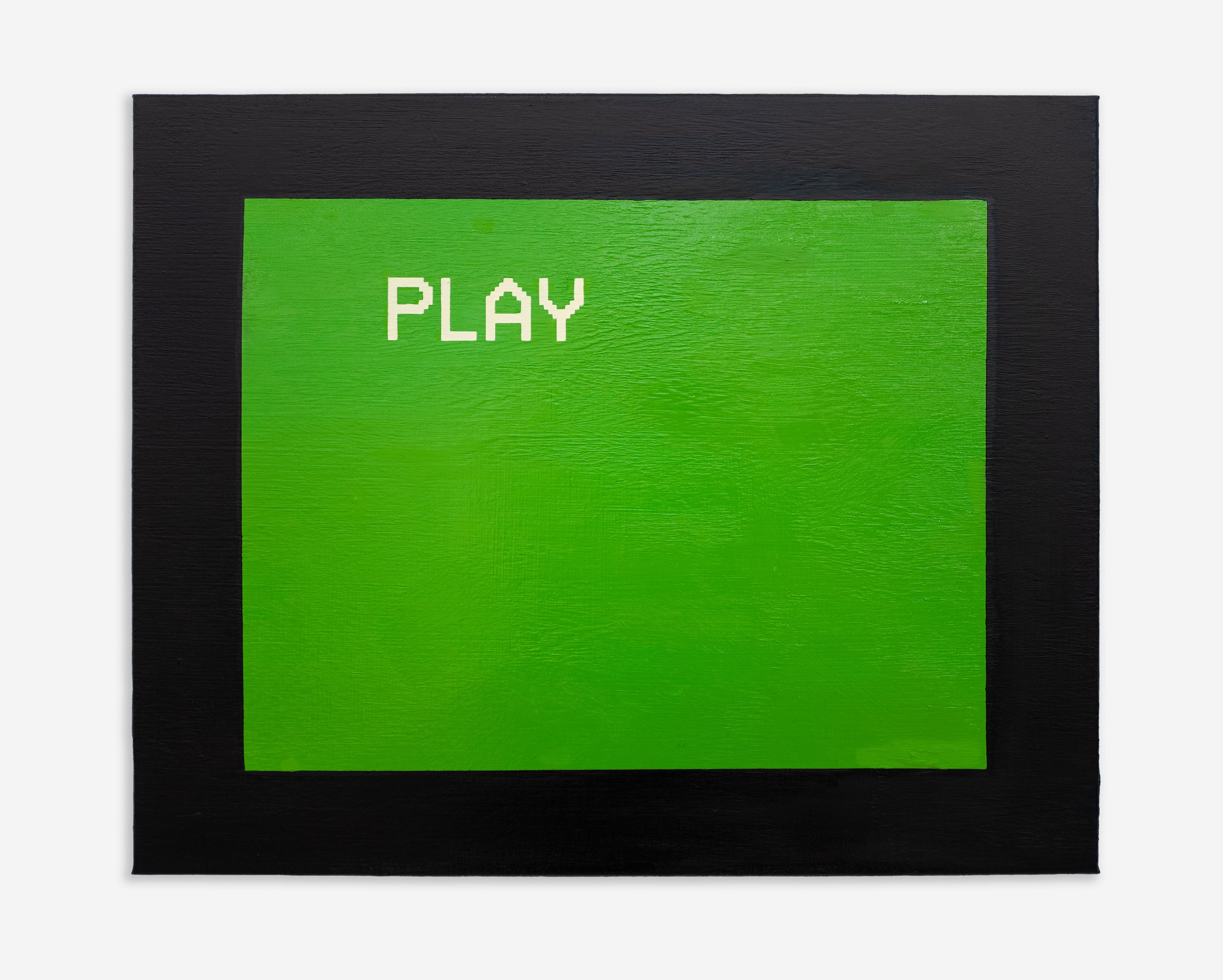
The green of the painting is not the green of nature. It is not the green of grass, or leaves, or the ocean in sunlight. It is the green of phosphor, the green of the cathode-ray tube, the green of the on-screen display that the VCR generated when it was playing a tape, and it is, in the history of display technology, a specific green, the green of the P1 phosphor, which was the first phosphor compound used in cathode-ray tubes and which emitted light at a wavelength of approximately 530 nanometers, in the center of the green portion of the visible spectrum, where the human eye is most sensitive, where the photoreceptors in the retina respond most strongly to the incoming light, and the choice of this green, which was not an aesthetic choice but an engineering decision based on the availability of phosphor compounds and the sensitivity of the human visual system, produced a display that was legible in the conditions under which VCRs were typically used, which is to say in domestic interiors, in living rooms and bedrooms, at viewing distances of six to eight feet, in the ambient light of a household that was illuminated by lamps and windows and, increasingly, by the glow of the screen itself, and the green, which was chosen for its legibility, became, over the two decades in which the VCR was the dominant playback device in the domestic interior, the color of watching, the color of receiving, the color of the state of play, and the painting, by reproducing this green in oil paint, by mixing pigments on a palette until the color matched the color that the phosphor compound produced, by applying the mixture to a linen surface in horizontal strokes that mimicked the scan lines of the CRT, by building up the green over a black underpainting that gave it the depth and luminosity of the phosphor screen, transferred the color from the medium of electronics to the medium of painting, and the transfer, which is a translation, is not a neutral act, because the green, in the medium of electronics, is the color of a command, the color of the word that tells the viewer to play, and the same green, in the medium of painting, is the color of a surface that invites the viewer to look, and the difference between the command and the invitation is the difference between the state of play and the state of attention, and the painting, by changing the medium, changes the state, and the viewer, who approaches the painting and leans in to see the scan lines and the brushstrokes, is no longer in the state that the word on the screen prescribed, is no longer playing, is no longer receiving, is no longer in the flow, but is standing in front of a surface that does not flow, that does not refresh, that does not command, that invites, and the invitation, which is extended by the green and the black and the scan lines and the word that spells "PLAY" in the blocky characters of the on-screen display, is the invitation to stop playing and start looking, to step out of the state that the screen imposes and into the state that the painting makes possible, and the state, which is the state of sustained attention to a surface that does not change, is the state that Postman identified as the state of print culture, the state of reading, the state of following an argument, the state of thinking, and the painting, by translating the screen into the surface, restores this state, not by arguing against television but by making the visual language of television available to the kind of attention that television was designed to eliminate, and the attention, which the painting demands and the screen suppresses, is the attention that the word "PLAY," rendered in oil paint on a linen canvas, 41 x 51 cm, small enough to hold in the hands, close enough to see the brushstrokes, still enough to examine the command, now receives.