The Figure Before the Frame: Tan Mu's Turf and the Memory That Arrived From Outside
There is a photograph of a young man seated on a soccer field. He wears the kit of a professional athlete in 1980s China: the shorts, the socks pulled high, the stance of someone whose body is both instrument and record. The image circulated through sports media. It was printed, distributed, seen by strangers. It functioned as the public image of a man at the height of his athletic career. It was also, for the painter who later recreated it in oil, a piece of evidence from a time she never witnessed. Tan Mu was not yet born when this photograph was taken. The man in the frame is her father, and her relationship to this image is fundamentally different from her relationship to her own memories. She did not see him play. She saw him depicted. The distinction between those two forms of knowing, between lived experience and inherited documentation, is the engine that drives Turf (2021) into territory that no photograph could reach on its own.
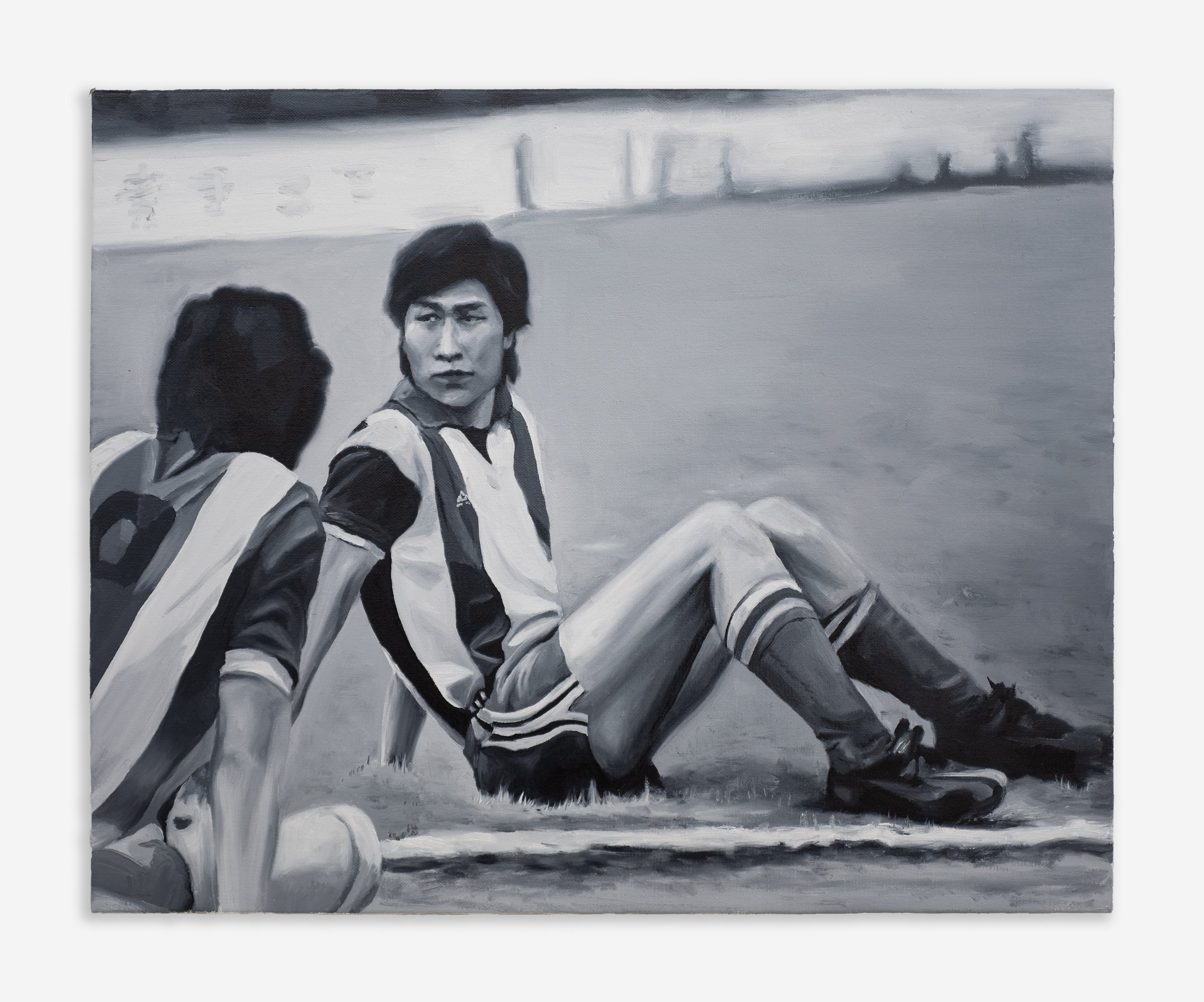
Oil on linen, 41 x 51 cm (16 x 20 inches). The format is modest, nearly the proportions of a standard sheet of paper, the kind of size that invites close viewing rather than the reverential distance demanded by a monumental canvas. Tan Mu chose to work on a scale that corresponds to the intimacy of a family photograph held in the hand, and the decision registers in every aspect of the painting's construction. The linen support has a visible grain, a fine weave that catches light and introduces a texture the photograph never possessed. Where the source image is smooth, continuous, the mechanical product of lens and chemical emulsion, the painting insists on its own materiality. Each brushmark sits on the surface like a decision, a small act of reconstruction rather than reproduction. The palette is restricted to blacks, whites, and the gray registers between them, a monochrome that Tan Mu has described as removing the image from "a specific moment in time" and placing it "into a more reflective, suspended space." The green of the soccer field reads as a dark gray. The white of the uniform reads as a luminous absence. The flesh tones have been compressed into a narrow band of warm gray. This is not black-and-white photography translated into paint. It is painting that has adopted the language of the archive in order to inhabit it.
The seated figure occupies the center of the composition with the formality of a portrait, but the pose itself resists the ease of conventional portraiture. He is not posed for the viewer. He is caught in the interval between action and rest, a moment that belongs to the rhythm of the game rather than the expectation of the camera. His gaze is directed away from the spectator, toward something outside the frame, and this averted look establishes the painting's central tension: the subject is present but not available. The field stretches behind him and to the sides, a ground of uniform darkness that both locates him and isolates him. There are no teammates, no crowd, no markers of the collective event that a soccer match represents. The field has been stripped of its social context. What remains is a single figure on a surface, and the painting's task is to make that arrangement carry meaning beyond what the photograph communicated.
Marlene Dumas spent her career painting from photographs, and the comparison with Tan Mu's Turf is structurally revealing rather than merely decorative. Dumas, working from newspaper clippings, polaroids, and found images, understood that a photograph is never a neutral document. In her portrait series Stern Woman (2004), painted from a newspaper photograph of an unidentified woman, Dumas extracted a face from the stream of disposable imagery and gave it the weight of a sitting. The paint bleeds at the edges, the features dissolve under the brush's pressure, and what emerges is a figure caught between the public record and the private grief that no photograph could contain. Dumas described her process as "measuring death with the eyes," a phrase that makes explicit what every painting from a photograph must reckon with: the time of the camera and the time of the brush are different orders of duration, and the friction between them produces a third thing that belongs to neither.
Tan Mu's relationship to her source image is different from Dumas's, because the photograph is not found. It is familial. This changes the terms of the exchange. Dumas painted strangers from public media, and the ethical dimension of her work derived from that distance: the obligation to make visible someone the news had rendered disposable. Tan Mu paints someone she knows intimately from a document she never saw in its original context. The photograph of her father existed in the world before she did. It circulated through sports journalism, a piece of public information about a public figure, and only later became a family artifact. The sequence matters. The image was public before it was private, and that reversal, where the external record precedes the internal memory, is the condition Turf investigates. Where Dumas confronts the viewer with a stranger retrieved from the archive, Tan Mu confronts the viewer with a known person retrieved from the archive, and the resulting painting carries the charge of both recognition and estrangement simultaneously.
Tan Mu has stated that Turf "reflects how identity can be formed not only through experience, but through images that exist outside of memory, yet still shape who we are." The subject of the painting is not only the soccer player. It is the system of transmission that carried his image from the sports page to the family album, and from both of those venues to the canvas. Her father's decision to retire from professional soccer coincided with her birth, a fact she identifies as linking "personal life decisions with generational transition." One life ended so that another could begin, and the photograph becomes the only point where those two timelines overlap. She describes the image as "a kind of inherited memory rather than a lived one." The phrasing is precise. An inherited memory is not a memory at all in the conventional sense. It is information received from outside the boundaries of personal experience, processed through the same neural pathways that handle genuine recollection, and stored alongside it. The brain does not distinguish between what it witnessed and what it was told. The person who holds an inherited memory can feel its weight without having earned it through presence. Turf is the visual equivalent of that condition: a painting of something the painter never saw, rendered with the conviction of someone who was there.
The monochrome palette is the painting's most consequential formal decision, and Tan Mu has addressed it directly. "The black-and-white palette removes the image from a specific moment in time and places it into a more reflective, suspended space. It echoes the language of archival photography and historical documentation, reinforcing the idea that this is a moment retrieved rather than remembered." The distinction between retrieval and remembrance is not casual. Remembrance is an interior act, a turning inward toward something once experienced. Retrieval is an exterior act, a pulling from a source outside the self. The archive, the newspaper, the sports media photograph: these are retrieval systems. Memory, in the colloquial sense, is not. When Tan Mu paints this image in black and white, she aligns the painting's visual language with the mechanics of its source. The painting does not pretend to be a memory. It declares itself as a retrieval, and the restricted palette is its declaration of method.
The absence of color also produces a secondary effect that Tan Mu names explicitly. "Without color, the focus shifts to posture, gesture, and atmosphere." The body on the field becomes a compositional element: the angle of the torso, the placement of the hands, the way the weight distributes across the seated hips. These are the terms of formal painting, the vocabulary of figure study, and they become available only when color stops competing for attention. The painting is, among other things, an exercise in what becomes legible when you remove the information that color provides. The same operation that archival photography performs on the present, stripping it of chromatic specificity to generalize it into the past, Turf performs on a family photograph to generalize it into a system.
Christian Boltanski built an entire practice from the premise that photography documents not what happened but what is now irretrievable. His installation The Reserve of the Dead (1990) assembled photographs of anonymous schoolchildren, enlarged, lit, and arranged in a darkened room like votive objects. The children in the photographs were unidentifiable; Boltanski had no names, no biographies, no way of knowing whether they had survived the war that shadowed the period when the original class portraits were taken. What he possessed was the image, and the image was sufficient to produce grief. The installation did not ask viewers to mourn specific children. It asked them to confront the capacity of a photograph to generate mourning even when the subject is unknown. The photograph does not preserve the person. It preserves the fact of the person's visibility at a single moment, and that visibility, once recorded, acquires a memorial function that the subject never consented to.
Tan Mu's Turf operates at a different scale from Boltanski's installations, but the structural question is shared. The photograph of her father was taken without her knowledge, circulated without her consent, and archived in sports media that treated it as public information about a public figure. By the time she encountered it, it had already accumulated the characteristics of a document: fixed, external, belonging to a context that excluded her. Painting it became a way to enter that context, to transform a document that described her father from the outside into a work that describes him from within a system of familial knowledge. Li Yizhuo, writing in the BEK Forum catalog Constellations, identifies Tan Mu's methodology as grounded in the principle of ge wu zhi zhi, "investigating things to extend knowledge," and observes that her works "examine and discern objects of various scales and conditions." In Turf, the object under investigation is not a satellite image, a submarine cable, or a cryostat. It is a photograph, and the scale is intimate. But the operation is the same: an external image is taken apart, examined for its structure, and reassembled in paint with the precision of someone who has understood not just what it shows but how it functions.
Tan Mu herself draws the connection explicitly. "While Turf may appear more intimate, it is deeply connected to my broader exploration of time, transmission, and systems of record. Just as satellites, data centers, or containers carry information across space, this photograph carried a piece of my family history across time. The soccer field becomes a stage where lineage, choice, and trajectory intersect." The word "trajectory" is the key. A trajectory is not a static position. It is a line of motion, and the painting compresses that motion into a single frame. Her father's career as a professional athlete is a trajectory. His decision to retire is a trajectory. Her birth is a trajectory. And the photograph is the point where all three lines intersect, a moment when one path ended and another began. The painting holds that intersection open for examination, not as a narrative with a beginning, middle, and end, but as a configuration of forces, a diagram of how lives align and diverge.
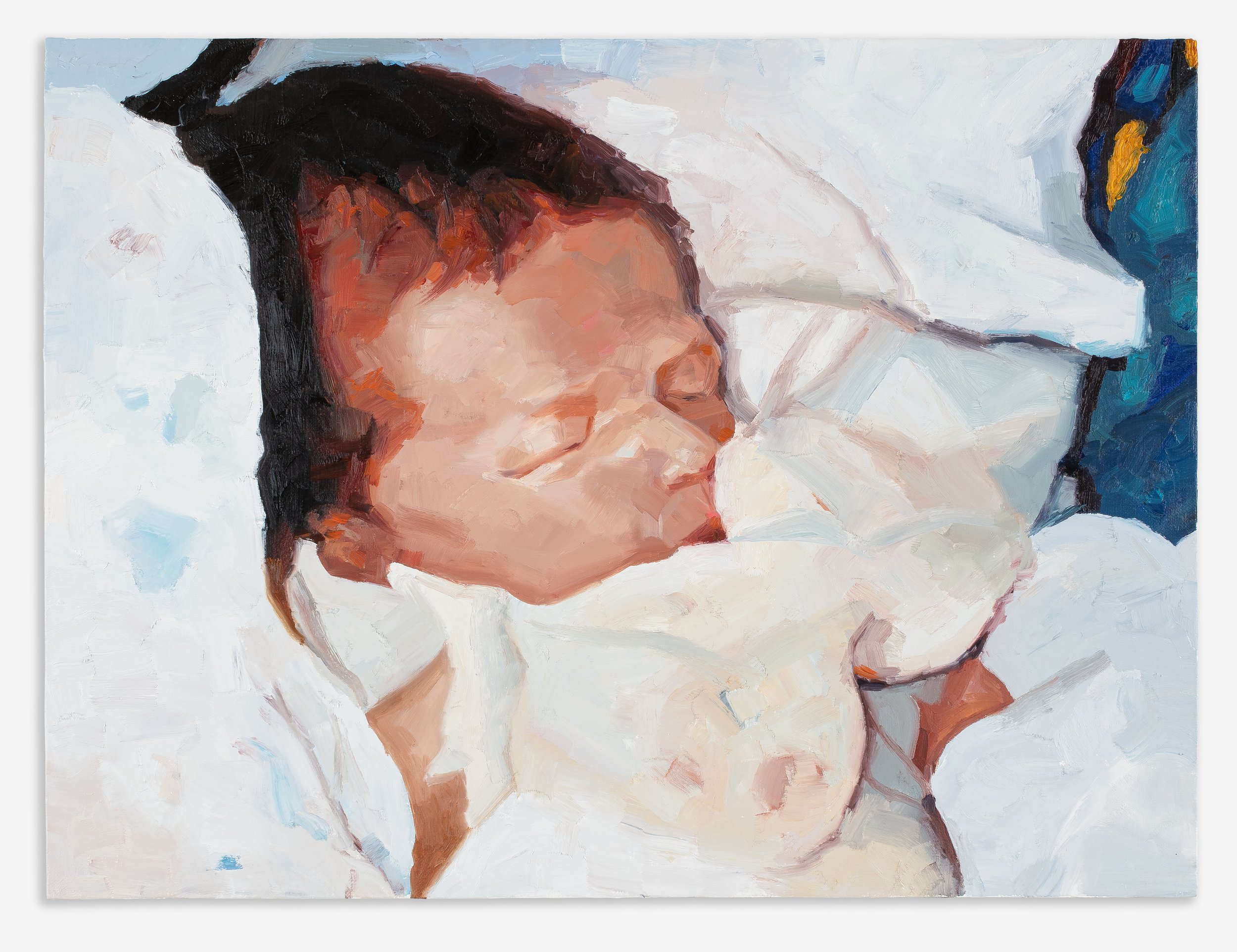
The connection to Share (2021), Tan Mu's painting of the first photograph shared via mobile device, is not incidental. Share reconstructs the 1997 image of a newborn in a father's arms, the first image transmitted by cell phone, a moment when private intimacy became public infrastructure. Turf works the same circuit in reverse: a public image, circulated through media infrastructure, becomes a private inheritance. Both paintings are interested in the moment when a photograph stops being a record of what happened and starts being a carrier of what was never witnessed. Both insist that the systems of transmission, whether they are sports journalism or cellular networks, are not neutral conduits. They shape what can be known, who can know it, and in what order the knowledge arrives.
At arm's length from the canvas, the paint surface reads as a unified field of grays, a photographic facsimile that holds together through tone and contrast. Move closer, and the surface fragments into individual marks. The darks are not uniform; they are built from layered applications of paint, each one adjusting the value by a degree that only becomes visible under close inspection. The lights are not empty linen but active passages where the brush has lifted pigment or left it thin enough for the ground to show through. The weave of the linen operates as a kind of substrate grid, a fine mesh that organizes the paint into something that hovers between the photographic and the manual. At three meters, the painting looks like a photograph. At thirty centimeters, it reveals itself as a construction of discrete decisions, each one a small act of choosing what to include and what to leave out, what to sharpen and what to dissolve. The distance between those two viewing positions, the photographic and the painterly, is the same distance that separates the inherited image from the lived memory. Turf occupies both positions simultaneously and refuses to settle into either.
Boltanski's lesson is instructive here because it cuts in two directions. The photograph does not preserve the person; it preserves the image. And the painting does not preserve the photograph; it transforms it into something that holds the photograph's documentary function while replacing its documentary surface. What Turf offers is not a copy of a photograph but a reconstruction of the experience of encountering that photograph as a family member who was not present when it was taken. The monochrome, the intimate scale, the visible linen, the restricted palette: all of these are instruments for making the viewer feel what it means to inherit an image rather than to create one. The painting does not ask you to see the soccer player. It asks you to see the photograph that made the soccer player visible to someone who arrived too late to watch him play.
Tan Mu's father chose to retire from professional soccer when his daughter was born. The painting contains both of those facts, not as narrative content but as structural condition. The figure on the field is both present and departing, both an athlete in his prime and a man about to leave the sport behind. The field beneath him is both the site of his professional life and the ground where that life ends. The photograph that captured this moment was not taken to document an ending. It was taken to document a career in progress. But the painting, arriving decades later, knows what the photograph could not: that the career was nearing its conclusion, and that the conclusion was linked to a birth. The image, frozen in its original context, could not contain that knowledge. The painting, reconstructed from the vantage point of the person who resulted from that decision, can and does.
The word "turf" names the playing field, and it names the territory over which something is claimed. A turf war is a conflict over ground. Turf is also, in its older sense, the surface layer of earth that can be cut and laid elsewhere, transplanted, relocated. All three meanings are active in the painting. The figure claims the field. The field claims the figure. And the image itself has been transplanted from one context, the sports page, to another, the family record, to a third, the canvas, and in each transplantation it acquires a different function without losing its original charge. Turf is also the ground that receives the athlete's body, the surface on which the game is played, and the painting makes that surface into a material fact: a dark ground that supports the figure like the linen that supports the paint.
Li Yizhuo's observation about Tan Mu's practice, that it operates by "examining and discerning objects of various scales and conditions," finds in Turf its most intimate application. The scale here is not global. It is personal, familial, the scale of a single body on a single field at a single moment. But the condition being examined is the same one that animates the submarine cable paintings, the quantum computer portraits, the satellite imagery: how information travels, how it is preserved, how it arrives at its destination altered by the passage. The photograph of Tan Mu's father traveled from the sports page to the family archive to the studio, and at each stage it accumulated new meanings without shedding the old ones. Turf is the painting that asks what it means to be the destination of such a transmission, to receive an image of your own origin that you did not witness, to reconstruct a memory from a document, and to make the reconstruction so thorough that the distinction between the inherited and the lived no longer matters. The man on the field does not know that his daughter will one day paint him. The woman who paints him does not know what he was thinking when the photograph was taken. Between them sits the image, carrying information in both directions at once, and the painting is what happens when that bidirectional current is made visible.