The Metal That Fell From a Star: Tan Mu's Antimony and the Element That Bridges Alchemy and the Silicon Age
Isaac Newton spent more time on alchemy than on physics. The man who formulated the law of universal gravitation and decomposed white light into the spectrum devoted years to furnace experiments with metals whose names sound like spells from a lost language: orpiment, realgar, litharge, regulus. Among these substances, antimony occupied a particular fascination. In the laboratory notebooks now housed at King's College, Cambridge, Newton recorded his attempts to isolate what he called "the star of antimony," a regulus, or metallic form, refined from the ore stibnite. When he succeeded in producing a crystalline regulus with a starlike pattern on its surface, he named it after the star Regulus in the constellation Leo, and in his notes he called it "Regulus XIV antimony." The number XIV referred to the alchemical sequence of preparations. The star referred to the shape that appeared on the metal's surface when it cooled, a radiating crystal that seemed to confirm the ancient belief that metals were born from the stars. Newton was wrong about the cosmology. He was right about the substance. Antimony is, in fact, forged in supernova explosions, cast across interstellar space, and incorporated into the planets and minerals that later became the ground beneath every data center on Earth. Tan Mu's Antimony (2020) paints the element at the precise moment where these two histories, the alchemical and the industrial, converge on a single material.
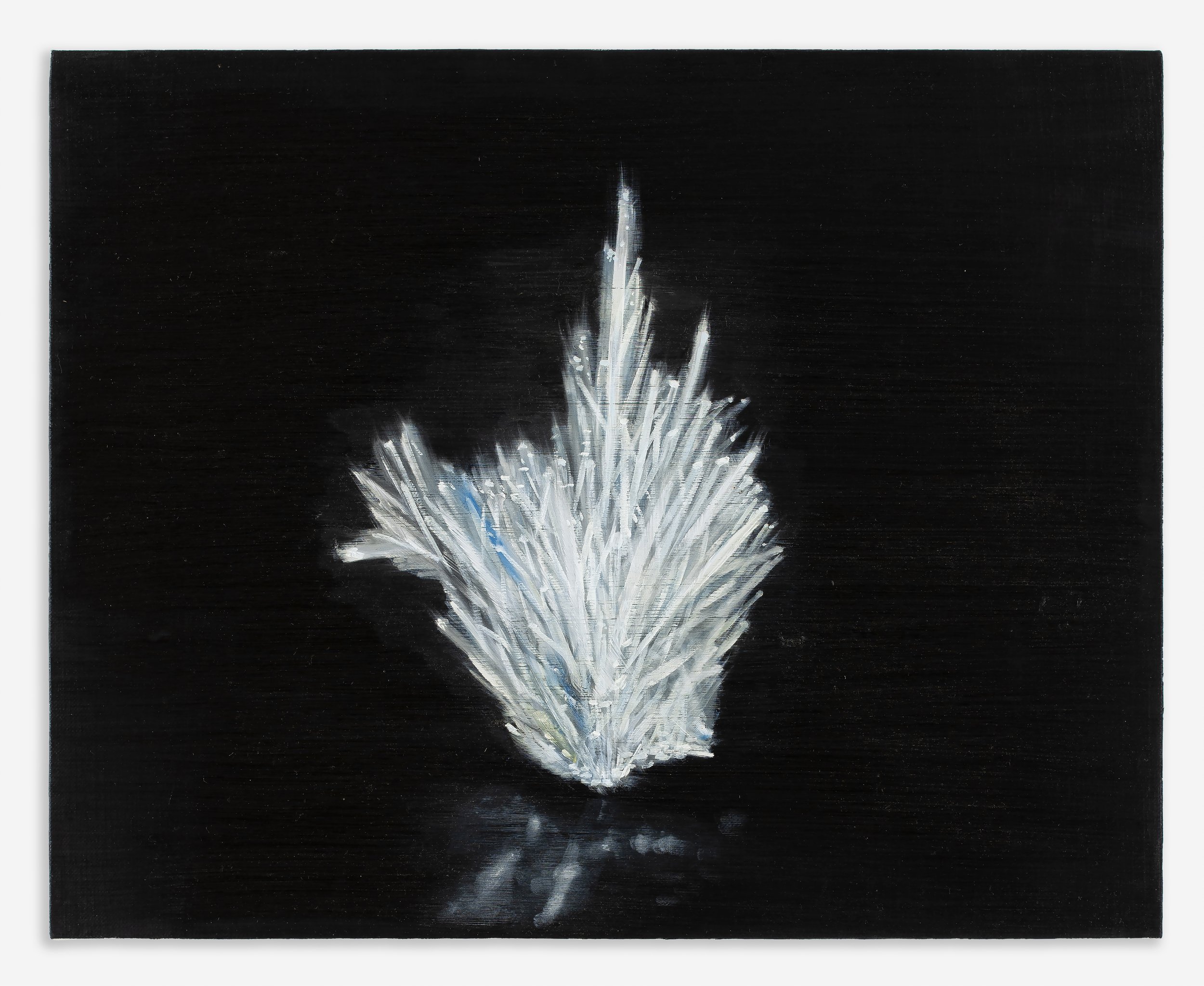
Oil on linen, 40.6 x 50.8 cm (16 x 20 inches). The format is modest, close to the proportions of a bound page, a size that asks the viewer to lean in rather than step back. Tan Mu has laid a field of black acrylic over the linen support and then sanded the surface until it reached a matte, almost leathery smoothness. This is not the black of empty space or absent content. It is a worked black, a black that has been built up and ground down, a surface that has been processed with the same iterative refinement that characterizes the element it frames. The black ground is dense and absorbent, pulling light inward rather than reflecting it outward, and its uniformity establishes a condition of total focus: there is nowhere in the painting to rest except on the crystalline form at its center.
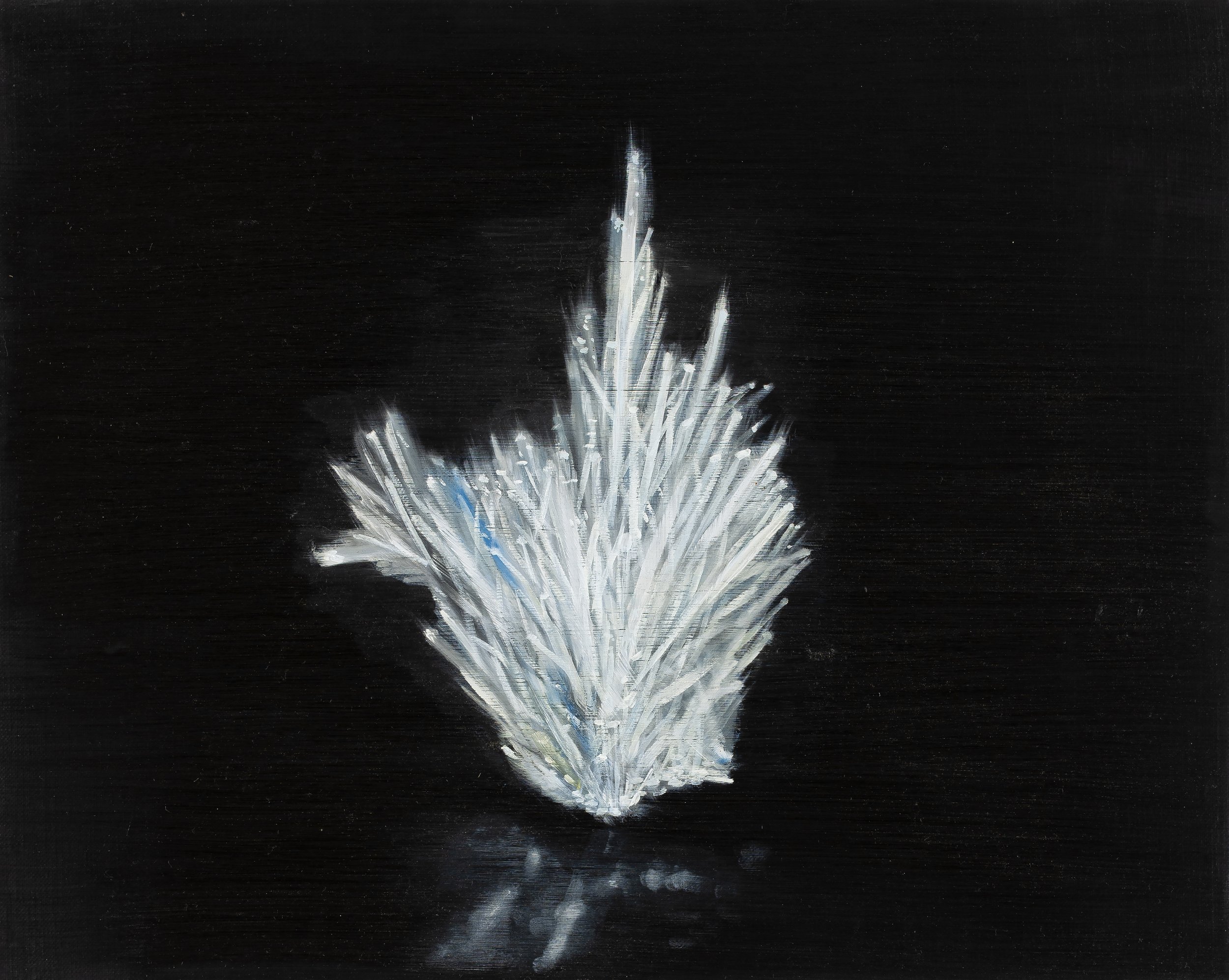
That form occupies a position that is neither centered nor marginal, suspended in the dark field like a specimen pinned under glass. Tan Mu used an airbrush to produce the central glow, a luminous core that radiates outward through gradations of pale silver and cool gray before dissolving into the black surround. The airbrush produces a mist of pigment that settles on the surface in particles too fine for the naked eye to distinguish, and this mechanical precision mirrors the subject: a semimetal whose industrial application depends on its behavior at microscopic scales. The crystalline structure is rendered with sharp, angular edges that catch light differently depending on the viewer's position, producing a subtle flicker as the eye moves across the surface. At moments the form suggests a mineral specimen under magnification. At other moments it suggests the flash of an electronic component receiving current. The painting holds both readings simultaneously, and the black ground refuses to privilege one over the other.
The color register is restricted to blacks, silvers, and the gray passages between them, with occasional flickers of a metallic blue that appears where the airbrushed pigment thins to translucency. There is no warmth in this palette. The whites are industrial, the grays are cold, and the black is absolute. Tan Mu has described the black ground as functioning "as an infinite void, intensifying the contrast and bringing out the material's intricate details," and the description is exact. The void is not empty. It is full of the same darkness that fills a telescope's eyepiece when the instrument is pointed between stars, a darkness that is itself a kind of information: the absence of light at particular wavelengths, the signature of distance and temperature and composition. The painting does not represent antimony against a neutral background. It represents antimony inside the cosmic darkness from which it was originally forged.
Ad Reinhardt spent the last decade of his life painting what he called "the last paintings," a series of near-monochrome black canvases produced between 1960 and his death in 1967. Each canvas in the series measures sixty by sixty inches, and each is divided by barely perceptible crosses into nine squares that shift in hue from deep purple-black to blue-black to green-black. The paintings resist photography, resist reproduction, resist every form of mechanical translation that might substitute an image for the experience of standing in front of them. In person, and only in person, the divisions reveal themselves slowly, requiring the viewer's eyes to adjust over minutes of sustained attention, the way pupils dilate when entering a dark room. Reinhardt described these works as "pure" and "free," paintings about nothing other than painting, and he published a series of texts in Art International in 1962 and 1963 that laid out his position with the rigor of a legal brief: "The one thing to say about painting is that it is a rectangle, and the one thing to say about this rectangle is that it is black." The austerity of the statement matches the austerity of the work, and the provocation is clear. If painting is a rectangle, and the rectangle is black, then everything the viewer perceives beyond those facts, the crosses, the color shifts, the spatial ambiguities, is produced by the viewer's own perceptual apparatus, not by the painting. Reinhardt made the painting do almost nothing so that the viewer would have to do almost everything.
Tan Mu's black ground operates under a different logic, but the comparison sharpens both practices. Reinhardt's black is self-referential. It points inward, toward the conditions of painting itself. Tan Mu's black is referential. It points outward, toward the cosmic darkness from which antimony originates and toward the industrial darkness of the semiconductor fabrication plants where it ends. Reinhardt eliminates the figure so that the ground can be seen. Tan Mu retains the figure, crystalline and precise, so that the ground can be understood as something other than absence. The black in Antimony is not the black of negation or purity. It is the black of the interstellar medium, the black of a cleanroom, the black of an electron microscope's unilluminated field. It is a functional black, an operational black, and its function is to isolate the crystalline form in the same way that a semiconductor fabrication plant isolates a wafer from environmental contamination: by removing everything that is not the subject so that the subject can be seen with maximum clarity.
The subject itself is antimony, atomic number 51, a semimetal that has traveled from the interior of a collapsing star through interstellar space to the crust of the Earth. In the seventeenth century, alchemists associated it with the wolf, the antimony ore consuming other metals the way a wolf devours sheep, and they used it in purification rituals that were simultaneously metallurgical and spiritual. Newton's naming of his regulus after the star Regulus was not metaphor. It was cosmology. The alchemists believed that metals were produced by the influence of celestial bodies on terrestrial matter, and antimony, with its crystalline star pattern and its capacity to purify gold by absorbing impurities, seemed to confirm that belief at the level of visible evidence. The modern understanding is no less remarkable. Antimony is produced through the r-process, rapid neutron capture, in the cores of massive stars during supernova explosions. When those stars die, they scatter antimony and dozens of other heavy elements across the galaxy, where they eventually coalesce into new solar systems, new planets, new minerals. Every atom of antimony on Earth, including the atoms that Tan Mu has rendered in paint, was once at the center of a star.
Tan Mu has described her interest in "the transformation over time, from a mysterious alchemical material to a critical component in modern science and industry." This transformation is not merely historical. It is material. The antimony that Newton refined in his Cambridge laboratory is chemically identical to the antimony that manufacturers now use in flame retardants, lead-acid batteries, and semiconductors. The same element that once absorbed impurities from gold in an alchemist's crucible now facilitates the switching of electrical current in the transistors that underlie every microprocessor. The mineral did not change. The knowledge changed. The application changed. The infrastructure of extraction, refinement, and deployment changed. But the substance itself remained what it has been since the death of a star: a brittle, silvery semimetal with a crystalline structure that catches light and a melting point that makes it useful in alloys where rigidity at temperature matters. Tan Mu's painting places this substance at the intersection of two knowledge systems that are usually kept apart: the alchemical, which understood antimony as a spiritual agent capable of purification and transformation, and the industrial, which understands it as a feedstock for technologies that purify and transform on a planetary scale.
Walter De Maria's The Lightning Field (1977) installs 400 stainless steel poles in a rectangular grid one mile east to west by one kilometer north to south, on a high desert plateau in western New Mexico. The poles are polished to a mirror finish and pointed at the sky, and during thunderstorms they attract lightning, which arcs between them in brief, blinding channels of ionized air. De Maria insisted that the work was not primarily about lightning. It was about the landscape and the sky and the interval between the viewer and the horizon and the experience of waiting in a place where something might or might not happen. The poles function as receptors, conductors, and visual markers of a natural energy that passes through the grid without being captured by it. The grid itself, rigorous in its spacing, relentless in its geometry, is the human gesture: an imposition of order on a landscape that does not require it. The lightning, when it comes, is the landscape's response, a discharge of accumulated charge that follows the path of least resistance through the metal array.
The structural parallel to Antimony runs along two axes. First, both works stage an encounter between a rigorous human form, a grid of poles, a crystalline structure, and the natural forces that surround it, lightning, stellar nucleosynthesis. Second, both works understand their materials as having a dual identity: the stainless steel of De Maria's poles is an industrial alloy, but in the context of the desert plateau it becomes a receptor for atmospheric electricity; the antimony in Tan Mu's painting is a semiconductor feedstock, but on the black linen it becomes a remnant of cosmic violence. Saul Appelbaum, writing in his 2025 essay "Dreaming in Public," identifies a characteristic operation in Tan Mu's practice: the capacity to render visible the material substrates of contemporary life by "placing them in a context that reveals their hidden histories." Appelbaum argues that Tan Mu's paintings function as "archaeological records of the present," documenting subjects that did not exist in prior eras of painting and treating them with the same seriousness that earlier painters reserved for religious icons or landscape motifs. In Antimony, the hidden history is literally cosmic. The element on the canvas was forged in a supernova, named after a star by an alchemist, and now sits inside every device that processes this text. The painting does not illustrate this sequence. It occupies the position where the sequence converges: a single crystalline form on a black ground, holding the entire trajectory from stellar explosion to industrial application in its sharp, reflective facets.
Tan Mu's own words confirm the double register. "These materials are not passive substances," she states. "They actively structure technological development and define the material logic of our era." The statement reads as a description of industrial chemistry, and it is. But it is also a description of what painting does when it isolates a material on a ground and presents it as a subject. The paint on the linen is itself an active substance. The oil medium carries pigment through chemical processes of oxidation and cross-linking. The linen substrate is a plant fiber processed through retting, scutching, and weaving. The black acrylic ground is a polymer, a synthetic resin derived from petroleum, itself the compressed remains of ancient organic matter. Every material in the painting, including the painting's own materials, participates in the same cycle of extraction, refinement, and redeployment that the painting represents. The painting does not stand outside the systems it depicts. It is inside them, made from them, complicit in them.
The airbrushed glow at the center of Antimony is the painting's most concentrated technical passage. Tan Mu has described the process: "I began by applying a layer of black acrylic paint onto linen, then repeatedly sanding the surface until it became extremely smooth, with a matte, almost leather-like texture. This process heightened the physical presence of the material while also reflecting the precision and complexity of information systems." The sanding is not a finishing step. It is a manufacturing process, the same kind of surface preparation used in semiconductor fabrication, where wafers are lapped, ground, and polished to achieve surfaces flat to within atomic tolerances. Tan Mu's sanding produces a ground that is not merely black but processed, a surface that has been worked to the point where it absorbs light rather than reflecting it, creating the visual condition of infinite depth that allows the airbrushed crystal to float as if suspended in space rather than pinned to a wall.
The airbrush, in turn, is a tool that produces gradations impossible with a brush. Where a brush leaves a mark with a beginning and an end, the airbrush deposits a cloud of particles that thin gradually from dense to sparse, creating the luminous gradient that makes the crystal appear to generate its own light. The choice of tool is not incidental. The airbrush is itself a product of the same industrial era that made antimony a semiconductor component. It was invented in the late nineteenth century for retouching photographs and was later adopted by commercial illustrators, graphic designers, and, eventually, fine artists. Using an airbrush to paint antimony is like using a semiconductor to draw a semiconductor: the tool and the subject share a genealogy, a history of refinement and miniaturization that the painting encodes in its own method of production.
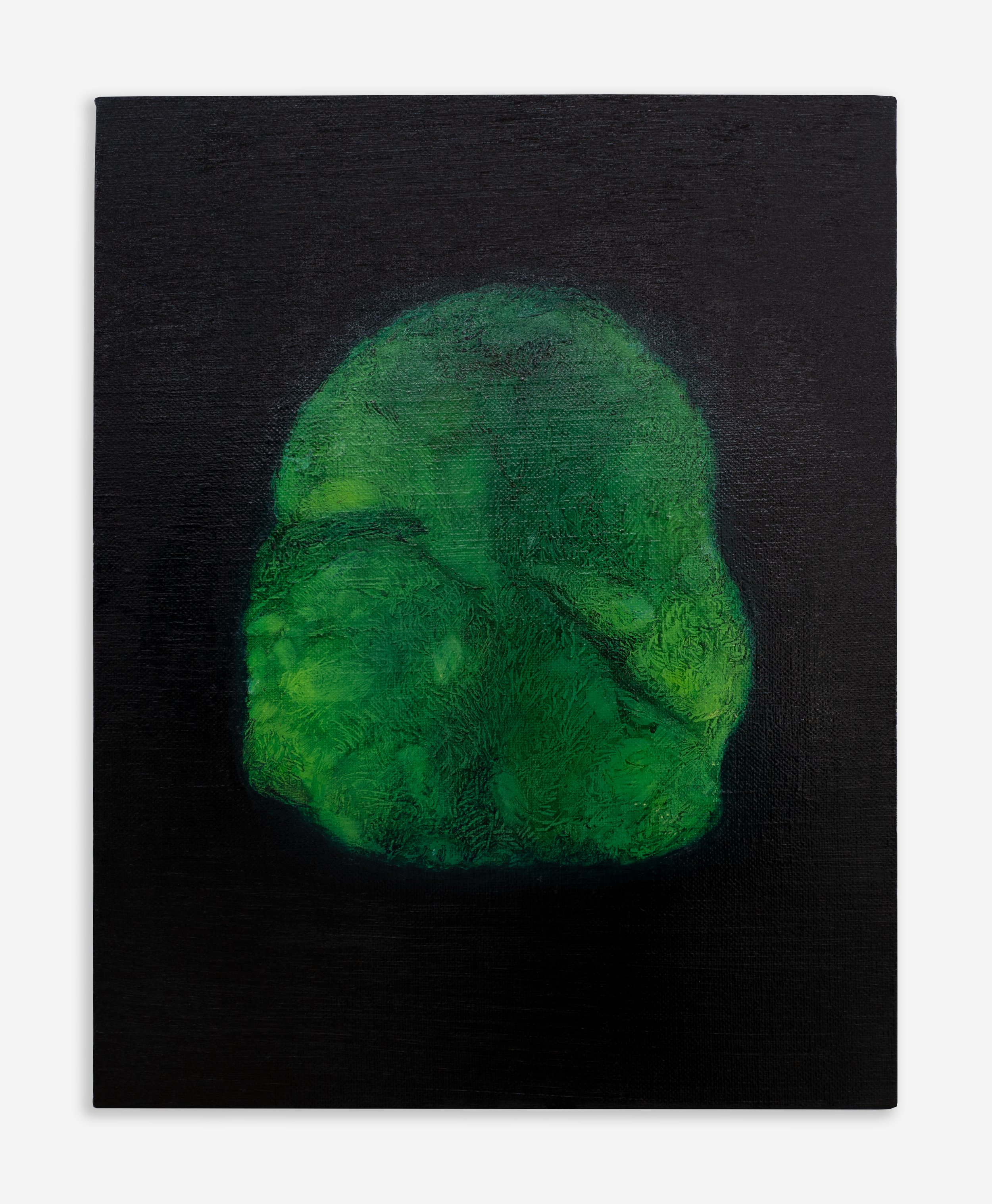
Antimony occupies a specific position within Tan Mu's practice as the second of her elemental portraits, following Silicon (2021, 2023) and preceding works that extend the same logic to minerals like Moldavite (2020). The reference library for this series, maintained as part of the "Beyond Signal" group of works, identifies Moldavite and Antimony together as "celestial minerals as carriers of memory," and the pairing is instructive. Moldavite is a tektite, a glass formed by the heat of a meteorite impact, a terrestrial stone forged by an extraterrestrial collision. Antimony is a semimetal forged in a stellar explosion and deposited on Earth through the same accretion processes that built the planet. Both are cosmic travelers. Both are now embedded in industrial systems. Both are presented by Tan Mu against black grounds that suggest the darkness from which they came. But where Moldavite presents its subject as a translucent green fragment, a piece of glass that carries the memory of its formation in its color and translucency, Antimony presents its subject as a sharp, reflective crystal, a form that carries the memory of its formation in its geometry and its refusal to transmit light. Moldavite glows. Antimony reflects. The difference is not aesthetic. It is mineralogical. It is the difference between a glass formed by rapid cooling, which preserves light within its structure, and a crystal formed by slow solidification, which organizes light along its facets. The painting registers this distinction with the precision of a mineralogist, and the precision is the argument.
Tan Mu connects the alchemical and the contemporary explicitly. "This transition reflects not only technological progress but also the evolution of human knowledge and our changing understanding of nature and the cosmos." The sentence could serve as a description of the entire painting, and it could also serve as a description of the alchemical project itself, which sought to understand nature through manipulation and which produced, as a byproduct of its failed quest for gold, the foundations of modern chemistry, metallurgy, and pharmacology. Antimony was present at that origin. The alchemists called it "the wolf" for its capacity to consume other metals. Newton called it "Regulus" for its star. The semiconductor industry calls it Sb, from stibium, the Latin name for the mineral from which it is refined. Three names for the same substance, three knowledge systems that each recognized antimony's capacity for transformation and each harnessed that capacity for different ends. The painting holds all three names in suspension, and the crystal at its center, sharp, reflective, and resolutely itself, refuses to privilege any one of them.
The final implication of Tan Mu's statement about art as archaeological record is worth holding. "As technology continues to evolve," she observes, "works like Solar Farm may one day function as archaeological records of our current energy infrastructure." The same logic applies to Antimony, but with a twist. Solar farms are visible. They occupy land, transform it, and can be documented from an airplane window. Antimony is invisible. It is embedded inside devices, sealed under epoxy coatings, hidden within the circuit boards that run everything from phones to satellites. Nobody sees antimony in daily life. Nobody holds it, smells it, or recognizes it. It functions as infrastructure, and infrastructure, by definition, disappears into the system it supports. Antimony makes the invisible visible by removing the element from its industrial context and placing it against a ground that functions as a cosmic void, the kind of darkness from which it originally emerged. The painting does not document what antimony looks like in a factory. It documents what antimony looks like when you strip away the factory, the supply chain, the geopolitical competition for rare minerals, and the semiconductor fabrication plant, and present the element in the condition that preceded all of those applications: alone, crystalline, and carrying the memory of a star that died before the Earth formed. The crystal that Newton named after Regulus, the alchemists called the wolf, and the semiconductor industry calls Sb is the same crystal. Antimony paints it at the point where all three names converge, and the convergence is the painting's subject: not the element alone, but the element as the site where cosmic origin, alchemical ambition, and industrial application meet in a single material that has been traveling toward this moment since a star exploded.