The Dot That Watches Back: Tan Mu's 4K and the Green Screen That Reverses the Gaze
Stand close enough to 4K (2022) and the surface declares itself first. Horizontal bands of green oil paint, each one the width of a brushstroke, accumulate across the linen in parallel rows, building a field of saturated color that vibrates with the slight irregularity of a hand moving left to right and left to right again. The bands are not identical. Some are denser, some thinner, some allow the dark underpainting to show through in a way that reads as scan lines on an old cathode-ray tube. The green itself is not a natural green, not the green of grass or leaves or seawater, but the specific synthetic chroma-key green used in video production to erase backgrounds and replace them with anything the editor chooses. It is a green that exists to disappear, a color whose function is to be removed, and painting it in oil on linen at this scale, 41 x 51 centimeters, is an act of deliberate contradiction: the color engineered for erasure has been made permanent, material, and slow.
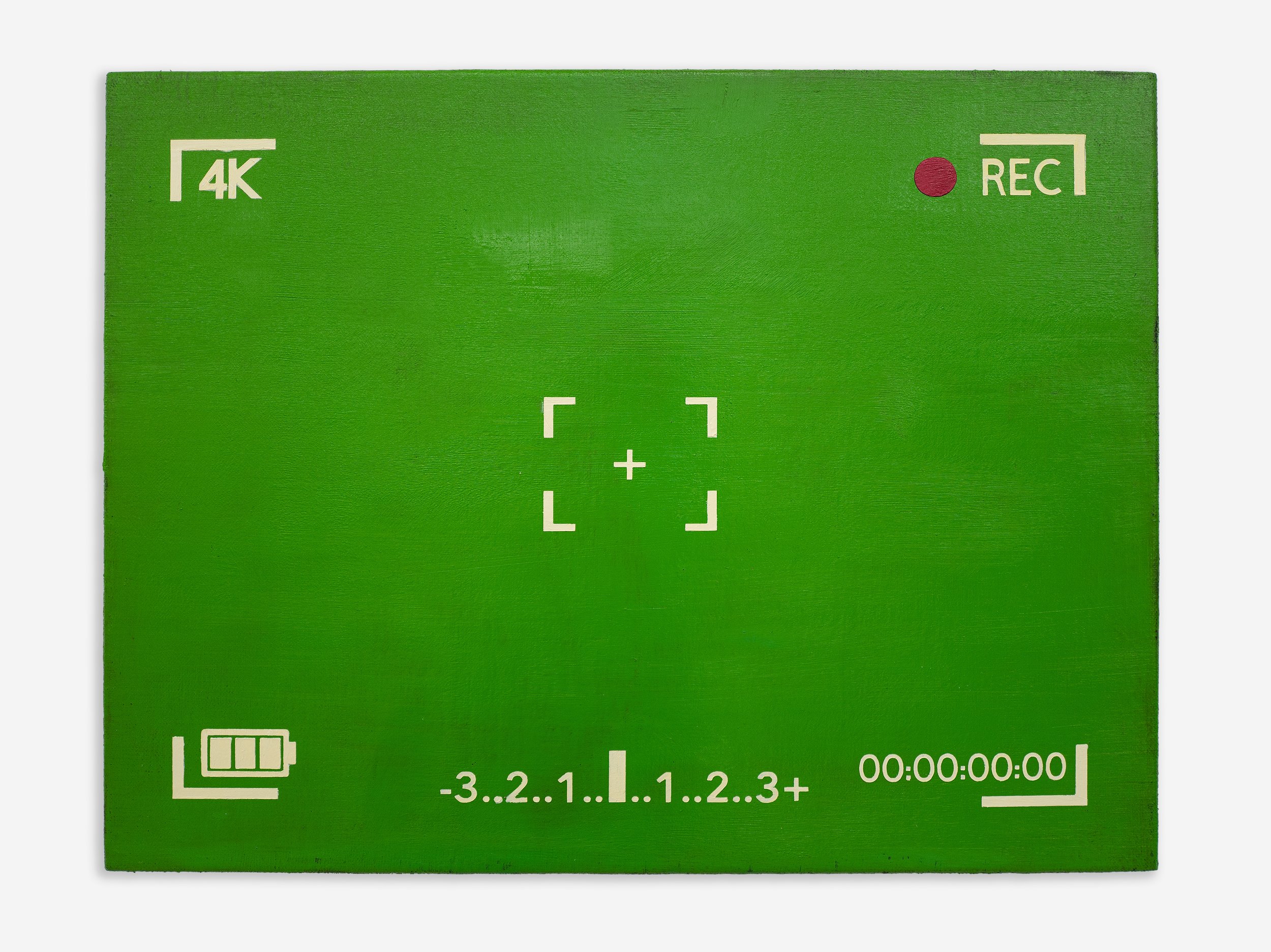
Oil on linen, 41 x 51 cm (16 x 20 inches). The dimensions place the work in the intimate range of Tan Mu's smaller paintings, the scale at which the viewer must lean in to register detail rather than step back to take in a panorama. At this scale, every brushstroke is a decision that remains legible on the surface. The green field is built from multiple layers applied over a dark base, each layer slightly translucent, so that the dark ground pulses beneath the green like a heartbeat visible under skin. Tan Mu has described the process: "I applied multiple layers of green oil paint over a dark base, allowing the surface to build up density and texture. Using horizontal brushstrokes, I swept across the canvas to create wave-like bands that mimic the refresh rate and scan lines of screen imagery." The scan-line effect is not a painted imitation of a digital artifact. It is a structural consequence of the method. The horizontal strokes produce bands that reference the way a cathode-ray tube draws an image one line at a time, and the slight variations in density and width between adjacent bands produce the illusion of a screen refreshing itself in real time. The painting does not depict a screen. It enacts one.
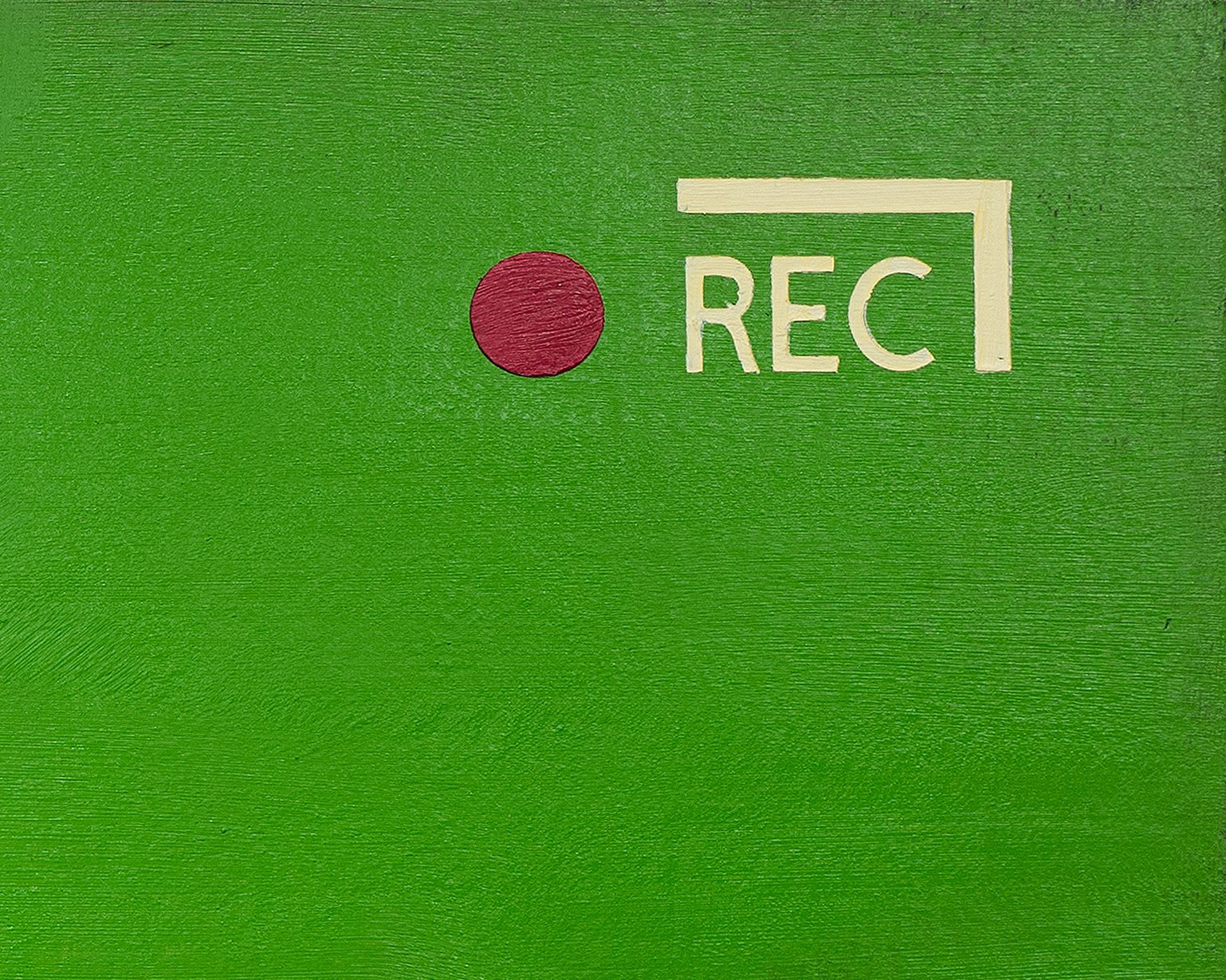
At the upper left of the composition, a small red dot marks the recording state. Below it, the letters "4K" appear in white, indicating the resolution standard. A thin white frame line runs along the edges, the boundary marker of the camera's viewfinder. These are the only elements that break the green field, and they do so with the flat, schematic clarity of a user interface: functional, legible, and indifferent to the painting they interrupt. The red dot is not decorative. On a camera, it indicates that recording is active, that the device is capturing whatever falls within its frame. Placed inside the painted image, the dot reverses the direction of observation. The viewer is no longer looking at a painting of a screen. The viewer is looking at a screen that is recording the viewer. The position of the dot, inside the frame rather than above it or outside it, transforms the painting from a representation of a camera interface into an instance of that interface, a moment where the technology of looking becomes the subject being looked at.
Tan Mu has articulated this reversal explicitly. "The red dot usually indicates that a camera is actively recording, which carries an implicit psychological weight. It suggests surveillance, documentation, and the awareness of being seen. In this painting, the meaning of the red dot depends on its position within the visual field. When it appears inside the frame, the viewer may feel as though they are being observed rather than simply observing." The shift from observing to being observed is not metaphorical. It is structural. A camera pointed at the world records the world. A camera whose screen is pointed at the viewer records the viewer. The painting places the viewer inside the apparatus, on the side of the recorded rather than the side of the recorder, and the green screen, which in production would be replaced by another image, remains stubbornly present, refusing to disappear, refusing to be substituted, insisting on its own materiality as a surface that was designed to vanish.
When Édouard Manet exhibited Olympia in 1865, the scandal was not the nudity. Academic nudes had been displayed in the Salon for decades without provoking outrage. What made Olympia intolerable was the gaze. The reclining nude in Manet's painting does not avert her eyes or dissolve into allegory. She looks directly at the viewer with the expression of someone who is evaluating, not performing. The art critic Jules Castagnary, writing that same year, observed that the woman in the painting "is not a woman asleep, she is a woman waiting," and the distinction is precise. A woman asleep is an object of contemplation. A woman waiting is a subject of judgment. Manet's composition reinforces the reversal: the black maid presenting flowers from an unseen client makes explicit that the viewer is not a neutral observer but a participant in a transaction, and Olympia's direct gaze confronts the viewer with the terms of that participation. The painting does not display a body for visual pleasure. It stages an encounter in which the viewer's looking is itself being observed, evaluated, and potentially refused.
The structural operation in 4K is the same operation transposed from the body to the screen. Where Olympia places a woman who looks back at the viewer, 4K places a recording indicator that looks back at the viewer. The red dot is the contemporary equivalent of Olympia's gaze: a marker that the apparatus of observation has been turned around, that the subject position has been inverted, and that the viewer is no longer the one who sees but the one who is seen. The green screen amplifies this reversal. In video production, the green screen is the surface that disappears, the background that is meant to be replaced by any image the editor chooses. It is the most compliant surface in the visual economy: it exists only to be overwritten. By painting it in oil on linen and refusing to replace it with another image, Tan Mu stops the erasure mid-process. The surface that was designed to vanish becomes the only thing the viewer can see. The result is a painting that is entirely surface, entirely the thing that is supposed to be absent, and this refusal to disappear is itself a form of looking back, a form of resistance to the logic of substitution that defines digital image production.
The chroma-key green screen, known in broadcasting as "Chroma Key Green" or informally as "green screen," was developed in the 1940s and standardized in the 1960s as a compositing technique for film and television. The principle is straightforward: film a subject against a uniformly colored background, then use electronic or digital processing to replace that background with any other image. The color green was chosen because it is the furthest from human skin tones on the spectrum, minimizing the risk of the compositing process accidentally removing parts of the performer's body along with the background. The green screen is therefore a technology designed around the human body. Its color was selected to protect the body from digital erasure, to ensure that the system can distinguish between the person and the surface behind them. Tan Mu's decision to paint this surface, the one that exists only to be removed, the one whose entire function is defined by its absence from the final image, is a decision to paint the infrastructure of visual production rather than its product. It is the equivalent of photographing the back of a movie set rather than the scene being filmed, or broadcasting the control room rather than the program.
The "4K" designation in the upper portion of the painting refers to a resolution standard of approximately 4,000 pixels across the horizontal axis, roughly four times the pixel density of standard high-definition video. 4K resolution produces an image so detailed that it exceeds the resolving capacity of the human eye at typical viewing distances. The technology was developed for cinema projection and has since become standard in consumer electronics, from televisions to smartphone cameras. The 4K label in Tan Mu's painting does not describe the painting's own resolution. Oil on linen at 41 x 51 centimeters contains no pixels. The label instead names the aspiration of the system that the painting depicts: a system that pursues ever-greater visual fidelity in order to produce images that are, paradoxically, more easily manipulated. The higher the resolution of the original capture, the more convincing the compositing. The green screen works better in 4K than it did in standard definition because the edges between subject and background are sharper, the color separation is cleaner, and the resulting composite is more difficult to distinguish from a real scene. The pursuit of visual fidelity and the pursuit of visual deception are not opposed. They are the same trajectory, and the painting makes this explicit by placing the "4K" label inside a composition that is entirely green screen, entirely the surface that is meant to be invisible, entirely the technology of erasure.

Thomas Ruff's Jpegs series, produced between 2002 and 2007, takes internet-sourced photographs of disasters, landscapes, and architectural landmarks and enlarges them to monumental dimensions, revealing the compression artifacts that the original files were designed to conceal. A forest fire in a 200-kilobyte JPEG becomes, at three meters wide, a mosaic of visible blocks and color shifts, the mathematical structure of the compression algorithm laid bare for the eye to trace. Ruff did not manipulate these images. He simply made them large enough for the artifact to become visible. The compression artifacts were already present in the original files. They had been designed to be imperceptible at the scale of a monitor or a phone screen, and they would have remained invisible if Ruff had left the images at their native resolution. By enlarging them, he did not add information. He revealed the structure that was already there, the architecture of compression that makes digital images portable and transmittable but at the cost of discarding data that the algorithm considers redundant. The Jpegs series demonstrates that every digital image carries within it the evidence of its own compression, and that this evidence, normally invisible, is the true content of the image, the thing that tells you how it was made, how it was stored, and how it was transmitted.
Tan Mu's 4K operates by a related logic. The scan-line brushwork, the chroma-key green, the recording indicator, and the 4K label are all artifacts of the image-production system. They are the things that the system is designed to hide or to make transparent: the refresh rate, the compositing surface, the recording state, the resolution standard. By painting them, Tan Mu makes visible the infrastructure that digital media normally renders invisible. Nick Koenigsknecht, writing in the BEK Forum catalog, identifies this as a characteristic operation of Tan Mu's practice: "While observing technology, are we not looking at ourselves? Therefore perhaps these works function more as self-portraits, rather than depictions of external, scientific milestones." The observation is precise. When the red dot turns the viewer into the recorded subject, the painting ceases to be a depiction of a camera interface and becomes a mirror in which the viewer sees their own position within the apparatus of looking. The green screen, the scan lines, the resolution label: these are not external objects that the painter has reproduced. They are the conditions of seeing that make the reproduction possible, and painting them makes those conditions visible in a way that the original technology cannot.
Tan Mu's description of the work's relationship to her practice on screens deepens this connection. "The process of creating this painting is closely related to my work Play, which also explores screen-based visual language," she notes. "I was particularly interested in recreating the scan-line effect associated with early television and video displays. To achieve this, I applied multiple layers of green oil paint over a dark base, allowing the surface to build up density and texture. Using horizontal brushstrokes, I swept across the canvas to create wave-like bands that mimic the refresh rate and scan lines of screen imagery. This method emphasizes the physicality of paint while referencing the immaterial nature of digital images." The horizontal stroke is the painting's structural unit, the equivalent of the scan line in the cathode-ray tube. Each stroke is a line drawn by a hand across a surface, and together the lines produce the illusion of a screen that is simultaneously present and vanishing, a surface that declares its materiality while representing a technology designed to erase materiality. The tension between these two conditions, the painted and the digital, the permanent and the erasable, the slow and the instantaneous, is not a paradox the painting resolves. It is the condition the painting inhabits.
The green of a chroma-key screen is not a color found in nature. It was selected for its chromatic distance from human skin, and its saturation is calibrated to the spectral sensitivity of video sensors, not to the preferences of painters. When Tan Mu mixes this green in oil paint, she is translating a color that was engineered for electronic sensors into a color that will be perceived by human eyes in gallery light. The translation is necessarily imperfect. The green in the painting is not the green that a camera would read as transparent. It is a green that a camera would read as a surface, as something present and opaque, exactly the opposite of what the chroma-key system intends. This imperfection is not a failure of the painting. It is its argument. The painting insists that the green screen is a surface, not an absence, and it does so by rendering it in a medium, oil paint on linen, that cannot be composited, cannot be keyed out, cannot be replaced by another image. The green in 4K is as permanent as the red dot. Neither will vanish. Both will remain on the canvas for as long as the linen holds, and their permanence is the painting's counter-proposal to the logic of digital erasure that the green screen represents.
Tan Mu has described the green screen as "not an image in itself, but a transitional surface that enables images to move between different visual systems." The description is exact, and it identifies the green screen as a medium rather than a content, a conduit rather than a destination. Painting a medium rather than a content is a decision that carries specific risks. A medium is by definition transparent, designed to disappear in favor of what it carries. Painting it means painting something that was never intended to be seen, and the act of making it visible forces the viewer to confront the infrastructure of image production rather than the image it was designed to deliver. The red recording dot reinforces this confrontation. It is the indicator that the apparatus is active, that capture is in progress, that whatever falls within the frame is being recorded. In a camera interface, the red dot appears above or beside the image, outside the recorded field. In the painting, it appears inside the field, on the surface that is being recorded, which means that the viewer, standing in front of the painting, is implicitly inside the frame, implicitly the subject of the recording, implicitly the one being watched. The painting makes the apparatus of observation visible by turning it around, and the viewer who stands before it is no longer the one who looks. They are the one who is looked at.
The "4K" label functions in the same register. It names a standard of visual fidelity that the painting itself does not possess and does not need. The painting is not 4K. It is oil on linen at a modest scale, and its resolution is determined by the fineness of the brush and the weave of the canvas, not by a pixel count. By including the label, Tan Mu signals that the painting is aware of the standard it is not meeting, and that this awareness is part of its content. The label is not a boast about image quality. It is a citation of a system of visual production that defines quality in terms of pixel density, and the painting's refusal to participate in that system, its insistence on being paint on linen rather than data on a screen, is itself a form of commentary. The scan lines are hand-painted. The green is mixed from pigments. The red dot is a mark made by a brush, not a pixel illuminated by a sensor. Every element of the digital interface that the painting depicts has been translated into a material that is slower, thicker, and more permanent than the technology it represents, and the translation is the painting's subject: not the screen, not the interface, but the act of translating the ephemeral apparatus of digital looking into the durable medium of paint.
The green screen was designed to vanish. The recording dot was designed to be small. The 4K label was designed to be informational. In the painting, none of them vanish, none of them are small, and none of them are merely informational. They have been lifted out of the interface that was supposed to contain them and placed on a surface that will not let them go. The painting is the thing that remains after the composite is finished, after the green screen has been replaced, after the recording has ended, after the 4K footage has been compressed and streamed and discarded. It is the infrastructure of looking, preserved in a medium that does not compress, does not stream, and does not discard. The red dot does not blink. The green screen does not disappear. The label does not update. Everything that the digital image was designed to make invisible, the painting makes permanent, and the permanence is the point: the screen that watches back does not look away.