The Wall That Breathes: Tan Mu's Epithelial Cells and the Boundary That Makes the Body a System
Julien Offray de La Mettrie published Man a Machine in 1748, and the scandal of the proposition has never fully subsided. La Mettrie argued that the human body is not a vessel for an immaterial soul but a complex mechanism whose behavior can be fully explained by the organization of its parts. He was not reducing the body to a clockwork. He was proposing that the body is a system whose properties emerge from the arrangement and interaction of its components, and that consciousness, feeling, and thought are among those emergent properties rather than something added from outside the mechanism. The argument was materialist, and it was dangerous: La Mettrie was exiled from Paris, then from Leiden, and died in Berlin under the protection of Frederick the Great, who found him entertaining. What makes La Mettrie's proposition relevant to a painting of epithelial cells is not the controversy of 1748 but the precision of the analogy. Epithelial cells are the body's interface. They line every surface that separates the interior of the organism from the exterior world: the skin, the gut, the respiratory tract, the blood vessels, the cornea. They are the boundary that makes the body a bounded system rather than an undifferentiated mass of tissue. Without them, there is no inside and no outside, no self and no environment, no organism and no world. They are the machine's casing, and they are alive.
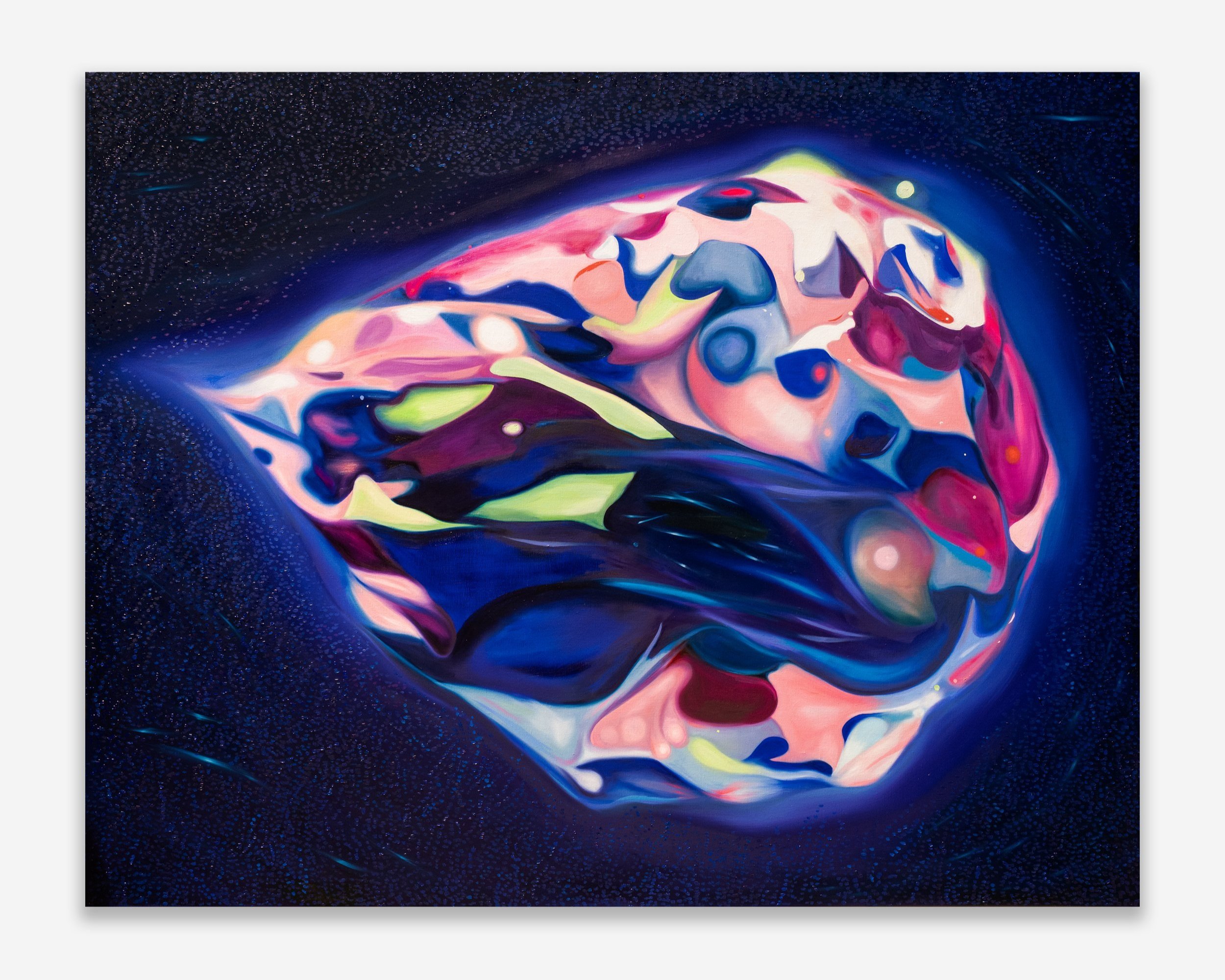
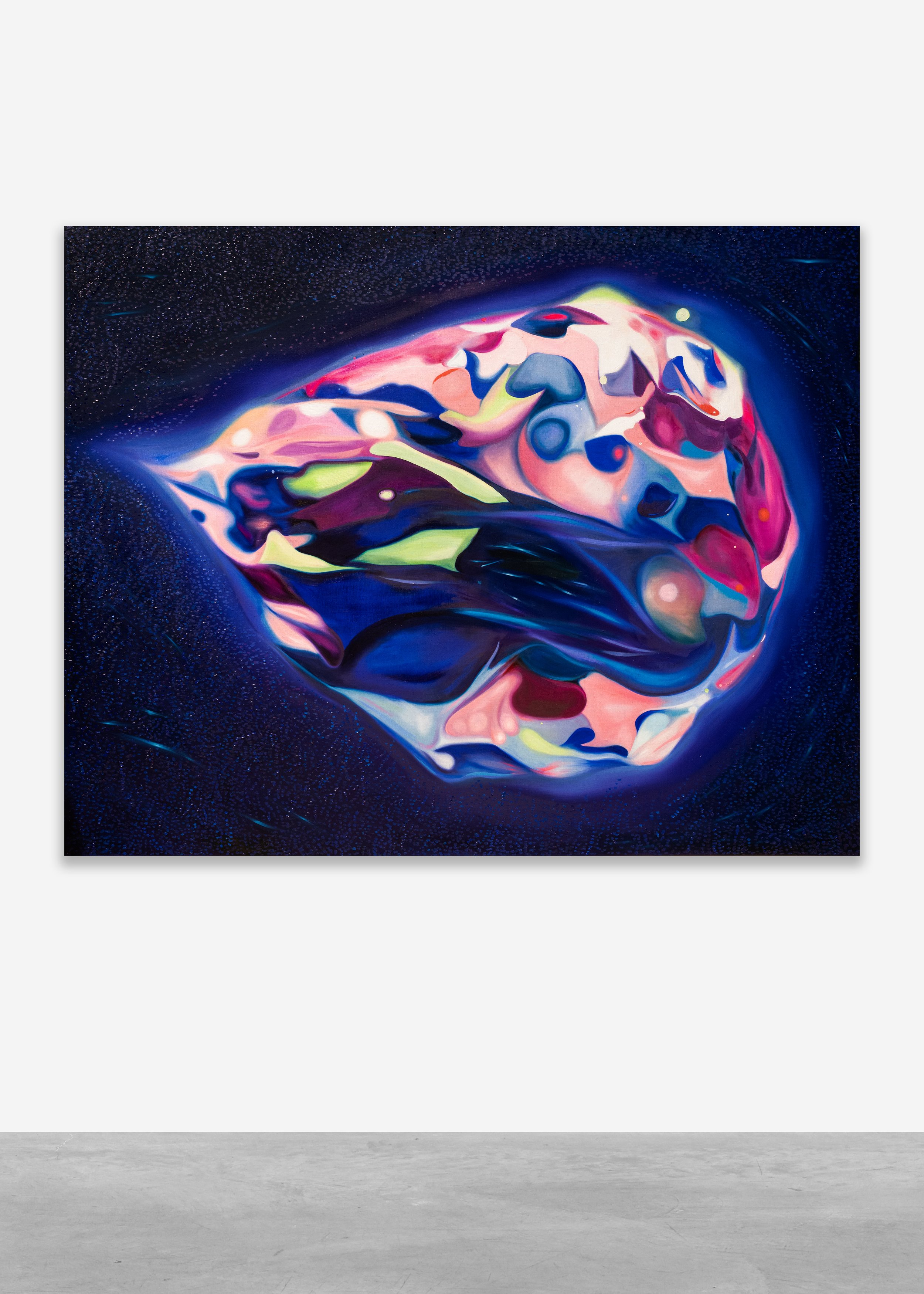
Oil on linen, 122 x 153 cm (48 x 60 in). The format is large, the scale of a history painting or an altarpiece, and the dimensions register immediately as a decision about seriousness. Tan Mu has chosen to paint cells that are typically visible only through a microscope at a size that would accommodate a full-length portrait, and the enlargement is not decorative. It is an argument about what deserves to be seen at this scale. The linen support is prepared with a dark ground, and against this darkness the cell clusters ignite like stained glass in a cathedral window. Each cluster is a single color, a saturated ruby, emerald, sapphire, amber, amethyst, and the colors do not blend where adjacent clusters meet. They abut, they press against each other, they compete for territory on the surface with the territorial insistence of actual cells dividing in a dish. The color is applied in thick, decisive passages of oil paint, built up in layers that produce a slight impasto at the center of each cluster and thin to transparency at the edges, where the dark ground shows through like the membrane of a cell seen under phase-contrast microscopy.
The background is not empty. It is populated with dots, Tan Mu's signature motif, scattered across the dark field in varying densities and sizes. Some are precise, the size of a pinprick. Others are larger, more diffuse, like cells caught in an earlier stage of staining. Tan Mu has described these dots as functioning simultaneously as "biological particles, data points, or even celestial bodies," and the deliberate ambiguity is structural. The dots connect this painting to her broader practice: to the submarine cables and satellite images and quantum computers that appear in other works, all of which share the same logic of small units composing large systems. In Epithelial Cells, the dots also serve a specific compositional function. They fill the negative space between the color clusters with activity, preventing the dark ground from reading as void or absence. The space between cells in a tissue culture is not empty. It is filled with medium, nutrients, signaling molecules, the chemical substrate that makes cell division possible. Tan Mu's dots represent this substrate visually, filling the intercellular space with information, and their presence insists that the space between structures is itself structured.
Ernst Haeckel published the first volume of Kunstformen der Natur, Art Forms in Nature, in 1899, and the work's influence on twentieth-century art and design has been documented in exhaustive detail. Haeckel was a zoologist, a Darwinist, and a prodigious draftsman. His lithographic plates depict radiolarians, medusae, diatoms, and other microscopic organisms with a precision that exceeds the requirements of scientific documentation and enters the territory of aesthetic elaboration. The symmetry of a radiolarian skeleton, the radial geometry of a jellyfish bell, the fractal repetition of a diatom's pore pattern: Haeckel drew these forms with the care of a jeweler setting stones, and the resulting images oscillate between illustration and invention in a way that has never been fully resolved. Critics have accused Haeckel of embellishment, of making nature more symmetrical than it actually is, of preferring the regular and the beautiful to the irregular and the real. The accusation misunderstands the project. Haeckel was not falsifying nature. He was making visible the structural logic that the organism embodies, the logic that makes a radiolarian skeleton a sphere rather than a blob and a jellyfish bell a circle rather than a smear. His drawings are not photographs. They are translations of three-dimensional structures into two-dimensional patterns, and the translation necessarily emphasizes the regular over the irregular because the regular is the information that the structure carries.
Tan Mu's Epithelial Cells operates in the same territory between documentation and elaboration, and the comparison sharpens the specific terms of her intervention. Haeckel drew individual organisms: a single radiolarian, a single medusa, a single diatom, centered on the page and isolated from its environment. Tan Mu paints populations: clusters of cells that have divided from a common ancestor, spreading across the surface in a competitive landscape that has no center and no frame. Where Haeckel's plates present nature as a cabinet of singular specimens, each one a perfect example of its type, Tan Mu's canvas presents nature as a process of multiplication, differentiation, and territorial expansion. The color clusters are not types. They are lineages, families of cells that share a common origin and have diverged in their behavior, some expanding rapidly, others stabilizing, others beginning to slow. The painting does not classify. It narrates, and the narrative is one of growth, competition, and the constant negotiation of boundaries that defines biological life at every scale.
The scientific technique that makes this painting possible is clonal labeling, a method developed in developmental biology that allows researchers to tag individual cells with heritable fluorescent markers. When a labeled cell divides, its daughters inherit the same marker, producing a visible patch of identically colored tissue that grows over time. The size of the patch reveals how many times the original cell has divided. The shape reveals whether the daughter cells remain tightly clustered or migrate away from each other. The distribution of patches across the tissue reveals which cells are stem cells, capable of indefinite division, and which are differentiated, dividing only a limited number of times before exhausting their proliferative potential. The technique was developed to study cancer, among other conditions, because cancer is fundamentally a disease of clonal expansion: a single cell that acquires a mutation conferring unlimited proliferative capacity and produces a population that grows without regulation, outcompeting its neighbors for space and resources.
Tan Mu has addressed this dimension of the work directly. "As genetic decoding and editing technologies advance, we are forced to confront difficult issues. How far should human intervention go. Who has access to these technologies. Could their misuse deepen global inequalities or redefine concepts of life itself." The questions are not rhetorical. They are the questions that clonal labeling was designed to answer in the laboratory, and they are the questions that the painting asks in the gallery. The color clusters on the canvas are beautiful. They are also a map of power. Each cluster that expands at the expense of its neighbors represents a lineage that has gained a proliferative advantage, and the advantage may be benign, a stem cell doing its job of tissue renewal, or it may be malignant, a cancer cell dividing without limit. The painting does not distinguish between these possibilities. It presents the clonal landscape as it appears under the microscope, and the viewer is left to determine whether what they are seeing is health or disease, growth or invasion, the body maintaining itself or the body being consumed from within.
Helen Chadwick's Piss Flowers (1991-92) cast urine in bronze and presented the results as sculptural objects on a gallery plinth. The work was not a provocation. It was a systematic investigation of the boundary between the body's interior and the world outside it. Urine is a substance produced inside the body, processed through the kidneys, stored in the bladder, and expelled through the urethra, and at the moment of expulsion it crosses the epithelial boundary that separates the organism from its environment. Chadwick took this substance at the moment of its transition, while it was still warm, while it was still shaped by the force of its expulsion, and she froze it in a material, bronze, that would preserve its form permanently. The resulting sculptures are biomorphic, vaguely floral, and deeply ambiguous. They look like they grew. They also look like they were cast. The ambiguity is the work's content: the body produces forms that are simultaneously organic and systematic, and the system of production, the kidney, the ureter, the bladder, the sphincter, is itself epithelial, lined with the same kind of cells that Tan Mu has painted on this canvas.
Chadwick's work insists that the body's interior is not private. It is productive. It generates forms and substances that enter the world and take on lives of their own, and the boundary that separates inside from outside is not a wall but a membrane, a selectively permeable surface that allows some things to pass and others to remain. This is precisely what epithelial cells do. They form tightly packed layers that regulate exchange between the organism and its environment, permitting the absorption of nutrients, the expulsion of waste, and the reception of sensory information while preventing the entry of pathogens and the loss of fluid. Tan Mu's description of their function echoes this logic with striking precision. "These cells exist at boundaries, constantly negotiating exchange and protection." The word "negotiating" is the key. A wall does not negotiate. A membrane does. A wall either blocks or permits. A membrane selects, and selection is a form of judgment. Yiren Shen, writing in the 2025 essay "Painting the Invisible," identifies this as a defining characteristic of Tan Mu's practice: the capacity to render visible the "material substrates of contemporary life" by treating them not as inert objects but as active participants in the systems they constitute. In Epithelial Cells, the substrate is the cell layer itself, the biological boundary that makes the body a system, and the painting treats it not as a passive barrier but as a negotiating surface that is constantly deciding what to let in and what to keep out.
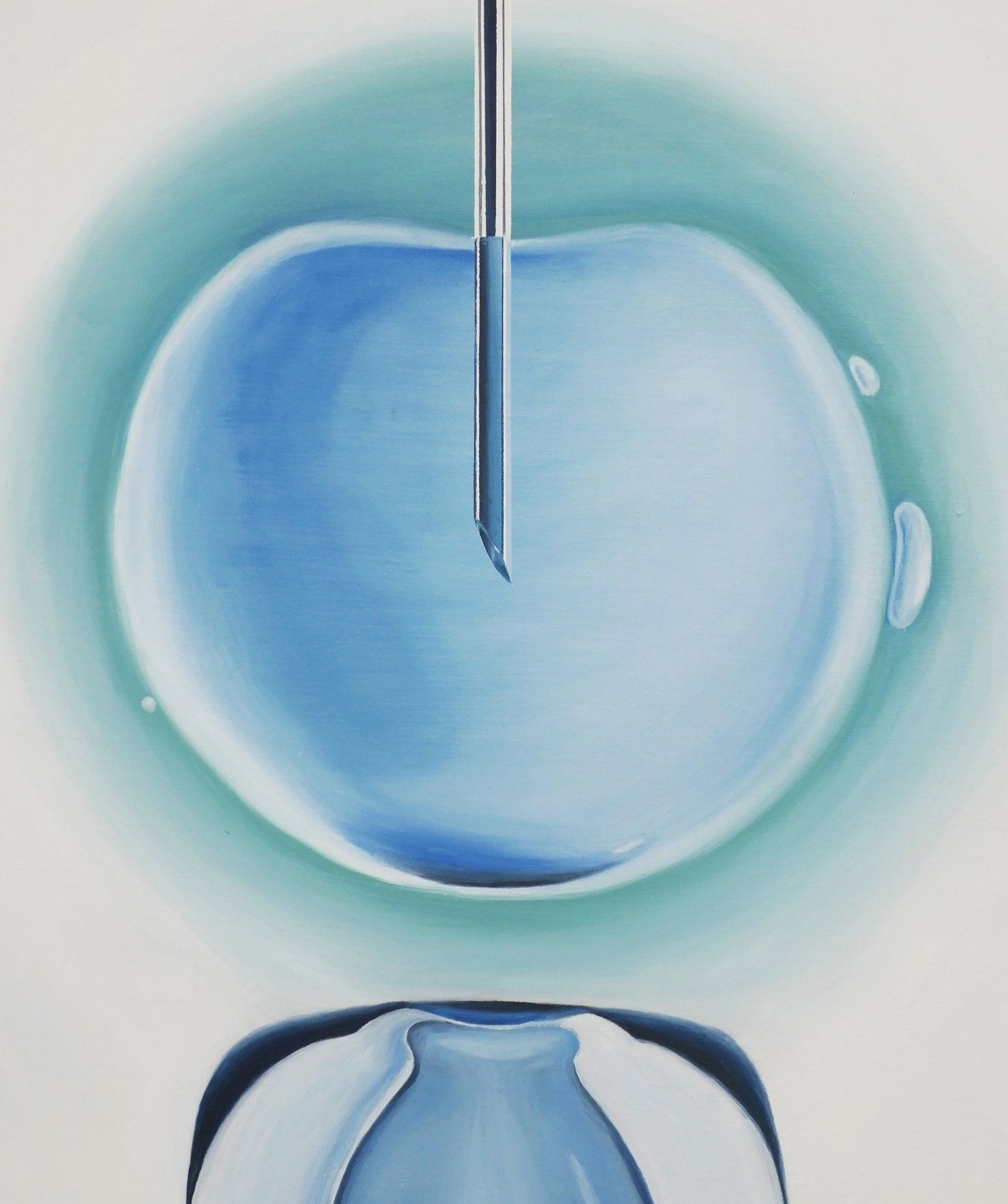
Tan Mu connects epithelial cells to her broader practice explicitly. "Whether I depict neurons, epithelial tissues, embryonic cells, or technological components, I am consistently drawn to the fundamental units that make up larger systems. These biological elements function much like the technological components I paint elsewhere, reinforcing my ongoing exploration of the parallel structures of biology and technology." The parallel is structural, not metaphorical. A neuron is a fundamental unit of the nervous system the way a transistor is a fundamental unit of a computer. An epithelial cell is a fundamental unit of the body's boundary the way a firewall is a fundamental unit of a network's boundary. Both regulate traffic. Both enforce selectivity. Both maintain the integrity of the system they enclose by controlling what passes through. The painting does not illustrate this parallel. It enacts it, by presenting the epithelial boundary at a scale that makes its structural logic legible, and the logic is the same logic that governs every interface between a system and its environment: filter, admit, exclude, maintain.
The connection to La Mettrie is not incidental. Tan Mu cites him directly. "This quality strongly connects to Julien Offray de La Mettrie's idea in Man a Machine, in which the human body is understood as a complex and highly organized system." La Mettrie's proposition was scandalous in 1748 because it denied the soul a separate substance from the body. It is less scandalous now, not because the soul has been proven absent but because the body has been shown to be far more complex and organized than La Mettrie could have imagined. The epithelial boundary is a system of systems. The cells that compose it are themselves composed of organelles, membranes, proteins, and signaling molecules, each of which operates according to chemical and physical principles that are increasingly well understood. The boundary between self and environment is not a philosophical abstraction. It is a material structure, and the material structure is made of cells, and the cells are made of molecules, and the molecules obey the same laws that govern every other physical system. La Mettrie was right that the body is a machine. He was wrong about how complex a machine can be.
The staining technique that produces the vivid colors in the painting is itself a hybrid of science and art, and Tan Mu addresses this convergence with precision. "I find it fascinating that scientific staining processes closely parallel the logic of painting. In my own work, variations within a single color emerge through pigment mixtures that share the same origin but differ in proportion. This connection between scientific visualization and painterly method reinforces the idea that both disciplines rely on precision, interpretation, and creativity." The observation is not decorative. It identifies a structural homology between the laboratory and the studio. A fluorescent stain marks a cell by binding to a specific molecular target, and the color that results encodes information about that target's presence, concentration, and distribution. A pigment mixture produces a color by combining specific proportions of raw materials, and the resulting hue encodes information about those proportions. In both cases, the color is not an addition to the subject. It is a reading of the subject, a translation of invisible structure into visible form. The epithelial cells in the painting are not colored the way they appear in the body. They are colored the way they appear after staining, which means the color is not their natural state but a diagnostic intervention, a way of making lineage visible by assigning it a hue. The painting preserves this diagnostic function. Each color cluster is not just beautiful. It is a record of a specific cell's decision to divide, and the cumulative pattern of clusters is a record of all the decisions that every cell in the dish has made since the first label was applied.
The scale of the painting, 122 x 153 cm, is not incidental to its argument. At this size, the cell clusters are large enough to be read as individual compositional elements, each one a shape with a history, a territory with a border, a population with a founder. The viewer can trace the expansion of a single lineage from a small cluster of cells at the edge of the canvas to a large field of identical color that has overtaken its neighbors. The viewer can see where two lineages meet and form a boundary, a line of contact that is straight where neither side has gained an advantage and irregular where one side has pushed into the other's territory. These boundaries are the painting's most charged passages. They are the edges where the body's negotiation with itself becomes visible, where the maintenance of the system depends on the balance between competing populations, and where the tipping point between health and disease, between regulated growth and uncontrolled expansion, is located. The painting does not show this tipping point. It shows the condition that contains it, the condition of constant competition and constant selection that is the reality of every living tissue, and it does so at a scale that makes the competition legible as a visual event rather than an abstract concept.
The dot-field background connects Epithelial Cells to the full range of Tan Mu's practice, from the submarine cable paintings to the satellite imagery to the quantum computer portraits, and the connection is not thematic but structural. In every case, the painting presents a system at a scale that makes its operating logic visible. The submarine cables are data channels. The satellite pixels are information units. The epithelial cells are lineage markers. The dots in the background are all of these and none of them: they are the generic unit of information, the smallest visible mark that can carry meaning, and their presence in this painting insists that the distinction between biological information and technological information, between a cell lineage and a data stream, between a membrane and a firewall, is a distinction of content, not of form. The form is the same. A boundary that regulates exchange is a boundary that regulates exchange, whether it is made of phospholipid bilayer or packet-filtering software, and the painting places both on the same surface, at the same scale, with the same intensity of color and the same insistence that what you are seeing is not a metaphor but a structure.
La Mettrie wrote that the body is a machine, and the machine's most essential component is the boundary that separates it from the world it processes. Without that boundary, there is no machine. There is only undifferentiated material. Epithelial Cells paints that boundary at the moment when it is most active, most alive, most engaged in the work of deciding what the self is and what the self excludes. The colors on the canvas are the colors of clonal lineages competing for space in a dish, and each lineage is a record of a cell's decision to divide, and each division is a small assertion that the body will continue, that the boundary will hold, that the wall between self and world will remain a membrane and not dissolve into the undifferentiated mass that precedes every organism and succeeds every death. The painting holds this condition open for inspection. It does not resolve the tension between growth and invasion, between the cell that maintains the tissue and the cell that consumes it. It presents both as the same process viewed from different angles, and the angle is the viewer's to choose. The boundary that breathes is the boundary that can also break, and the color that marks a healthy lineage is the same color that marks a malignant one. The painting knows this. It does not warn. It shows.