The Form That Circulates: Tan Mu's Torus and the Shape That Organizes Energy
A diver floating at neutral buoyancy sees the ocean surface from below. The light enters from above, fractured by waves into shifting columns that move across the visual field like searchlights. Below, the darkness is total. Above, the surface membrane divides two atmospheres, two densities, two conditions of light. And between them, suspended in the water column, the diver occupies a position that belongs to neither realm, a position that is neither inside nor outside but in continuous circulation between states of pressure, temperature, and luminance. Tan Mu has described this experience as formative. "When you are underwater and look upward, the surface of the ocean reflects light in a way that resembles the night sky. In that moment, sea and sky collapse into a single plane." The observation is not metaphorical. It is perceptual. It describes a condition in which the distinction between two visual fields dissolves, and what remains is a single surface of flickering points, a membrane of light that is neither ocean nor atmosphere but something that circulates between them.
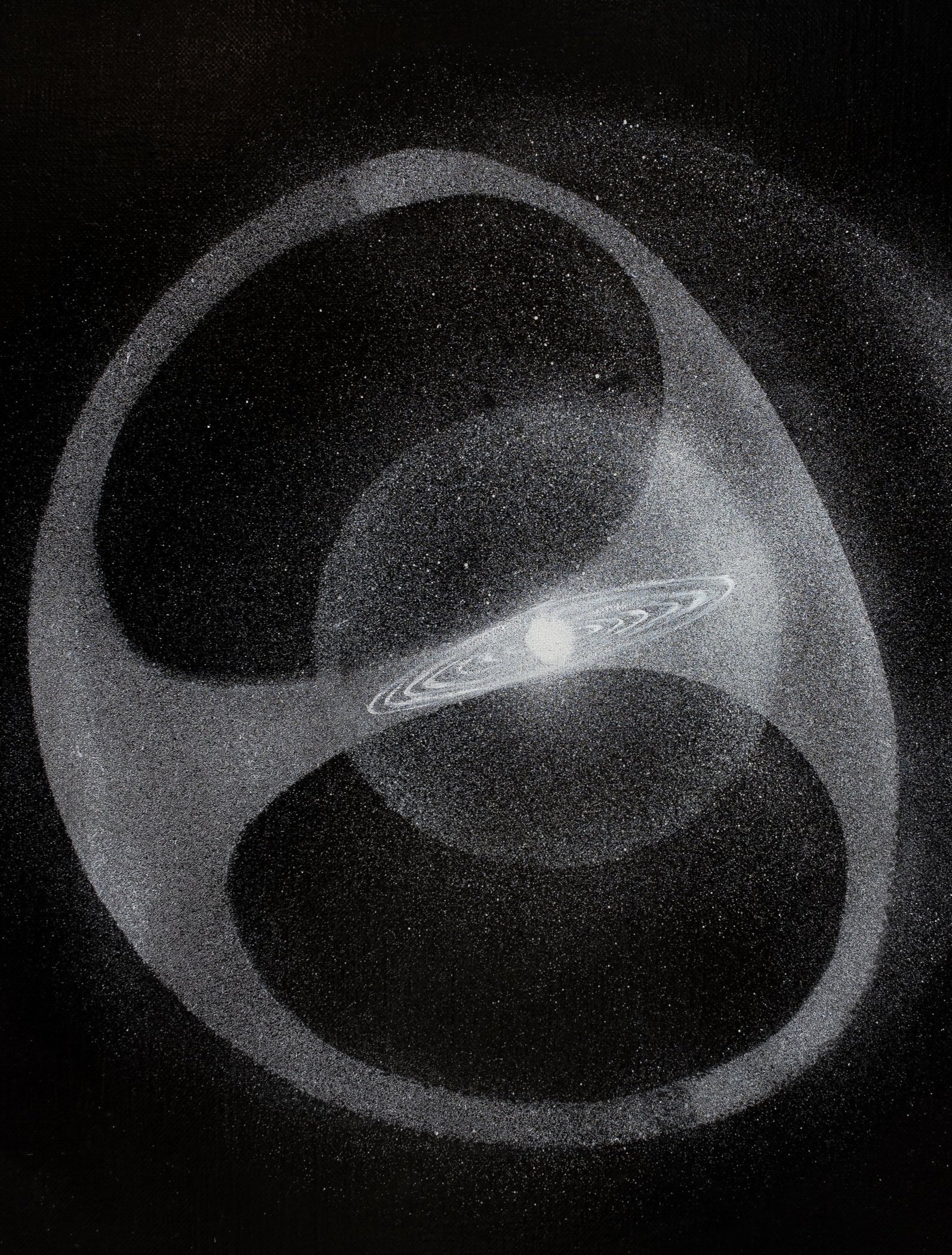
Oil on linen, 61 x 46 cm (24 x 18 in). The format is vertical, the proportions of a standing figure or a manuscript page, and the torus occupies the center of the composition like a form suspended in a dark liquid. The painting is executed entirely in black and white, a deliberate restriction that Tan Mu has described as a way to keep the form central. "I deliberately chose a black and white painting language rather than using technical rendering, data visualization, or pseudo color systems often seen in scientific imaging. Black and white allows the form to remain central. It removes distraction and directs attention to structure, rhythm, and movement." The black ground is deep and matte, absorbing light rather than reflecting it, and the white lines that define the torus emerge from this darkness with the precision of a mathematical rendering and the vibrancy of a bioluminescent organism seen through deep water. The torus itself is drawn as a wireframe, a continuous surface of intersecting curves that describe the form's volume without filling it. The lines are thin, precise, and evenly spaced, and they produce the illusion of rotation even though the image is static. The eye follows the curves around the form's central void, around the outer rim, back through the interior, and the motion is not inferred. It is produced by the geometry itself. A torus, by definition, is a surface of revolution. Every point on it traces a circle around the central axis, and the painting's wireframe lines follow these circles with such regularity that the form appears to be turning on its axis, generating its own energy from the logic of its own structure.
The surface of the torus is covered with points. Hundreds of them, perhaps more, distributed across every wireframe line and every intersection, each one a small mark of white paint that sits on the surface like a star on a celestial map or a phosphorescent organism in a dark ocean. Tan Mu has described these points as existing "at the intersection of aesthetics and meaning," and the description is exact. Aesthetically, they generate a vibrating surface that enhances the sense of rotation and transparency. Conceptually, they represent connectivity, information, and energy in motion. The points are not uniform. Some are larger, denser, more insistently present. Others are smaller, more diffuse, as if they were receding from the viewer into the depth of the form. This variation in size and density creates the impression that the torus is not a fixed object but a field of particles in continuous circulation, each one following the curved trajectory of the surface, each one carrying a small charge of visual energy that contributes to the overall vibration of the form. The painting does not depict a torus. It enacts the behavior of a torus: circulation, continuity, the return of energy to its point of origin.
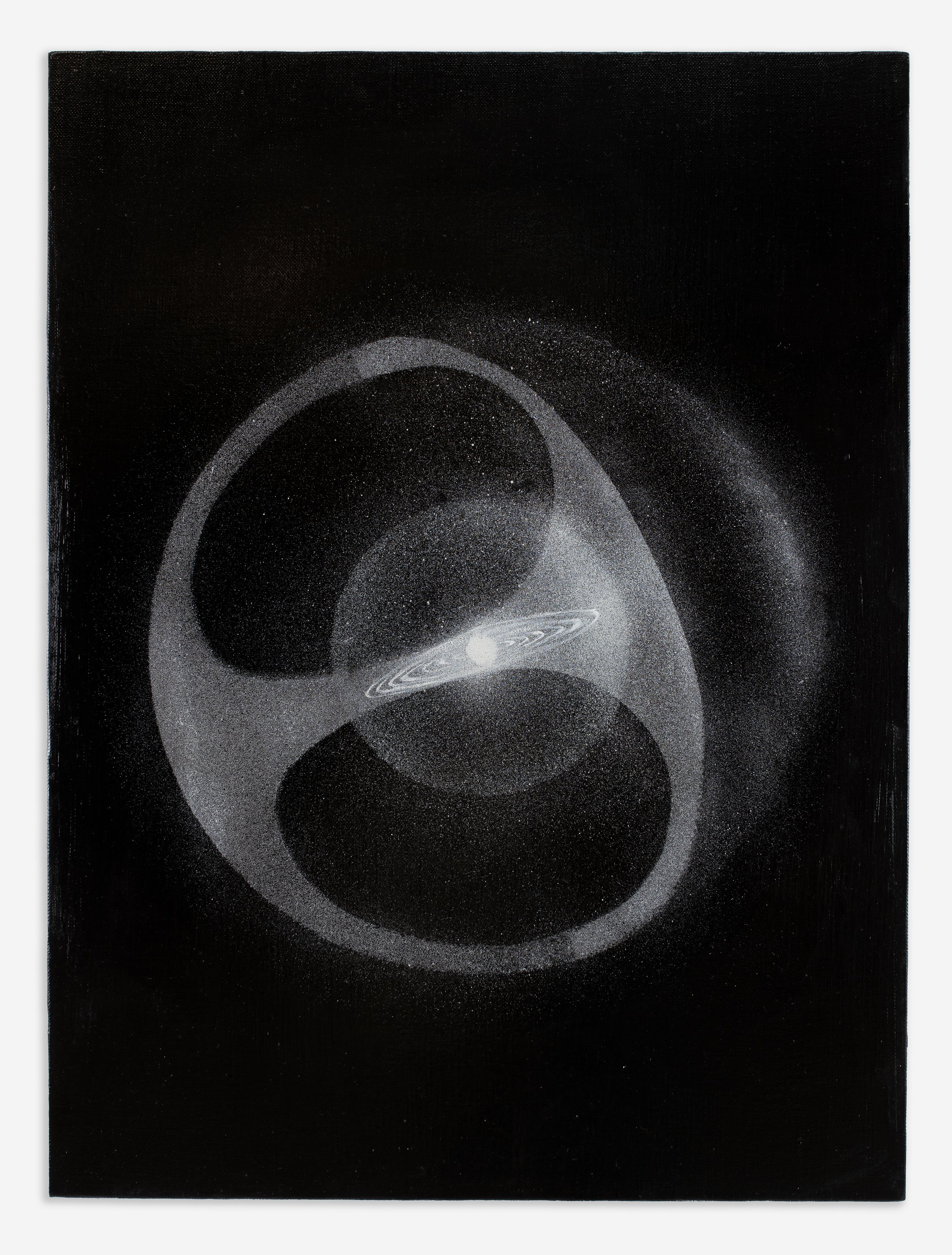
Agnes Martin's Night Sea (1963) is a painting of almost incomprehensible restraint. The canvas, sixty by sixty inches, is covered with a grid of horizontal lines so fine that they can barely be distinguished from the weave of the canvas itself. The paint is applied in thin washes of gold and dark blue, and the overall effect is of a field that shimmers at the threshold of visibility, a surface that seems to be generating its own light from within the interaction of grid, ground, and atmosphere. Martin described her work as a response to what she called "the abstract insights of the mind," a phrase that locates the paintings not in the tradition of optical art but in the tradition of contemplative practice. The grid is not a structure imposed on the canvas. It is a structure that emerges from the act of sustained attention, the way a pattern of stars emerges from the night sky when the eyes have adjusted to the dark. Martin's grids do not represent anything. They are not maps or diagrams or data visualizations. They are fields of accumulated marks that produce, through their repetition, a condition of visual stillness so complete that the eye begins to generate its own perceptual events: flickers, shimmer, the appearance and disappearance of secondary patterns that do not exist on the canvas but emerge from the viewer's visual system responding to regularity at the limit of resolution.
The comparison with Tan Mu's Torus is not a comparison of surface. Martin's grid is flat, rectilinear, and still. Tan Mu's torus is curved, volumetric, and in apparent motion. The comparison is a comparison of method. Both painters have chosen a restricted visual language, Martin her horizontal lines, Tan Mu her monochrome wireframe and point-field, and both have used that restriction to direct attention away from the decorative and toward the structural. Martin's grid produces stillness through repetition. Tan Mu's points produce vibration through accumulation. The points in Torus function the way Martin's lines function in Night Sea: they are the minimal unit of information, the smallest mark that can carry meaning, and their accumulation produces an effect that no single point could produce alone. The vibrating surface that Tan Mu describes is not an illustration of energy. It is the visual evidence of accumulation, the same evidence that Martin's grid provides for stillness. Both painters understand that repetition at sufficient density transforms the character of a surface, and both have chosen their restricted palettes precisely to make this transformation visible.
The torus is a surface of revolution generated by rotating a circle around an axis that lies in the same plane as the circle but does not intersect it. The result is a shape with a hole, like an inner tube or a doughnut, and the hole is not incidental. It is the defining feature of the form. Without the hole, the torus would be a sphere, a closed surface with no interior passage, no circulation, no way for energy to flow through the center and return to the outside. The hole makes the torus a topologically distinct object from the sphere, and the distinction is the reason the form appears in so many physical systems: magnetic fields around a current-carrying wire, smoke rings, blood flow through the heart's chambers, the vortex produced by a tornado, the magnetic containment field of a tokamak fusion reactor. In each case, the torus is not the shape of the object but the shape of the energy that flows through it, the shape of the path that a particle or a field follows when it is constrained by circulation. Tan Mu has described the torus as "a structural archetype of the universe," and the description is precise not because the torus is the shape of the universe but because the torus is the shape that the universe uses when it needs to organize energy into a circuit.
The artist's own language confirms this reading. "What draws me to the torus is its embodiment of circulation, continuity, and energy flow. Similar patterns can be found in chemical reactions, embryonic development, bacterial growth, atmospheric systems, and cloud formations." The list is not random. Each example is a system in which energy circulates through a toroidal path. In chemical reactions, the Belousov-Zhabotinsky oscillation produces spiraling waves that form toroidal structures in solution. In embryonic development, the primitive streak that defines the body axis of the vertebrate embryo forms along a path that folds the blastula into a toroidal topology. In bacterial growth, the vortex formed by swimming bacteria in a drop of water traces a toroidal flow field. In atmospheric systems, the Hadley cells that drive tropical weather are toroidal circulation patterns. The torus is not one shape among many. It is the shape that energy takes when it circulates, and the painting makes this principle visible by presenting the form stripped of all context, all color, all distraction, leaving nothing but the geometry and the points that trace its movement.
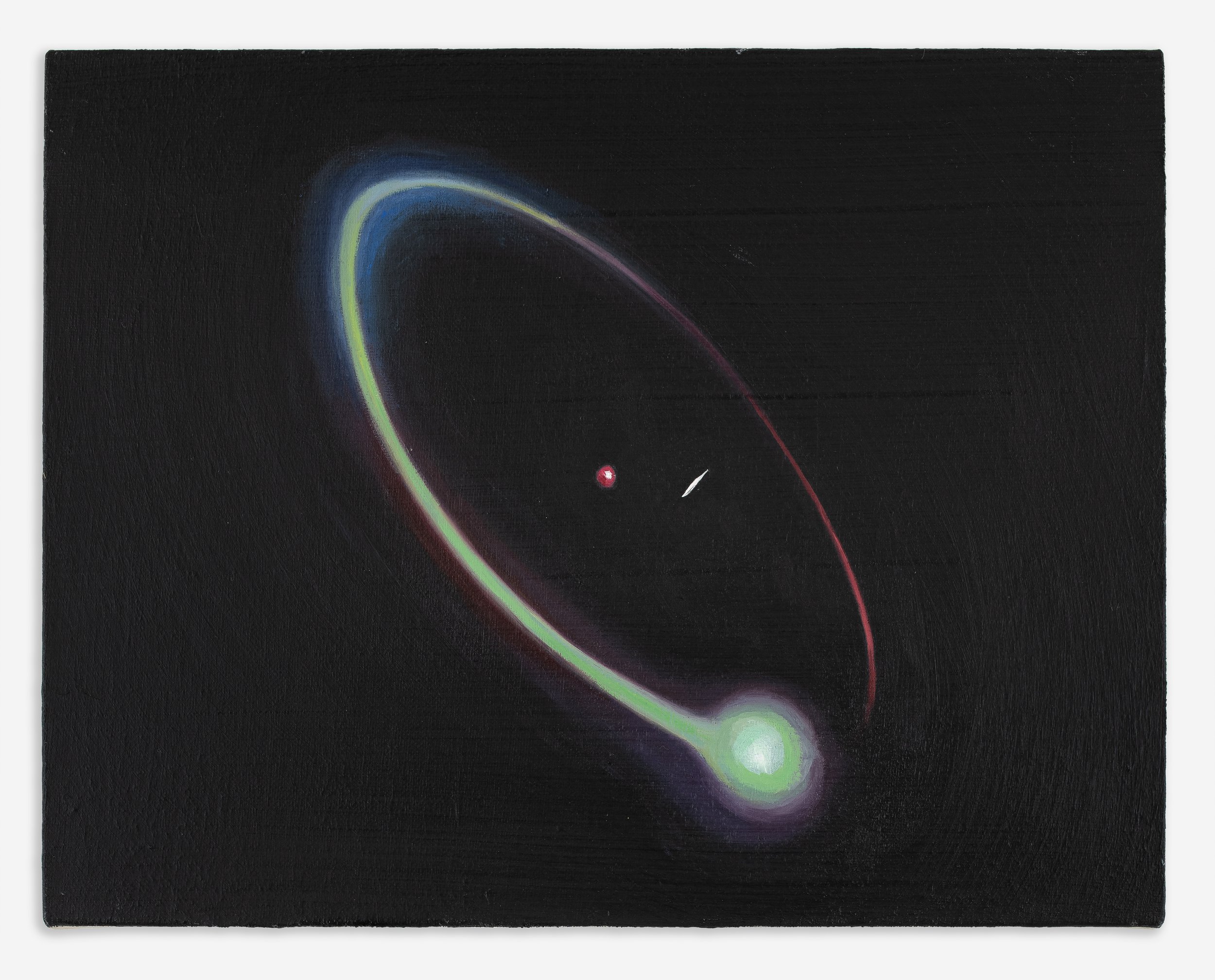
Bridget Riley's Blaze (1962) is a composition of concentric zigzag lines that spiral from the center of the canvas to its edges, producing an optical effect of intense rotation and vibration. The lines are black and white, painted in acrylic on a modest board, and the painting operates at the intersection of perceptual psychology and abstract composition. When viewed from a fixed position, the concentric zigzags produce the illusion that the center of the painting is rotating, that the surface is advancing and receding in waves, and that the black-and-white pattern is generating color afterimages in the complementary range, specifically in the greens and purples that the eye produces when it is fatigued by high-contrast flicker. Riley described these effects as "perception in motion," a phrase that locates the experience not in the painting but in the viewer's visual system, which is actively constructing the illusion of movement from a static image. The painting does not move. The eye moves, and the eye's movement produces the sensation of rotation.
The structural parallel with Torus operates on the level of method rather than effect. Riley used black-and-white restriction to make the eye's contribution visible. Remove the color, and the eye generates color. Remove the stable geometry, and the eye generates movement. The restriction is the instrument that reveals the viewer's perceptual activity. Tan Mu uses the same restriction for a different purpose. The black-and-white palette in Torus removes the distraction of color in order to direct attention to "structure, rhythm, and movement," but it also produces a secondary effect that Riley would recognize: the point-field on the torus surface vibrates against the black ground in a way that activates the same flicker-sensitive channels in the visual system. The points, densely accumulated along the wireframe lines, produce a shimmer at the boundary between the form and the background, and this shimmer is not decorative. It is the visual signature of energy in motion, the perceptual equivalent of the circulation that the torus represents mathematically. Li Yizhuo, writing in the BEK Forum catalog, identifies Tan Mu's methodology as grounded in the principle of ge wu zhi zhi, "investigating things to extend knowledge," and observes that her works "examine and discern objects of various scales and conditions." In Torus, the object under investigation is not a physical thing but a mathematical form, and the condition being examined is the condition of energy that has been organized into a circuit. The painting investigates this condition by enacting it: the points circulate along the wireframe, the form appears to rotate, the surface vibrates, and the viewer's visual system completes the circuit by generating the illusion of movement from a static image.
The dense accumulation of points across the surface of the torus is the painting's most distinctive formal feature, and Tan Mu has addressed it directly. "Points have long been an essential visual language in my work. They exist at the intersection of aesthetics and meaning. In Torus (2021), the accumulation of points evokes associations with stars, particles, or bioluminescent organisms in deep water. Visually, they generate a vibrating surface that enhances the sense of rotation and transparency. Conceptually, they represent connectivity, information, and energy in motion." The three associations, stars, particles, bioluminescence, are not decorative metaphors. They are three manifestations of the same principle: the emergence of complex order from simple repetition. Stars appear in the night sky as points of light, but each point is a thermonuclear reaction generating energy through circulation, hydrogen fusing into helium, helium fusing into carbon, the same toroidal circulation of energy that the painting depicts at a macroscopic scale. Particles in a detector appear as points on a screen, but each point is evidence of a collision event, an exchange of energy and momentum that follows paths constrained by magnetic fields, fields that are themselves toroidal. Bioluminescent organisms in deep water appear as points of light against a dark field, but each point is a chemical reaction, a circulation of reactants through a protein complex, a toroidal flow at the molecular level. The points in the painting are not illustrations of these phenomena. They are their visual signature, the mark that each system leaves on a surface when it is rendered at a resolution that reduces circulation to a dot.
Tan Mu connects the torus explicitly to her broader practice. "For me, mathematics is never purely abstract. It carries an intrinsic aesthetic logic that mirrors natural order. As digital systems increasingly fragment our sensory experience, returning to these foundational mathematical forms becomes a way to restore balance and continuity. The torus represents a nature-based structure that offers both meditation and reflection on how life organizes itself." The word "organizes" is the operative verb. A torus does not generate energy. It organizes energy that already exists into a pattern of circulation. The energy comes from somewhere else: from the current that drives the magnetic field, from the heat that drives the tornado, from the contraction that drives the blood through the heart. The torus is the shape that this energy takes when it is constrained to circulate, and the painting presents that shape as a fundamental organizing principle, not of any particular system, but of circulation itself. The form is general. The application is specific. Every torus in nature is the same shape applied to a different material, and the painting's refusal to specify the material, its reduction to black and white, its elimination of color and texture and context, is precisely what allows it to function as a statement about the shape rather than any particular instance of it.
The reference to Fractal (2019) and Atom (2020) positions Torus within a sequence of mathematical forms that Tan Mu has investigated, and the sequence itself is significant. The fractal is a form of self-similarity across scales. The atom is a form of orbital enclosure. The torus is a form of circulation. Each form is more dynamic than the one before it. The fractal repeats. The atom orbits. The torus circulates. And the progression from repetition to orbit to circulation is a progression from stasis to movement to return, from a form that stays the same at every scale to a form that traces the same path through space and arrives back where it started. The torus is the first form in the sequence that includes the dimension of return, and this is why it appears in so many physical systems: it is the simplest shape that allows energy to flow through a system without accumulating or depleting, to circulate continuously, entering and exiting through the same passage, maintaining the system in a state of dynamic equilibrium. The painting's wireframe rendering of the torus emphasizes this dimension of return. The eye follows a line around the form's exterior, through the interior, and back to the starting point, and the circuit is complete. Nothing enters the form that does not also exit it. Nothing accumulates. Nothing is lost. The form circulates, and circulation is what the form is.
Tan Mu's description of the diving experience that grounds the Signal series applies with equal force to the torus. "When you reach neutral buoyancy underwater, there is a moment of suspension that feels completely detached from gravity and time. The surrounding marine life begins to resemble stars, drifting through space." The suspended state, neither rising nor sinking, is the condition that a toroidal field produces. In a magnetic containment field, particles neither escape nor collapse. They circulate. In a smoke ring, the air neither disperses nor condenses. It circulates. In the blood flow through the heart, the blood neither pools nor drains. It circulates. The moment of suspension that Tan Mu describes underwater is the perceptual experience of being inside a toroidal flow: weightless, directionless, in continuous circulation between states. The painting presents the form of this experience, stripped of the water and the body and the marine life, leaving only the shape that organizes the energy that produces the sensation of suspension. The black ground is the depth. The white lines are the currents. The points are the organisms and the stars and the particles, the things that circulate. And the form that contains them all, the form that makes the circulation possible, is the shape that returns to itself, the shape that has no beginning and no end because it is always already in the middle of its own circuit, the form that circulates.