The House Behind the Lens: Tan Mu's Vision and the Image That Belongs to Everyone
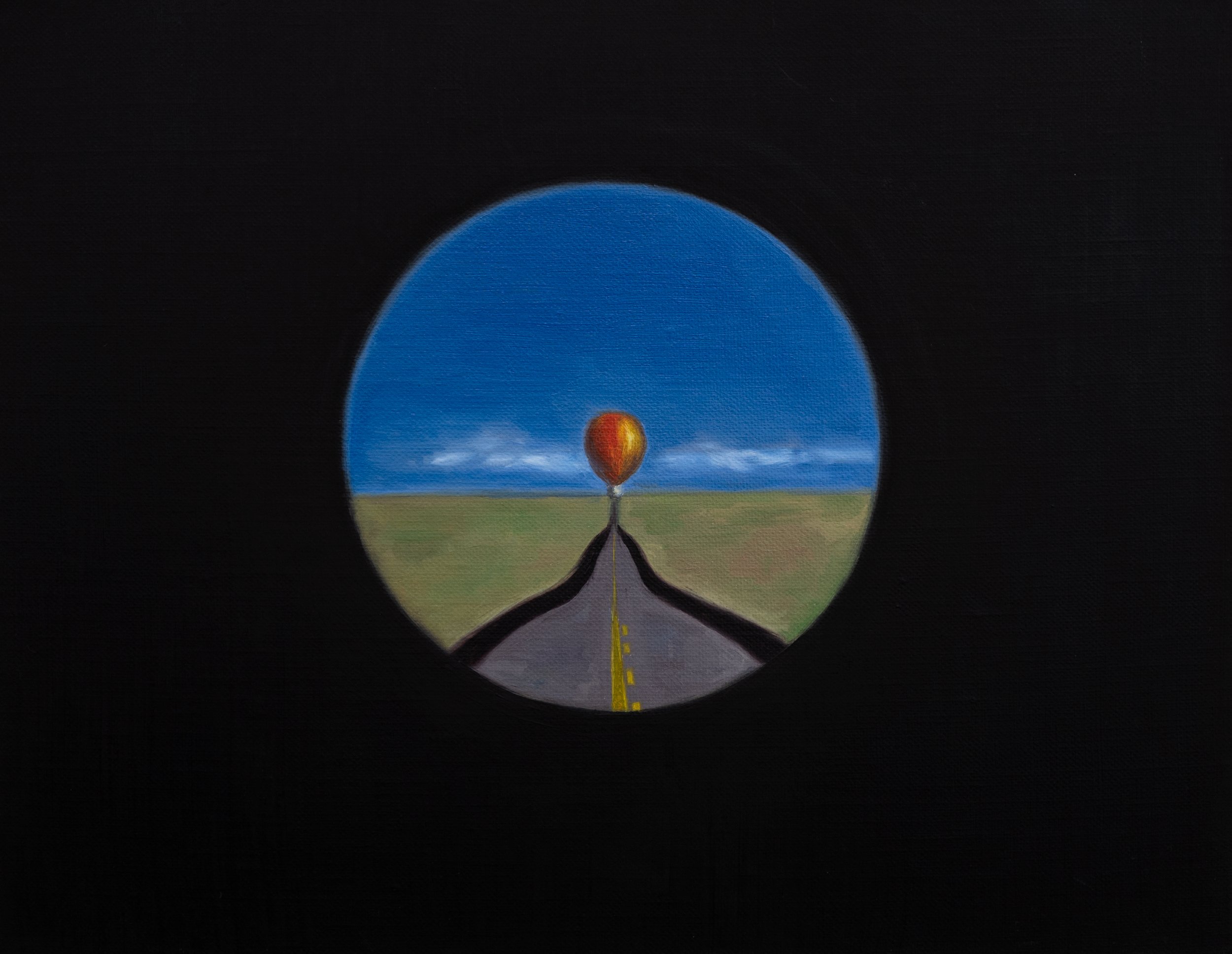
There is a house that millions of people have seen but no one has visited. It appears during eye examinations, inside the viewing aperture of an autorefractor, the device that measures refractive error by projecting an image into the patient's eye and analyzing the reflection from the retina. The image is a small house, sometimes a hot air balloon, sometimes a farmhouse at the end of a road, depending on the manufacturer and the model. The patient presses their forehead against the chin rest, the technician aligns the instrument, and the image appears, first blurred, then sharp, then blurred again, as the machine cycles through lenses of varying diopters to determine the precise prescription. The house is not a real house. It does not exist at any address. It was drawn by an engineer or a graphic designer at a medical device company and programmed into the machine's firmware, and it appears identically in autorefractors manufactured by Topcon, Nidek, and Reichert in clinics and hospitals around the world. It is one of the most widely seen images in human history, and it has no author, no copyright that matters, and no cultural context beyond the clinical. Tan Mu has been seeing this house since childhood. "Since childhood, I have been deeply impressed by the surreal and highly focused images that appear inside the refractor, such as a small house or a hot air balloon," she writes. "What fascinates me is that this imagery is almost universally shared. People around the world, regardless of age or background, recognize the same visual scene because it is a standard part of eye examinations." Vision (2020) paints the moment that this image enters consciousness, and the diptych format places the blurred and the focused states side by side, so that the viewer can experience the shift from one to the other without moving.
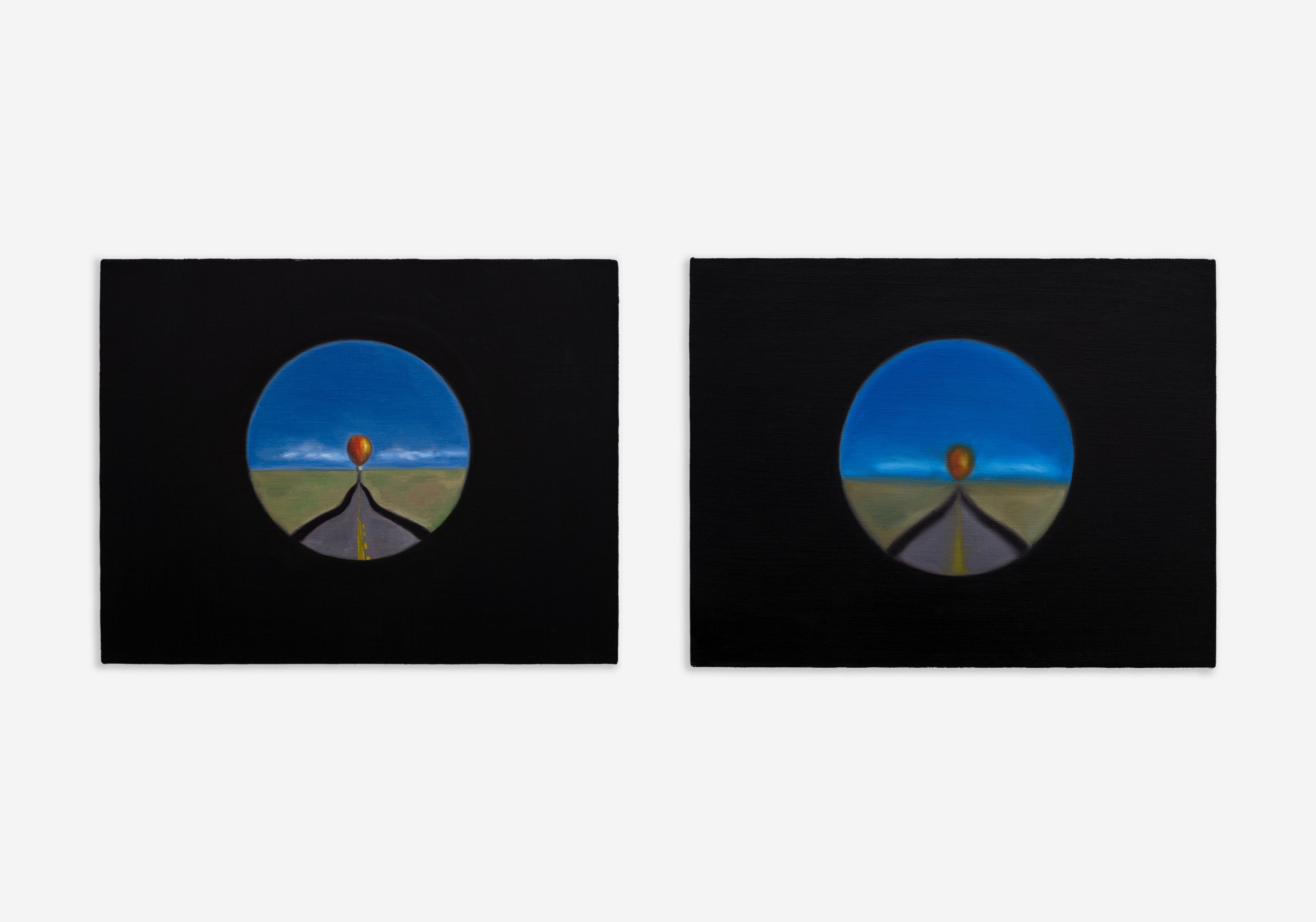
Oil on linen, diptych, 27.9 x 35.6 cm each (11 x 14 inches each). The format is small, intimate, the size of a personal device or a photograph held in the hand, and the decision to make the painting a diptych rather than a single panel is the work's most consequential structural choice. Each panel is framed by a black border that mimics the aperture of the autorefractor, the circular window through which the patient views the image during the examination. The black border is not decorative. It is the machine. It is the circumference of the lens, the housing of the instrument, the frame that defines the visual field and excludes everything outside it. Within this circular aperture, one panel presents a blurred image, a diffuse field of color and form that suggests a landscape, a horizon line, a structure, without resolving any of them into legibility. The other panel presents the same image in sharp focus: a small house, or the suggestion of one, rendered with the precision that the autorefractor achieves at the moment of calibration, when the lenses align and the image snaps from soft confusion into sudden clarity.
The color palette is restrained: warm earth tones, ochres and umbers and pale golds, with a sky that reads as a slightly cooler gray-blue and a ground that reads as warm brown. The house, when it resolves in the focused panel, is a simple structure, a gabled roof and a rectangular body, the kind of house a child might draw, which is precisely the kind of image that autorefractor manufacturers select for their devices. The house must be simple enough to be recognized by anyone regardless of culture, language, or age, and it must contain enough spatial information, foreground, background, verticals, horizontals, a vanishing point, to allow the instrument to measure the eye's refractive error by analyzing how the retina reflects the image. The house in the autorefractor is not a house that anyone lives in. It is a calibration target. It is a tool disguised as a scene, a measurement device wearing the mask of a landscape, and Tan Mu's decision to paint it in oil on linen rather than leaving it inside the machine is a decision to treat the calibration target as a subject worthy of sustained attention.
René Magritte's The False Mirror (1928) presents a single eye that fills the canvas. The iris is a blue sky with white clouds, the pupil is a black disc, and the outline of the eye is drawn with the precision of a medical diagram. The painting operates on a single, devastating conceit: the eye that sees the sky is also the sky that the eye sees. There is no separation between the organ of vision and the field it perceives. The pupil, which should be the point where vision originates, is instead an absence, a black hole that swallows light rather than emitting it. The painting denies the viewer any position outside the eye. You cannot stand behind the eye and look through it. You are inside it, looking out, and what you see is sky, which is to say you see what the eye has already constructed. Magritte's title makes the proposition explicit: the mirror is false because it does not reflect what is in front of it. It reflects what is behind it, inside the eye, in the neural processing that transforms light into the experience of seeing. The eye in the painting is not a window. It is a projector.
The autorefractor in Tan Mu's Vision operates on the same principle as Magritte's eye, but in reverse. Where Magritte's eye projects the sky outward, the autorefractor projects the house inward. It sends an image into the patient's eye and analyzes what comes back, measuring the distortion introduced by the eye's optical system and calculating the lens prescription that will correct it. The image inside the autorefractor, the house or the hot air balloon, is not something the patient is meant to admire. It is a probe, a calibrated stimulus that allows the machine to read the eye's refractive characteristics. The patient's role in this process is passive. They look, and the machine measures. They do not need to understand what they are seeing. They only need to see it, and the machine does the rest. Magritte's False Mirror asks what happens inside the eye when it sees the sky. Vision asks what happens inside the eye when a machine sees the eye seeing. The difference is not small. In Magritte's painting, the eye is a closed circuit: it sees the sky that it has already constructed. In Tan Mu's diptych, the eye is part of a feedback loop that includes the machine, the image, and the measurement, and the image that circulates through this loop is not the sky, which is infinite and uncontained, but a house, which is finite, specific, and deliberately designed to be recognized by any eye in the world.
The blurred panel of the diptych represents the state of vision before the machine's intervention, what Tan Mu describes as "unfocused, organic vision, a soft and diffused image that mirrors how the world appears without any technological assistance." The description is precise. Without correction, the myopic eye sees the world as a field of soft shapes, indistinct masses of color that suggest objects without confirming them. The blurred panel is not an abstraction. It is an accurate representation of what the world looks like to an uncorrected eye, and it is also an accurate representation of what the autorefractor image looks like when the machine's lenses are not yet aligned. In both cases, the blur is not a stylistic choice. It is a condition of the optical system, and the painting presents this condition without comment, as a fact of vision rather than a defect of it. The focused panel, by contrast, represents the moment of correction, "when the image suddenly snaps into focus through mechanical calibration." The word "suddenly" is the key. The transition from blur to clarity is not gradual. It is instantaneous, and the diptych format captures this instantaneity by placing the two states side by side rather than in sequence. There is no transition panel. There is no intermediate state. The viewer moves from blur to focus by shifting their gaze from one panel to the other, and the shift is as sudden as the snap of the autorefractor's lens.
The autorefractor was invented in the 1970s and became standard clinical equipment in the 1980s. It replaced the manual retinoscopy procedure, in which an ophthalmologist or optometrist shone a light into the patient's eye and interpreted the reflection by hand, a process that required skill, experience, and subjective judgment. The autorefractor automated this procedure, replacing the human interpreter with a photoelectric sensor and a microprocessor, and it replaced the arbitrary images that the retinoscopist might have used as fixation targets with standardized images, the house, the hot air balloon, the farmhouse, that now circulate through millions of examinations every year. The standardization was necessary. The machine needed a target that the patient could recognize and fixate on, and the target needed to be simple enough to be legible at any level of refractive error, from mild myopia to severe astigmatism. The result is an image that is recognized by more people than any painting, any photograph, or any film still, and that has no author, no origin story, and no cultural context beyond the clinic.
László Moholy-Nagy's Light-Space Modulator (1922-1930) is a motorized sculpture consisting of perforated metal discs, rotating arms, and polished surfaces that intercept and redirect beams of electric light. The device was designed to produce a kinetic light show, a spectacle of reflections, shadows, and projected shapes that would demonstrate the aesthetic possibilities of light as a sculptural material. Moholy-Nagy filmed the Modulator in his short film Light Play: Black-White-Grey (1930), and the footage shows the rotating elements casting shifting patterns of light and shadow across the walls and ceiling of the studio, producing an abstract ballet of illumination that has no subject, no narrative, and no representational content. The Modulator does not depict light. It produces it. It is not a picture of light in motion. It is light in motion, generated by a machine that was designed to make the mechanics of perception visible.
Moholy-Nagy described the Modulator as a demonstration of "the new vision," a phrase he used throughout his career to describe the expanded perceptual capacities that modern technology, photography, film, X-rays, microscopes, telescopes, made available to the human eye. The new vision was not a metaphor. It was a literal expansion of what the eye could see, and it was produced not by the eye itself but by the instruments that mediated between the eye and the world. The Modulator was a teaching device, a machine that made the viewer aware of their own perceptual apparatus by placing it in an environment where the usual cues of depth, distance, and solidity were suspended. In the Modulator's light play, the viewer cannot tell whether a shape is a solid object or a projection, whether a shadow is cast by something in front of them or something behind them, whether the light is coming from the machine or from the projection of the machine. The result is a visual experience that is entirely mediated by technology, an experience that would not exist without the machine that generates it.
The structural parallel to Vision is clear. Both works place the viewer inside a technological apparatus that mediates their perception. Moholy-Nagy's Modulator produces light that the viewer would not otherwise see. Tan Mu's autorefractor produces an image that the viewer would not otherwise encounter, an image that exists only inside the machine and only during the brief interval of an eye examination. Both works make the mediation visible by removing the context that would allow the viewer to forget it. The Modulator removes the studio walls and replaces them with projected light. Vision removes the clinic and replaces it with the black aperture of the autorefractor, the circular frame that isolates the image from everything outside it. Both works insist that what the viewer is seeing is not the world but a technological construction of the world, and both insist that this construction is worth looking at, worth painting, worth filming, worth taking seriously as a visual experience in its own right.
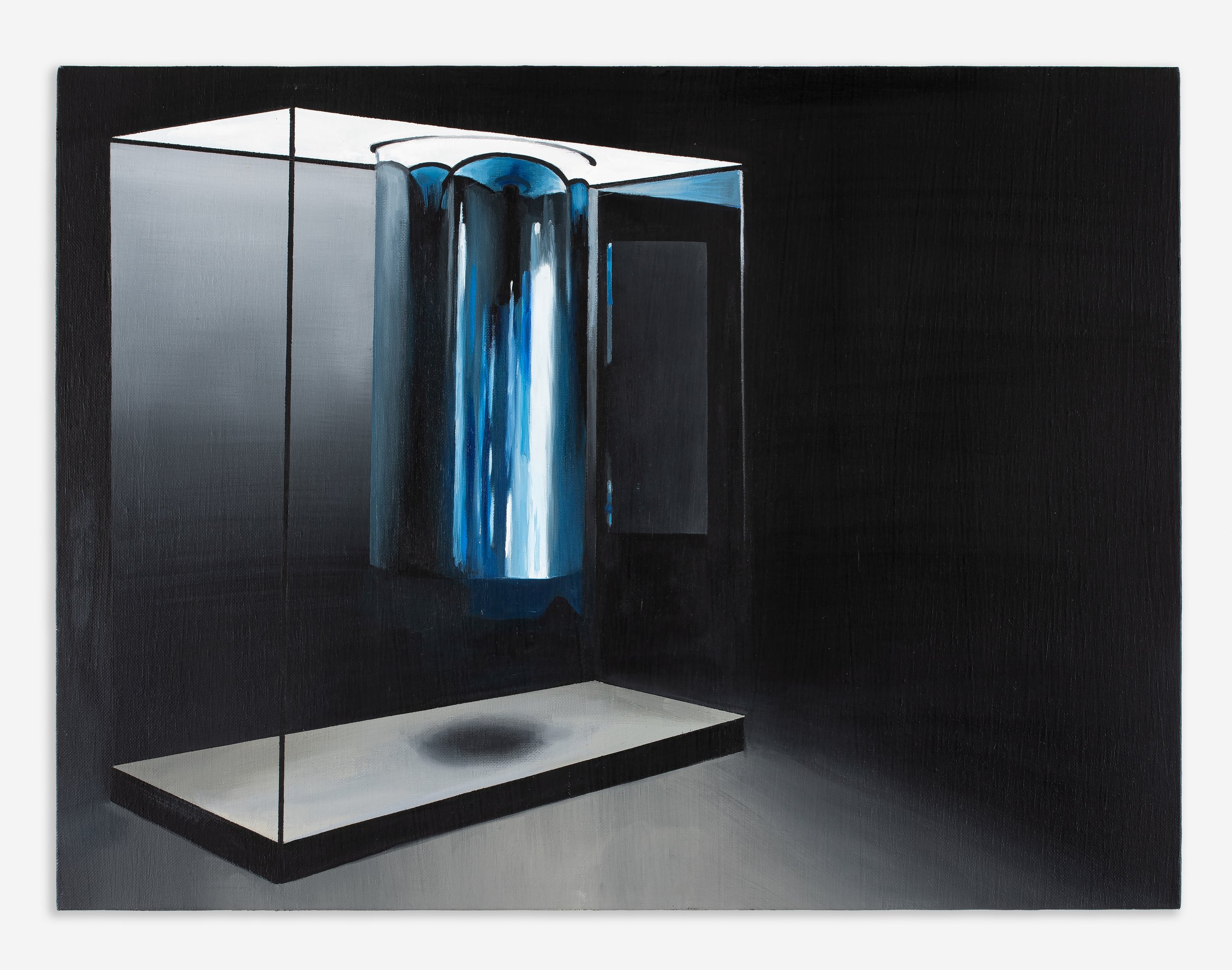
Danni Shen, writing in Emergent Magazine in 2024, identifies Tan Mu's paintings as serving "as a kind of witness to human socio-technological histories," and the description applies with particular force to Vision. The autorefractor image is a socio-technological artifact in the most literal sense. It was designed by engineers, manufactured by corporations, distributed to clinics, and seen by patients as part of a routine medical procedure. It has no author, no artistic intention, and no aesthetic program. It exists solely to serve as a fixation target for a diagnostic instrument. And yet it is seen by more people than any work of art, and it is remembered, as Tan Mu testifies, with a vividness that has nothing to do with its clinical function and everything to do with its visual singularity. The small house inside the autorefractor is surreal, dreamlike, and slightly uncanny, a landscape that appears inside a medical device and disappears when the examination is over. It is a vision that belongs to everyone and no one, a collective hallucination produced by a machine, and Vision is the painting that recognizes this hallucination as a subject worthy of the same sustained attention that painters have historically given to landscapes, portraits, and still lifes.
Tan Mu has described the image inside the autorefractor as "a collective visual memory, a moment where technology temporarily reshapes how we see." The phrase "collective visual memory" is the key. A collective visual memory is not a memory that anyone has of an event they experienced. It is a memory that belongs to everyone who has sat in the chair, pressed their forehead against the rest, and watched the house appear inside the lens. The memory is shared not because the experience is the same, since every eye examination is different, but because the image is the same. The house that appears in a Topcon autorefractor in a clinic in Shanghai is the same house that appears in a Nidek autorefractor in a clinic in New York. It was drawn once and replicated millions of times, and it enters the memory of every person who has had their eyes checked in the last forty years. This is what makes it different from a photograph or a painting or a film still. Those images are distributed, but they are distributed as copies of an original that was created by an author. The autorefractor image has no original. It was designed to be a copy from the moment it was first programmed into the machine's firmware, and its mode of distribution is not reproduction but clinical routine, a process that is simultaneously medical, industrial, and intimate.
The diptych format places the blurred and focused states side by side, and the arrangement is not neutral. In a left-to-right reading culture, the blurred panel falls on the left and the focused panel falls on the right, which means that the viewer's eye moves from confusion to clarity, from the state of uncorrected vision to the state of corrected vision, from what the eye sees without assistance to what it sees with the machine's intervention. This is the narrative of the eye examination: you sit down, you see blur, the machine clicks, and suddenly you see the house. But the narrative is not the only reading available. The blurred panel is not an inferior version of the focused panel. It is an accurate representation of a specific visual state, the state of the myopic eye, the state that most of the world's population inhabits without correction, and it has its own aesthetic density, its own softness, its own refusal to resolve the world into edges and names. Tan Mu describes this state as "organic vision," and the word "organic" is not casual. Organic vision is the vision that the body produces without assistance. It is the vision that belongs to the eye itself, not to the machine that corrects it. The diptych places these two states in conversation rather than in hierarchy, and the conversation is the painting's subject: not the house inside the lens, but the relationship between the eye that sees blur and the machine that makes it see clarity.
Tan Mu connects this to a broader argument about technology and perception. "I think of technology as an extension of the human body. Tools such as microscopes and telescopes expand or alter our visual range, allowing us to see what would otherwise remain invisible. Vision captures the instant when technology recalibrates our sight, revealing how perception can be transformed in a single moment through mechanical adjustment." The word "recalibrates" is precise. Calibration is not creation. It is adjustment. The machine does not give the eye new capacities. It adjusts the existing capacities to a different standard, the standard of emmetropia, the condition of the eye that focuses correctly without assistance. The diptych does not show the eye becoming better. It shows the eye becoming calibrated, and calibration, unlike improvement, is a reversible process. The eye can be recalibrated again tomorrow. The prescription can change. The machine can produce a different measurement. The house inside the lens will remain the same, but the eye that sees it will not, and the painting holds both states, the organic and the calibrated, the blurred and the sharp, in a single frame, side by side, asking the viewer to decide whether the recalibrated state is more real than the organic one, or whether it is simply more useful. The house does not care. It appears identically in both panels. It is the eye that changes.