The Circle That Holds Everything: Tan Mu's Embryo and the Density of the Beginning
A human embryo at the blastocyst stage, approximately five days after fertilization, consists of roughly one hundred cells. Those one hundred cells contain the complete genetic blueprint for an organism that will eventually comprise thirty-seven trillion. The ratio of information to material at this stage is the highest it will ever be. Every gene that will produce the liver, the retinas, the fingernails, the language centers of the brain, the enzymes that digest lactose, the melanin that determines skin color, the antibodies that fight infection, every instruction for every organ and every function that the adult body will ever perform, all of it is present in a sphere roughly one-tenth of a millimeter in diameter, a sphere so small that it would be invisible to the naked eye without magnification. The density is not metaphorical. It is informational, physical, and biological simultaneously. The DNA in those one hundred cells, if uncoiled and laid end to end, would stretch roughly two meters, and every millimeter of that length carries the code for a specific protein or regulatory function. The embryo is the most informationally dense object in the known biological world, and it achieves this density by folding two meters of code into a sphere that could rest on the period at the end of this sentence.
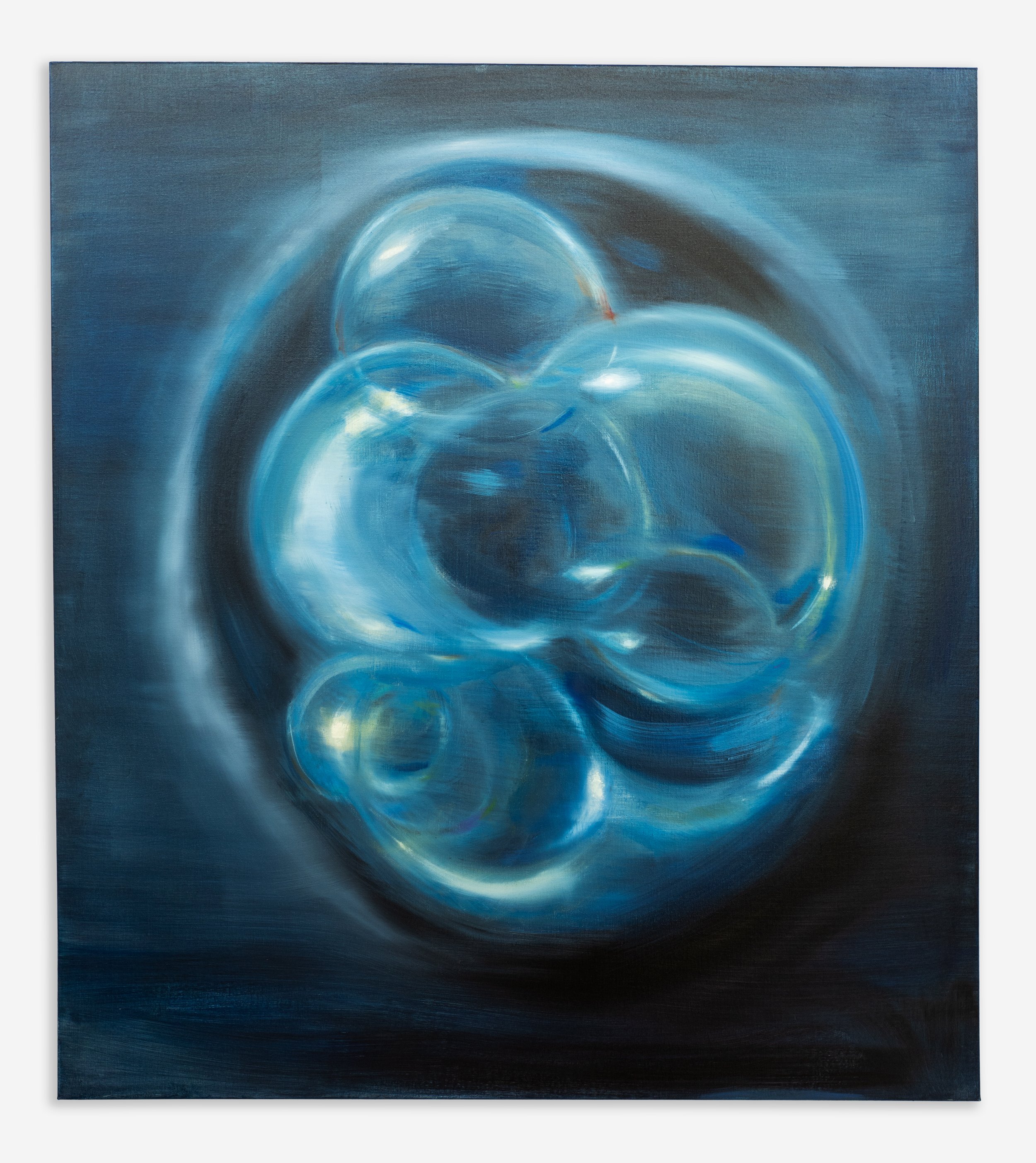
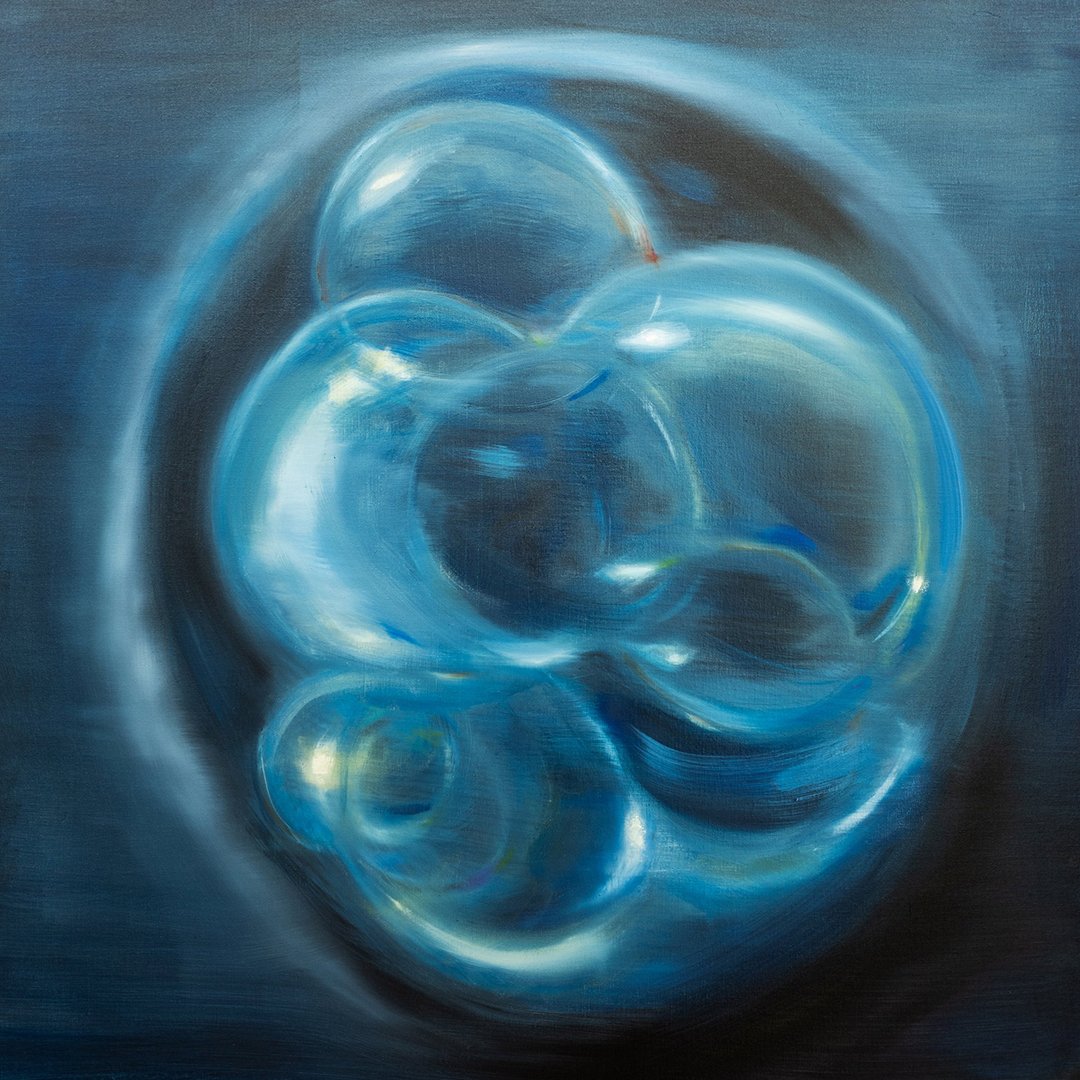
Oil on linen, 102 x 91 cm (40 x 36 in). The format is close to square, the proportions of an icon or a portrait, and the decision to paint a microscopic structure at a scale that could accommodate a seated figure is itself an argument about significance. Tan Mu has taken an object that is ordinarily visible only through a microscope and placed it at the center of a canvas large enough to hold it as a subject rather than a specimen. The dark ground is characteristic of her recent work: a deep, absorbing black that functions as a void, a surround of indeterminate depth that isolates the central form the way a microscope's dark-field illumination isolates a specimen against a black background. Against this darkness, the embryonic form glows with an internal luminosity that suggests bioluminescence, fluorescence, or the light of a microscope's transilluminator passing through a translucent cell. The form is circular, not perfectly round but close enough to read as a sphere seen from the front, and it is surrounded by a halo of softer light that fades gradually into the darkness, as if the cell were emitting its own radiance into the surrounding medium.
The interior of the circle is not uniform. It is structured by fine lines that trace the contours of what could be cell walls, membranes, or division planes, and these lines produce the impression of a structure in the process of organizing itself. Some areas within the circle are denser, with more lines converging, while others are more open, with larger gaps between the structural elements. The variation in density is not random. It follows the logic of embryonic development, in which the cells at the interior of the blastocyst begin to differentiate and cluster while the outer ring of cells, the trophectoderm, maintains its structural integrity as the boundary between the embryo and its environment. Tan Mu's brushwork here is at its most precise, with individual lines that are thin enough to suggest biological structure rather than painterly gesture, and the overall effect is of looking through a microscope at a living specimen that is actively dividing, actively organizing, actively becoming. The color is restricted to warm whites and pale golds against the black ground, with occasional flashes of a cooler tone that reads as cytoplasm or culture medium rather than pigment, and the palette produces an effect that is simultaneously clinical and luminous, as if the painting were both a scientific illustration and an altarpiece.
Gustav Klimt's Medicine (1901) was one of four ceiling paintings commissioned for the University of Vienna, and it remains one of the most confrontational works in the history of Austrian art. The painting depicts a column of naked human bodies rising from the depths of a dark river, their limbs intertwined in a vertical procession that ascends from illness and death at the bottom to health and vitality at the top. At the center of the composition, a pregnant woman stands with her belly swollen and her arms raised, and beside her, barely visible in the darkness, a skeleton turns its head as if considering the living. The painting was attacked by the Austrian parliament and the medical faculty for its apparent suggestion that medicine could not save the patients it depicted, and Klimt was forced to withdraw it from the exhibition. What makes Medicine relevant to Embryo is not its critique of the medical establishment but its treatment of the generative force. The pregnant woman at the center of Klimt's composition is not a patient. She is the source. She stands at the axis of the composition, the point from which life flows upward, and her body contains the same informational density that Tan Mu's embryonic circle contains: the complete blueprint for a new human being, folded into a form so small that it is invisible without magnification. Klimt painted this force at the scale of the body, a woman standing, a belly rounding, a gesture of offering or surrender. Tan Mu paints it at the scale of the cell, a circle glowing against a dark ground, a form so compressed that it carries the weight of an entire organism in the space of a single brushstroke.
The formal comparison is also instructive. Klimt's surface in Medicine is encrusted with decorative patterns, gold leaf, and ornamental motifs that derive from Byzantine mosaic and Egyptian funerary art. The decorative surface is not incidental to the content. It is the content. The patterns encode the idea that the life force is not a biological mechanism but a cosmic principle, a force that flows through all living things and connects them across time and species. The gold is not decoration. It is the visual signature of the sacred, and the sacred in Klimt's vocabulary is the generative force itself, the power that creates life from matter and maintains it against entropy. Tan Mu's surface in Embryo is the opposite of Klimt's: stripped, monochrome, precise, without ornament. Where Klimt accumulates, Tan Mu reduces. Where Klimt covers the canvas with pattern, Tan Mu removes everything that is not the central form. But the reduction serves the same purpose as the accumulation. Both painters are trying to make visible the same thing: the force that generates life, the informational density that is present at the beginning and that unfolds over time into the full complexity of the organism. Klimt makes it visible by wrapping it in decoration. Tan Mu makes it visible by stripping away everything that is not it.
Tan Mu has described the embryonic cell as containing "a significant force, replicating genetic information that can now be studied with precision," and the word "force" is the operative term. An embryo at this stage is not a miniature person. It is a sphere of cells in the process of determining what it will become, and that determination, that decision-making process at the cellular level, is what the painting makes visible. The lines inside the circle are not decorative. They are the traces of cellular division, the paths along which the organism's body plan is being laid out, and each one represents a decision that, once made, cannot be unmade. The cells that become the trophectoderm will form the placenta. The cells that become the inner cell mass will form the body. The distinction between these two lineages, which appears in the painting as a structural variation in the density of lines, is the first and most consequential decision that the embryo makes, and it is a decision that is made without a brain, without a nervous system, without consciousness, by chemical gradients and mechanical forces acting on a sphere of one hundred cells.
Arthur Dove's abstractions of the 1920s and 1930s are among the earliest sustained attempts in American painting to represent natural forces rather than natural appearances. Dove's Sun (1935) reduces the sun to a concentric series of circles and rays that emanate from a bright center into a dark surround, producing an image that reads simultaneously as a celestial body and as a pulse of energy, a visual representation of the force that drives photosynthesis, weather, and the entire terrestrial biosphere. Dove was not painting the sun as it appears to the eye. He was painting the sun as a generative principle, the source of the energy that produces growth, and his formal vocabulary, circles, rays, gradients of warmth and light, is the same vocabulary that Tan Mu uses in Embryo. The embryonic circle glows against a dark ground. Lines radiate from its interior. The whole form pulses with an internal luminosity that suggests energy rather than illumination. The similarity is not coincidental. Both painters are working with the same subject: the generative force, the power at the center of a system that produces everything that follows from it.
Dove described his method as extracting "the sense of reality" from nature rather than its appearance, and the distinction is precise. The appearance of the sun is a bright disc in a blue sky. The sense of the sun is the force that makes plants grow and skin burn and weather systems circulate. Dove's abstraction is not a simplification of the appearance. It is a translation of the force into visual terms, and the visual terms he chose, concentric circles, radial lines, warm colors against dark grounds, are the same terms that the natural world uses when it represents its own generative forces: the concentric rings of a tree trunk, the radial symmetry of a flower, the spiral arms of a galaxy, and the spherical luminosity of an embryo photographed under a transilluminating microscope. Tan Mu's Embryo uses this same vocabulary to represent the same force at a different scale. Where Dove's sun generates energy through nuclear fusion, Tan Mu's embryo generates form through cell division. Where Dove's concentric circles represent the outward radiation of photons, Tan Mu's internal lines represent the inward organization of genetic information. The direction is opposite, outward in Dove, inward in Tan Mu, but the principle is the same: a central source radiating structure into the space around it, and a painter who has chosen to represent that structure not as it appears to the casual eye but as it functions, as a force that produces order from undifferentiated matter.
The connection between Embryo and First Week, its companion piece in Tan Mu's practice, is explicit. "Embryo and First Week are closely connected as part of my ongoing exploration of the origins of life," Tan Mu states. "First Week follows the early biological progression of an embryo, focusing on the initial stages after fertilization. It traces the transformation from a single-celled zygote into a more complex form, emphasizing the abstract beauty and structural simplicity of life at its earliest stage. Embryo, by contrast, concentrates on a specific moment within this process. Through magnification and the aid of modern imaging technologies, it allows for a more intimate observation of the embryonic cell." The distinction between the two works is temporal. First Week covers a span of days, the gradual progression from zygote to blastocyst to implantation. Embryo freezes a single moment, the moment when the cell's informational density is at its peak, when all the instructions for the entire organism are present but none of them has yet been executed. The painting holds this moment open for examination, and the examination is not purely scientific. It is aesthetic, philosophical, and, in the deepest sense, biological, because the question that the painting poses, the question of how a sphere of one hundred cells becomes a body of thirty-seven trillion, is not a question that belongs to any single discipline.
Saul Appelbaum, writing in his 2025 essay "Dreaming in Public" for the BEK Forum, identifies Tan Mu's paintings as functioning "as a kind of witness to human socio-technological histories," and this framing applies with particular force to Embryo. The painting is not a scientific illustration. It does not document the embryo for diagnostic purposes. It witnesses the embryo for its own sake, as an object that exists at the intersection of biology, technology, and aesthetics, and it does so at a moment when the technologies that make the embryo visible, microscopy, in vitro fertilization, genetic sequencing, are the same technologies that make it possible to intervene in the embryo's development, to select embryos for implantation, to edit the genes that the embryo carries, to choose which informational blueprints are allowed to unfold and which are not. The painting does not take a position on these interventions. It presents the embryo as it appears under magnification, a luminous circle of immense density against a dark ground, and the density is the content. Every gene, every chromosome, every regulatory sequence that will produce the liver and the retinas and the language centers and the antibodies is contained within this circle, and the painting holds it at the moment before any of these instructions have been executed, before the blueprint has become a building, before the information has become a body.
Tan Mu's description of technology as "a bridge between observation and imagination, allowing creative expression to move past the limits of the visible world" identifies the specific contribution that microscopy makes to painting. A painter working in the seventeenth century could not have produced Embryo because the microscope that makes the embryonic cell visible at this level of detail did not exist. The painting depends on the technology of magnification, and the technology of magnification depends on the science of optics, and the science of optics depends on the mathematics of light, and the mathematics of light depends on the physics of electromagnetic radiation, and the chain of dependencies extends backward until it reaches the same principle that the painting depicts: the principle that information, when it is dense enough and organized enough, produces form. The genes in the embryo produce the body. The optics in the microscope produce the image. The image in the painting produces the form on the canvas. The form on the canvas produces the viewer's understanding of what an embryo is, not as a concept, not as a slogan, not as a position in a bioethical argument, but as a luminous circle of immense density that contains, in a form so small it cannot be seen without assistance, the complete instructions for everything that will follow.
The dark ground that surrounds the embryonic circle is not an absence. It is the medium, the culture solution, the fluid that sustains the cell and through which nutrients and signaling molecules pass. In the painting, it is also the space of non-being, the condition that precedes the embryo's decisions, the state of matter before it has been organized by the information contained in the genes. The circle glows against this darkness the way a cell glows under a fluorescence microscope, not because it emits light but because the light that passes through it is scattered and refracted by its internal structures, producing a luminosity that is not decoration but evidence, the visible signature of organization at work. The painting holds this luminosity in suspension, freezes it at the moment when the information is most compressed and the potential is most dense, and the result is not a documentation of a biological process but a portrait of the force that drives it, the generative principle that operates at every scale from the embryo to the sun, the circle that holds everything that will follow from the beginning.