The Gold That Circles the Star: Tan Mu's Dyson Sphere and the Computation That Consumes the Sun
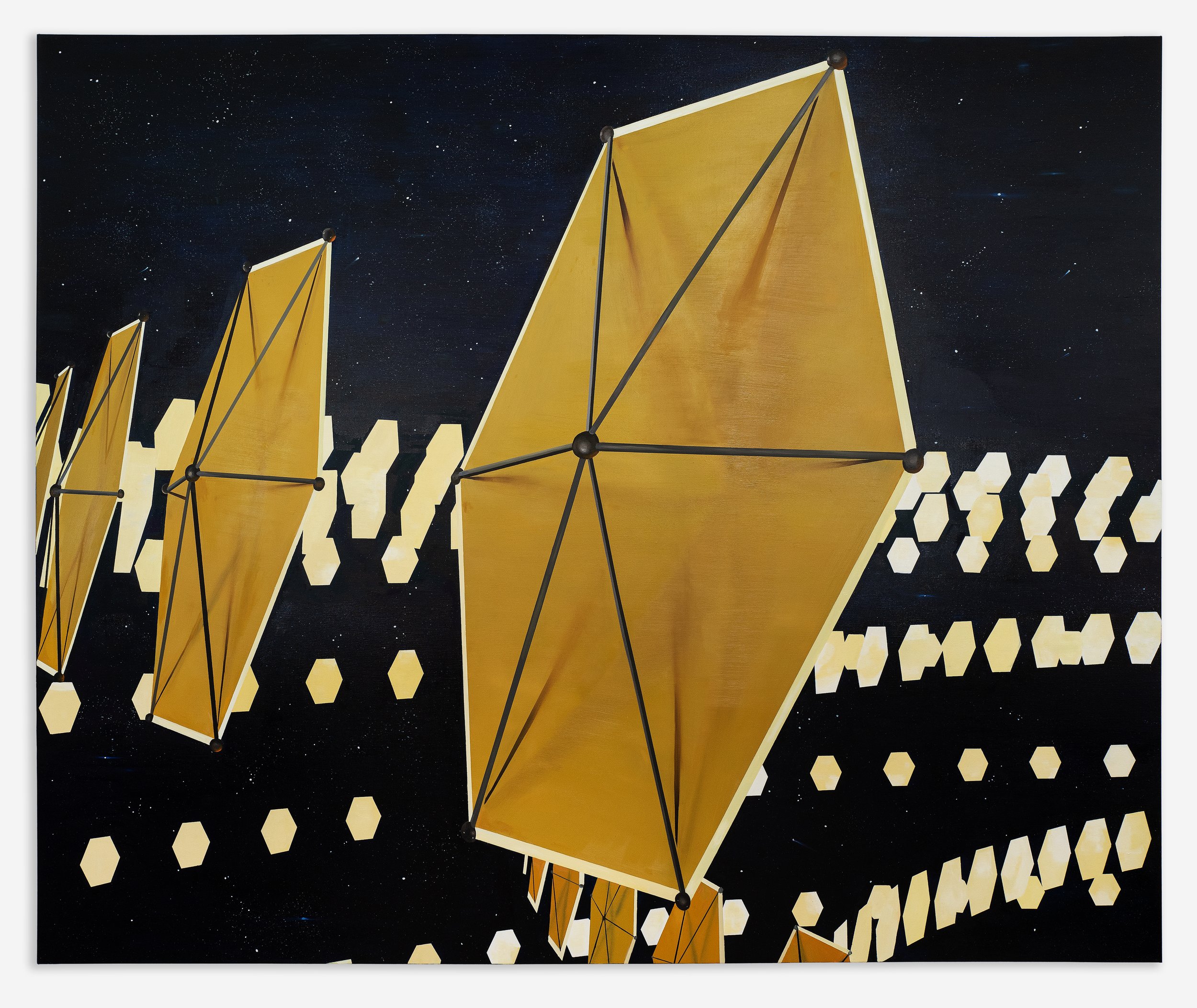
A Dyson Sphere would require more matter than exists in all the planets of a solar system combined. Freeman Dyson proposed the concept in a 1960 paper in Science, calculating that a shell surrounding a star at the radius of Earth's orbit would need a surface area roughly six hundred million times the surface area of Earth, and that the material for such a shell would have to be harvested from the planets themselves, stripped down to their constituent elements and reassembled as solar collectors, habitats, and computational infrastructure. The scale is not large. It is incomprehensible. The human mind cannot hold the image of a structure whose surface area exceeds the Earth's by nine orders of magnitude. The number is too abstract, too far from experience, to be felt as anything but a mathematical proposition. Tan Mu's Dyson Sphere (2023) does not attempt to make this scale comprehensible. It makes it visible. The painting translates the incomprehensible into the perceivable, not by reducing the scale but by rendering the structure at a scale that the human eye can hold, 152 x 183 centimeters, and filling that surface with a density of golden marks that accumulates until the viewer's visual system begins to saturate, producing an experience that approaches, through sensory overload rather than numerical comparison, something of what it might feel like to stand inside a shell that has swallowed a star.
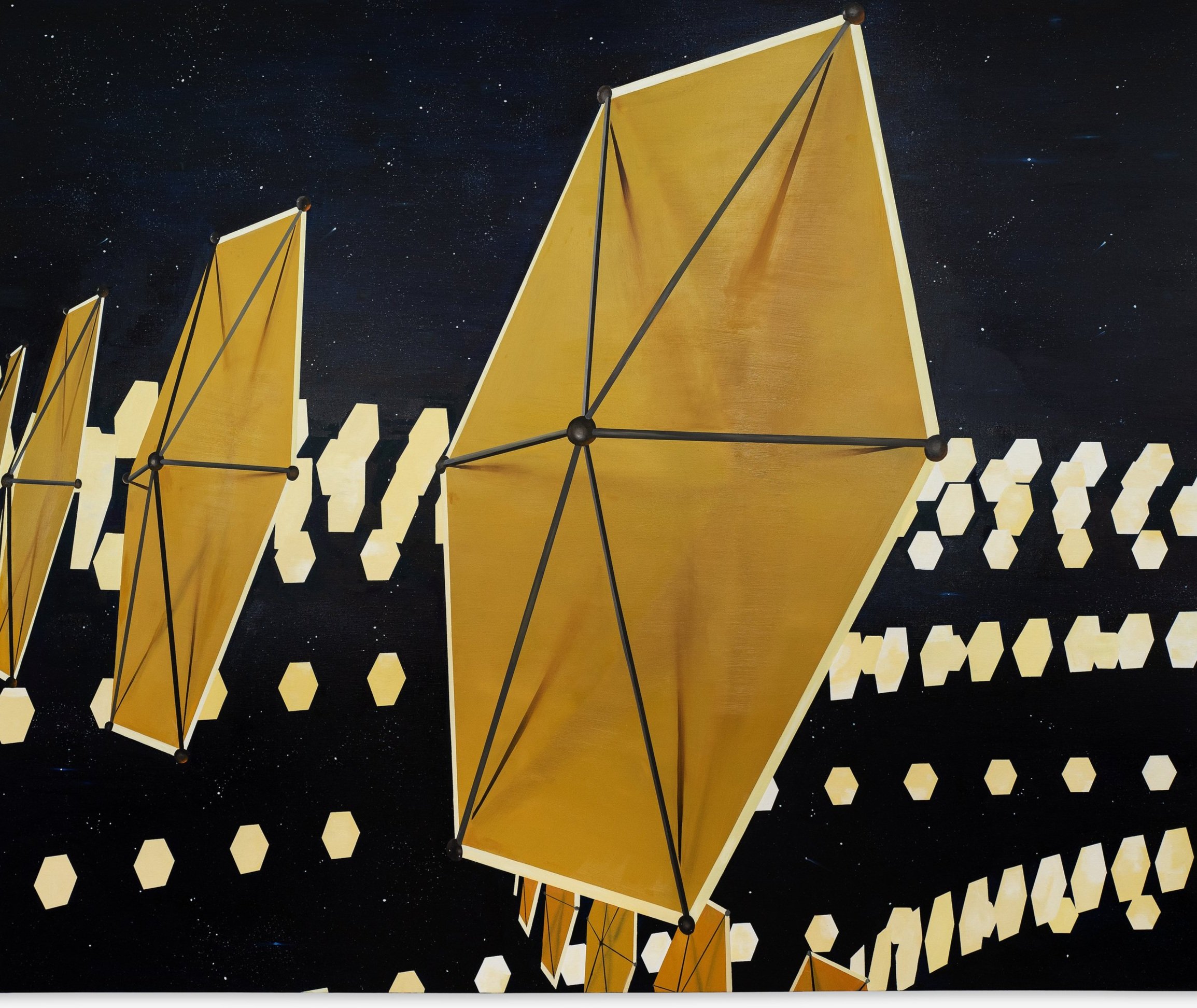
Oil on linen, 152 x 183 cm (60 x 72 in). This is the largest format in Tan Mu's recent practice, and the scale is itself a statement. The painting occupies a wall the way a landscape occupies a horizon, and the viewer must stand back to take in the whole or move close to examine the detail, and both positions deliver different information. From a distance, the canvas reads as a field of gold: a warm, saturated amber that glows against the dark ground like the light of a star seen through a translucent shell. The impression is not of a painting but of a luminous object, a surface that appears to be generating its own light rather than reflecting ambient illumination. Move closer, and the field resolves into individual brushstrokes, each one a mark of gold or ochre or pale honey, laid down in horizontal and slightly curving strokes that follow the imagined curvature of the sphere's panels. The strokes overlap, layer, and interleave, producing a surface that is dense with incident without being chaotic, a texture that suggests both the regularity of engineered panels and the irregularity of paint applied by hand.
The color is predominantly gold, but it is not a single gold. It ranges from a deep, almost coppery amber at the edges of the composition to a pale, nearly white champagne at the center, where the light of the star would be strongest and the panels would receive the most direct illumination. Tan Mu has described this palette as chosen to depict "energy collection panels orbiting a star," with "the flowing gradients suggest[ing] light being reflected, absorbed, and transformed." The gradients are produced not by airbrushing or mechanical means but by the accumulation of brushstrokes in varying densities and hues, and the result is a surface that shifts in tone as the viewer moves across it, as if the panels themselves were catching and redirecting light in real time. Against this golden field, a dense population of small points represents the starry sky, and this is the painting's first large-scale use of the point-field that would become foundational in Tan Mu's subsequent Horizons and Signal series. The points are white and pale gold, distributed across the dark areas between the panels, and they function simultaneously as stars, data points, and units of visual information, the same ambiguous particles that populate her submarine cable paintings and her chromosome portraits.
Caspar David Friedrich's Wanderer Above the Sea of Fog (1818) places a single figure on a rocky promontory, his back to the viewer, facing a landscape of fog-covered mountains that stretches to the horizon and beyond. The figure is dressed in dark green, his stance is confident, and his position at the top of the composition gives him dominion over the scene below. But the fog obscures the terrain, and the mountains that emerge from it are distant, indistinct, and indifferent to his presence. The painting is usually read as an image of the sublime, the confrontation between human consciousness and natural forces that exceed comprehension, and the figure's posture, turned away from the viewer and toward the landscape, is read as an assertion of mastery. But there is another reading available, one that the composition supports as strongly as the first. The figure is standing on a rock. Below him is fog. The fog hides the ground. He cannot see where his rock ends and the void begins. His mastery is performed from a position of radical uncertainty, and the landscape he surveys is not a landscape he controls. It is a landscape that contains him, and the fog that obscures the terrain also obscures the limits of his knowledge.
The Dyson Sphere is the technological equivalent of Friedrich's fog. It is a structure that would give its builders dominion over the entire energy output of a star, but the scale of that dominion is so far beyond current human capability that the concept functions not as a plan but as a limit, a boundary beyond which imagination can reach but engineering cannot. Tan Mu's painting places the viewer inside this boundary. The golden field fills the visual field the way the fog fills Friedrich's, and the viewer's position, inside the shell rather than outside it, corresponds to the wanderer's position on the rock: elevated, panoramic, and fundamentally uncertain about what lies beyond the visible horizon. The Dyson Sphere, as a concept, is an expression of mastery over nature at the stellar scale. As a painting, it is an encounter with a scale that exceeds mastery, and the encounter produces not confidence but wonder, the same wonder that Friedrich's wanderer feels when he looks out over the fog and realizes that the landscape is larger than his capacity to comprehend it.
Freeman Dyson's original 1960 paper proposed the structure not as an engineering project but as a thought experiment about the detectability of advanced civilizations. If a civilization were capable of building a shell around its star, the shell would absorb the star's visible light and re-emit it as infrared radiation, and this infrared signature would be detectable by astronomers on other worlds. Dyson was not proposing that humans build such a structure. He was proposing that astronomers look for the thermal signature of civilizations that already had. The paper's elegance lies in this reversal: the Dyson Sphere is not a tool for harnessing energy but a tool for detecting intelligence, and the energy it would capture is evidence not of power but of presence. A civilization that surrounds its star with solar collectors is a civilization that exists, and the waste heat of its collectors is the proof. The structure is simultaneously an instrument of survival and a beacon of existence, and the painting holds both functions in suspension without resolving the tension between them.
Tan Mu has articulated the connection between energy and computation directly. "Energy and computation are deeply interconnected. As computational systems become faster and more complex, their demand for energy increases dramatically. Data centers, quantum computers, and global digital networks rely on continuous and large-scale energy flows." The statement is not speculative. It is factual. A modern data center consumes between twenty and forty megawatts of electrical power, roughly the output of a small power plant. The global data center infrastructure consumes more electricity than most nations, and the consumption is growing at a rate that outpaces renewable energy installation by a significant margin. The demand is driven not by inefficiency but by the physics of computation: every logical operation performed by a processor dissipates heat, and the heat must be removed, which requires more energy, which produces more heat, in a cycle that has no thermodynamic ceiling short of the Landauer limit, the theoretical minimum energy required to erase one bit of information. A civilization that wanted to perform arbitrarily large computations would need arbitrarily large amounts of energy, and the only source of arbitrarily large energy in the known universe is a star. The Dyson Sphere is not primarily a habitat. It is a computer. The panels that surround the star are not walls and roofs. They are processors, and the light they collect is not illumination. It is computation.
James Turrell has spent more than four decades converting a volcanic crater in northern Arizona into an instrument for observing celestial light. Roden Crater, begun in 1979 and still under construction, is a cinder cone that Turrell has carved, tunneled, and shaped into a series of chambers and apertures that frame the sky, the sun, and the stars at specific angles and moments, producing controlled experiences of light that are neither natural nor artificial but something in between, something that exists at the intersection of geological formation and human intention. The crater does not generate light. It receives it, shapes it, and presents it to the viewer in conditions that are so carefully controlled that the experience of seeing light inside the crater is categorically different from the experience of seeing light anywhere else. Turrell describes the work as creating "spaces that engage celestial events," and the description is precise. The crater is not a sculpture. It is an observatory, and the observations it enables are not astronomical but perceptual: what happens to the eye, the mind, and the body when light is presented under conditions that remove all the usual contextual cues that allow us to locate ourselves in relation to the source.
The structural parallel to Dyson Sphere operates at the level of the relationship between the observer and the light source. Turrell places the observer inside a natural formation that has been modified to frame the sky. Tan Mu places the observer inside a hypothetical structure that has been designed to surround a star. In both cases, the observer is enclosed within a system that mediates their experience of light, and the mediation is the content. Turrell's crater filters and frames the light of the actual sun and the actual stars. Tan Mu's sphere filters and frames the light of a star that exists only as a concept, and the difference between the actual and the conceptual is the difference between a work that presents a perceptual experience and a work that presents an imaginative one. But both works insist that the experience of light inside a constructed environment is fundamentally different from the experience of light in open space, and both insist that this difference is worth the enormous effort required to create it. Yiren Shen, writing in 10 Magazine in 2025, describes Tan Mu's practice as visualizing "an interwoven world" between technological infrastructure and natural phenomena, and Dyson Sphere is the most extreme expression of this interweaving: a structure that would erase the boundary between technology and nature by encasing the natural source of all energy inside a technological shell, producing a condition in which the star exists only as a power supply and the sky exists only as a surface of collectors.
Tan Mu's description of the painting process reveals a tension that the work preserves rather than resolves. "While painting, I felt a constant tension between scientific logic and emotional intuition. That tension is essential to the work. It allows the painting to exist between rational speculation and poetic imagination, preserving a sense of wonder rather than technical certainty." The word "wonder" is the key. Wonder is not the same as optimism. It is not the same as hope or aspiration or faith in progress. Wonder is the response to something that exceeds comprehension, and the Dyson Sphere, as a concept, exceeds comprehension by design. Its scale is too large, its energy too vast, its material requirements too extreme for any existing civilization to achieve. The painting does not represent the structure as an engineering project. It represents it as an encounter with the incomprehensible, rendered in gold on linen at a scale that the body can hold, and the gold is not the color of wealth. It is the color of starlight filtered through a shell of collectors, the color of energy at the moment of its capture, the color of the power that would run every computer and sustain every civilization inside the sphere, if the sphere could ever be built.
The point-field that represents the starry sky in Dyson Sphere became, in Tan Mu's own account, "a foundational visual language" for the works that followed. In the Horizons series, the points evolved into symbols of expanded perception. In the Signal series, they merged conceptually with submarine cables to form "a digital constellation." In the biological works, they represented "the circulation of biological information." The point is the most economical mark in painting, a single touch of the brush that carries minimal information on its own but accumulates, through repetition, into a field that can represent stars, data, cells, or cables depending on the context. In Dyson Sphere, the context is the golden field of energy collectors, and the points are the stars that the collectors have not yet absorbed, the light that the shell has not yet captured, the energy that still circulates freely through the universe rather than being channeled through a computational infrastructure. The points represent the gap between the current state of the cosmos and the state it would enter if a civilization were to enclose its star. They represent what has not yet been consumed, and their presence inside the composition, surrounded by the golden field, is a reminder that the Dyson Sphere, for all its ambition, is not a completed project. It is a proposal, a limit, a horizon that can be seen but not reached, and the painting holds it at the point where imagination is still free to wonder what it would mean to stand inside a shell that held a star, and whether the computation that consumed the sun would be worth the darkness that followed.