The Ink That Foretold the Future: Tan Mu's The Note G and the Vision That Outlived the Page
Ada Lovelace died on November 27, 1852, at the age of thirty six. She had written the note that would be recognized, more than a century later, as the first computer program. She had proposed, in language that her contemporaries could not fully understand, that a machine designed for calculation might one day compose music, generate images, and produce patterns of arbitrary complexity. She had done this work as an annotation, a supplement to a translation of another person's paper, and she had signed it only with her initials. The note was published. The machine it described was never built. The ideas it contained would lie dormant for a hundred years before being rediscovered, and even then they would be debated, minimized, and contested by historians who found it difficult to believe that a woman, the daughter of a poet no less, could have understood what she was writing. Tan Mu learned, during her research for The Note G (2022), that Lovelace had died at thirty six. Tan Mu was thirty six at the time. The coincidence was not lost on her. "Despite her short life," she wrote, "her ideas have profoundly shaped the development of computer science and continue to influence the world we inhabit now. Painting this moment felt like a way of preserving and honoring that vision."
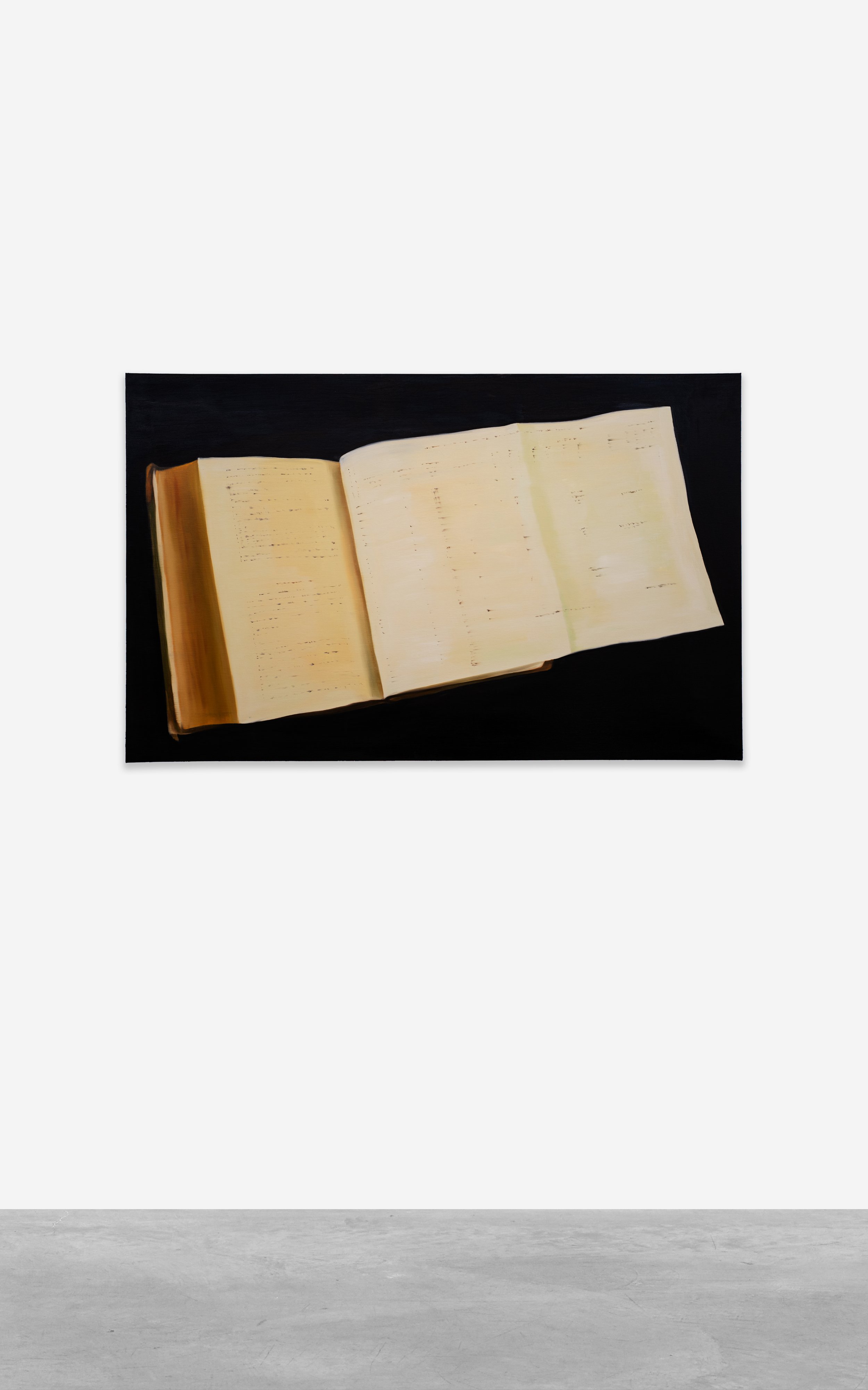
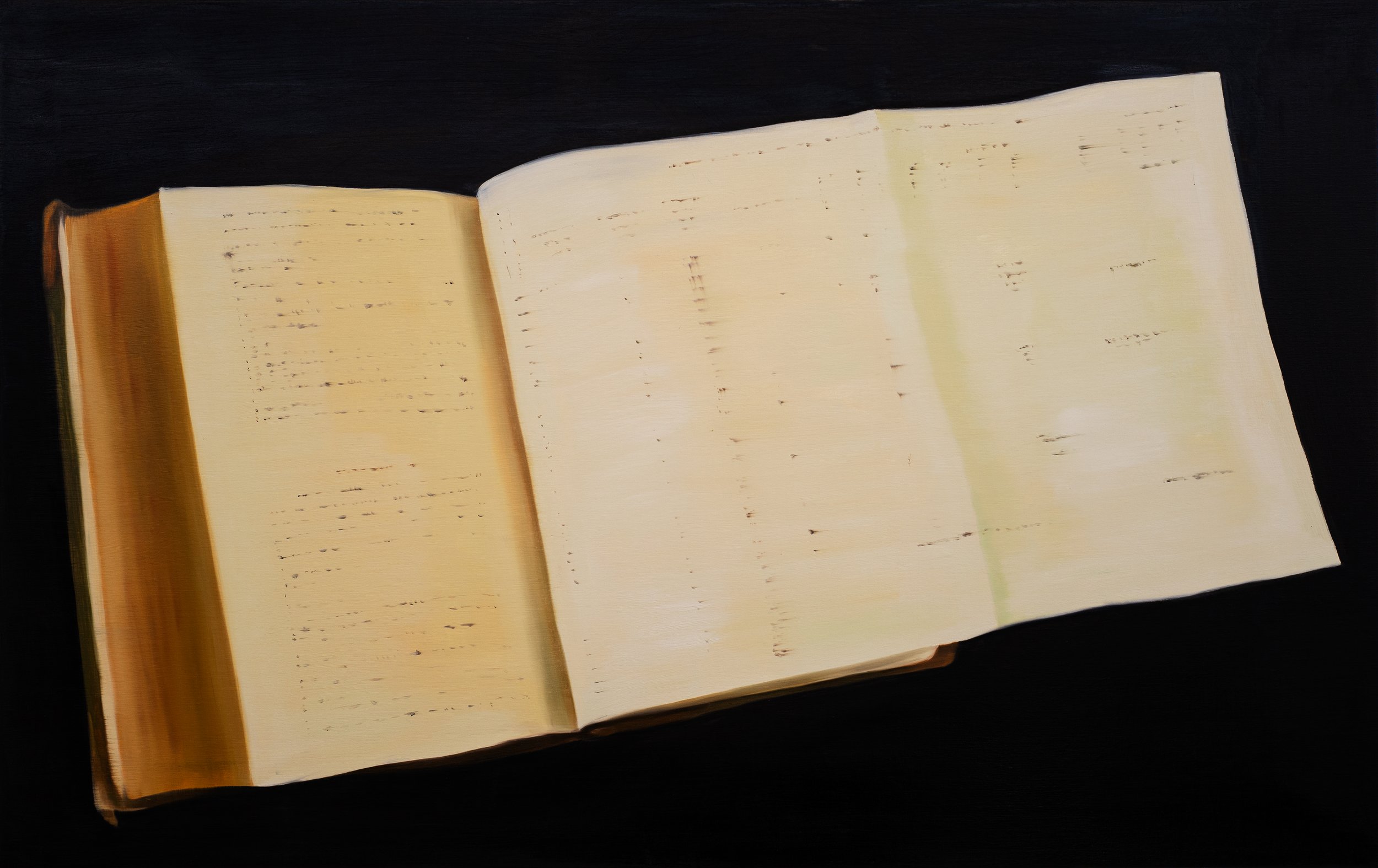
Oil on linen, 76 x 122 cm (30 x 48 in). The format is wider than it is tall, a landscape orientation that suggests the spread of a document, a page laid open on a desk or a screen. The proportions approximate the aspect ratio of a sheet of paper or a letter, and the painting exploits this association by filling the central field with the image of a page covered in handwritten notations, mathematical symbols, and the dense, angular script of nineteenth century penmanship. The page floats against a background of pure black, and the black is not a neutral ground. It is the black of a screen, a terminal, a void from which information emerges, and it isolates the document with the same absolute authority that a spotlight isolates an object on a darkened stage. There is no context, no desk, no room, no hand holding the pen. The page exists in a space that has been stripped of everything except itself, and the stripping is itself a statement: this document, this note, this afterthought appended to a translation of a paper written by someone else, is the object that matters.
The content of the page is blurred. The equations, the operational steps, the specific mathematical procedures that Lovelace outlined for the computation of Bernoulli numbers are present in the painting, but they are not legible. The brushwork softens the lines and disperses the ink marks, producing a surface in which the writing is visible as writing, as a pattern of marks on a ground, but not readable as text. The effect is not random. It is controlled, deliberate, and consistent across the entire surface of the page, and it produces a specific emotional and intellectual response: the viewer can see that there is writing, can identify it as writing, can perhaps recognize individual letters or symbols in isolated passages, but cannot extract the meaning that the writing was designed to carry. The information is there, present in the image, but it has been made inaccessible by the very act of representation. Tan Mu has described this choice explicitly: "The equations and specific steps are no longer fully legible. This obscurity mirrors how the historical contributions of women in computing have been gradually erased or rendered indistinct over time." The blurring is not a failure of precision. It is an act of fidelity to a historical truth: the erasure of women's intellectual labor from the record of technological progress is not an absence of information but a deliberate making-indistinct, a process that leaves traces without making them legible, that preserves the outline of the contribution while denying access to its content.
Johannes Vermeer's The Geographer (1669) depicts a scholar standing at his desk, one hand resting on a sheet of paper, the other holding a pair of dividers, his body turned slightly toward the window that illuminates the room. Behind him, on the wall, hangs a map. Before him, on the table, lie charts, books, and a globe. The composition is organized around the act of looking outward: the light enters from the left, the geographer faces the window, and his instruments are arranged on the surface that separates him from the world he is trying to measure. The painting is a portrait of concentration, but it is also a portrait of privilege: the privilege of a room of one's own, the privilege of instruments purchased and maintained, the privilege of time to think, to calculate, to draw conclusions from observations. The geographer is not looking at the map. He is looking past it, through the window, toward the world itself, and the map on the wall behind him is the record of an earlier attempt to contain that world in a system of lines and coordinates. The dividers in his hand are the tool of that system, the instrument that translates the curved surface of the earth into the flat geometry of the chart, and his slight turn away from the desk and toward the light suggests a mind that is not satisfied with the representation but is reaching toward the thing represented, the world beyond the window that the map can only approximate.
Lovelace's Note G is a document that shares this dual orientation. It is a representation of a machine that did not exist, describing operations that could not be performed, articulating a vision of what computing might become that exceeded the capabilities of the hardware its author was annotating. The Analytical Engine, designed by Charles Babbage, was a mechanical device for performing numerical calculations. Lovelace's note proposed that such a device could operate on symbols of arbitrary complexity, that it could compose music, generate patterns, and perform tasks that had nothing to do with arithmetic. This was not a prediction. It was a specification, a description of a capability that the machine, if it were built, would possess, and the description was so far ahead of its time that more than a century would pass before the computing community recognized it as a program rather than a commentary. The Note G is the map on the wall behind the geographer: a record of an attempt to contain the future in a system of symbols, written by someone who understood that the system was not the point. The point was what the system could produce, and Lovelace saw, with a clarity that no one around her shared, that what the system could produce was not limited to what it had been designed to produce. This is the generative insight, the idea that a machine for calculation could become a machine for creation, and it is the insight that Tan Mu's painting holds at its center, preserved under a layer of blur that protects it from easy consumption while making its presence unmistakable.
The historical context of Note G is inseparable from the question of authorship and credit. Lovelace's notes were published under the initials "A.A.L." in 1843, appended to her English translation of Luigi Menabrea's Italian paper on the Analytical Engine. The notes were three times the length of the original paper. They contained, in Note G, a detailed algorithm for computing Bernoulli numbers using the Engine's operations, complete with step by step instructions, variable assignments, and a traced execution path that demonstrated the algorithm would produce the correct result. This is, by any reasonable definition, a computer program: a sequence of operations to be performed by a machine, specified with enough precision that the machine could, if it existed, execute them without further human intervention. Babbage himself, who had designed the Engine, did not write this program. He provided the hardware specification. Lovelace provided the software. The division of labor is exact, and it mirrors the division that would persist throughout the history of computing: men build machines, women write instructions, and the instructions are treated as supplementary to the machine rather than constitutive of it. Tan Mu's deliberate blurring of the page enacts this supplementary status at the level of the image. The page is present, the writing is visible, but the content, the program itself, has been rendered indistinct, as though the historical record could acknowledge that Lovelace wrote something without having to specify what that something was or why it mattered.
Hannah Hoch's Cut with the Kitchen Knife Through the Epoch of the Weimar Beer Belly (1919) is a photomontage that assembles newspaper photographs, advertisements, and mechanical illustrations into a composition that dismantles the visual language of the Weimar Republic's mass media. Hoch, working in the medium of photomontage, which involves cutting, rearranging, and recombining existing images to produce new meanings, took the tools of mass reproduction, the camera, the printing press, the illustrated magazine, and used them against the narratives they were designed to propagate. The title itself is a provocation: the kitchen knife, a domestic tool associated with women's labor, becomes the instrument of an epochal critique, cutting through the "beer belly" of Weimar masculinity with the precision of a blade that knows exactly where to sever. The photomontage is dense, crowded, and overwhelming, filled with faces of politicians, industrialists, and cultural figures who are repositioned, resized, and juxtaposed in ways that strip them of their original authority and reveal the constructed nature of the images that sustain their power. The faces of women, including Hoch's own, appear throughout the composition, not as passive subjects of the male gaze but as active agents who reassemble the visual field according to their own logic.
The structural parallel to The Note G operates at the level of the woman who uses the tools of the dominant system to expose and transform that system. Lovelace used the tools of mathematical notation, the formal language of computation, to write a program that revealed the creative potential of a machine that its own designer had conceived as a calculator. Hoch used the tools of mass reproduction, the photograph and the printing press, to expose the mechanisms of ideological construction that sustained the Weimar political order. In both cases, the woman's intervention is made from within the system, using its own materials and conventions, and in both cases the intervention is subsequently marginalized: Lovelace's note was treated for decades as a commentary rather than a program, and Hoch's photomontages were dismissed by some critics as craft rather than art, a gendered classification that consigned her work to the category of domestic production rather than fine art. Nick Koenigsknecht, writing in the BEK Forum catalog in 2025, observes that Tan Mu's paintings function as "self portraits" of our relationship to technology: "While observing technology, are we not looking at ourselves? Therefore perhaps these works function more as self portraits, rather than depictions of external, scientific milestones." The Note G is the most explicit of these self portraits. It is a painting of a document written by a woman who used the formal tools of a male discipline to articulate a vision that the discipline itself could not yet accommodate, and it is a painting made by a woman who encountered that document at the same age as its author and who recognized in it a mirror of her own practice: the practice of seeing what the system cannot yet see and recording it in a form that the system will not yet read.
The black background of the painting is not an absence but a presence. Tan Mu has described it as a visual language she returns to when depicting objects that carry the weight of history: the black isolates the document, forces the viewer to confront it directly, and elevates its significance by removing every possible distraction. The black is also the color of the screen, the void from which data emerges, the ground against which luminous text appears in computing environments. Lovelace's note, written in ink on paper, is presented in the painting as though it were appearing on a display, a luminous document floating in the dark, and the blurring that makes the text illegible also makes it appear to glow, as though the ink were emitting light rather than absorbing it. This is not how ink on paper behaves. This is how pixels on a screen behave, and the translation of the medium, from paper to screen, from ink to light, from the nineteenth century to the twenty first, is the painting's most radical act of interpretation. It takes a document that was written for a machine that did not exist and presents it as a document that might have been written by a machine that does exist, and in doing so it collapses the hundred and eighty years between Lovelace's annotation and the present moment into a single visual field, where the blurred handwriting of a woman who died at thirty six is displayed on a dark ground that resembles the terminal that her note, if it had been read correctly, would have anticipated.
Tan Mu's description of her process reveals a specific and deliberate choice that connects the painting to the broader themes of her practice. "The image in the work is based on a handwritten note added by Ada Lovelace while translating Charles Babbage's writing. In this annotation, she proposed an idea that was radically ahead of its time: that mathematical equations could evolve into intelligent algorithms, and that machines might one day generate music, images, and patterns rather than simply perform calculations." The word "evolve" is the key. Lovelace did not predict that machines would calculate. She predicted that they would create, and the creation she envisioned was not mechanical reproduction but generative transformation, the production of outputs that could not be predicted from the inputs alone. This is the definition of generative computation that would not be formalized until Alan Turing's work on computability in the 1930s and would not be realized in practice until the development of stored program computers in the 1940s and 1950s. Lovelace saw it in 1843, in a note appended to a translation of a paper written by a man who did not see it himself, and she wrote it in language so precise that it could be executed, without modification, on a modern computer, if anyone had been willing to build one in the century between her note and its realization.
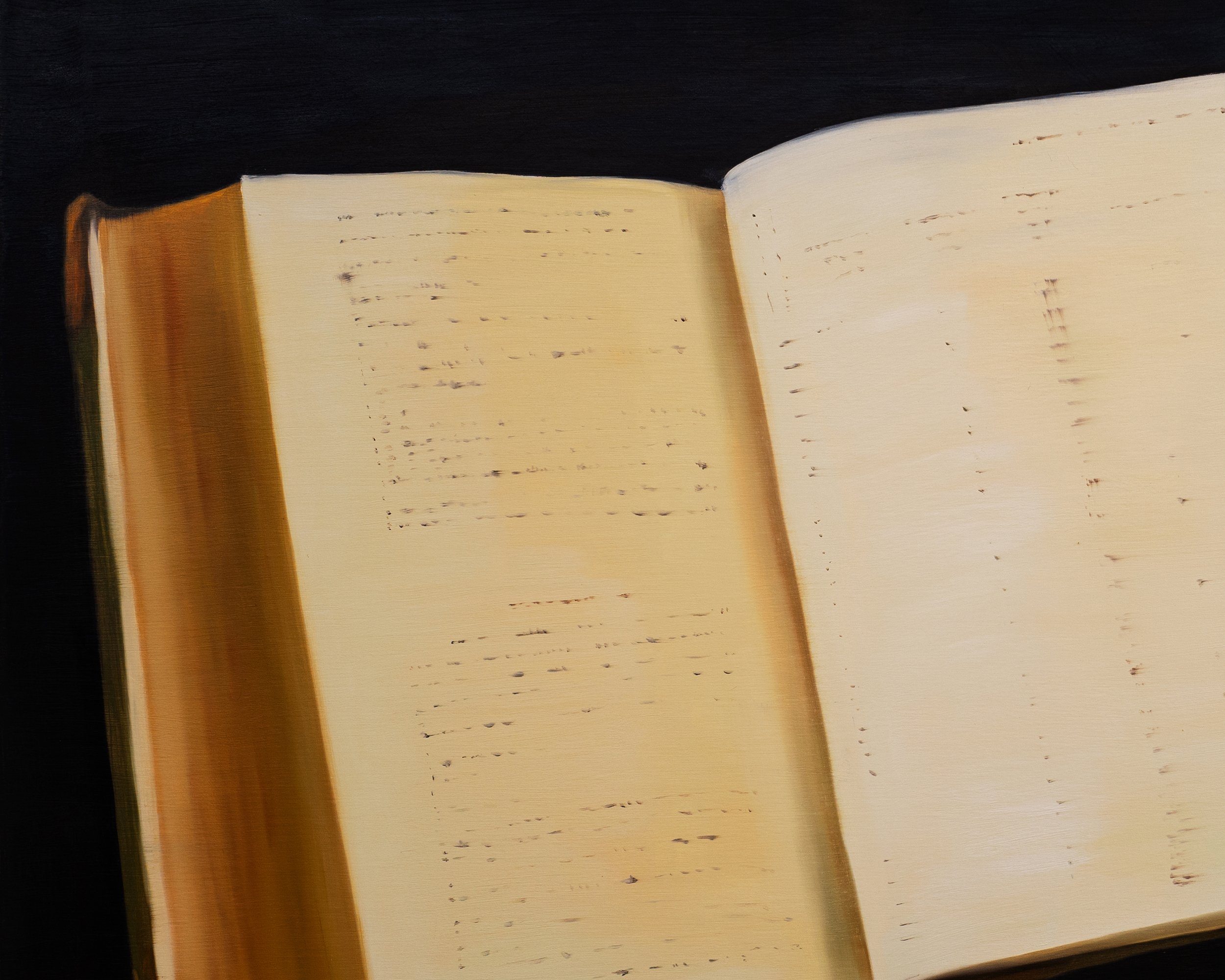
The painting holds two moments simultaneously. The first is the moment of composition, 1843, when a woman sat at a desk and wrote a sequence of operations that would not be recognized as a program for more than a hundred years. The second is the moment of erasure, the ongoing process by which women's contributions to computing have been rendered indistinct, attributed to others, or dismissed as supplementary to the real work of building machines. The blur in the painting is the visual register of this erasure, and it is also, paradoxically, an act of preservation. By blurring the content rather than removing it, Tan Mu makes the erasure itself visible. The viewer can see that there was something written here, that it was important enough to paint, that it contained information that has been made inaccessible. The blur does not conceal the fact of the writing. It reveals the fact of the concealment. It makes visible, in the language of paint, what the historical record has made invisible through the slow accumulation of omissions, misattributions, and deliberate minimizations. The Note G exists. It was published. It was read. And yet, for most of the history of computing, it was treated as a curiosity rather than a foundation, a footnote rather than a cornerstone. Tan Mu's painting takes this footnote and places it against a black ground, in a field of oil on linen, at a size that makes it inescapable, and asks the viewer to look at what they cannot read, and to consider why they cannot read it, and to understand that the illegibility is not an accident of time but a product of the same systematic processes that built the technology on which the painting itself is now being viewed, displayed, discussed, and archived. The ink that foretold the future was written by a woman who died at the same age as the artist who painted her page, and the page, blurred and luminous against its dark ground, is both a memorial and a provocation: a reminder that the future was foretold by someone whose name was reduced to initials, and that the blurring of her words is the blinding of a light that has always been there, waiting to be read.