The Page That Never Loads: Tan Mu’s Web and the Architecture of Overload
The browser tab sits in the foreground, spinning. The page you were reading has dissolved into a white void, and the new page has not yet arrived. For a fraction of a second, sometimes longer, the screen holds nothing but potential: no content, no narrative, no destination, only the thin rectangular outline of a window waiting to fill with information it has not yet received. Most people never notice this interval. It passes in the time it takes a server to respond, a packet to travel, a render engine to assemble pixels into type. Tan Mu noticed. She built an entire painting from that pause.
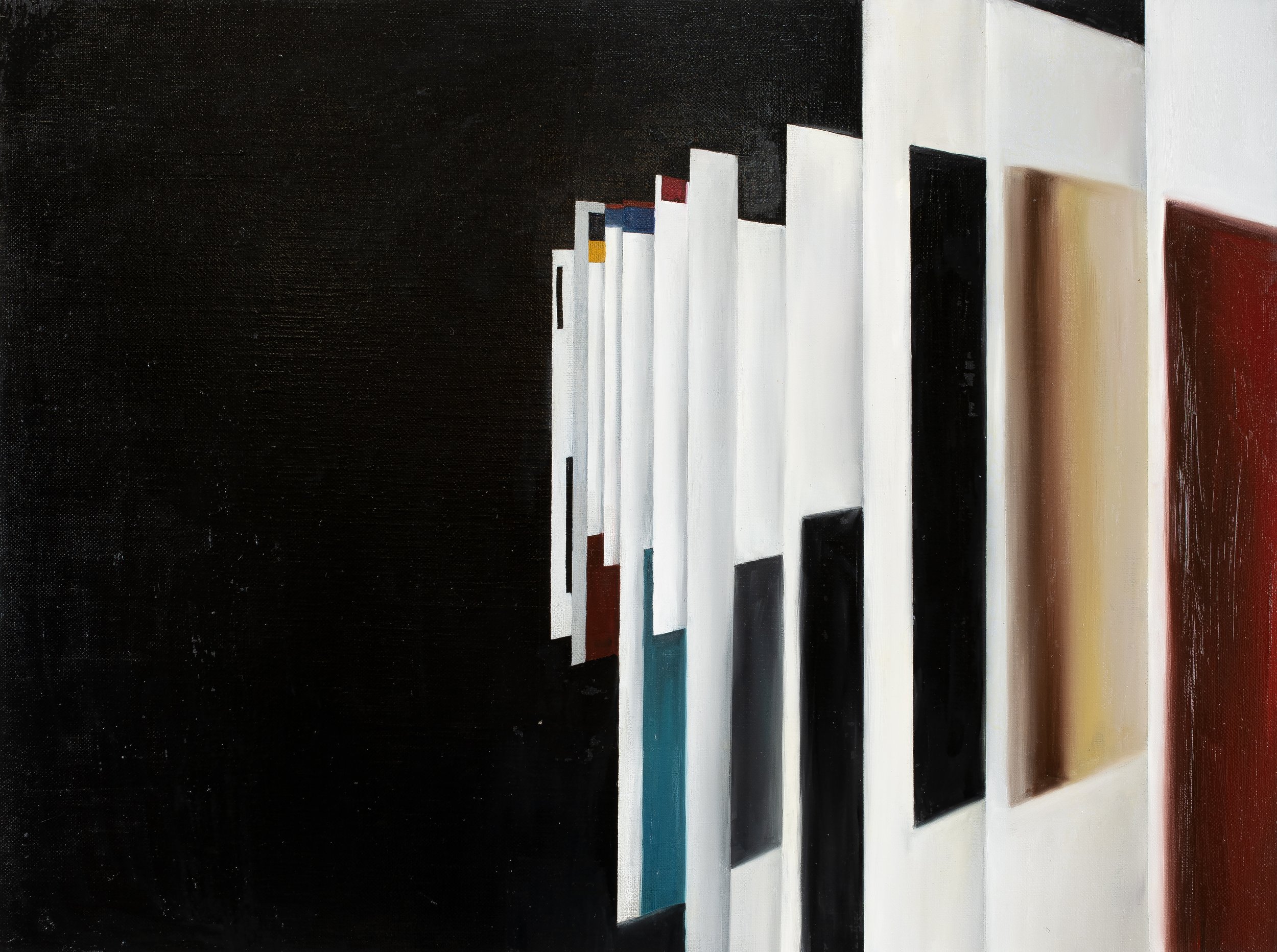
Web (2021), oil on linen, 18 x 24 inches, is not a painting of the internet in the way that a photograph of a server farm is of the internet. It is a painting of the experience of being inside the internet, of having multiple demands on attention open simultaneously, of the way a screen can present twelve different kinds of content at once and still feel like a single unified field of consciousness. The composition overlays several rectangular windows, each cropped and offset, against a black ground so deep it reads as void rather than background. These windows contain no legible text, no recognizable logos, no headlines or banners. Tan Mu has abstracted every specific content into color blocks: blue-grey rectangles, pale amber fields, thin white borders, a muted crimson bar along one edge. The recognizable has been removed, and what remains is the structure of attention itself, the geometry of being online.
Danni Shen, writing in Emergent Magazine in 2024, observed that Tan Mu's works "serve as a kind of witness to human socio-technological histories," registering "the trajectory and continuum of bodily and mediated presence through human technical developments." Web does not illustrate this trajectory. It inhabits it. The painting does not show you what is on the screen. It shows you what it feels like to have a screen show you everything at once, and to feel neither informed nor overwhelmed but suspended in a state of continuous partial attention that has become so routine it no longer registers as a condition worth naming.
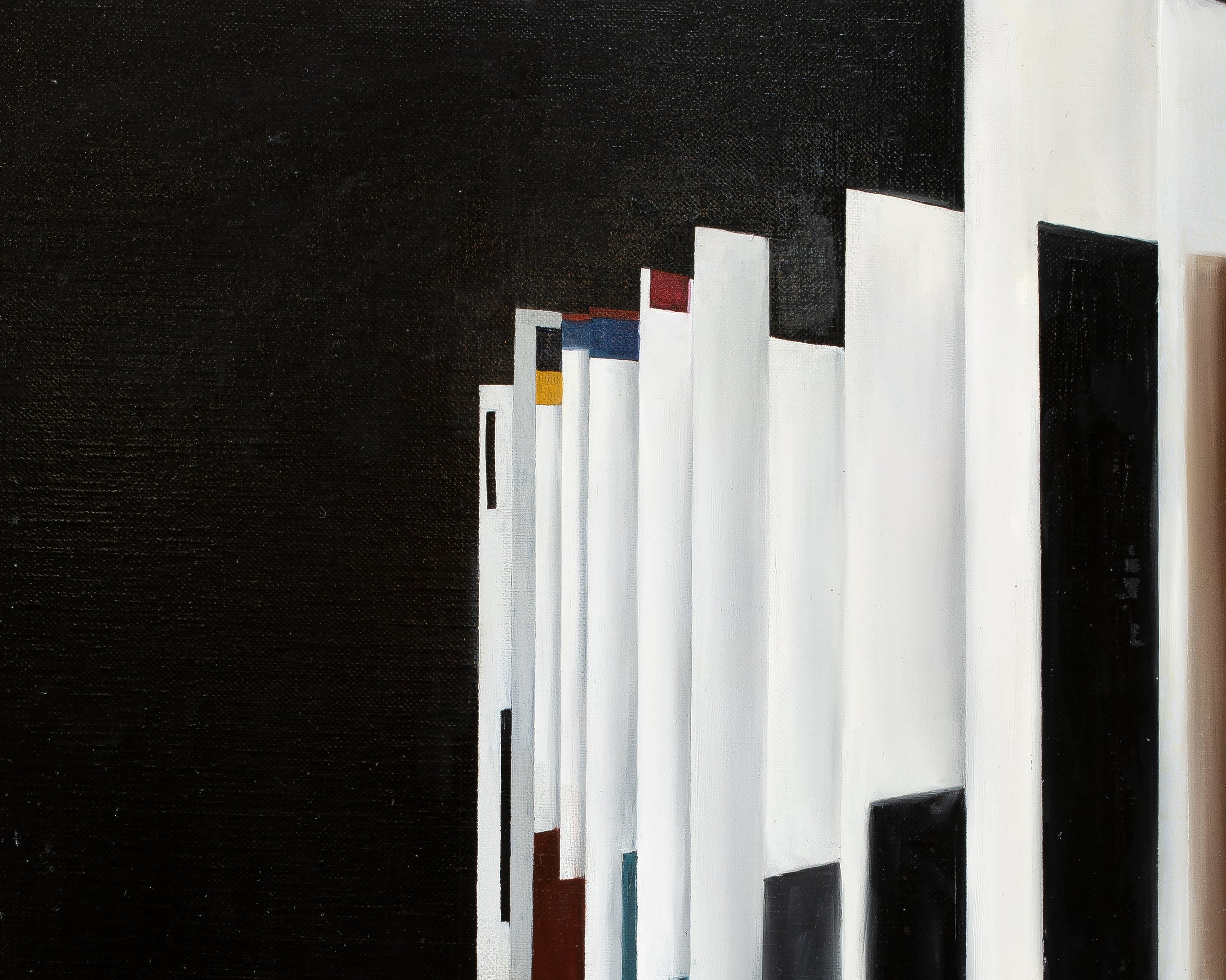
The physical presence of Web contradicts the weightlessness of its subject. Oil on linen at 18 x 24 inches is a modest format, roughly the dimensions of a laptop screen turned sideways, and this is not an accident of convenience. The scale matches the device that produces the experience the painting depicts. At arm's length, the linen weave is visible through the paint in the darker passages, a reminder that the void behind those floating windows is not digital black but pigmented absence, built up in thin layers over a material substrate. The black ground has depth. It is not the flat black of a powered-off monitor but a layered, optical black that recedes, pulling the floating rectangles forward as if they were projected onto a theatrical scrim. The windows themselves are painted with enough impasto along their edges to cast faint shadows under raking light. These are not flat planes of color; they are objects in shallow space, each one hovering slightly above or below its neighbor, overlapping and occluding. The composition creates a consistent illusion of depth without resorting to perspective: the windows are simply in front of and behind each other, the way browser tabs and application windows actually arrange themselves on a screen, each one a layer of simultaneous demand.
The color palette is restrained and specific. Muted steel blues, warm off-whites, a thin line of crimson near the upper edge, cool greys that shift toward green in certain light. These are not the saturated colors of a screenshot or a digital mockup. They are the colors of content after it has been stripped of specificity, the residual chromatic memory of news sites and social media feeds and streaming video thumbnails. Tan Mu describes her process as one of progressive simplification: "At first, I included multiple overlapping elements such as news articles, advertisements, and recognizable media logos. Over time, I chose to simplify these details. I transformed text and logos into abstract color blocks, allowing the composition to become more universal and less tied to specific sources." The painting records this reduction. The traces of recognizable content are gone, and what persists is the rhythm of information, the cadence at which one window replaces another, the tempo of scrolling, refreshing, switching, returning. The painting is not about any particular website. It is about the shape that all websites share when you stop reading them and start seeing them as color and edge.
In 1923, Raoul Hausmann assembled the photomontage ABCD, a self-portrait of the artist with the letters of the alphabet spilling from his open mouth, fragments of newspaper type and mechanical imagery layered across the picture plane in a density that matched the sensory assault of Weimar Berlin. Hausmann was a Berlin Dadaist, a provocateur who believed that the fragmentation of modern urban experience demanded a correspondingly fractured visual form. His photomontages, like those of his colleague Hannah Hoch, took the literal material of mass media, newspapers, advertisements, mechanical diagrams, and cut them into new compositions that refused hierarchy. Every fragment was simultaneous. No single element dominated. The photomontage was a portrait not of a person but of a condition: the condition of being bombarded by information that arrives in fragments and never resolves into a coherent whole.
Web shares this genealogy. Where Hausmann cut physical newspaper with scissors and glued the fragments onto paper, Tan Mu paints the rectangles that organize digital content with oil on linen, but the structural logic is the same. Both artists take the raw material of information overload and compose it into a field where no single element claims primacy. The difference is that Hausmann preserved the legibility of his fragments. You can still read the headlines in ABCD, still identify the mechanical parts, still parse the political content. Tan Mu has stripped her fragments of all legibility. The headlines have become blue-grey rectangles. The advertisements have become amber fields. The social media feeds have become thin white borders. This is not abstraction for its own sake. It is an act of radical translation that asks what remains of information when you remove the information itself. Hausmann showed that media fragments could be rearranged to reveal new meanings. Tan Mu shows that media fragments can be emptied of meaning and still register as a portrait of contemporary consciousness. The structure persists even when the content has been evacuated.
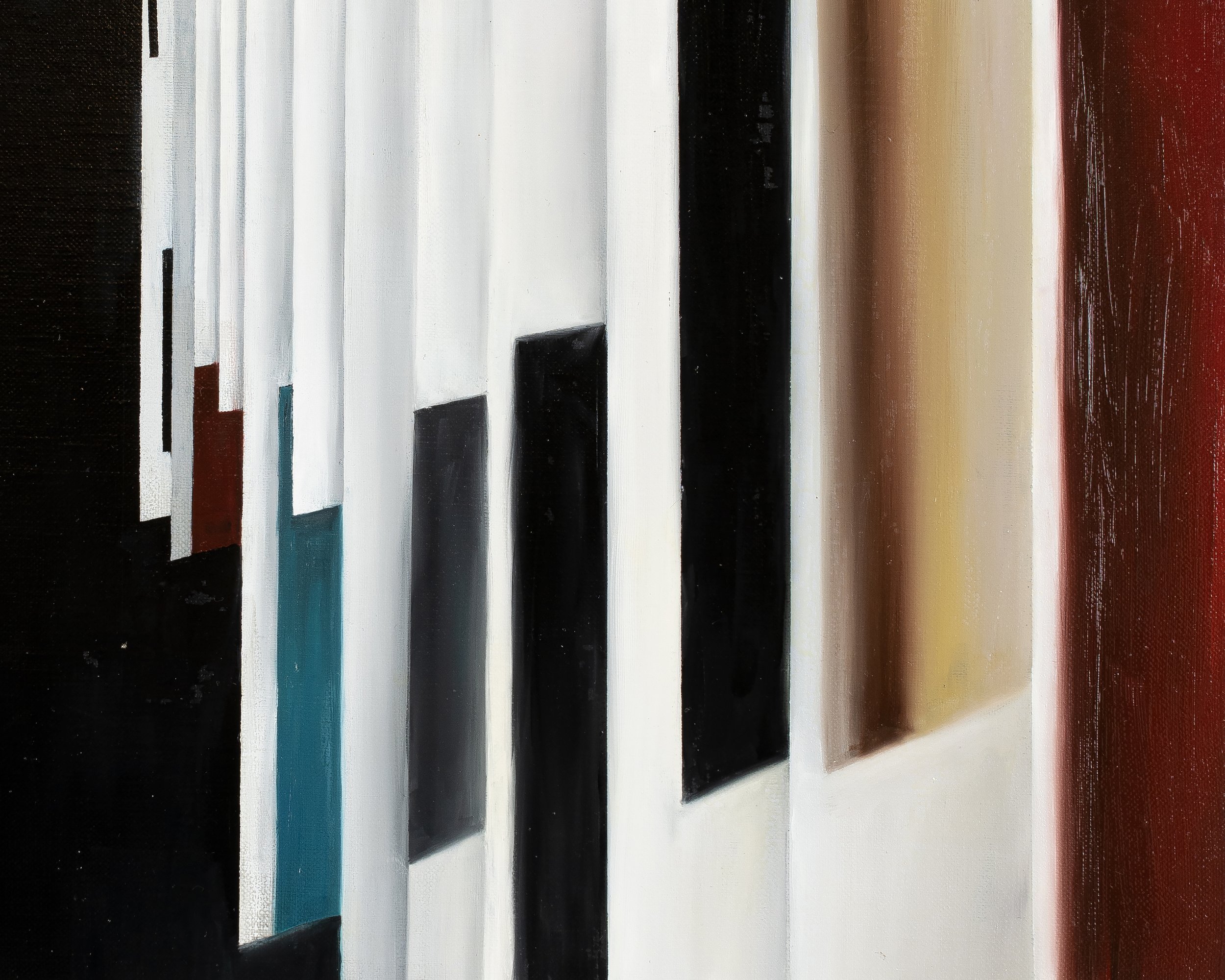
The stated subject of Web is the moment of page transition, the instant when one browser page dissolves and another has not yet materialized. Tan Mu describes this as part of a sustained investigation of fleeting moments that carry outsized consequences. In her own framing, Web belongs alongside The Splash of a Drop 1 (2022), which captures the microsecond a water droplet impacts a surface, and Trinity Testing (2020), which freezes the seconds of a nuclear explosion. These are works about instants that seem negligible but determine everything that follows. The browser transition is such an instant. In the half-second between one page and the next, the entire architecture of digital attention is exposed: the window that closes, the window that opens, the windows that remain open behind both, each one a demand that has not yet been answered and will not wait indefinitely.
The history that Web enters is the history of the graphical user interface as a compositional principle. The overlapping window, the menu bar, the scrollable column, the tab: these are the elements that organize nearly every waking hour of the approximately five billion people who use the internet regularly. They were invented at Xerox PARC in the 1970s, commercialized by Apple in 1984, and universalized by Microsoft Windows in the 1990s. By 2021, when Tan Mu painted Web, the windowed interface had been the dominant visual environment on Earth for three decades. The rectangular frame had become the most commonly viewed shape in human history, surpassing the horizon line, the doorway, the page. Every email is a rectangle. Every photograph on a screen is a rectangle. Every video is a rectangle inside a rectangle. The geometry of the interface has trained a generation to see the world as a set of overlapping, resizable, minimizable frames, each one containing a different stream of information that competes for attention with every other frame simultaneously visible.
Tan Mu's composition does not merely depict this condition. It performs it. The windows in Web overlap at angles and offsets that create a shallow but insistent spatial depth, and the viewer's eye cannot settle on any single rectangle without being pulled toward the one behind it or the one overlapping it from above. This is exactly the experience of navigating a screen with multiple applications open: the eye is always in transit, always en route from one demand to the next, never arriving at a destination because arrival would mean closing the other windows, and the other windows contain things you have not yet finished. The painting's modest scale intensifies this. At 18 x 24 inches, it is small enough that you can see the entire composition at once, but the overlapping geometry prevents any single reading. Your attention skims the surface the way it skims a browser, landing briefly on one color block before sliding to the next, never quite finding the focal point that would organize the whole.
Vera Molnar, the Hungarian-French pioneer of computer art, spent decades investigating what happens when geometric rules are applied to visual composition and then systematically disrupted. Her series Des Ordres (1975) begins with a simple premise: draw a grid of squares, then introduce slight, programmed irregularities into the lines. The resulting images hover between order and disorder, between the grid as a rational structure and the grid as a field of perceptual vibration. Molnar was working with plotters and algorithms, not oil paint, and she was not depicting browser windows, but her central insight is one that Web shares: that the rectangle, when multiplied and overlapped and slightly misaligned, becomes the most powerful visual instrument for registering the tension between system and sensation. Molnar's squares wobble. Tan Mu's windows overlap. Both artists understand that the grid is never neutral. It is the shape of administration, of bureaucracy, of the spreadsheet and the database and the browser tab. To make art from the grid is not to celebrate its efficiency but to expose the human cost of living inside it, the way it partitions attention into units too small to sustain thought but too numerous to ignore.
Molnar's method was algorithmic. She wrote programs that generated variations on a theme, and the computer executed the instructions without deviation. The irregularities in Des Ordres were not mistakes; they were parameters built into the code. Tan Mu's method is painterly and deliberative. She began Web with recognizable content and then, by hand, over the course of weeks, removed every identifiable element, replacing headlines with colored bands, logos with abstract shapes, photographs with tonal fields. The process is the opposite of Molnar's: where Molnar wrote rules and let the machine produce the image, Tan Mu made the image by hand and then subtracted the specific until only the general remained. Both arrive at a similar destination: an image that is recognizably structured but resistant to any single reading, an image that mirrors the experience of being inside a system that processes more information than any individual can absorb.
Tan Mu has identified Cubism as a predecessor for the visual logic of Web, and the connection is precise but not decorative. Cubism, beginning around 1907, was the first sustained attempt in Western painting to represent the experience of seeing multiple aspects of an object simultaneously. A Cubist portrait presents the front and the side of a face at the same time, flattening the illusion of depth into a field of overlapping planes. This was a response to a specific historical condition: the acceleration of urban life, the arrival of the automobile, the cinema, the newspaper, all of which imposed a new tempo on perception. The Cubists did not paint what a face looked like. They painted what it felt like to see a face in an environment where attention was fragmented across multiple stimuli. Web extends this logic from the physical world to the digital one. The overlapping windows in the painting are not Cubist facets of a single object but Cubist facets of a single screen session, each one a different stream of information competing for the same rectangle of visual real estate. The painting translates the Cubist strategy of simultaneity into the language of the graphical user interface, and in doing so, it reveals that the interface itself is already Cubist. Every time you open a browser, you are looking at a Cubist composition: multiple perspectives compressed into a single plane, none dominant, all demanding.
The black ground in Web is not simply a background. It functions as the virtual space that the internet occupies, a space that is not empty but is devoid of the visual markers that would identify it as a place. In Tan Mu's description, "the black background represents the virtual space of the internet, while the floating windows act as fragmented pieces of the digital experience, both familiar and abstract." The depth of this black, achieved through layered oil paint on linen, creates a spatial recession that the floating windows occupy at different depths. Some windows sit close to the surface, their edges sharp and their colors relatively saturated. Others recede, their borders softened and their tones muted, as if seen through a slight haze. The painting constructs a depth that mimics the experience of toggling between windows on a screen: the active window is bright and present, the background windows are dimmed, partially obscured, still visible but requiring an effort of attention to parse. This is not the atmospheric perspective of Renaissance landscape painting, where distant mountains fade toward a common horizon. It is the depth of the operating system, where each layer of information exists at a different level of activation, and the user's attention determines which layer becomes the foreground.
The connection to Tan Mu's other works is structural, not thematic. Silicon (2021) and Logic Circuit (2022) also employ layered compositions with stark contrasts, dark grounds, and rectilinear elements that read as circuit traces or data pathways. Web belongs to this lineage, but where Silicon compresses the circuit board into a single dense field and Logic Circuit maps the pathways of computation with a cartographer's specificity, Web opens the field into a set of overlapping planes that behave like windows rather than traces. The shift is from the circuit as a map to the circuit as an environment. In Silicon and Logic Circuit, you are looking down at a system. In Web, you are looking through it, and the system is looking back at you from multiple directions simultaneously.
Tan Mu has described her paintings as acts of witnessing, and the word is chosen with care. A witness does not interpret; a witness records. "Following the trajectory of social history in my painting essentially involves attempting to create a visual narrative that connects the perspectives of time," she told Danni Shen. "This witnessing behavior is akin to storytelling." Web witnesses the page transition not by depicting the content of any particular page but by preserving the interval between pages, the moment when the screen is neither here nor there, when one regime of information has dissolved and the next has not yet arrived. This interval, which lasts a fraction of a second on a functioning internet connection, has become the defining rhythm of contemporary consciousness. The average person switches between applications, tabs, and windows hundreds of times per day. Each switch is a micro-transition, a micro-interruption, a micro-loss of continuity that cumulates into a condition of permanent partial attention. Web makes this condition visible by refusing to resolve it. The painting offers no dominant window, no focal point, no single narrative. It presents the structure of overload without commenting on whether overload is good or bad. It is a record of what it looks like to be inside a system that processes more information than any single node was designed to handle.
The modest scale of the painting, 18 x 24 inches, is part of its argument. A larger canvas would have permitted more windows, more detail, more specificity. The small format forces a compression that mirrors the compression of the browser interface itself. On a phone screen, the windows do not overlap; they replace each other entirely, one after another, in a sequence that produces the illusion of depth without the spatial complexity of a desktop environment. Web returns to the desktop model of overlapping windows, but it reduces the scale to something that can be taken in at a glance, like a phone screen, while preserving the layered depth that the phone screen has flattened out of existence. The painting occupies a middle position between the two dominant screen experiences of 2021, and in doing so, it reveals something that neither screen format shows on its own: that the way information is presented, the geometry of its delivery, is not neutral. It is an architecture that shapes what you see, what you remember, and what you never have time to finish reading.
Raoul Hausmann's photomontages were called "synthetic portraits" by their maker, portraits of a condition rather than a person. Web is a synthetic portrait of a different condition, the condition of permanent adjacency, in which every piece of information exists next to every other piece of information, and no piece is more important than the piece beside it. The painting does not resolve this condition. It records it. And in recording it, with the patience and deliberation that oil paint demands, it transforms an experience that most people undergo thousands of times a day without noticing into something that can be seen, held, and considered. The page transition is no longer disposable. It has been given weight. The window is no longer transparent. It has been given opacity, and color, and a place on a surface that does not refresh.