The Command That Stays Still: Tan Mu’s Play and the Screen That Tells You What to Do
On September 7, 1927, Philo Farnsworth transmitted the first electronic television image in his laboratory at 202 Green Street, San Francisco: a simple horizontal line. When he was asked what he had seen on the screen, the sixteen-year-old inventor who had conceived the idea of electronic television while plowing a potato field in Idaho replied that the image was not worth looking at. The line itself was the achievement. The fact that it appeared at all, that electrons could be made to scan a surface and reproduce an image in real time, was the revolution. Content would come later. First came the screen, and the screen came empty. Nearly a century later, that emptiness still haunts every image that appears on a display. The screen is always there first, waiting, dark, patient. Whatever fills it is temporary. The screen persists.
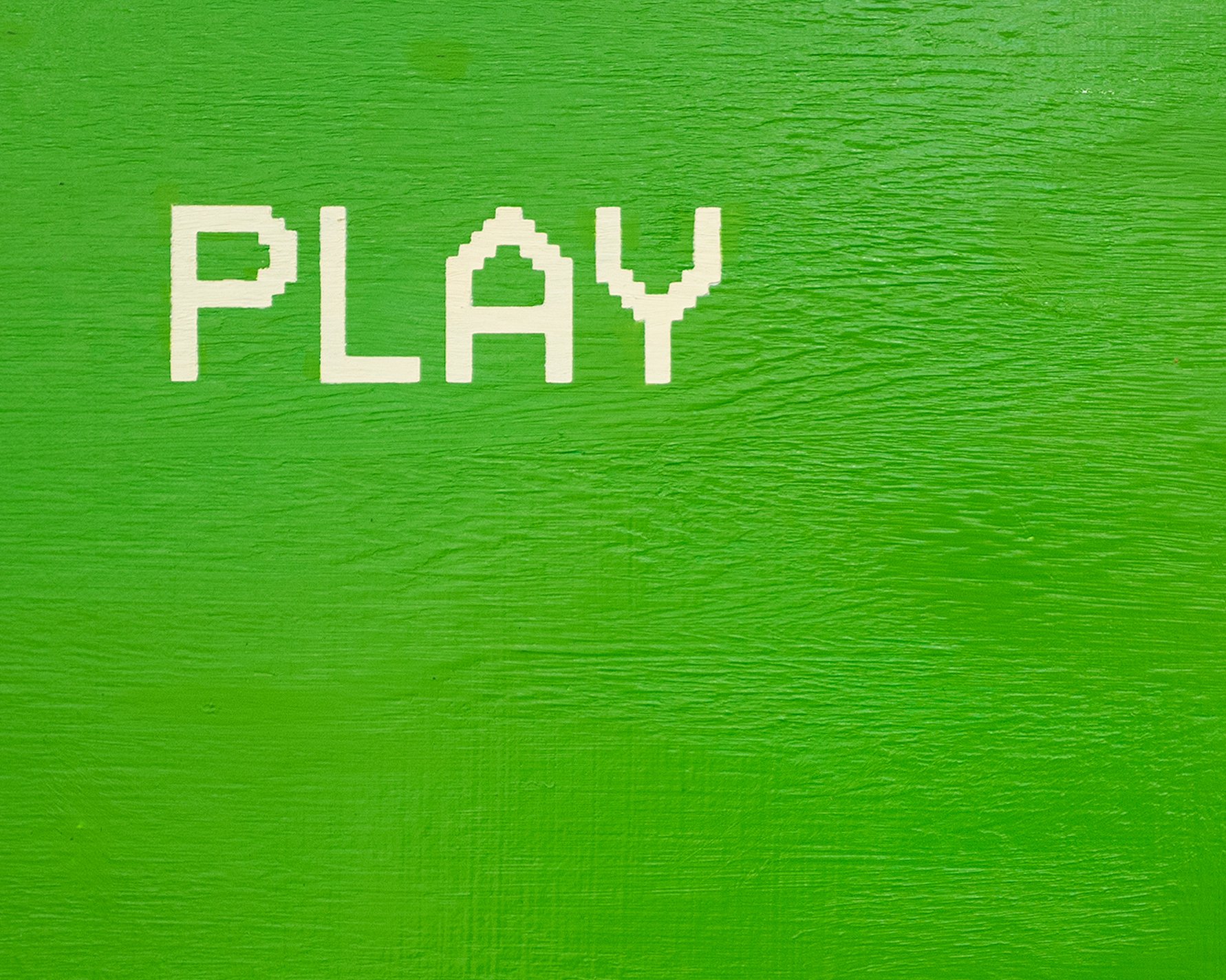
Play (2022), oil on linen, 41 x 51 cm, is a painting of that waiting. A single word, "PLAY," in blocky green capital letters, floats against a field of green scan lines that recede into a black surround. The composition replicates the visual language of a videocassette recorder paused at the moment before playback begins, when the machine has accepted the tape, registered the command, and the screen holds the word that promises motion without yet delivering it. The word is both an instruction and a status report. It tells you that the system is ready and that you have requested something, but it does not yet show you what you asked for. It is a command that has been issued but not yet fulfilled, a verb frozen in the infinitive between intention and action.
This is the paradox at the center of the painting. "Play" is a verb that means movement, spontaneity, freedom, improvisation, the opposite of work and the opposite of stillness. But on the VCR screen, "PLAY" is a static label. It sits on the screen doing nothing, representing the category of experience it promises without delivering any of that experience. The viewer looks at a command to move and sees only stillness. The painting extends this paradox into its own material: oil paint, the slowest of all media, applied by hand over weeks, depicting the fastest of all commands, the one that says "begin now." Every time you look at the painting, you are looking at a start that never starts, a play that never plays.
The physical presence of Play is inseparable from its subject. At 41 x 51 cm, the canvas is roughly the size of a paperback book held at arm's length, or the screen of a portable television from the early 1990s, the kind with a cathode ray tube built into a plastic housing that weighed as much as a small child. This is not the scale of a cinema screen or a contemporary flatscreen. It is the scale of domestic media, the screen you watched alone in a bedroom or a dorm room, the screen that belonged to you and not to the household. The format matches the intimacy of the experience it depicts: watching a VCR cue up a tape, waiting for the word "PLAY" to be replaced by the opening credits of a rented movie, alone in a room, late at night.
The paint surface enacts its subject with a precision that rewards close attention. Tan Mu describes beginning with a black base layer, allowing it to dry completely, then applying layers of green oil paint over the dried ground. The result is a surface that reads as luminous from a distance, the green appearing to emit its own light as a CRT phosphor does, but resolves at close range into a dense accumulation of horizontal brushstrokes that function as both image and texture. These brushstrokes, applied in deliberate horizontal passes, replicate the scan lines of a cathode ray tube, the thin luminous stripes that compose the television image by drawing it one line at a time, sixty fields per second. In the painting, those lines hold still. They do not refresh. They are paint, not phosphor, and they will not be replaced by the next frame because there is no next frame. The green field is permanent, fixed, terminal. The word "PLAY" sits on top of these scan lines in a slightly thicker impasto, its edges sharp and geometric, the letters rendered in a sans-serif typeface that recalls the on-screen displays of early video equipment. The black border around the green field is the deepest black in the painting, built up in multiple layers to create a void that the green appears to float above rather than sit within. This is not a flat black but a spatial black, a black that suggests the interior of a television cabinet, the darkness behind the glass before the tube warms up and the image appears.
In 1963, Ed Ruscha painted OOF, a three-letter word in bold yellow capitals against a deep blue ground, the letters cast in a blocky pseudo-serif typeface that seems to vibrate against its background. The painting is a sonic event made visual. The word "OOF" is the sound of a punch, an impact, a collision, but the painting delivers no impact, no motion, no violence. It delivers only the word that names the event, suspended in oil on canvas, silent, still, and completely inert. Ruscha's text paintings of the 1960s, including OOF, NOISE (1963), and GAS (1963), isolate ordinary words from their functional contexts and present them as objects to be seen rather than read. The word becomes a shape, a composition, a formal arrangement of geometric forms that happens to correspond to a syllable in English. You can read the word, but you cannot hear it. You can recognize the command, but you cannot obey it. The painting holds the word in a state of permanent deferral, a sign that points to an action it will never perform.
Play shares this logic. The word "PLAY" on the VCR screen is a command. It instructs the viewer to begin playback, to start the tape, to watch the content that the cassette contains. But in Tan Mu's painting, the command is decoupled from any content it might activate. There is no tape, no cassette, no program. There is only the word, sitting on the screen, glowing green in the dark, asking you to do something that the painting itself makes impossible. Ruscha's OOF isolates an onomatopoeia from the impact it describes; Tan Mu's Play isolates an imperative from the action it commands. Both paintings turn a word into an image and in doing so, reveal that words on screens have always been images first, signs second. The green "PLAY" on a VCR display was never really a word in the linguistic sense. It was an icon, a visual shorthand for a complex mechanical process: the engagement of the playback heads, the rotation of the helical scan drum, the conversion of magnetic patterns on tape into electrical signals and then into light on a phosphor screen. The word "PLAY" did not mean "play" the way a child means it or a musician means it. It meant "the machine is doing what you asked." It was a status indicator, not a philosophical proposition. But when you freeze that status indicator in oil paint, when you remove it from the flow of time that the VCR was designed to deliver, the word regains the other meanings that the machine had suppressed. Play as freedom. Play as improvisation. Play as the opposite of work, of duty, of the regime of productivity that the television was also a part of. The painting holds all these meanings open simultaneously, and none of them resolve.
The subject of Play, as Tan Mu states it, is the VCR playback screen and the cultural condition it represents. In her own words, "the word 'Play' operates on multiple levels. It is a technical instruction, but it is also a symbol of entertainment, consumption, and information delivery." The painting locates itself at the intersection of two histories: the history of video playback technology and the history of media critique. The VCR, introduced commercially in the 1970s and dominant in the 1980s and 1990s, was the first device that allowed ordinary people to control when and how they watched moving images. The remote control, the pause button, the rewind: these were new powers. For the first time, the viewer could stop the flow of broadcast television and resume it at will. The VCR gave the audience sovereignty over time, but it also trained them to expect that sovereignty, and when that expectation was transferred to the internet and the smartphone, it became a demand that every moment of attention be controllable, skipable, adjustable. The "PLAY" button is the ancestor of every "skip ad" button, every "tap to advance" prompt, every swipe that replaces one piece of content with the next. It is the origin of the assumption that the viewer is in charge.
Neil Postman, whose Amusing Ourselves to Death: Public Discourse in the Age of Show Business (1985) is the stated inspiration for the painting, argued that television had transformed American public discourse from a culture of print, where ideas could be developed at length and debated on their merits, into a culture of entertainment, where everything must be visually interesting, emotionally stimulating, and brief. Postman contrasted the Lincoln-Douglas debates, where audiences listened to hours of sustained argument, with television news, where a presidential candidate might receive thirty seconds of airtime, most of it showing the candidate's appearance and manner rather than the content of their speech. He did not argue that television was evil. He argued that it was a medium with a bias, and that the bias was toward spectacle, toward brevity, toward the emotional payoff over the sustained argument. The "PLAY" command on the VCR is the purest expression of this bias. It asks nothing of you. It does not ask you to think, to argue, to reflect. It asks you to watch. It asks you to consume. It asks you to be entertained. And it promises, in exchange, that the entertainment will be effortless, immediate, and continuous.
Tan Mu's painting does not illustrate Postman's argument. It materializes it. The green screen with its single imperative word is not a representation of a television; it is the experience of looking at one, condensed into a single moment of held breath. The scan lines, the phosphorescent green, the black surround, the blocky typeface: these are not metaphors for media culture. They are the visual grammar of media culture, rendered in oil paint with the same deliberation that a portraitist brings to the folds of a sleeve or the reflection in an eye. The painting takes the most ephemeral of visual experiences, the on-screen display of a VCR before playback begins, and gives it the permanence and material weight of a canvas that will hang on a wall for decades. It is a portrait of an interface, and the interface is one that most people would never have thought to look at twice. The VCR display was infrastructure, not content. It was the thing you saw while waiting for the thing you actually wanted to see. By freezing it, Tan Mu asks you to see what you were not seeing: the command structure that organizes your attention before the content even arrives.
Nick Koenigsknecht, in his catalog essay for the BEK Forum exhibition in 2025, observed that Tan Mu's paintings of technology "function more as self-portraits than depictions of external, scientific milestones." This observation, made in the context of the Signal series, applies with particular force to Play. The painting is not a depiction of a VCR. It is a self-portrait of the condition that the VCR created: the condition of being instructed by a screen, of receiving commands from an interface, of organizing one's leisure time around a device that promises control while delivering a sequence of pre-programmed options. Koenigsknecht continues: "While observing technology, are we not looking at ourselves?" The question reframes the painting entirely. The word "PLAY" is not addressing the machine. It is addressing you. It is telling you to play, to consume, to watch, to sit still while the images flow. And you do. The compliance is so automatic that it does not register as compliance. The VCR display trained a generation to respond to on-screen commands without thinking, and that training is the direct ancestor of the swipe, the tap, the scroll that now governs five billion daily interactions with screens.
The green of the painting is specific and deliberate. It is not the green of grass, or of emeralds, or of any natural phenomenon. It is the green of a cathode ray tube, the green of the earliest computer monitors and the monochrome displays that preceded color television. This green, known in the industry as P1 phosphor, was produced by zinc silicate activated by manganese, and it emitted light at approximately 525 nanometers, in the center of the human eye's range of peak sensitivity. The phosphor was chosen not for its beauty but for its efficiency: it produced the brightest image for the least electrical power, and it persisted on the screen long enough to reduce perceived flicker. In other words, this particular green was engineered to be as visible as possible, as legible as possible, as attention-grabbing as possible. It was not designed for aesthetic pleasure. It was designed for command and control. When Tan Mu applies this green in thick, horizontal brushstrokes that replicate the scan lines of a CRT, she is not painting a color. She is painting an engineered visual system, a technology of attention that was optimized for maximum legibility and minimum fatigue. The green does not ask you to admire it. It tells you to read it, to obey it, to play.
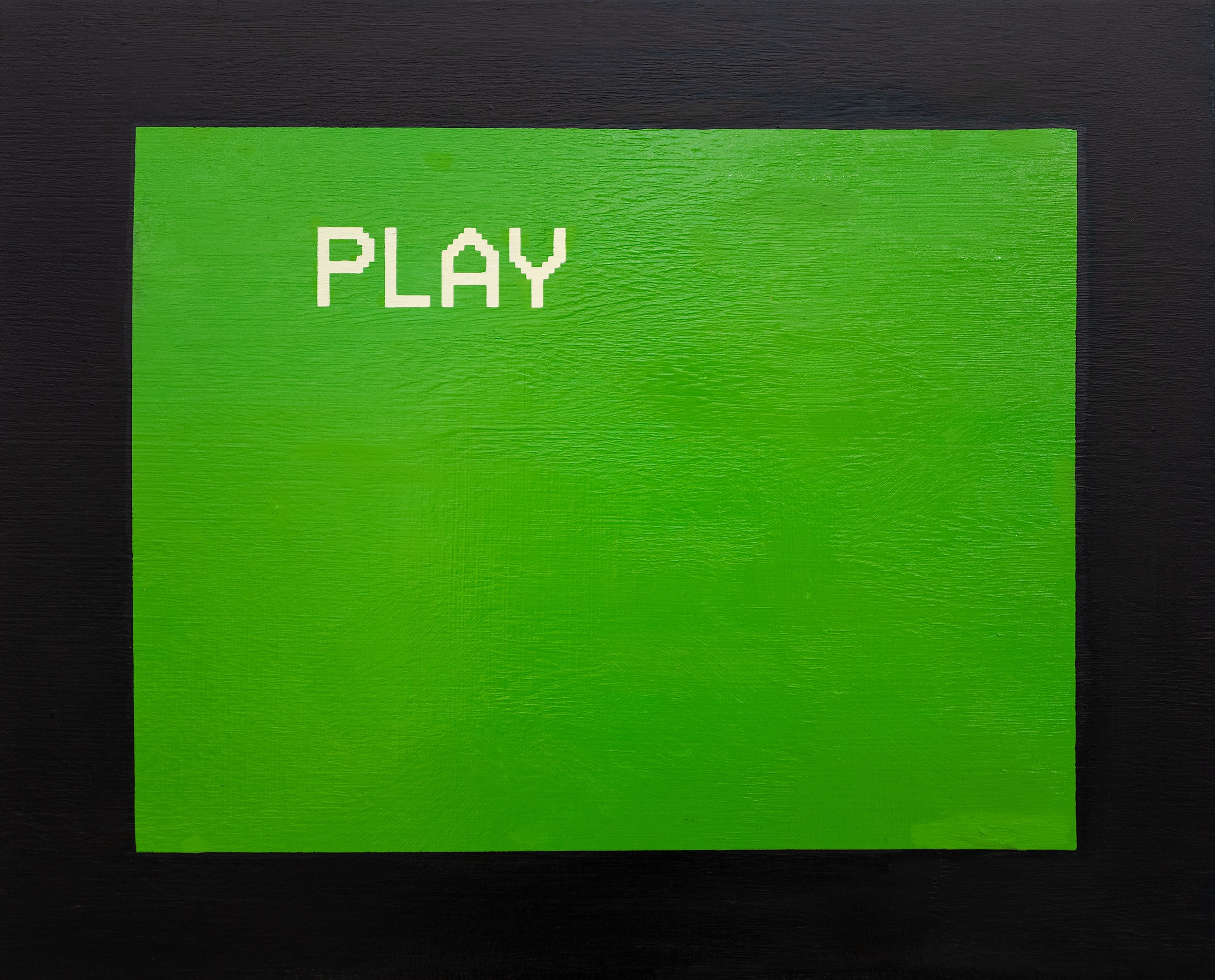
Tan Mu describes her process as beginning with the black base layer and building the green surface on top, with the word "PLAY" added as the final visual anchor. This sequence mirrors the actual operation of a VCR: the screen is black until the machine is activated, at which point the green on-screen display appears, followed by the content of the tape. In the painting, the content never arrives. The word "PLAY" is the last thing added, and it is the only thing the viewer sees. The tape is missing. The program is missing. The movie, the show, the advertisement, all the things the VCR was designed to deliver are absent. What remains is the frame, the interface, the command structure that tells you what to do without telling you what you will see when you do it. The painting is a portrait of a delivery system with nothing left to deliver.
This emptiness is not an omission. It is the argument. Postman argued that the medium of television had so thoroughly subordinated content to entertainment that the content no longer mattered; what mattered was the form, the pace, the visual rhythm, the expectation of pleasure that the medium itself created. Play makes this argument material. Remove the content, and what you see is the form: a green rectangle, a black border, a word in capitals, a set of scan lines. These elements are the architecture of attention. They are the structure that organized viewing time for three decades, from the introduction of the VCR in the late 1970s to its displacement by the DVD player in the early 2000s. During that period, hundreds of millions of people looked at screens just like this one, waiting for the word "PLAY" to appear, trusting that when it did, entertainment would follow. The trust was not in the content but in the command. The command was the content. The instruction to play was itself a form of entertainment, a promise embedded in a visual syntax so simple it could be read at a glance, so authoritative it required no interpretation.
The painting also connects to a lineage within Tan Mu's own practice. Like Web (2021), which freezes the moment of a browser page transition, and like The Splash of a Drop (2022), which freezes the microsecond of a water droplet's impact, Play isolates a fleeting moment of technological interface and gives it the duration of painting. These three works share a method: identify the instant that passes unnoticed, extract it from the flow of time, and render it in oil on linen with sufficient deliberation that the viewer must confront what they normally overlook. In each case, the instant reveals something about the system that produced it. The page transition reveals the architecture of multitasking. The splash reveals the physics of photography. The "PLAY" command reveals the logic of entertainment culture, the assumption that attention should be engaged, held, and directed by a system that operates before the content arrives and persists after it ends.
Ruscha's OOF hangs in the Museum of Modern Art in New York. It is small, funny, and instantly recognizable. Most visitors spend a few seconds with it, register the joke, and move on. The joke is the disjunction between the word's sound and the painting's silence, between the violence the word implies and the stillness the painting delivers. Play extends this disjunction into a new register. The word "PLAY" is not an onomatopoeia. It is a command. It does not describe a sound. It issues an order. And the order is one that hundreds of millions of people obeyed every day for decades without thinking of it as obedience. They pressed play. They watched. They consumed. They did what the screen told them to do. Tan Mu's painting holds that moment of obedience open, stretches it across linen, and makes it visible as what it was: a command disguised as a convenience, a control mechanism disguised as a service, a screen that tells you what to do and a culture that has agreed to call it entertainment.
The green field holds. The word holds. The scan lines hold. Nothing moves. Nothing will move. The painting is the command, and the command is the painting, and neither one is going anywhere.