The Posture That Held: Tan Mu’s Yoga Isolation and the Body in Ranged Separation
At a distance of six inches, the surface of Yoga Isolation is a field of thin, horizontal striations. The paint has been applied in narrow bands that travel across the linen from left edge to right edge, each band slightly different in tonal value from the one above it, creating a shallow but insistent atmospheric depth that holds the figures in place like sediment layered over time. The marks are not expressive. They do not gesture or swirl. They move in one direction, left to right, with the consistency of data plotted on a graph or lines of text read across a page. Up close, the painting is nearly abstract: a series of tonal events that shift from pale grey-green at the top to a muted teal-blue in the midsection to a darkened earth tone at the bottom, with no immediately legible figure to anchor the eye. Step back three feet and the figures emerge. Step back six feet and they become a pattern, a grid of bodies arranged on a green surface, each one occupying its own rectangle of space, each one performing the same activity with the same orientation, each one separated from its neighbor by a measured interval that no one in the painting chose but everyone in the painting obeys.
This is the central tension of the painting, and it is a tension that cannot be resolved by looking. Yoga Isolation (2022), oil on linen, 91 x 102 cm, is based on a photograph taken on June 21, 2020, during an outdoor yoga session in Toronto. The date is specific, and it matters. June 2020 was the first summer of the COVID-19 pandemic, a period when outdoor gathering was permitted in many cities under conditions of physical distancing, typically two meters of separation between individuals. The photograph that Tan Mu worked from shows what this looked like in practice: a group of people spread across a public park, each one confined to a small rectangle of ground, each one facing the same direction, each one performing the same sequence of postures, alone together. The word "yoga" comes from the Sanskrit for "union," and the practice has always been understood as a discipline of integration: the union of body and breath, of individual self and universal consciousness, of the practitioner and the community of practitioners. The pandemic transformed this union into a geometry. The practitioners were still together, still following the same sequence, still breathing in unison, but they were held apart by a distance measured not in the language of community but in the language of infection control. The painting records this transformation with a precision that neither the photograph nor the memory of the event can match.
The color palette is monochrome, or near enough to monochrome to read as such from any distance greater than arm's length. Tan Mu describes extracting color from the original photograph and then reducing it to a limited range of green-grey-blue tones that give the scene what she calls "an otherworldly atmosphere reminiscent of vintage science fiction posters." The comparison is exact. The green of the grass is not the green of any real park in summer. It is the green of a speculative landscape, the green of a world that might exist on another planet or in a future that has not yet arrived, a green that is both natural and artificial, both organic and processed. The figures on this surface are rendered in the same tonal range, their bodies flattened into the same chromatic field as the ground they stand on, their forms delineated not by outline but by the same horizontal brushstrokes that compose the background, so that at certain distances they appear to emerge from and dissolve back into the surface like organisms visible only under specific conditions of light and proximity.
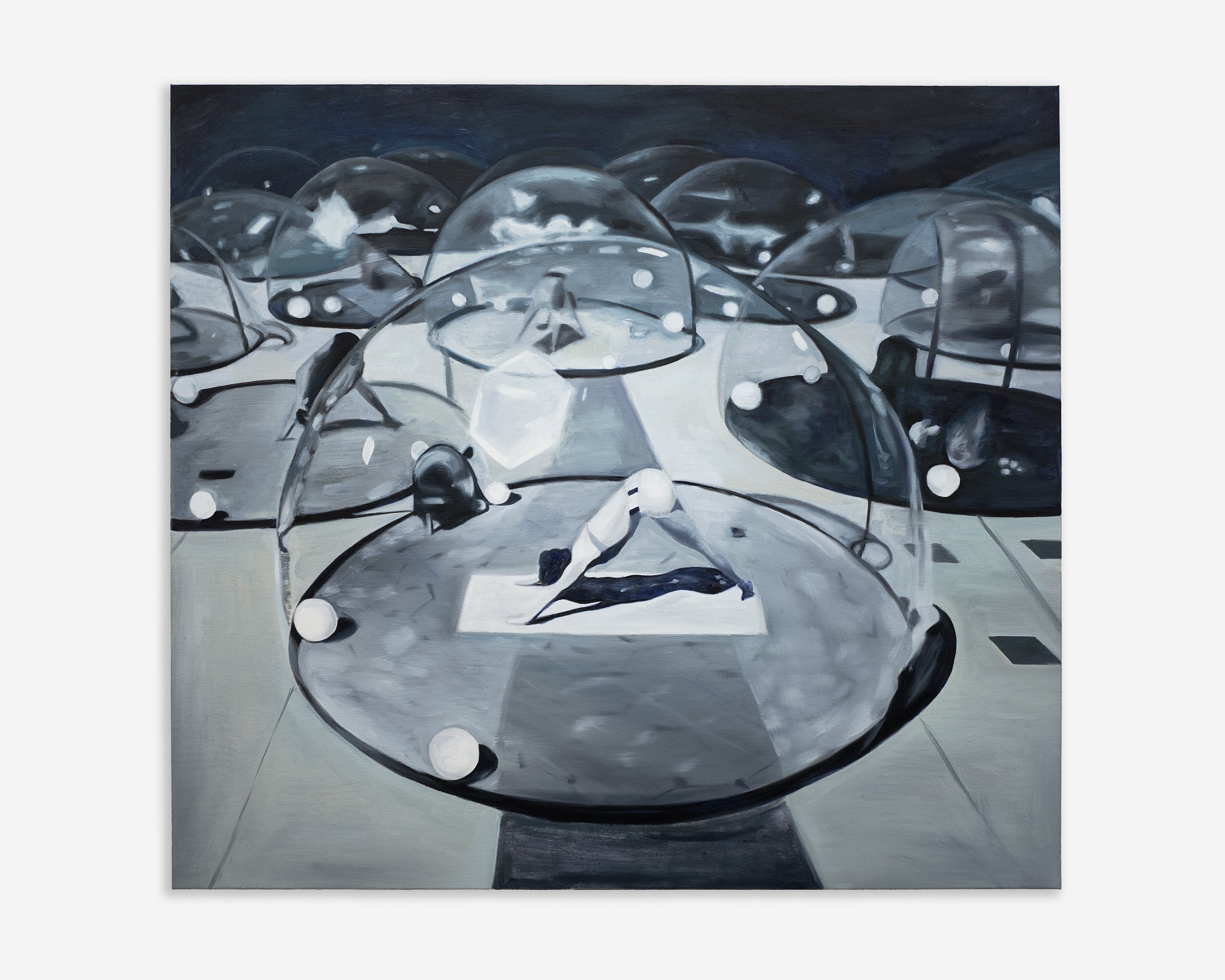
Edward Hopper painted Nighthawks in 1942, three weeks after the bombing of Pearl Harbor, in a country that had just entered a world war and a city where blackout regulations had darkened every window. The painting shows four figures inside a brightly lit diner after dark: three customers and one server, each one occupying a separate zone of the counter, each one turned away from the others, each one sealed inside a glass rectangle that opens onto an empty street. There is no door visible in the painting. The diner is a fishbowl, its interior exposed to the street but inaccessible from it, and the figures inside it are together but not together, present in the same space but oriented in directions that prevent any of them from meeting the eyes of another. Hopper denied any intentional symbolism. He said he was just painting a restaurant at night. But the painting has become the canonical image of urban solitude in the twentieth century because it captures a condition that most people recognized without being able to name: the condition of being surrounded by others who are equally unreachable, of sharing a space with people who are physically proximate and emotionally remote.
Yoga Isolation shares this structural logic, but it inverts the spatial arrangement. In Nighthawks, the figures are inside, sealed behind glass, visible from the outside but enclosed in a private interior. In Yoga Isolation, the figures are outside, spread across an open park, visible from every angle, with no walls or windows separating them from one another. The separation is not architectural but epidemiological. There is no glass, no counter, no barrier except the two meters of empty ground between each practitioner. This makes the isolation more visible and more strange, because there is nothing physical preventing the figures from approaching each other. The distance between them is not imposed by walls but by understanding, by the shared knowledge that proximity is dangerous and that the ethical thing to do is to stay apart. Hopper's diners are isolated by architecture. Tan Mu's yogis are isolated by consensus. The painting makes this consensus legible as a visual pattern: the regular spacing of the figures across the green field, each one in its own rectangle, each one facing the same direction, each one performing the same posture, produces an image that looks simultaneously like a community and like a diagram. The figures are in formation, but the formation is one of distance, not proximity. They are aligned, but their alignment is a consequence of separation, not connection.
The source photograph for Yoga Isolation was taken during International Day of Yoga, June 21, 2020, in Toronto, one of the many cities that observed the annual event with mass outdoor sessions. In normal years, these sessions produce images of bodies flowing together in parks, thousands of practitioners moving in unison across open lawns, their mats touching or nearly touching, their breath synchronized, their postures aligned. In 2020, the same event produced something entirely different: bodies arranged in rows and columns with measured intervals between them, each one occupying a prescribed rectangle of space, each one maintaining the distance that public health guidelines mandated. The contrast between the intention of the event (union, community, shared breath) and the condition of its execution (separation, measurement, controlled distance) is the subject that the painting was built to hold. Tan Mu describes the choice of monochrome as a response to the emotional weight of physical distance and silence. Removing color, she explains, allowed her to heighten the surreal quality of the moment, "where ordinary activities took on a strange and suspended feeling." Yoga, a practice rooted in balance and continuity, became a symbol of resilience within an uncertain and fragmented world.
The monochrome palette does more than create a science fiction atmosphere. It removes the specific time of day, the specific season, the specific weather. In the original photograph, the Toronto park is green and bright, a summer morning with all the particularity that sunlight and grass and warm air produce. In the painting, this particularity has been compressed into a range of cool, desaturated tones that could belong to any climate or no climate, any planet or a studio set. The figures, too, have been stripped of their individual colors. Their clothing merges with the ground. Their skin tones approximate the same grey-green as the grass beneath them. The effect is not dehumanizing in the way that military uniformity dehumanizes, because the postures are varied enough to suggest individual bodies with individual capabilities. But it is de-contextualizing. The painting removes the evidence that would place this scene in Toronto in June 2020, and in doing so, it makes the scene available to any viewer who has experienced the condition it depicts: the condition of performing a communal activity in isolation, of being with others while remaining apart, of following instructions that were designed for connection through a framework that enforces distance.
The dimensions of the painting, 91 x 102 cm, are modest but not small. The canvas is large enough to accommodate the full breadth of the arrangement, the regular spacing of the figures across the park, but small enough that the viewer must step close to see the brushwork and step back to see the pattern. This dual viewing distance replicates the experience of the pandemic itself: at close range, you see the individual, the specific person on their specific mat, performing their specific variation of the pose; at a distance, you see the pattern, the grid, the arrangement that reduces every individual to a unit in a system of measured separation. The painting holds both views simultaneously and refuses to let either one cancel the other. The figures are individuals and they are units. The pattern is a community and it is a diagram. The separation is protective and it is alienating. The painting does not adjudicate between these readings. It holds them open.
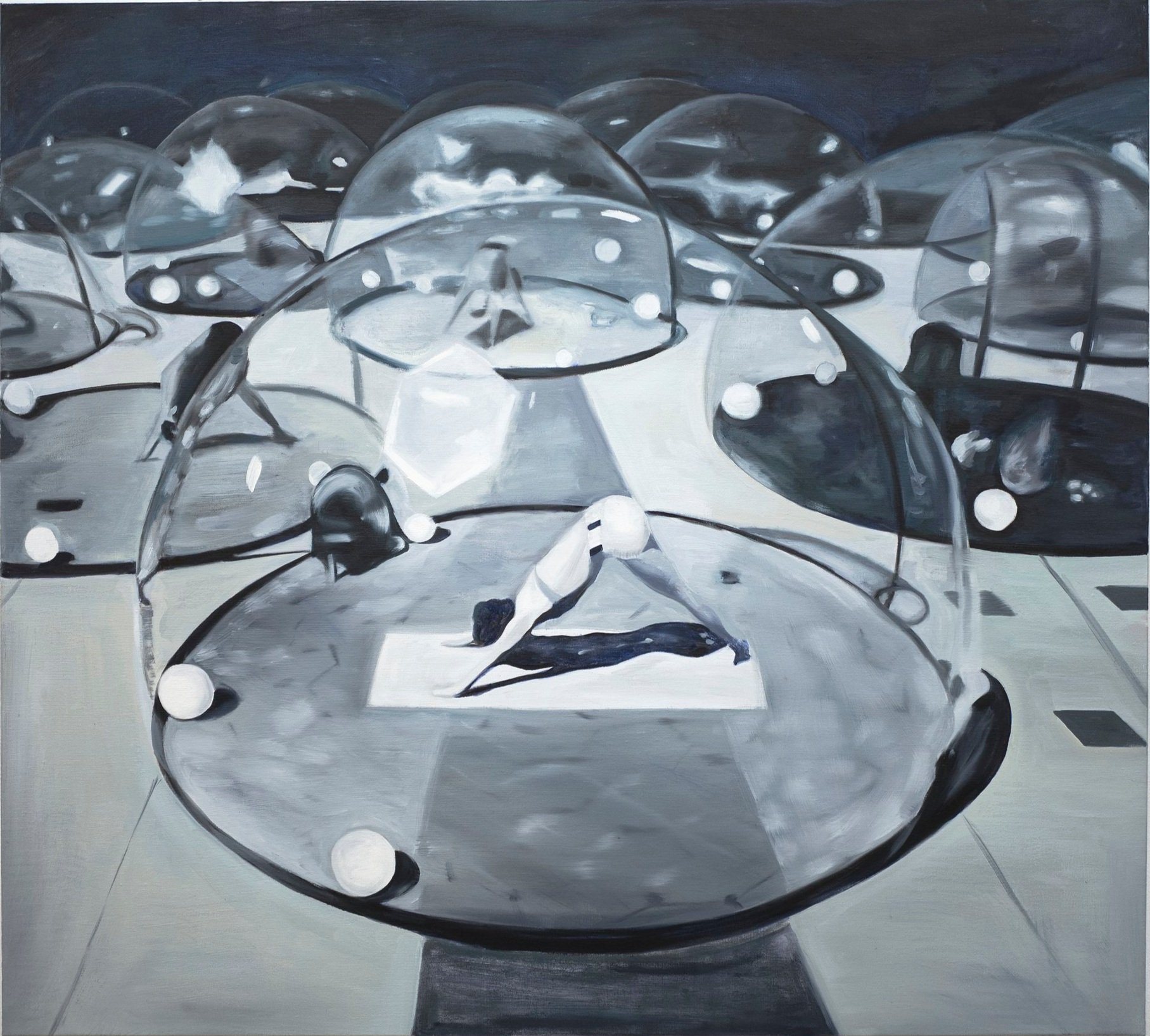
Andreas Gursky's large-format photographs of crowds organized in geometric patterns provide a structural parallel. In works such as 99 Cent (1999) and Bahrain I (2008), Gursky presents human beings as elements in a larger visual system, their individuality apparent on close inspection but subsumed into the overall pattern when viewed from the distance the photograph's scale demands. 99 Cent shows the interior of a discount store, its shelves packed with brightly colored merchandise, its aisles populated by shoppers who appear as small vertical forms against a horizontal field of product. The scale of the print, nearly two meters tall and over three meters wide, makes the pattern inescapable: the viewer sees the store first as a field of color and only secondarily as a space inhabited by people. Gursky's photographs are often read as critiques of consumer culture, and they are that, but they are also formal investigations of what happens to the human figure when it is subordinated to a larger visual order. The shoppers in 99 Cent are not anonymous because Gursky has obscured their faces. They are anonymous because the pattern of the store, the regular grid of shelves and products, organizes them into visual units that register as color and shape before they register as people.
Yoga Isolation operates through a related but inverted logic. Where Gursky's photographs overwhelm the figure with visual density, Tan Mu's painting simplifies the figure through chromatic reduction. The figures in Yoga Isolation are not lost in a field of merchandise. They are isolated in a field of measured emptiness. The green surface of the park is not cluttered; it is sparse, with each figure occupying a clearly defined zone separated from its neighbors by wide bands of empty ground. The pattern is legible at any distance because there is so little visual competition. But this legibility is itself the point. The pattern is not something the viewer discovers after looking closely. It is the first thing the viewer sees. It is the thing that organizes the entire painting. And the pattern is a pattern of distance, a grid of separation, an arrangement that makes the absence of connection as visible as connection itself would be. Gursky shows crowds in which the individual is consumed by the mass. Tan Mu shows a gathering in which the individual is preserved by distance, and the distance itself becomes the dominant visual fact. The preservation is real: keeping two meters apart during a global pandemic was an act of care, a way of protecting strangers from a virus you might be carrying without knowing it. But the visual consequence of that care is a pattern that looks like alienation, a grid that looks like a diagram of loneliness, a field of figures that are together but apart and can be seen as both simultaneously.
Li Yizhuo, in his 2022 essay for the Signal exhibition catalog at YveYANG Gallery, wrote that Tan Mu's works "function as temporal anchors, recording not only what is seen but the condition of seeing itself." This observation, made about the Signal series as a whole, applies with particular precision to Yoga Isolation. The painting does not simply depict a yoga session during a pandemic. It records the condition of seeing a yoga session during a pandemic, the condition of looking at a group of people who are following instructions designed for togetherness through a framework designed for separation. The monochrome palette is not a stylistic choice applied after the fact. It is an expression of the condition itself. During the pandemic, color drained from experience. The world did not literally lose its hues, but the emotional register of daily life shifted toward a narrower band, a range of muted sensations that corresponded to the restricted circumstances under which life was being lived. Removing color from the photograph was not an aesthetic gesture. It was a phenomenological one. It reproduced in paint the experience of living in a world that had been reduced in complexity, where every interaction was filtered through the awareness of risk, where every gesture of connection was accompanied by a calculation of distance, where the ordinary activities that once anchored daily life continued but under conditions that made them feel strange, suspended, as Tan Mu says, otherworldly.
Tan Mu has described her personal experience of the pandemic as one of deep isolation and disruption of everyday rhythms. She moved her painting practice from her New York studio back to her home, experiencing lockdown while watching collective upheaval unfold through screens. Yoga Isolation is one of several works from this period that address the pandemic's restructuring of social space, alongside Minneapolis (2020), Philadelphia (2020), Vaccine (2021), and First Week (2022). But where Minneapolis and Philadelphia focus on the eruption of protest and the collision of isolation with collective action, Yoga Isolation addresses the quieter dimension of pandemic experience: the way routine persisted, the way people continued to do the things they had always done, but under conditions that transformed the meaning of those actions. Yoga, practiced alone in a living room over a video call, is not the same activity as yoga practiced in a studio with a teacher present. Yoga, practiced in a park at a measured distance from other practitioners, is not the same activity as yoga practiced shoulder to shoulder on a summer morning. The postures are the same. The breath is the same. The intention is the same. But the spatial condition has changed, and the spatial condition is not peripheral to the practice. It is the practice. Yoga is not a sequence of postures that can be performed anywhere under any conditions and remain the same activity. It is a practice of integration, and integration requires proximity, breath shared, energy exchanged. Removing proximity does not remove the practice. It transforms it into something that looks like the practice but operates under a different logic. The painting captures this transformation at the exact moment it occurs, before the new condition has become normalized, before the strangeness has worn off, before the measured distance has become just the way things are.
The brushwork reinforces the painting's argument about sameness and difference. Every figure in the composition is painted with the same horizontal strokes, the same tonal range, the same degree of definition. No single figure is given more attention than any other. No single figure is positioned at the compositional center. The arrangement is democratic in the way that a grid is democratic: every unit receives equal visual weight, every position in the pattern is equivalent to every other position. This democracy of treatment mirrors the pandemic's own indifference to individual distinction. The virus did not care who you were. The protocols did not distinguish between one body and another. Two meters was two meters for everyone. The mat was the same size for everyone. The distance was the same for everyone. The painting's refusal to single out any one practitioner, its insistence on treating every figure as a unit in a system rather than as a portrait of a specific person, is not an act of dehumanization. It is an act of fidelity to the condition it depicts, a condition in which the defining feature of social life was the application of a uniform rule to every body regardless of identity.
Hopper's Nighthawks ends where it begins, with the viewer standing outside a brightly lit interior, unable to enter, unable to look away, watching three figures who cannot see each other inhabit a space they cannot leave. Yoga Isolation reverses this position. The viewer stands outside an open field where figures are visible, present, and physically accessible, but separated by a protocol that none of them are violating. The isolation in the painting is not imposed by glass or architecture. It is imposed by understanding, by the shared knowledge that the ethical thing to do is to stay apart. This makes the isolation harder to name and harder to protest. When you are locked out, you can bang on the glass. When you are standing two meters from someone who is doing the same thing you are doing, in the same place, at the same time, and you cannot approach them, there is no glass to bang on. There is only the green surface of the park, the measured distance, the body on the next mat, and the posture that holds you both in place.