The Cloud That Looks Like Cotton: Tan Mu’s Bikini Atoll and the Compression of Destruction
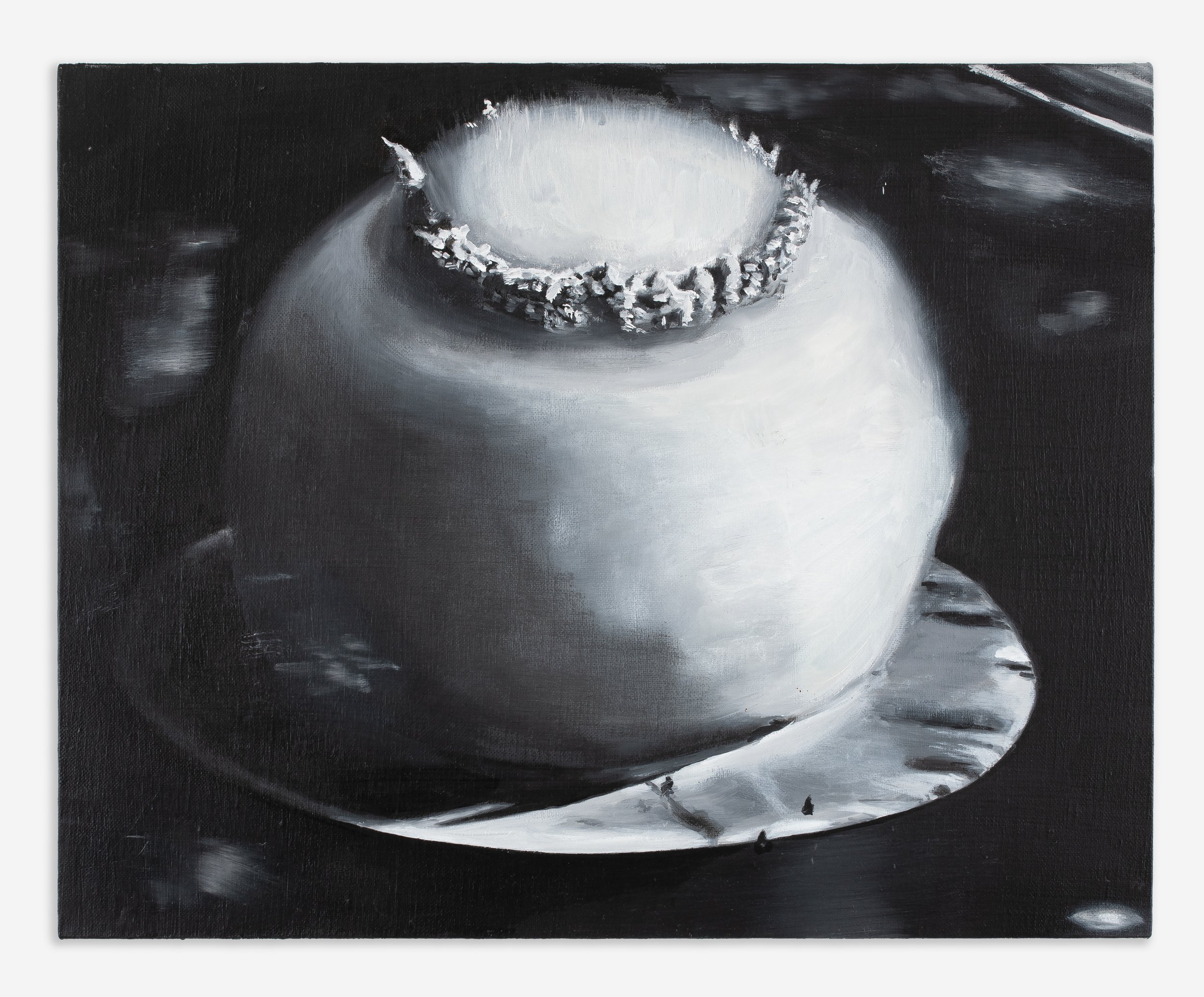
Seen at the right distance, it could be a cauliflower. Or a snowball. Or a tuft of cotton candy pulled from a machine at a county fair. The mushroom cloud that rises from the center of Bikini Atoll (2020), oil on linen, 41 x 51 cm, is small, pale, and almost soft. It floats against a field of grey that darkens toward the edges, a single rounded form with a delicate stem, the whole thing no larger than a fist held at arm's length. The mind registers the shape before it registers the subject, and the shape reads as harmless. This is the first deception. The second deception follows immediately: the painting is in black and white, and the absence of color removes the fire. The original photographs of the Baker test at Bikini Atoll on July 25, 1946, show a column of white spray and vapor erupting from the lagoon, ringed by a condensation cloud that catches the Pacific sunlight. In color, the image is lurid: the spray is white, the surrounding water is turquoise, the sky is blue, and the cloud at the apex is a dirty cream that turns orange-brown as it absorbs the pulverized coral and seabed material thrown upward by the detonation. Tan Mu has removed all of this. What remains is a shape in grey scale, a form that could be any cloud rising from any surface under any circumstances, and it is only the knowledge that the viewer brings to the painting, the knowledge that this particular cloud is the product of a twenty-three-kiloton nuclear detonation, that transforms the cauliflower into a weapon.
The painting was made in 2020, during the first months of the COVID-19 pandemic, when Tan Mu had left her New York studio and returned to painting at home. She describes this displacement as a forced slowing that created the space to think more carefully about the relationship between history and the present. The choice of subject, a nuclear test conducted seventy-four years earlier, might seem disconnected from the immediate circumstances of lockdown, but it is not. The pandemic was, among other things, an event that forced the entire world to confront the consequences of decisions made by a small number of people with the authority to act on behalf of millions. The nuclear testing program at Bikini Atoll was another such event. The indigenous residents of the atoll were relocated to a smaller island with the promise that they could return when the tests were complete. They were never able to return. The tests contaminated the land and the water, poisoned the food chain, and produced rates of cancer and birth defects that persist to this day. The people who made these decisions were military officers and government officials who operated under the assumption that the strategic value of the tests outweighed the cost to the people who lived there. The parallels with the pandemic, in which decisions about public health were made by governments and corporations with varying degrees of transparency and accountability, are not exact, but they share a structural logic: immense consequences distributed unequally, authority concentrated in few hands, and the people most affected the least consulted.
The physical surface of the painting enacts its own argument about proximity and distance. At 41 x 51 cm, the canvas is slightly wider than a standard sheet of paper turned sideways. This is an intimate format for a subject that in reality occupied miles of ocean and sky. The choice of scale is not accidental. Tan Mu describes studying historical photographs of the Baker test and noticing that "the mushroom cloud often resembles something deceptively small, like a snowball or cotton candy." She then made the deliberate decision to reduce the scale of the painting, compressing the visual impact of the event and treating the explosion as an object rather than a vast scene. This compression is the painting's central operation. The mushroom cloud, which in reality rose thousands of feet into the atmosphere, is here contained within a canvas that could be held in two hands. The oil paint is applied in thin, horizontal layers that build the cloud from the ground up, each layer slightly lighter than the one beneath it, creating an internal luminosity that mimics the way a real cloud catches and diffuses light. The edges of the cloud are not sharp. They soften into the surrounding grey, blurring the boundary between the cloud and the atmosphere it occupies, so that the form appears to be both solid and dissolving at the same time. This ambiguity is deliberate. Tan Mu describes the layering and blending of oil paint as mirroring "the accumulation and reconstruction of historical memory," a process in which each new account of an event overlays the previous one, modifying its contours without entirely replacing it.
The black and white palette removes the spectacle from the event without removing the event itself. In color, a nuclear explosion is a visual event of extreme intensity: the flash, the fireball, the rising column of vaporized material, the condensation cloud that forms around the stem as the shock wave expands outward through humid tropical air. The color photographs of the Baker test are overwhelming. They demand attention the way a fire demands attention, by being bright and hot and dangerous. Removing the color does not make the painting quieter. It makes it stranger. The cloud in grey scale is not an image of a nuclear explosion that has been subdued. It is an image of a nuclear explosion that has been defamiliarized, presented in a register that does not match the viewer's expectations, and this mismatch produces a disorientation that is more unsettling than spectacle would be. Spectacle tells you what to feel. Defamiliarization asks you to figure out what you are seeing.
J.M.W. Turner painted Snow Storm: Steam-Boat off a Harbour's Mouth in 1842, at the age of sixty-seven, during a period when he was increasingly interested in the capacity of paint to represent forces that exceed the frame. The painting shows a steamboat caught in a vortex of snow, steam, and sea spray, the vessel nearly invisible within the swirling composition that Turner constructed from thick, overlapping arcs of white, grey, and brown pigment. The painting was exhibited at the Royal Academy with a subtitle that claimed the artist had been "attached to the mast of a vessel during the storm," a claim that may or may not be true but which articulates the painting's central argument: that the only way to paint a storm is to be inside it, to subject the painting to the same forces that the painting depicts. Turner's late vortex paintings, including Snow Storm and Storm over a Landscape (c. 1840), do not illustrate weather. They materialize it. The paint is the storm. The brushstrokes are the wind. The canvas is not a window onto a scene but a surface that has been acted upon by the same energy that the scene describes.
Bikini Atoll shares this logic but deploys it in reverse. Where Turner placed the viewer inside the storm, Tan Mu places the viewer at a measured distance from the explosion, close enough to see the brushwork but far enough to see the form. The cloud in Bikini Atoll is not a vortex. It is an object. It sits in the center of the canvas with the composure of a still life, a peach on a table, a vase against a wall, a cloud above an atoll. This stillness is the painting's most radical decision. Turner's storm is an event in progress, a system of forces caught at the moment of maximum intensity. Tan Mu's mushroom cloud is an event that has already achieved its shape, a form that has completed its rise and is now simply existing, occupying space, being what it is. The stillness is not the stillness of calm. It is the stillness of after. The explosion has happened. The cloud has formed. The damage is done. What you are looking at is not the moment of detonation but the moment after detonation, when the cloud has become a shape that can be looked at, considered, and mistaken for something harmless.
The stated subject of Bikini Atoll is the nuclear test conducted at the atoll on July 1, 1946, the first of sixty-seven detonations that the United States would carry out in the Marshall Islands over the following twelve years. The Baker test, which produced the specific cloud that Tan Mu painted, was conducted on July 25, 1946, and it was the first nuclear detonation in peacetime. The test was detonated underwater, ninety feet below the surface of the lagoon, and the resulting explosion threw a column of water and vapor more than a mile into the sky. The test was part of Operation Crossroads, a program designed to evaluate the effects of nuclear weapons on naval vessels. A fleet of ninety-five surplus ships, including captured Japanese and German vessels, was anchored in the lagoon as targets. Five of these ships were sunk outright. Most of the rest were contaminated with radioactive spray that coated their surfaces and could not be removed. The test was witnessed by a press corps of journalists and photographers who had been invited to document the event, and the photographs they produced circulated around the world, becoming the first widely seen images of a nuclear detonation. These photographs, grainy, dramatic, and often beautiful in the way that images of immense force can be beautiful, are the visual source material from which Tan Mu worked.
Tan Mu describes the tension between nuclear energy as progress and nuclear energy as destruction as the conceptual entry point for the painting. "Nuclear energy is often promoted as a form of clean energy," she observes, "yet its destructive legacy continues to damage the environment. This tension between progress and destruction became the conceptual entry point for the painting." The mushroom cloud is the visual form of this tension. It is the product of a technology that can produce both electrical power and annihilation, and the same physical process, the splitting of atoms, produces both outcomes. There is no way to look at a mushroom cloud and see only one of these meanings. The cloud is always both. It is always the symbol of the energy that might power a city and the weapon that might destroy one. The painting holds this duality open by rendering the cloud as a still life, a form that can be looked at without being overwhelmed, a shape that can be considered without being consumed by its own spectacle. The stillness does not resolve the tension. It makes the tension visible by giving the viewer enough distance to see both meanings at once.
Gerhard Richter's October 18, 1977 series, painted in 1988, consists of fifteen canvases based on photographs of the Baader-Meinhof group, members of the Red Army Faction who were found dead in their prison cells on the date that gives the series its title. Richter painted these images in black and white, using a technique of deliberate blurring that softens the photographic source material into a state of indeterminacy. The figures in the paintings are recognizable but not legible. You can see that they are people, but you cannot read their expressions. You can identify the prison cells, but the details dissolve before they resolve into information. The blur is not an accident of technique. It is an argument about the relationship between photography and memory, between the documentary image and the historical event it purports to represent. Richter has said that the blur makes the image "right," by which he means that it corrects the false clarity of the photograph, the illusion that a camera can capture the truth of an event simply by being present when it happens. The photograph is always already a selection, a framing, a point of view, and the blur acknowledges this by refusing the photograph's claim to transparency.
Bikini Atoll operates in a related register but with a different target. Where Richter blurs the photographic source to undermine the photograph's authority, Tan Mu renders the photographic source with sufficient fidelity that the viewer can identify the cloud and its origin, but she compresses the scale and removes the color in a way that undermines the photograph's capacity to overwhelm. The original photographs of the Baker test are spectacular. They are designed to impress. They were taken by military photographers using large-format cameras from positions chosen to maximize the visual impact of the explosion. These photographs were then released to the press as evidence of American military power, and they functioned as propaganda even when they were presented as journalism. Tan Mu's painting takes this propaganda and drains it of its force, not by blurring it or obscuring it but by rendering it with a fidelity that preserves the form while removing the conditions that made the form spectacular. The result is not a critique of the nuclear test itself. It is a critique of the way the nuclear test has been seen, the way it has been photographed, the way those photographs have circulated, and the way the image of the mushroom cloud has been naturalized as a symbol of power rather than a record of consequence.
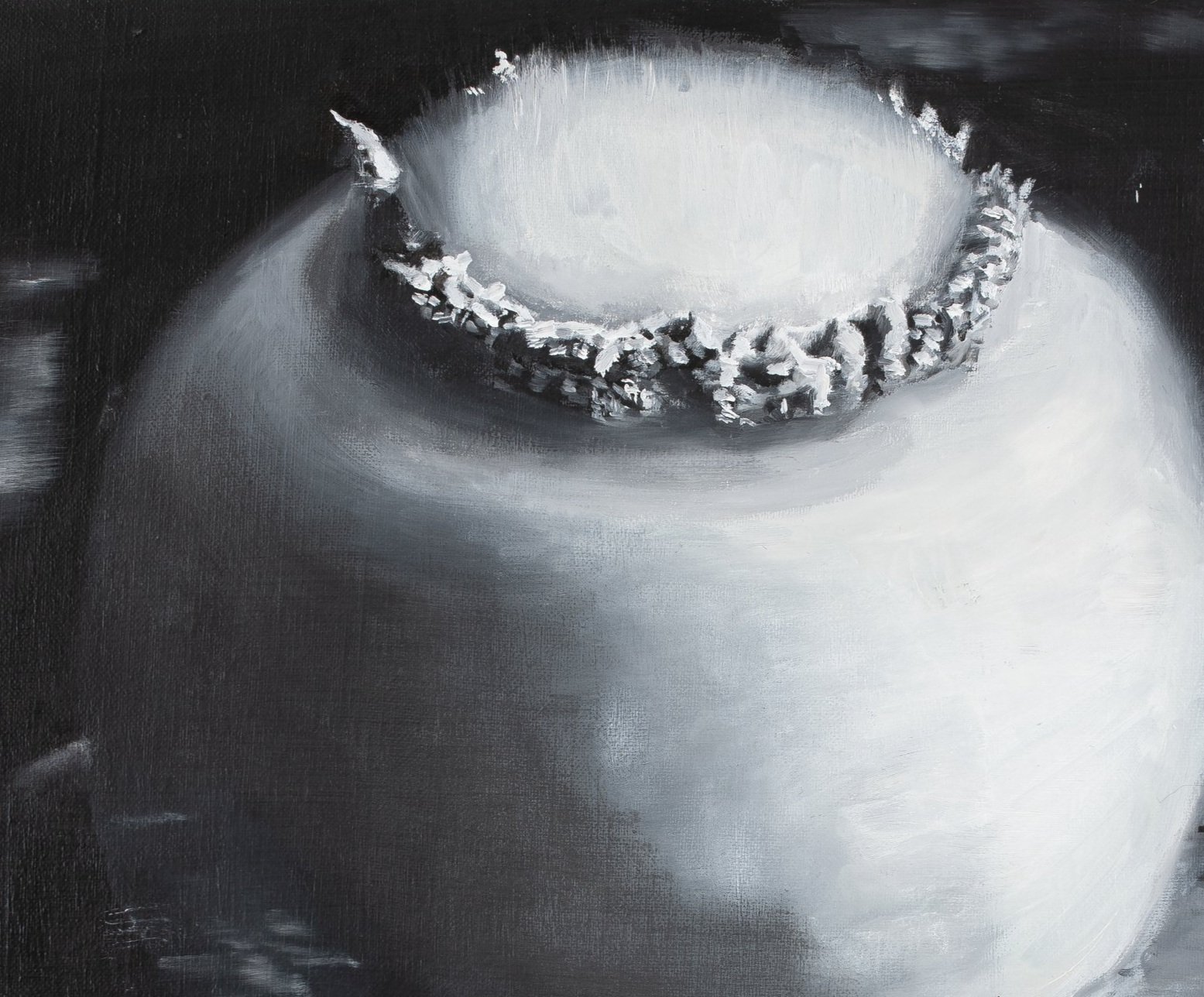
Saul Appelbaum, writing in 2025, observed that Tan Mu's practice "operates at the intersection of documentation and meditation, where the act of recording becomes a form of sustained attention that transforms the recorded event into something it was not before." This observation, made about the Signal series as a whole, is particularly precise when applied to Bikini Atoll. The painting does not simply record the nuclear test. It transforms it. It takes an event that was designed for spectacle and re-presents it as an object for contemplation. It takes an image that was produced to demonstrate power and re-presents it as an image that asks questions about power. It takes a cloud that was photographed from a distance of miles and re-presents it at a scale that can be held in the hands. Each of these transformations is an act of sustained attention, and each one changes what the image means without changing what it depicts. The mushroom cloud is still the mushroom cloud. The test is still the test. The damage is still the damage. But the painting has created a space around the image that the photograph could not provide, a space in which the viewer can look at the cloud without being commanded to look, can consider the form without being overwhelmed by the force, can see the object without being told what to think about it.
Tan Mu connects Bikini Atoll to a lineage within her own practice that includes Trinity Testing (2020), which depicts the first nuclear detonation at the Alamogordo Bombing Range in New Mexico on July 16, 1945. These two works are bookends: Trinity Testing, the first nuclear explosion, and Bikini Atoll, the first peacetime nuclear explosion. Together, they bracket the transition from weapon to technology, from wartime necessity to Cold War strategy, from the bomb that ended a war to the bomb that was tested to demonstrate that the war's end had not ended the need for bombs. The paintings share a black and white palette, a source in archival photographs, and a commitment to rendering the mushroom cloud as a visual object rather than a symbol. But where Trinity Testing captures the moment of the flash, the instant of detonation before the cloud has formed, Bikini Atoll captures the moment after, when the cloud has achieved its shape and the event has become an image. The difference is crucial. The flash is instantaneous. It cannot be looked at directly. The cloud endures. It can be seen, photographed, painted, and considered. The cloud is what remains when the explosion is over, and what remains is what the painting was made to hold.
The compression of scale in Bikini Atoll is not merely a formal decision. It is a political one. Tan Mu explicitly frames it as such: "If such immense energy can be reduced and framed in this way, it raises the question of who has the authority to define, manage, and control it." The small canvas, the still life format, the intimate scale, all of these are acts of reframing that transfer the mushroom cloud from the register of the uncontrollable to the register of the held, the examined, the contained. The painting does not pretend that the explosion was small. It makes the image of the explosion small, and in doing so, it asks who made the image large in the first place, and why, and for whom. The mushroom cloud as a cultural icon was made large by the same institutions that made the explosion: the military, the government, the press, the defense industry. These institutions needed the cloud to be spectacular because spectacle served their purposes. A small cloud, a cloud that looked like a snowball, a cloud that could be held in two hands, would not have demonstrated power. It would have raised questions. The painting raises those questions now, seventy-four years after the test, by giving the cloud the scale it was never meant to have.
Turner's vortex pulled the viewer into the storm. Richter's blur pushed the viewer back from the photograph. Tan Mu's compression does both simultaneously. The small scale pulls the viewer close, close enough to see the individual brushstrokes that build the cloud layer by layer, close enough to see that the cloud is made of paint and not of vapor, close enough to register the material presence of the image before its subject overtakes the looking. But the compression also creates distance. The event that produced this cloud was vast. The canvas that holds it is small. The gap between the size of the event and the size of the painting is the space in which the viewer's mind must work, translating between what is seen and what is known, between the cauliflower shape on the canvas and the twenty-three kilotons of force that produced it. The painting does not bridge this gap. It opens it. And what falls into the gap is the question that the cloud has always carried but has rarely been asked: who decided that this shape, this form, this event, was necessary, and who bore the cost of that decision, and who is still bearing it, and who will continue to bear it long after the cloud has dissolved and the atoll has sunk below the rising Pacific and the only record left is a painting of a snowball on a small grey canvas hanging on a wall in a room where the air is quiet and the paint is still.