The Cross That Watched the Silence: Tan Mu’s Eruption and the Cable That Broke the World
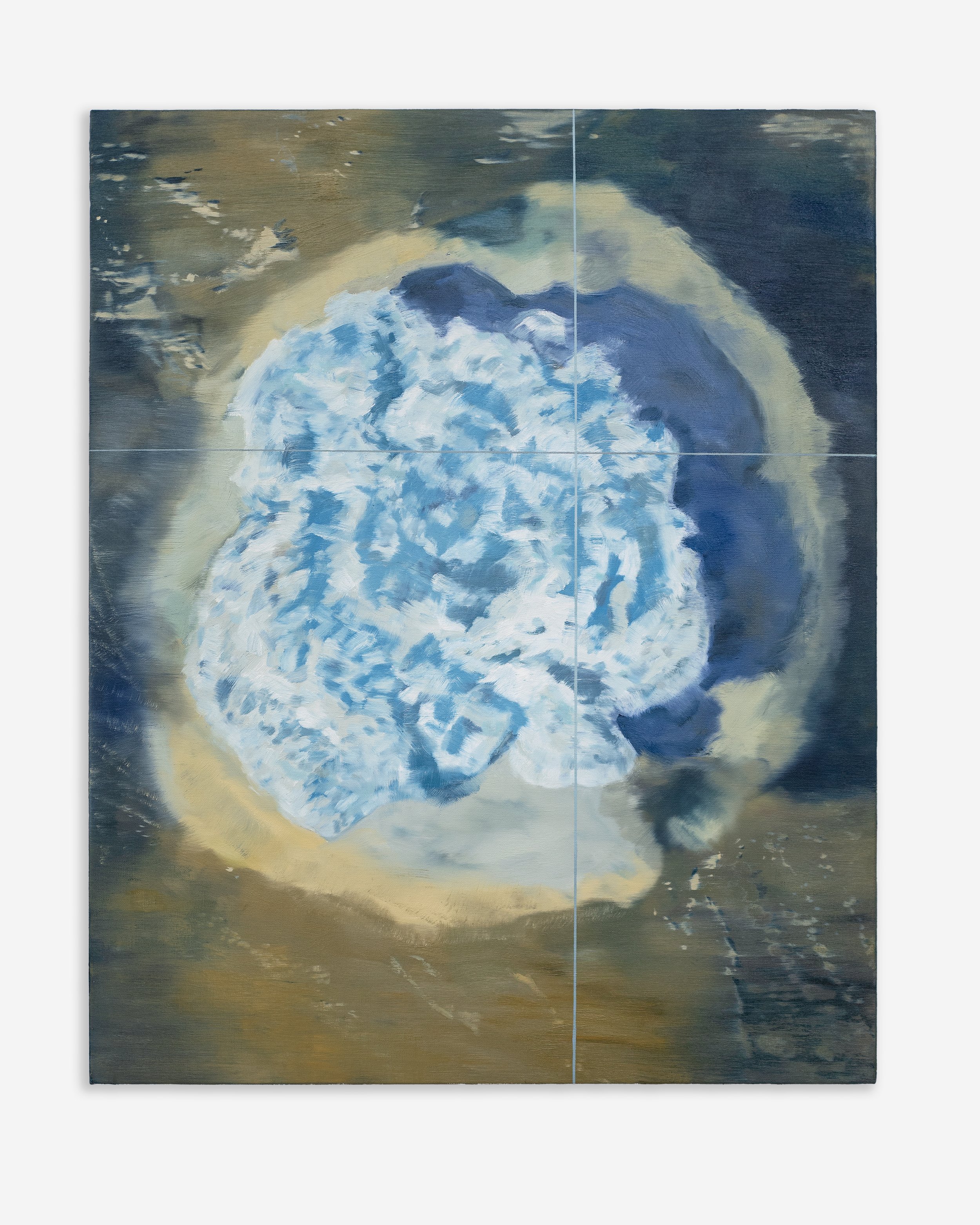
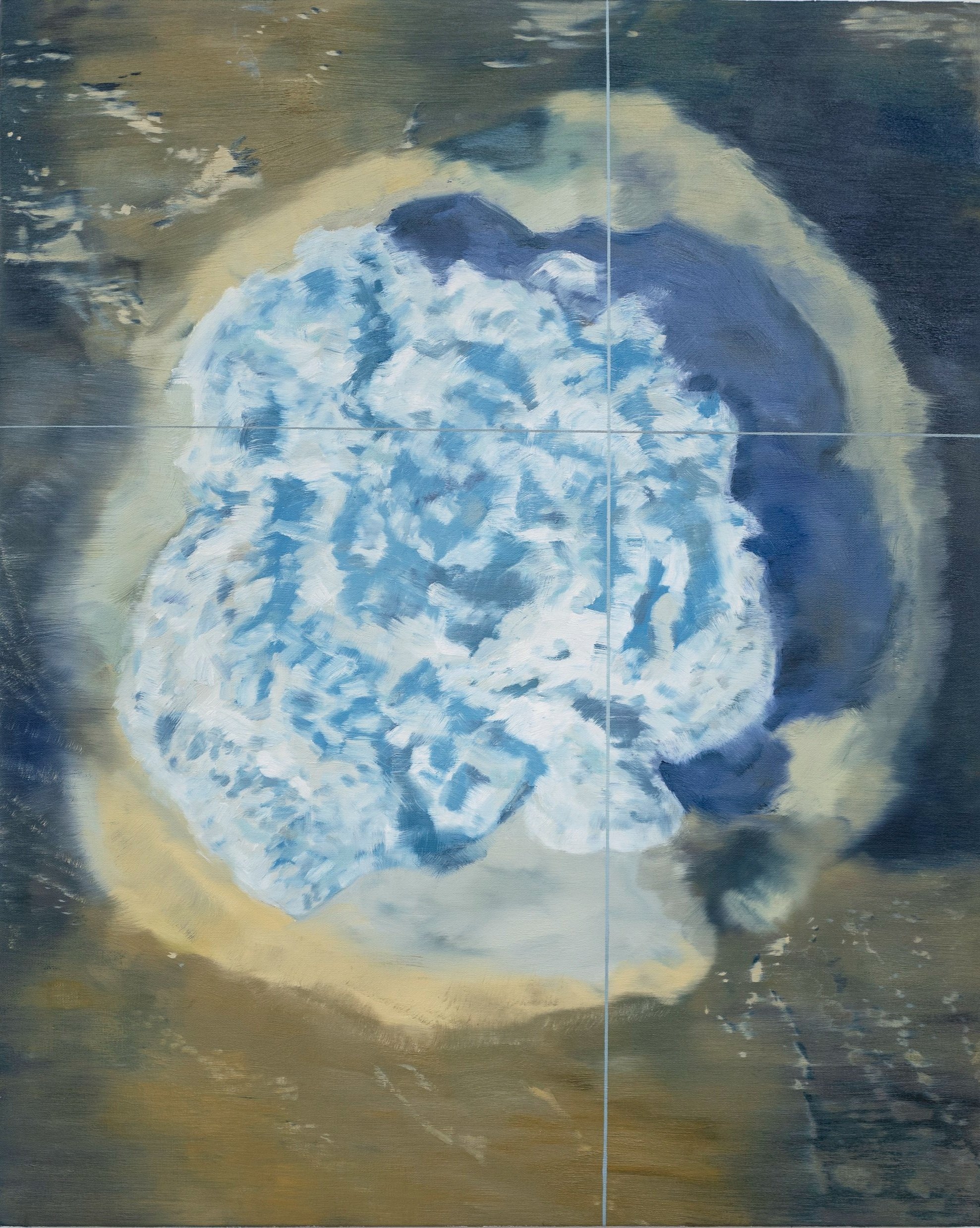
The composition is built around a cross. Two lines intersect at the center of the canvas, one running vertically from top edge to bottom edge, the other running horizontally from left edge to right edge. The lines are thin, precise, and almost mechanical, drawn with a straightedge and rendered in a cool grey that distinguishes them from the warmer tones of the volcanic cloud that surrounds their intersection. These lines are not decorative. They are the compositional spine of the painting, the axis around which every other element is organized, and they represent a specific mode of seeing: the overhead view, the satellite perspective, the view from a meteorological instrument that translates three-dimensional catastrophe into two-dimensional data. Eruption (2022), oil on linen, 76 x 61 cm, is a painting of the Hunga Tonga-Hunga Ha'apai submarine volcanic eruption that began on December 20, 2021, and reached its climax on January 15, 2022, with an explosion so powerful it was recorded by instruments on every continent. The painting does not show this explosion from the ground, as a witness on a boat might have seen it, or from the air, as a reconnaissance pilot might have photographed it. It shows it from above, from the position of a satellite, the same position from which the world first learned that something had happened in the South Pacific and then, for nearly a month, learned nothing more.
The eruption of Hunga Tonga-Hunga Ha'apai was not merely a volcanic event. It was a communication event. The explosion severed the undersea fiber optic cable that connected Tonga to the rest of the world, cutting off telephone service, internet access, and all digital communication for a nation of approximately 105,000 people. For nearly four weeks, the outside world could not confirm the extent of the damage, the number of casualties, or the condition of the islands. Satellite images showed the ash cloud spreading across the Pacific, but the satellite images could not show what was happening on the ground because the ground had been cut off from the networks that carry information. The world watched the eruption from space and heard nothing from below. This is the condition that Eruption was made to hold: the condition of seeing the catastrophe from above while being unable to reach the people it was happening to, the condition of total visual access and total communicative silence.
The painting's material presence contradicts the dematerialized perspective it depicts. At 76 x 61 cm, the canvas is vertical, slightly taller than it is wide, a format that emphasizes the upward thrust of the volcanic plume and the vertical line of the cross that bisects it. The oil paint is applied in layers that build the cloud from the center outward, with the densest impasto at the point where the eruption originates, at the bottom of the composition, where the volcanic vent releases its force into the atmosphere. The cloud itself is rendered in a range of warm greys and cool whites that shift toward pale ochre at the edges, suggesting the mixture of water vapor, ash, and sulfur dioxide that characterizes a real volcanic plume. The surrounding atmosphere is a deep, cool grey-blue that darkens toward the edges of the canvas, creating a vignette effect that concentrates the viewer's attention on the cloud at the center. The two intersecting lines of the cross are painted with a mechanical precision that contrasts with the organic turbulence of the cloud, as if a technical overlay has been placed on top of a natural phenomenon, or as if the natural phenomenon has been captured within a technical frame that reduces its chaotic energy to a set of coordinates.
This overlay is not an afterthought. Tan Mu describes the cross as representing the overhead perspective of meteorograms and satellite imagery, the visual systems through which modern audiences witnessed the eruption unfolding through screens and media coverage. The cross is the instrument of observation superimposed on the event being observed, and its presence in the painting makes visible a condition that satellite images normally conceal: the fact that the satellite view is itself a technology with its own biases, its own limitations, and its own way of organizing visual information. The satellite sees the eruption but it does not hear it, it does not feel the ash falling on the islands below, it does not register the severed cable that has cut off a nation's voice. The cross in the painting is the sign of this partial seeing, this technologically mediated witnessing that provides the image without providing the connection that the image promises.
Anselm Kiefer has spent a career making paintings that treat catastrophe as a subject worthy of the same sustained attention that earlier painters reserved for landscape, portraiture, and religious narrative. His series of works inspired by the Holocaust, by the mythology of the Third Reich, and by the ruins of European civilization are constructed from materials that carry their own history: lead, straw, ash, dried flowers, and broken ceramic. In Lilith (1987-90), Kiefer presents a desolate landscape of ash and rubble under a dark sky, the surface of the painting encrusted with material that reads as both pigment and debris, both paint and the residue of destruction. The title refers to the first wife of Adam in Jewish mythology, a figure who was exiled from Eden and who, in Kiefer's treatment, becomes an emblem of the outcast, the abandoned, the one who remains after the catastrophe has passed and the official narrative has moved on. The painting does not illustrate the catastrophe. It presents its aftermath, the landscape that remains when the fire has burned out and the smoke has cleared, and it presents this landscape as a site of memory that refuses to forget what the official narrative would prefer to leave behind.
Eruption shares Kiefer's conviction that catastrophe demands a visual language adequate to its scale, but it employs a radically different method. Where Kiefer builds his surfaces from accumulated material, layering straw and lead and ash until the painting becomes a relief object that protrudes from the wall, Tan Mu builds her surface from accumulated paint, thin layer over thin layer, each one slightly different in tone, until the cloud achieves a luminosity that no single layer could produce. The effect is not the weight of Kiefer's ash but the weightlessness of a plume that is simultaneously water vapor, volcanic ash, and sulfuric acid, a mixture that hangs in the atmosphere for weeks, reflecting sunlight and cooling the planet, a material paradox that is both present and dispersing, both solid and gaseous, both destructive and, in its capacity to lower global temperatures, temporarily restorative. Tan Mu's cloud is not a ruin. It is an event in progress, an eruption that has not yet settled, a force that is still expanding. The painting captures this force at the moment of its maximum visual impact, when the cloud has achieved its full height but has not yet begun to dissipate, and it holds this moment in oil paint with a deliberation that contradicts the speed and violence of the event itself.
The subject of Eruption is not only the volcanic eruption. It is the relationship between the eruption and the communication infrastructure that the eruption destroyed. The undersea cable that connected Tonga to the global internet was laid in 2018 by a consortium of telecommunications companies. It ran along the ocean floor for approximately 827 kilometers between Tonga and Fiji, carrying data at speeds sufficient for voice calls, internet browsing, and financial transactions. When the eruption severed this cable on January 15, 2022, Tonga was cut off from the world with a completeness that no natural disaster had achieved in the era of global telecommunications. There was no redundancy, no backup route, no satellite link that could carry the bandwidth that the cable had provided. The nation went silent. For nearly a month, the only information about Tonga's condition came from satellite imagery and from amateur radio operators who managed to establish limited contact with the outside world. The eruption demonstrated, with a clarity that no theoretical argument could match, that global connectivity depends on physical infrastructure that is vulnerable to the same natural forces it was designed to transcend. The cable that connects the world to the internet lies on the ocean floor, exposed to earthquakes, volcanic eruptions, and the slow corrosive action of salt water. It is a thin thread of glass and copper carrying the sum of human communication, and a volcano can cut it in an instant.
Tan Mu describes this moment of disconnection as the emotional and conceptual foundation of the painting. "What struck me most," she says, "was not only the scale of the natural event, but the sudden disappearance of information. The undersea eruption completely isolated the islands, preventing the world from knowing the extent of damage or casualties for nearly a month. This moment of total disconnection made me acutely aware of how fragile our global communication systems are." The painting makes this fragility visible by placing the satellite cross over the volcanic cloud, overlaying the instrument of observation onto the event it is observing, and then refusing to resolve the tension between them. The cross organizes the cloud into a readable image, but it cannot restore the connection that the eruption has severed. The satellite can see the eruption, but the satellite cannot reach the people under the ash. The instrument of observation and the instrument of communication are not the same instrument, and the painting holds them apart, the mechanical lines of the cross and the turbulent form of the cloud occupying the same canvas without merging, without reconciling, without pretending that seeing is the same as knowing or that data is the same as contact.
Danni Shen, writing in Emergent Magazine in 2024, observed that Tan Mu's works "serve as a kind of witness to human socio-technological histories," registering "the trajectory and continuum of bodily and mediated presence through human technical developments." Eruption is the work in which this witnessing function is most explicitly articulated, because it is the work that most directly confronts the failure of mediation. The satellite image of the eruption was witnessed by millions. The severed cable was not witnessed by anyone outside the telecommunications industry until the news reports began to circulate, and even then, the cable remained invisible, a thread of glass and copper on the ocean floor that no one could see and no one could reach. The painting makes the invisible infrastructure visible by making it the conceptual center of the composition, even though the cable itself does not appear in the painting. Its absence is the subject. The cross represents the satellite that can see but cannot speak. The cloud represents the eruption that destroyed the cable that could speak but cannot be seen. The painting holds both conditions at once, the condition of seeing without connecting and the condition of being connected without seeing, and it refuses to privilege either one over the other.
Pat Steir began her waterfall paintings in the late 1980s, working on large canvases that she placed upright against the wall of her studio and attacked with buckets of thinned paint, pouring the liquid down the surface and allowing gravity to determine the final form. In works such as Four Part Waterfall (1991-92) and the extended Silent Waterfall series, Steir removed herself from direct control of the paint's path, allowing the physical properties of the medium, its viscosity, its drying time, its interaction with the weave of the canvas, to determine the final image. The resulting paintings read simultaneously as representations of waterfalls and as records of the paint's own behavior, the vertical streaks and rivulets functioning as both image and trace, both the depiction of a natural force and the residue of a natural process that occurred on the canvas itself. Steir has described this method as a collaboration with gravity and with the paint, an act of allowing forces larger than her own hand to determine what appears on the surface.
Eruption operates through a related logic but in the opposite direction. Where Steir allows gravity to pull the paint downward, creating vertical cascades that read as falling water, Tan Mu builds the cloud upward from the center of the canvas, each layer slightly lighter and more diffuse than the one beneath it, creating an ascending form that reads as rising vapor and ash. The brushwork in the cloud is horizontal, not vertical, each stroke a thin band of grey or white that sits on top of the previous stroke and extends slightly further toward the edges, so that the cloud appears to be expanding as it rises, which is what volcanic plumes actually do. This upward construction is the inverse of Steir's downward pour, but it shares the same principle: the painting does not merely depict the force. It constructs the force, layer by layer, from the inside out, building the cloud the way a real volcanic plume builds itself, by accumulating material at the base and pushing it upward through successive layers of expanding gas and solidifying ash. The cross, imposed on top of this upward construction, represents the frame that interrupts the force, the technological system that captures the image and transmits it around the world while the cable that could have transmitted the voices of the people under the ash lies broken on the ocean floor.
Tan Mu's personal connection to the ocean runs through this painting with a directness that is unusual even in a practice that frequently returns to maritime subjects. She grew up by the sea. Her grandfather was a marine engineer who worked on port construction and land reclamation projects, and he was also a meteorologist who taught her to read weather maps and analyze cloud formations. "Every day," she recalls, "he taught me how to read weather maps, analyze cloud formations, and understand atmospheric systems. Through him, I developed an early habit of observing the world from above, through contour lines, satellite imagery, and abstract visual systems that translate natural phenomena into data." The cross in the painting is not an abstraction. It is the form of the weather map that Tan Mu learned to read as a child, the coordinate grid that transforms a three-dimensional event into a two-dimensional image, the technical overlay that makes the eruption visible to a satellite while the people beneath it remain invisible. The painting is a portrait of this double vision: the vision from above, which sees the cloud and measures the ash and tracks the shockwave across the Pacific, and the vision from below, which sees nothing because the cable has been cut and the island has gone dark.
Eruption marks a turning point in Tan Mu's practice. After this painting, she began researching the physical structure of undersea cables, their material composition, and their role in transmitting information across continents. This research produced Twenty Thousand Leagues Under the Seas (2023) and later evolved into the Signal series, in which she shifted from depicting cross sections of cables to mapping entire global networks. Eruption stands at the origin of this investigation, capturing the moment when a natural force exposed the vulnerability of the infrastructure that the world had come to depend on without knowing it was there. The undersea cable was invisible before the eruption and invisible after the eruption. It was invisible when it was working and invisible when it was broken. The only time it became visible was the moment it ceased to function, and even then, it was visible only as an absence, a silence, a gap in the flow of information that the world had come to assume was permanent. The painting gives this absence a shape. The cross holds the space where the connection should be. The cloud fills the space where the connection was cut. And the silence that fell over Tonga for nearly a month, the silence that the satellite could not penetrate and the cable could not repair, is the silence that the painting holds open, not as a void but as a condition, not as nothing but as the specific absence of something that was always there until the moment it was not.