The Monument Without a Face: Tan Mu’s Checkmate and the Machine That Learned to Think
Garry Kasparov sat across from a cabinet. The cabinet was six feet tall, painted IBM grey, and housed 480 custom chess chips capable of evaluating two hundred million positions per second. On the outside, it looked like a piece of office furniture. On the inside, it was the most powerful chess-playing device ever constructed. The match lasted six games, from May 3 to May 11, 1997, and when it was over, the cabinet had won. Kasparov, the world chess champion, the greatest player in the history of the game, had been defeated by a machine. The moment was immediately understood as a threshold. Whether it was the threshold the world expected or the threshold the world wanted was a question that the intervening decades have done more to complicate than to answer. Tan Mu was a child in 1997. She did not watch the match. She did not read the coverage. She encountered the event years later, through history and through reflection, and when she came to paint it, she approached it not as a journalist approaching a current event but as an archaeologist approaching a ruin. "I was not documenting the event as it happened," she says, "but reinterpreting it through the lens of what followed." What followed was a quarter century of artificial intelligence development that transformed Deep Blue from a singular achievement into a prologue, and transformed Kasparov's defeat from a shocking anomaly into the first of many moments when a machine did something that had previously been the exclusive province of human thought.
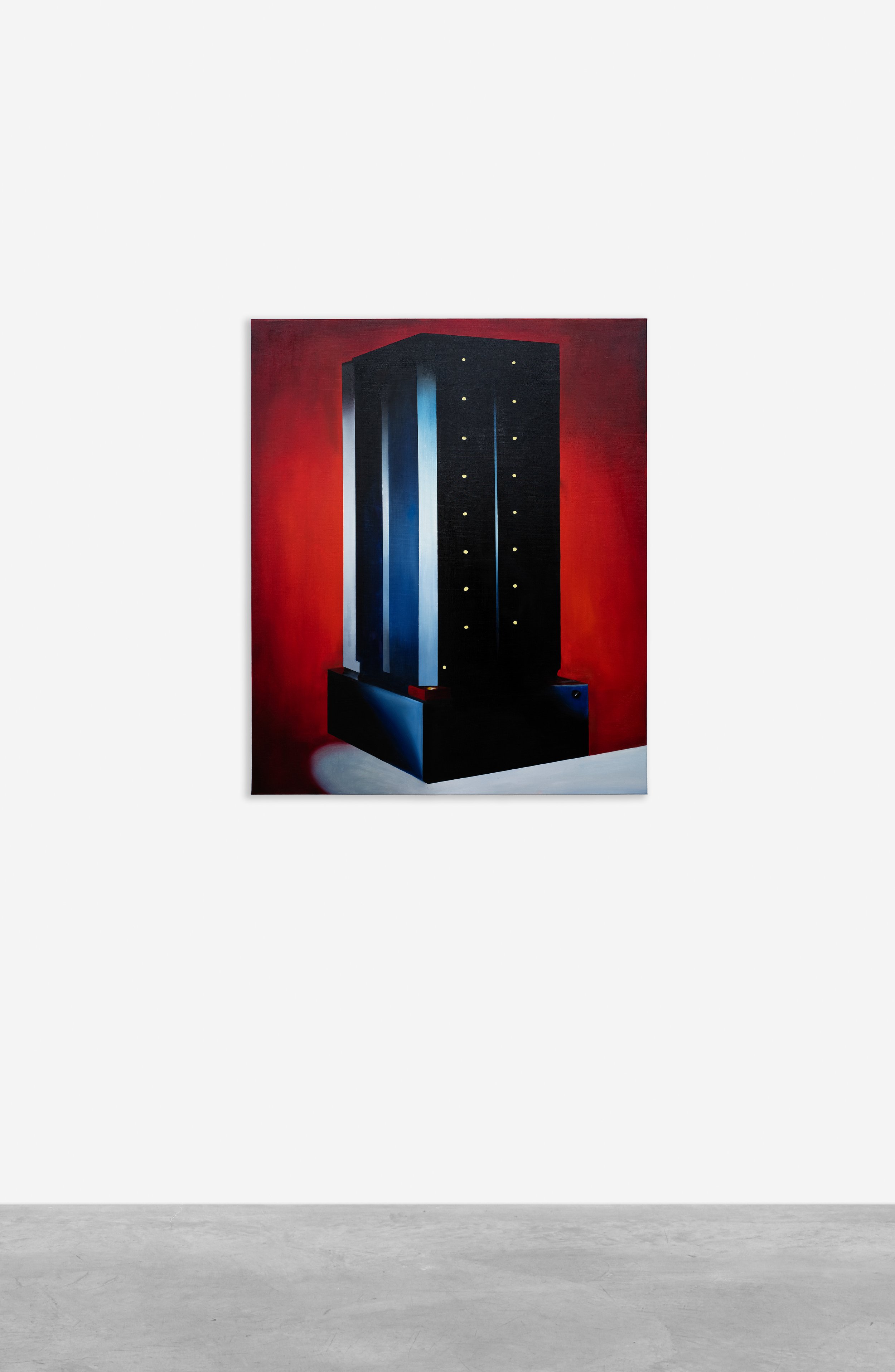
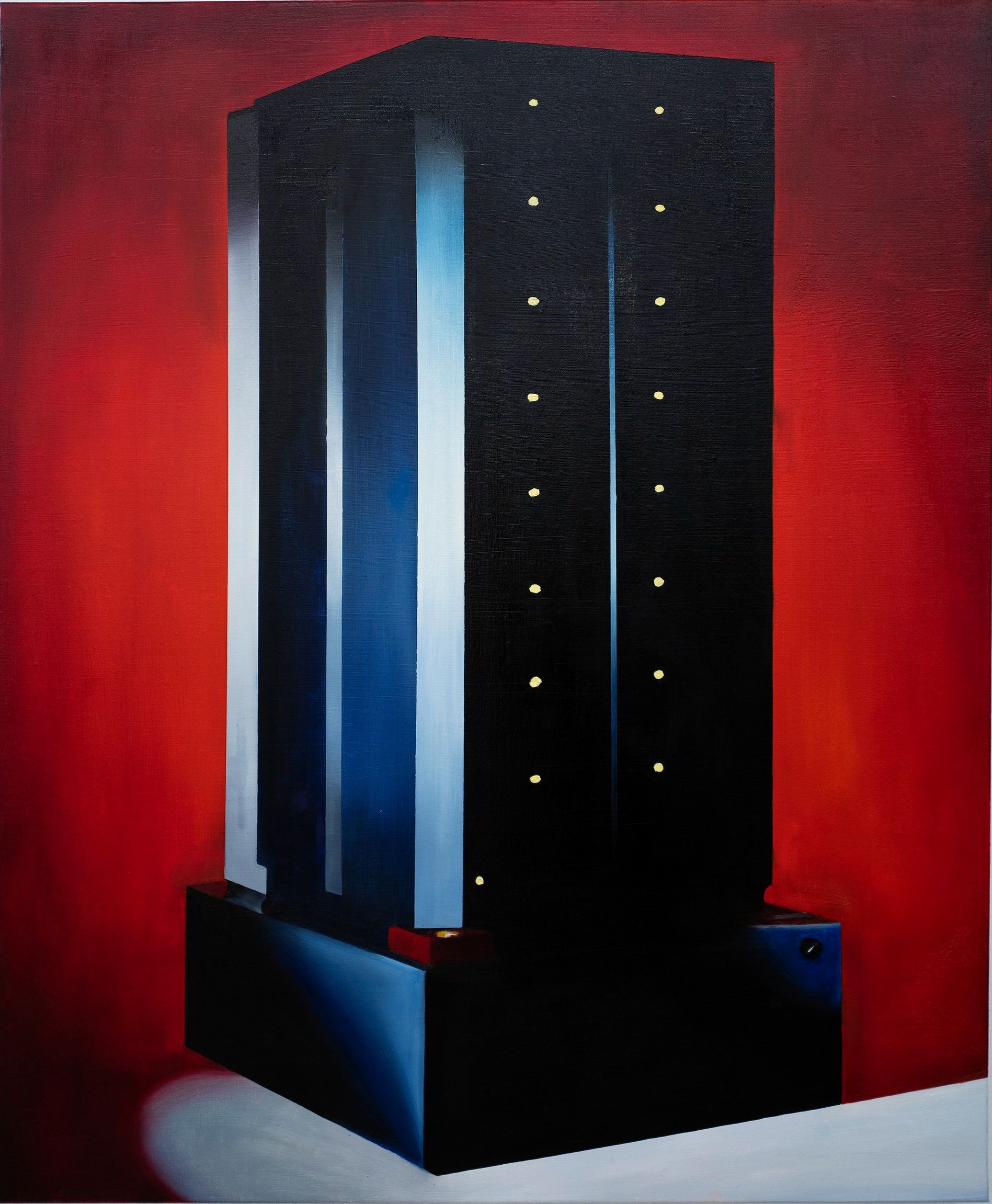
Checkmate (2022), oil on linen, 91 x 76 cm, is a portrait of the machine that won. It is not a portrait of Kasparov. It is not a painting of a chessboard. It is not a depiction of the match. It is an image of Deep Blue standing alone, occupying the full height of the canvas against a saturated red ground, a tower of blue metal and glowing circuit nodes that has no face, no expression, no body language, no visible means of thinking, and yet has just demonstrated that it can think well enough to beat the best human player who has ever lived. The painting isolates the machine the way a monument isolates a general: by removing it from the context of the battle and presenting it as a figure that stands for the entire conflict, the entire era, the entire transformation that the conflict represents. The decision to isolate the machine, to paint Deep Blue without its opponent, without the chessboard, without the spectators and the cameras and the journalists who filled the auditorium in New York, is the painting's most consequential formal choice. It presents the machine not as a participant in a contest but as a presence that has outlasted the contest, a form that continues to stand after the event it was built for has concluded.
The physical composition of Checkmate is built from three chromatic registers that work in opposition to each other. The machine occupies the vertical center of the canvas, its body a deep blue that is both the color of the IBM supercomputer's specialized chips and the color of a night sky seen through atmosphere. This blue is not uniform. It shifts across the surface of the machine from a dark navy at the edges to a brighter, more electric blue at the center, where the circuitry is densest, creating an internal luminosity that suggests the machine is generating its own light the way a screen generates its own light, by exciting phosphors or LEDs from behind a surface that appears opaque from a distance but reveals its activity at close range. The yellow points distributed across the machine's surface are the brightest elements in the painting. They glow against the blue body with an intensity that reads as electrical, as if each point is a circuit node carrying current, a logic gate processing data, a computational unit making a decision. Tan Mu describes these points as "computational nodes or internal logic units" that "function almost like eyes or neurons, implying awareness without humanity." The red background fills the remaining space around the machine, a deep, saturated crimson that darkens toward the edges of the canvas and lightens slightly where it meets the machine's body, as if the red were reacting to the blue, the way a photographic emulsion reacts to light, the way a retina reacts to an afterimage.
The scale of the painting, 91 x 76 cm, gives the machine a physical presence that matches the ambition of its subject. The canvas is tall enough that the machine fills the vertical dimension from near the top edge to near the bottom, and wide enough that the red ground provides a border on each side that frames the machine the way a plinth frames a statue. The vertical format emphasizes the machine's height and its rigidity, its refusal to bend or curve or accommodate the organic forms that populate the rest of the visual world. The machine in Checkmate is not a friendly presence. It does not invite approach. It stands the way a column stands, the way a monolith stands, with the self-sufficient authority of a form that does not need the viewer's approval. The red ground intensifies this authority. Red is the color of alarm, of urgency, of blood, of the emotional pressure that Tan Mu identifies as central to the match itself. It is also, by coincidence or by design, the color of the Soviet flag under which Kasparov was born, the color of the political system that produced him and that he later repudiated. The painting does not make this connection explicit. It does not need to. The red is there, surrounding the blue machine the way the Cold War surrounded the space race, the way ideology surrounds technology, the way the emotional stakes of a competition surround the competition itself.
Francis Bacon painted Study after Velazquez's Portrait of Pope Innocent X in 1953, reworking Diego Velazquez's seventeenth-century portrait of a pope into an image of a figure trapped inside a cage of vertical lines, its mouth open in what might be a scream or a word that cannot be spoken, its face dissolving into paint that no longer holds the features of a specific person. Bacon's pope is not an individual. It is a position, an office, a structure of authority that has been stripped of the flesh and personality that once made it recognizable. The vertical lines that frame the figure, sometimes read as the bars of a cage, sometimes as the vertical elements of a piece of furniture, isolate the pope from any context that would explain his expression or relieve his isolation. He sits in a golden chair against a dark ground, and he is alone, and he is screaming, and the painting offers no explanation for his condition. The authority that Velazquez's portrait confirmed, the authority of the papal office, the authority of the institution, the authority of the painted image itself, has been hollowed out by Bacon's treatment, leaving only the form of authority without its content, only the position without the person who occupies it.
Checkmate shares this logic of the emptied monument. Deep Blue in Tan Mu's painting occupies the position of the victor without displaying the qualities that a victor normally displays. There is no expression of triumph. There is no gesture of dominance. There is no body language that communicates satisfaction or relief or even acknowledgment of what has been achieved. The machine stands against the red ground the way Bacon's pope sits against the dark ground: isolated, rigid, stripped of the human qualities that would make it legible as a portrait of a specific consciousness rather than a portrait of a capacity. The difference is that Bacon's pope has lost his authority. Deep Blue has just acquired it. The painting captures the moment of acquisition, the moment when a new kind of intelligence enters history and takes up a position that has always been occupied by humans, and it presents this moment without celebration or lament, without the sentimentality that characterized so much of the commentary that surrounded the actual match. The machine is not a villain. It is not a hero. It is a form that has demonstrated a capability, and the painting gives that form the visual weight of a monument without giving it the face that a monument normally carries.
The subject of Checkmate, as Tan Mu states it, is the moment when a computer defeated a human grandmaster in chess for the first time, marking a decisive turning point in the relationship between machines and human cognition. The history is specific and verifiable. Deep Blue was conceived by Feng-hsiung Hsu in 1985 as a graduate student project at Carnegie Mellon University. Hsu and his team joined IBM in 1989, and by 1996 they had produced a machine capable of challenging Kasparov in a six-game match. Kasparov won that first match, four games to two, but he was shaken by the experience, particularly by a move in game one that he attributed to divine intelligence and that later turned out to be the result of a bug in the program. The rematch in 1997 was the one that mattered. Deep Blue had been upgraded with more powerful hardware and improved evaluation functions, and after six games, the score was three and a half to two and a half in favor of the machine. Kasparov resigned the final game after only nineteen moves. The press coverage was enormous. Time magazine ran a cover story. The New York Times published multiple analyses. Commentators divided between those who saw the victory as a milestone in human progress and those who saw it as a sign of human obsolescence. Kasparov himself accused IBM of cheating, suggesting that the machine's play in game two showed evidence of human intervention. The accusation was never substantiated, but it revealed the depth of the anxiety that the match had produced: even the world champion could not accept that a machine had outplayed him fairly.
The science of chess computation that made Deep Blue possible is worth understanding in its specifics, because the specifics illuminate the painting's central argument. Deep Blue did not play chess the way a human plays chess. A human grandmaster evaluates perhaps two or three positions per second, choosing among them on the basis of pattern recognition, strategic intuition, and accumulated experience. Deep Blue evaluated two hundred million positions per second, using a brute force search algorithm called alpha-beta pruning that systematically eliminated branches of the game tree that could not lead to a better outcome than a branch already evaluated. The machine did not understand chess in any meaningful sense. It did not find the game beautiful or the positions interesting or the strategic patterns satisfying. It processed the game as a combinatorial problem, a finite set of legal positions that could be searched exhaustively within the constraints of time and computational power. Kasparov played chess. Deep Blue searched chess. The distinction matters because it defines the terms of the confrontation. The machine was not competing in the same activity as the human. It was performing a different operation on the same formal system, and the result of that operation was superior to the result of the human operation, but this superiority did not answer the question of whether the machine understood what it was doing or whether understanding was necessary for the operation it performed. The painting presents the machine as a form that has achieved a result without displaying the qualities that normally accompany that result. It has won without comprehending. It has triumphed without feeling. It has changed the course of history without knowing that history exists.
Yiren Shen, writing in 2025, observed that Tan Mu's practice "collapses the distance between the technological event and the act of painting, producing works that are neither documentation nor illustration but something closer to a temporal inscription, a mark left at the intersection of what happened and what it means." This observation, made about the broader trajectory of Tan Mu's work, is particularly precise when applied to Checkmate, because the painting occupies exactly this intersection. The event happened in 1997. The painting was made in 2022. The twenty-five years between the event and its depiction are not a gap that the painting bridges. They are the material the painting is made from. Tan Mu's relationship to the event is shaped by distance, memory, and later reflection, and the painting reflects this distance in its formal choices. The machine is isolated because the painter is distant. The red ground surrounds the machine because the emotional stakes of the event have been magnified by the quarter century of AI development that followed it. The yellow nodes glow with an awareness that was not yet visible in 1997 but is unmistakable now, when artificial intelligence has moved from the research lab to the smartphone, from the chess match to the conversation, from evaluating positions to generating language, images, and decisions that shape the daily lives of billions of people.
Tan Mu describes her approach as "future archaeology," a term that reverses the normal direction of archaeological practice, which looks backward from the present into the past, and instead looks forward from the past into the present, treating the event as a site that will be excavated not by the archaeologist who stands over it now but by the archaeologist who will stand over it in ten or twenty years, when the meaning of the event has shifted again and the painting must speak to a condition that does not yet exist. This temporal reversal is encoded in the painting's formal structure. The machine stands against the red ground as if it has always been there, as if it were a monument that was erected at the moment of the victory and has remained in place ever since, waiting for the present to catch up with its significance. This is what monuments do. They stand. They persist. They outlast the events they commemorate, and in outlasting those events, they become available to meanings that were not available at the time of their construction. The monument to a military victory becomes, after enough time has passed, a monument to the cost of war. The monument to a scientific achievement becomes, after enough time has passed, a monument to the consequences of that achievement. Checkmate stands in this position, at the intersection of the event and its consequences, holding the moment of Deep Blue's victory open to the future meanings that the ongoing development of artificial intelligence will continue to produce.
The yellow nodes that glow across the surface of the machine are the painting's most speculative element. Tan Mu describes them as suggesting "awareness without humanity," and the description is exact. The nodes are not eyes. They do not look at the viewer or at anything else in the painting. They are points of light that register activity without specifying what kind of activity is occurring. They could be computational nodes processing chess positions. They could be neurons firing in a network that has not yet been mapped. They could be stars in a constellation that has not yet been named. Recent research into large language models has shown that the internal representations these systems construct, when visualized as point clouds, exhibit structural patterns that resemble atoms, neural networks, and cosmic formations. Tan Mu references this research directly: "Intelligence, whether biological or artificial, may follow shared organizational principles across different scales." The yellow nodes in the painting anticipate this insight. They are painted as points of light distributed across a blue field, and their distribution suggests a pattern that is not random but is not yet fully formed, a structure that is emerging rather than a structure that has been completed. This is the condition of artificial intelligence at the present moment: a system that is clearly organized, clearly capable, and clearly not yet finished becoming what it will be.
The painting does not tell you what to feel about this condition. It does not celebrate the machine or mourn the human. It presents the machine as a monument, and a monument does not ask you to agree with it. A monument stands, and you stand in front of it, and the meaning that passes between the monument and the viewer is produced by both of them together, by the weight of the form and the knowledge that the viewer brings to it. In 1997, Deep Blue's victory produced anxiety. In 2022, it produced a more complex mixture of anxiety, fascination, nostalgia, and anticipation. In ten or twenty years, it may produce something that cannot yet be named. The painting will still be here. The machine will still be standing against the red ground, its yellow nodes still glowing, its blue body still rigid and monumental and slightly unsettling, waiting for the meaning that the future will bring to the moment when a cabinet sat across from a man and, after six games, the cabinet won.