The Glow That Came From Within: Tan Mu’s Illuminate and the Filament That Made Time
New Year's Eve, 1879. Menlo Park, New Jersey. Three thousand people stood in the cold outside Thomas Edison's laboratory, watching the windows. Inside, the laboratory was lit by incandescent lamps, glass bulbs with carbonized bamboo filaments that glowed when an electric current passed through them. The light was not bright by contemporary standards. It was warm, amber, slightly unsteady, the kind of light that makes a room feel enclosed and intimate rather than illuminated in the modern sense. But the crowd outside was not looking at the quality of the light. They were looking at the fact of it. A glass bulb, smaller than a fist, was producing light without flame, without wick, without oil, without any of the combustible materials that humanity had relied on for illumination since the first fire was tamed. The light came from a filament inside a vacuum, heated by electricity until it glowed, and the glow was continuous, steady, and, for the first time in human history, controllable. You could turn it on. You could turn it off. You could make it last. This was the moment when humanity gained sustained authority over illumination, and the consequence of that authority was not merely that the night became brighter. The consequence was that the day became longer. The boundary between productive time and unproductive time, which had been set by the sun for the entire history of the species, was now subject to human decision.
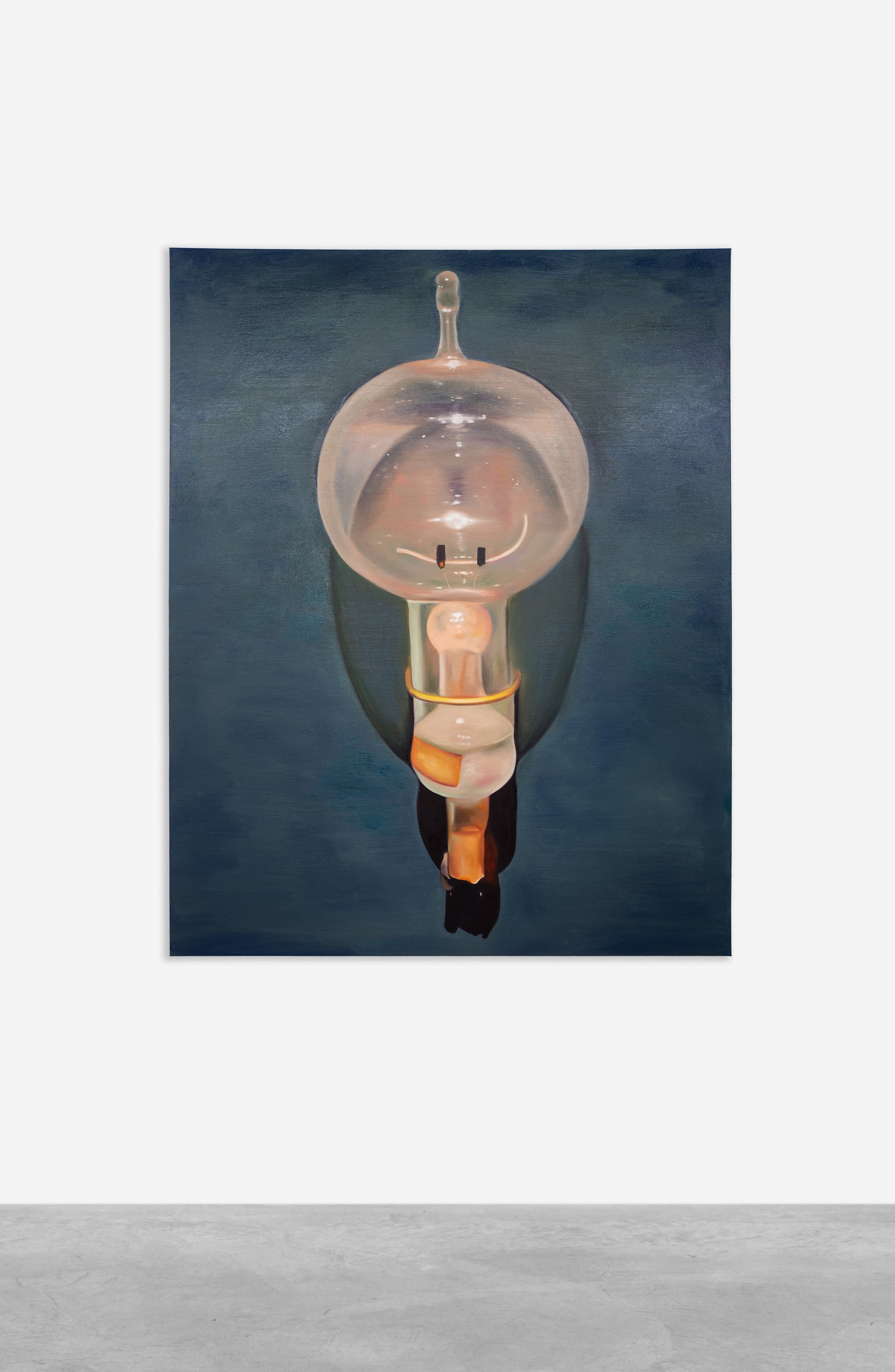
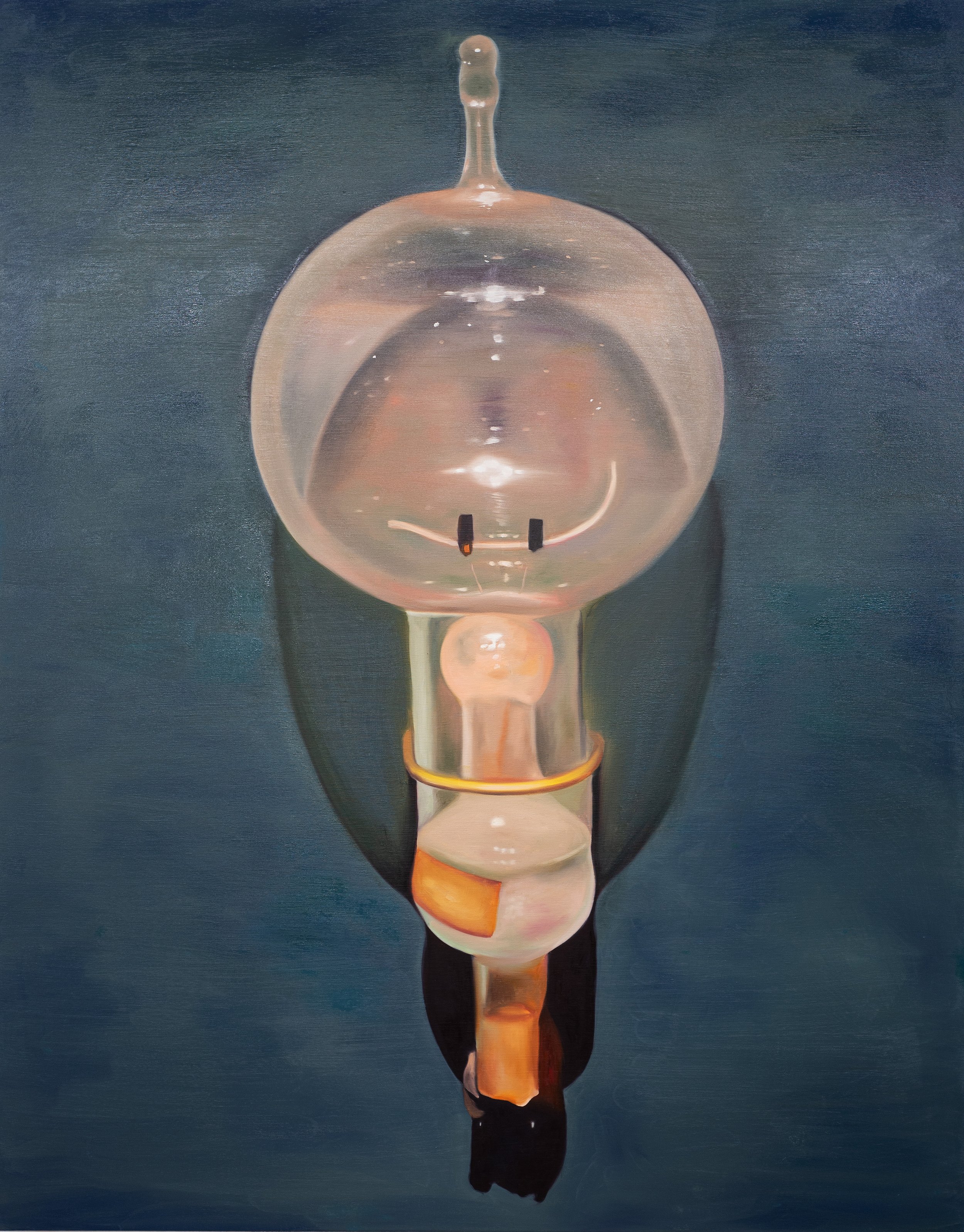
Illuminate (2022), oil on linen, 152 x 122 cm, is a painting of the object that produced this transformation. The light bulb occupies the center of the canvas, rendered at a scale that makes it larger than life, a glass form with a visible filament that glows from within, surrounded by a dark ground that recedes around the bulb the way night recedes around a lamp. The format is generous, 152 x 122 cm, large enough that the bulb fills the visual field the way a face fills a portrait, and this is not an accidental comparison. Tan Mu describes her approach as painting the bulb "in a portrait-like manner," focusing on its form, materiality, and internal structure rather than on the light it emits. The result is not a painting of illumination but a painting of the instrument of illumination, the object that makes light possible rather than the light itself. This is a crucial distinction. A painting of light shows you the effect. A painting of the light bulb shows you the cause. And the cause, in this case, is an object of extraordinary conceptual density: a glass envelope, a vacuum, a carbon filament, two conductive wires, and a base that screws into a socket. Together, these components constitute the most consequential invention of the nineteenth century, and Tan Mu paints them with the attention that a portraitist brings to the features of a sitter, treating every element of the bulb's construction as worthy of the same sustained looking that a face would demand.
The surface of Illuminate is built from layers of translucent oil paint that allow light to pass through the upper layers and reflect off the lower ones, creating an internal luminosity that mimics the way a real incandescent bulb emits light from its filament outward through the glass envelope. The bulb itself is rendered in pale golds and warm ambers that shift toward white at the point where the filament is hottest, the center of the glass form becoming the brightest area of the canvas. The glass is not transparent in the painting. It is translucent, a membrane that contains the light without fully revealing it, and the areas of the glass that are not directly lit by the filament recede into a cool grey that suggests the presence of the vacuum inside the envelope, the absence of air that makes the filament's incandescence possible. The filament itself is a thin, curved line of near-white that arcs between two support wires, its form precise and delicate against the warmer tones of the surrounding glass. The base of the bulb, where the glass meets the screw fitting, is painted in darker metallic tones, brass and iron and the dull silver of the electrical contacts, grounding the ethereal upper portion of the form in the material reality of the hardware that connects it to the circuit. The dark ground around the bulb is not a flat black but a deep, warm brown that lightens slightly where it meets the glass, as if the bulb's glow were diffusing into the surrounding space, illuminating the darkness not as a beam but as a presence, a warmth that extends beyond the boundary of the glass.
Rembrandt van Rijn spent a lifetime painting the moment when light emerges from darkness. In works such as The Return of the Prodigal Son (c. 1669) and the late self-portraits of the 1660s, Rembrandt constructed his figures from darkness outward, building the lit portions of the canvas over a ground of deep brown and black that functions not as a background but as a substance, a material darkness from which the illuminated forms seem to emerge rather than against which they are set. The light in Rembrandt's paintings does not fall on objects from an external source. It emanates from within them, as if the figures carried their own illumination, as if the light that makes them visible were a quality of their being rather than a condition of their environment. This is the tradition that Illuminate enters and extends. Where Rembrandt painted the light that reveals the human face, Tan Mu paints the light that reveals the artificial object that makes all subsequent light possible. The filament in the painting glows the way a face glows in Rembrandt, from within, as a consequence of what the object is rather than as a result of what shines upon it.
The structural parallel is precise. Rembrandt's method of building form from darkness, of allowing the lit portions of the canvas to emerge from the dark ground through successive layers of translucent paint, produces an effect that the artist and critic Max Doerner described in 1921 as "the luminosity of darkness," a condition in which the dark areas of the painting are not empty but full, not absent but present, containing the potential for light that the illuminated areas actualize. Tan Mu's dark ground in Illuminate operates in the same register. The space around the bulb is not empty. It is the darkness that existed before the bulb was invented, the darkness that human beings lived in for the entirety of their history until a carbon filament in a vacuum changed the terms of the relationship between the species and the night. The painting does not simply show a light bulb against a dark background. It shows the light bulb emerging from the darkness it was invented to dispel, and it shows this emergence as a process, the way Rembrandt shows a face emerging from shadow, not all at once but through the gradual accumulation of paint that builds the form from the inside out.
The stated subject of Illuminate is Edison's carbon filament light bulb, first publicly demonstrated on New Year's Eve, 1879, at the Menlo Park laboratory. The demonstration was not a quiet affair. Edison had invited journalists, investors, and the general public to witness the lighting of his laboratory by incandescent lamps, and the event was covered by newspapers across the United States and Europe. The New York Herald reported that "the exhibition was a complete success, and the light was pronounced by all present to be steady, pleasant, and effective." The demonstration established that incandescent electric light was not a laboratory curiosity but a practical technology that could be manufactured, installed, and used in ordinary settings. The carbonized bamboo filament that Edison had settled on after testing thousands of materials could burn for over twelve hundred hours before failing, making the lamp commercially viable. Within a decade, electric lighting had spread from Menlo Park to the streets and homes of major cities around the world. Within two decades, the gas lamps that had illuminated cities for a century were being removed. The speed of the transformation was without historical parallel. The light bulb did not merely replace an earlier technology. It restructured the temporal organization of human life. Factories could run twenty-four hours a day. Offices could work past sunset. Streets could be patrolled at night. The accident rate in industrial settings dropped because workers could see what they were doing. The reading rate increased because people could read after dark. The sleep rate decreased because there was no longer a biological imperative to stop when the sun went down.
Tan Mu describes a conceptual bridge that emerged during the painting process between the artificial illumination of the light bulb and the biological genesis of cell division. "Although the light bulb is entirely man made," she observes, "the way light emerges from within it evoked associations with the origins of life. I began thinking about the first single cell, round in form, dividing and multiplying. This parallel between artificial illumination and biological genesis fascinated me." The parallel is not merely formal. The light bulb is round, like a cell. It glows from within, like a cell that has been activated. It contains a filament that is both fragile and generative, like the DNA in a nucleus that can produce an entire organism from a single strand. And it occupies a dark space, the way a cell occupies the amniotic fluid or the way a fertilized egg occupies the darkness of the womb before it emerges into the light. The painting makes this parallel visible by treating the bulb not as a functional device but as a living form, an entity with presence and weight and the capacity to generate something larger than itself. The bulb in the painting does not merely produce light. It initiates a process, the way a cell initiates the process of growth, the way a fertilized egg initiates the process of development, the way a single invention initiates the process of civilizational transformation.
Dan Flavin began making art from fluorescent light tubes in 1963, when he mounted a standard eight-foot commercial fluorescent fixture on the wall of his studio at an angle of forty-five degrees and declared it a work of art. The piece was called the diagonal of May 25, 1963 (to Robert Ryman), and it consisted of nothing except the fixture, the tube, and the light it produced. No canvas. No paint. No frame. No composition. Just an industrial object that had been placed in a specific position in a specific room and plugged in. The light filled the space the way no painting could, because the light was not on the wall. It was in the room. It colored the walls, the floor, the ceiling, and the body of anyone who stood in front of it. Flavin's subsequent works expanded this principle into entire installations, corridors of fluorescent tubes in different colors that transformed the architecture they occupied into an environment of pure, generated light. These works eliminated the distinction between the representation of light and the presence of light. Flavin's art did not depict illumination. It was illumination. The light was not a metaphor. It was the medium.
Illuminate occupies the opposite position from Flavin's practice, and the opposition is the source of its argument. Where Flavin removed the painting entirely and replaced it with actual light, Tan Mu removes the actual light and replaces it with a painting of the object that produces it. The result is not an experience of illumination but a meditation on the instrument of illumination, the glass form and the carbon filament and the vacuum that together constitute the technology that changed the relationship between humanity and the night. Flavin's fluorescent tubes make the room brighter. Tan Mu's painted bulb makes the viewer think about what it means to make a room brighter, about the object that made that brightness possible, about the chain of consequences that extends from a carbonized bamboo filament in a glass vacuum to the twenty-four-hour city, the night shift, the all-night diner, the neon skyline, and the entire architecture of modern life that assumes light will always be available at the flip of a switch. The painting does not give you the light. It gives you the cause of the light, and the cause is an object that fits in your hand and changed the world.
Nick Koenigsknecht, in his 2025 catalog essay for the BEK Forum exhibition, wrote that Tan Mu's works "function more as self-portraits than depictions of external, scientific milestones," observing that "while observing technology, are we not looking at ourselves?" This observation acquires a particular resonance in Illuminate, because the light bulb is the technology that most directly extends the human body. The eye evolved to detect light. The hand evolved to manipulate objects. The light bulb is an artificial eye that works in reverse, producing the light that the eye evolved to receive, and it is an artificial hand that works in reverse, generating the illumination that the hand needs in order to see what it is doing. When Tan Mu paints the light bulb as a portrait, she is painting a portrait of the technology that most closely resembles a bodily function, the technology that does what the body cannot do for itself: make the dark light. The bulb is a surrogate for the sun, and the sun is the original condition of human vision, the external source that made sight possible. When that external source was replaced by an internal source, a glass bulb on a desk, a lamp in a factory, a fixture on a ceiling, the species gained a degree of autonomy from the natural cycle of light and dark that it had never possessed before. The painting holds this autonomy as a visual fact: the bulb stands alone against the dark ground, generating its own light, answering to no cycle, obeying no season, producing illumination on demand, the way a self-portrait produces a likeness on demand, the way a cell produces a body on demand, the way an invention produces a future that did not exist before it was made.
The connection to Tan Mu's IVF (2020) is not incidental. Both paintings depict moments of origin, moments when something that did not previously exist is brought into being through deliberate human intervention. IVF shows a needle injecting genetic material into an egg, the moment of artificial insemination, the instant when a new life is initiated in a laboratory. Illuminate shows a filament beginning to glow inside a glass envelope, the moment of artificial illumination, the instant when a new kind of light is initiated in a workshop. In both cases, the subject is not the result but the cause, not the child but the needle, not the light but the bulb, not what came after but what made what came after possible. This focus on origins rather than outcomes is a consistent feature of Tan Mu's practice, and it produces a specific kind of attention in the viewer: not the attention of someone looking at a consequence but the attention of someone looking at a beginning, a moment when the future is still undetermined and the object on the canvas could still become anything. The light bulb in Illuminate has not yet illuminated a factory or a street or a city. It has just begun to glow. The filament has just reached the temperature at which it emits visible light. The glass envelope has just become luminous for the first time. The painting holds this moment open, the way all portraits hold their subjects in the instant before the future arrives, and in doing so, it asks the viewer to consider what this beginning has produced, what it has cost, and what it has made possible that the world it was born into could not have imagined.
Rembrandt's faces emerge from darkness. Flavin's tubes fill the room with light. Tan Mu's bulb stands at the precise point between these two traditions, an object that produces light painted on a surface that does not, a cause rendered in a medium that can only depict its effect, a beginning held open against the dark ground that it was invented to dispel. The filament glows. The glass holds. The vacuum persists. And the night that the bulb was made to conquer is still there, in the dark ground that surrounds the form, in the brown that deepens toward the edges of the canvas, in the darkness that the bulb has pushed back but has not eliminated and will never eliminate, because the darkness was always there before the light and will always be there after it, waiting, patient, the condition that makes the filament's glow visible and the reason it was lit in the first place.