The Star in the Metal: Tan Mu's Antimony and the Element That Traveled From Supernova to Silicon
Isaac Newton wrote more than a million words on alchemy. This is not the Newton of the textbooks, the architect of universal gravitation and the calculus, the president of the Royal Society who stood at the summit of Enlightenment reason. This is the Newton who spent decades in his laboratory at Trinity College heating antimony ore in crucibles, distilling volatile spirits from metallic salts, and recording the results in cipher. He was trying to produce what alchemists called the "star regulus," a crystalline form of antimony that, when fractured, displayed a radiating pattern of lines that resembled a star. Newton succeeded. He named his specimen "Regulus XIV antimony," the Roman numeral indicating the fourteenth alchemical operation he had performed on the material, the word "Regulus" referring to the brightest star in the constellation Leo. The name was not poetic. It was cosmological. Newton believed that the metallic luster of antimony connected it to the celestial bodies whose gravitational influence he would later describe. He believed that the star in the metal was the same star in the sky, that the crystalline structure of the regulus was a terrestrial echo of the celestial order, and that understanding one would unlock the other. He was wrong about the mechanism, but he was right about the connection. Antimony is formed in supernovae. The element with atomic number 51, the semimetal that Newton heated in his crucible, is produced in the death throes of massive stars, forged in the same explosive nucleosynthesis that creates gold, silver, and uranium, then scattered across the interstellar medium and incorporated into the dust clouds that condense into new stars, new planets, new worlds. Every atom of antimony on Earth arrived here from the interior of a star that no longer exists. Newton could not have known this. But he felt it, and he named his specimen after a star.
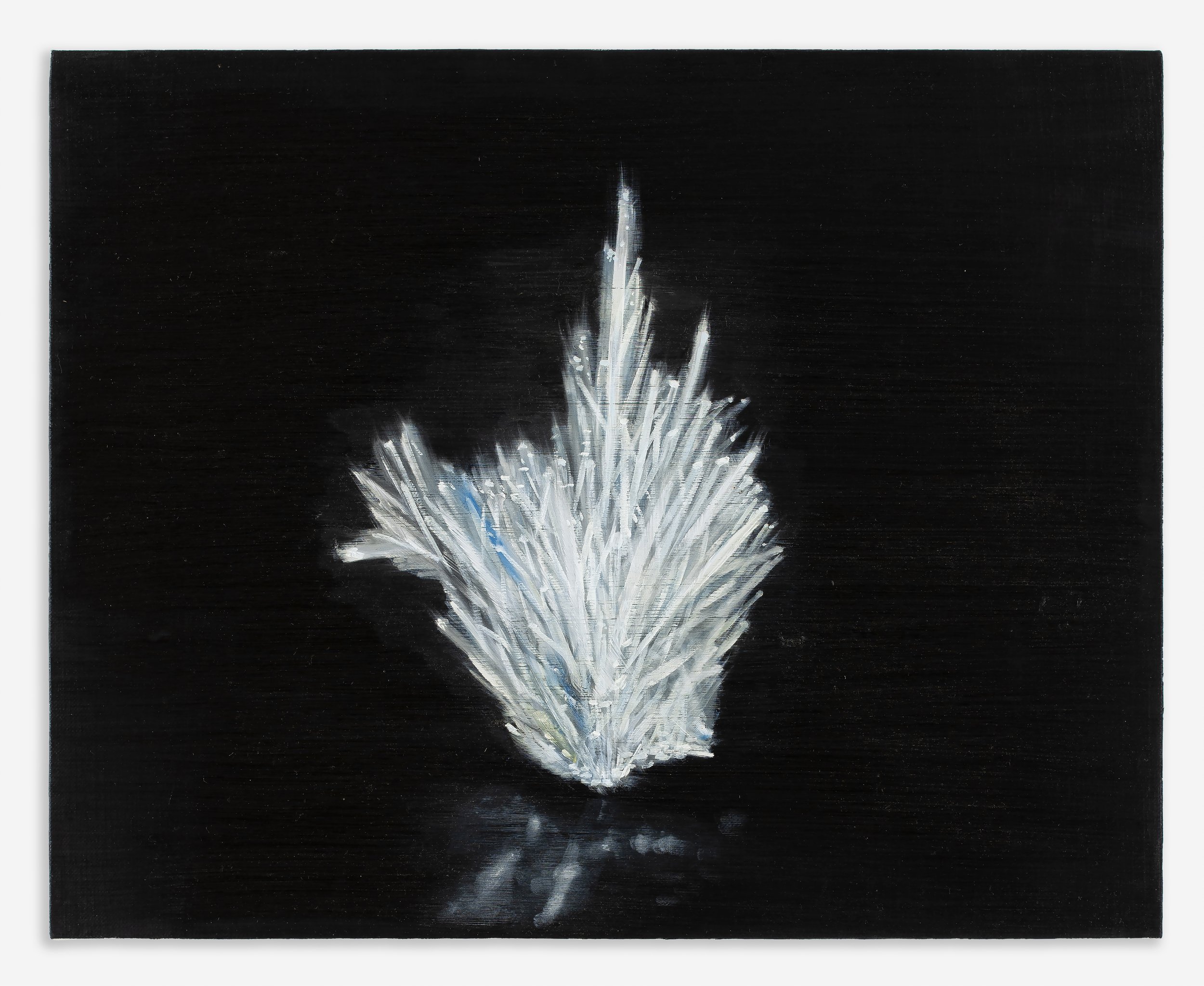
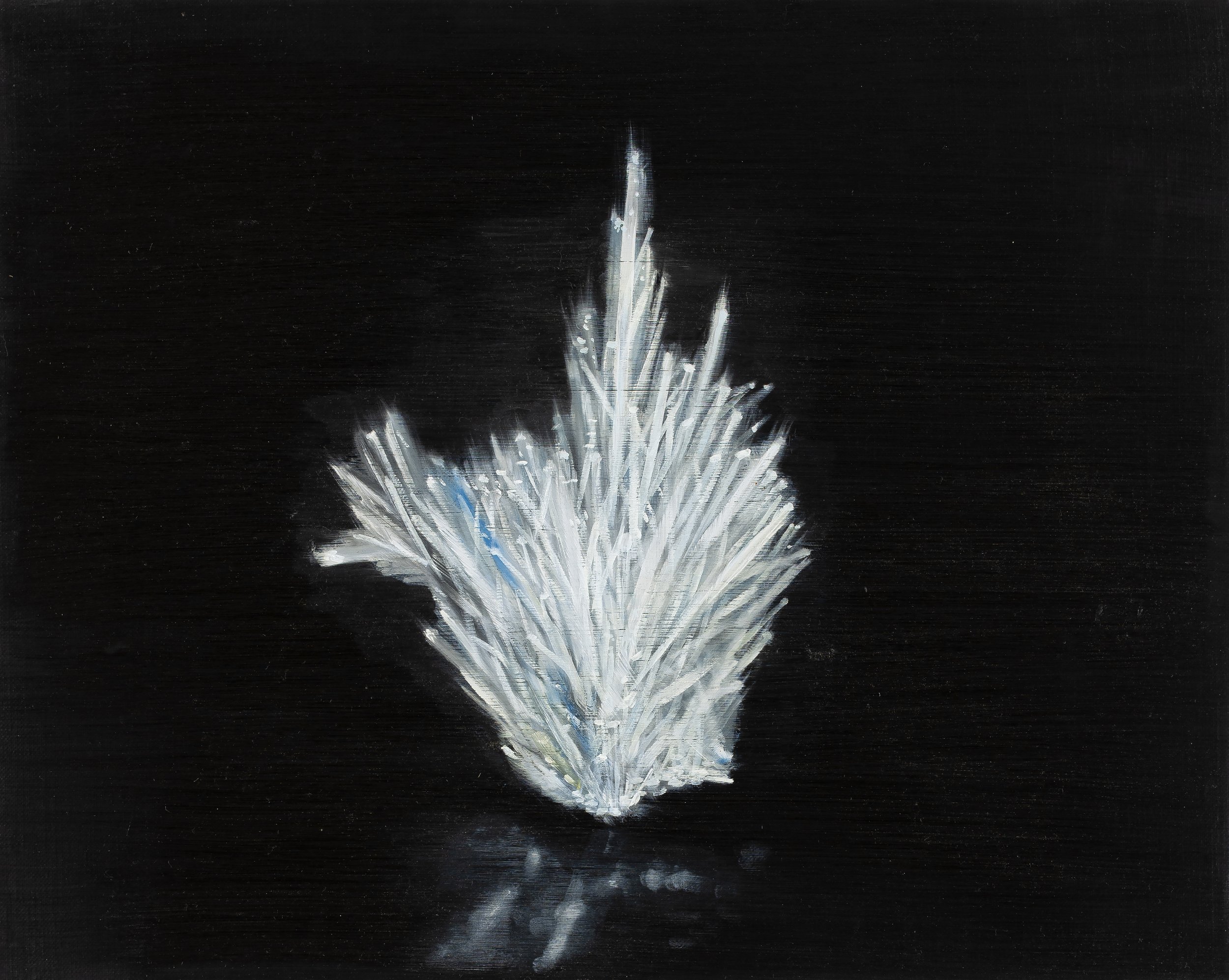
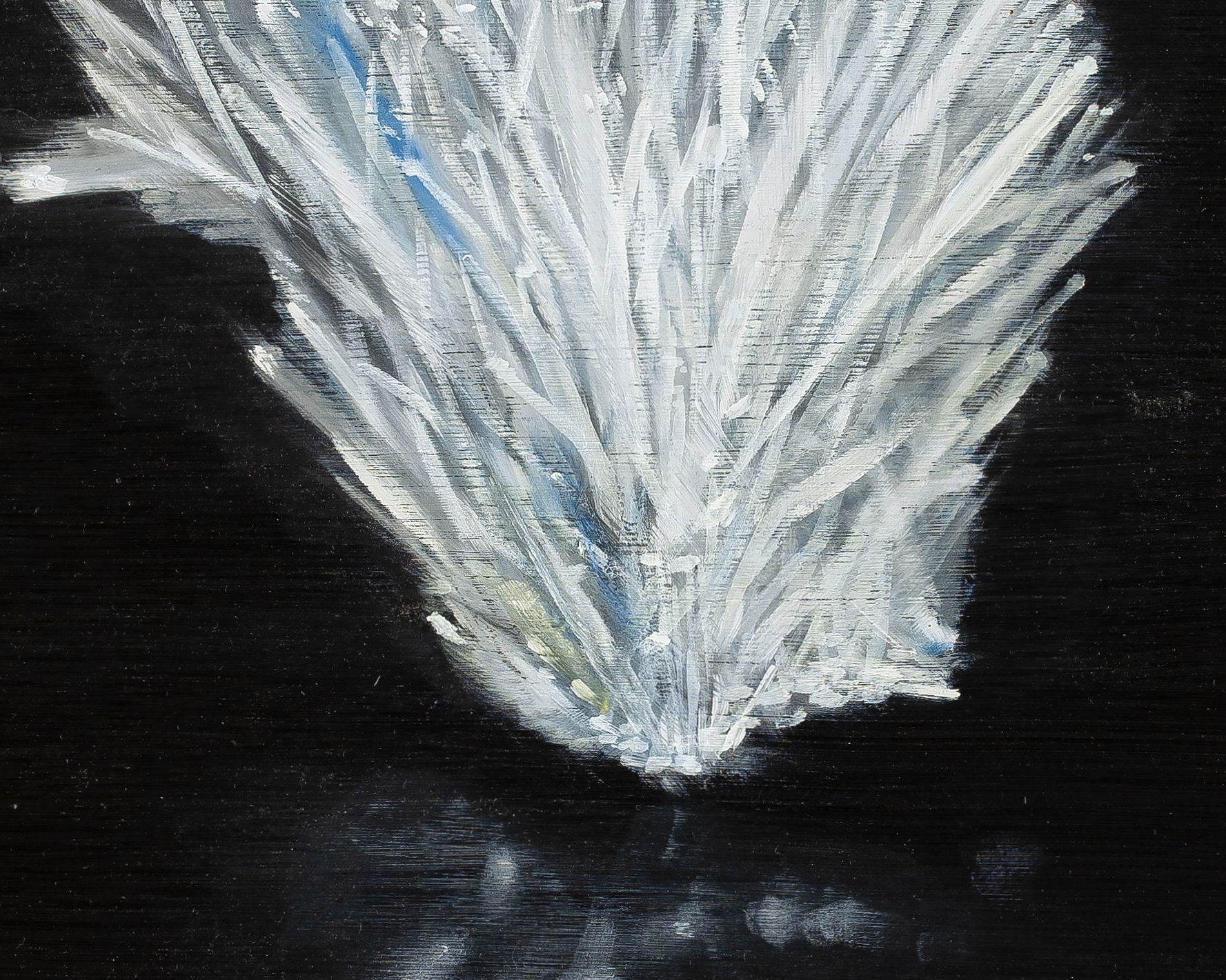
Tan Mu's Antimony (2020) is a painting of this element on a black field. The format is intimate: 16 x 20 inches (40.6 x 50.8 cm), oil on linen, a dimension that belongs to the tradition of cabinet painting rather than the wall-scale formats of her larger works such as Powehi (152 x 122 cm) or Emergence (193 x 244 cm). The intimacy is deliberate. This is not a painting that demands a gallery wall. It is a painting that asks to be held, to be looked at closely, the way a mineral specimen is held and turned in the hand. The crystalline form occupies the center of the canvas, a structure of angular facets and radiating ridges that catches and reflects the light of the room in which it hangs. The paint is built up in thick layers in the crystalline region, creating a surface topography that is actual rather than illusionistic. The facets protrude. The ridges cast faint shadows. At close range, you can see the brushwork that built each plane, the way the paint was laid on in successive coats, each one slightly different in tone, creating an internal variation that reads as the play of light across a mineral surface but is in fact the residue of a hand mixing pigment and applying it to linen in a sequence of decisions that parallel the crystallization process the painting depicts. The crystallization of antimony from its molten state also produces layers, successive shells of atoms arranging themselves into a lattice, each shell slightly different in its orientation from the one beneath it. The paint and the crystal share a logic of accretion.
The black background is total. It is not a dark grey or a deep blue-black. It is black, applied as a solid field that extends to the edges of the canvas and receives no light except what the crystalline form reflects back into it. The effect is not merely of contrast but of isolation. The crystal floats in a void. There is no shelf, no table, no surface on which it rests. There is no horizon, no depth cue, no atmospheric perspective. The black field is infinite in the sense that it provides no information about its extent. It could be a centimeter deep or a light year deep. It could be the interior of a laboratory or the interior of a supernova remnant. The crystal exists in this ambiguity, and the ambiguity is the point. Tan Mu has stated that the black background "functions as an infinite void, intensifying the contrast and bringing out the material's intricate details." The void is not empty. It is the medium through which the crystal arrived: the interstellar medium, the space between stars, the darkness from which all heavy elements emerge and into which all heavy elements will eventually return. The black field in Antimony is the same black field that Newton saw when he looked up at the night sky from his laboratory in Cambridge and identified Regulus in the constellation Leo. It is the same black field that contains the remnants of the star whose death produced the antimony atoms in Newton's crucible and in Tan Mu's painting.
Adriaen van Ostade painted The Alchemist in 1661, during the same decade that Newton was conducting his own alchemical experiments at Cambridge. The painting shows a cluttered interior, a figure hunched over a small furnace, surrounded by the apparatus of the alchemical laboratory: glass vessels, crucibles, retorts, a mortar and pestle, books open to pages of diagrams and symbols. The room is dark, lit only by the glow of the furnace and the faint daylight that enters through a window at the upper left. The alchemist is alone, bent over his work, absorbed in a process that the viewer can observe but not share. The tone of the painting is ambiguous. Van Ostade was working in a tradition that depicted alchemists as either sages or fools, and this painting resists the simplification of either reading. The alchemist is not a figure of ridicule. His concentration is genuine. His instruments are real. His labor is disciplined. But the clutter of the room, the disorder of the vessels, the accumulation of failed experiments that litter the floor suggest that the discipline has not produced the result that the alchemist seeks. The painting is not a satire of alchemy. It is a portrait of a method that has not yet arrived at its conclusion, a mind that has not yet found what it is looking for, a practice that is suspended between the certainty of its premise and the uncertainty of its outcome.
The structural resonance with Antimony is not in the depiction of alchemy but in the relationship between the isolated figure and the dark room that contains the labor. Van Ostade's alchemist works in a space defined by darkness, and the only light in the painting comes from the process he is conducting, the fire in the furnace and the glow of the substances he heats. The room is a black field, and the alchemist is the crystal that occupies it. Tan Mu has removed the alchemist. She has removed the furnace, the crucibles, the retorts, the books, the clutter of the laboratory. She has stripped the scene down to its essential element: the crystalline product that emerges from the labor, the regulus that Newton named after a star, the antimony that sits at the center of the canvas and radiates its own light into the surrounding darkness. The painting is the aftermath of the alchemical process. It is what remains when the alchemist has gone, when the furnace has cooled, when the crucibles have been put away. It is the element itself, isolated from the human activity that produced it and the technological systems that now depend on it, presented in a void that is simultaneously the darkness of the laboratory and the darkness of interstellar space.
The science of antimony's cosmic origin is a twentieth-century discovery, but its implications reach backward through the entire history of the element's use. Antimony has atomic number 51. It sits in the pnictogen group of the periodic table, between arsenic and bismuth, in a position that gives it the properties of both a metal and a nonmetal, a semimetal, a substance that does not conduct electricity as well as a metal but conducts it better than an insulator. This intermediate character is what makes it useful in semiconductors, where precise control of electrical conductivity is the foundation of all digital computation. The same atomic structure that makes antimony a semimetal also produces its distinctive crystalline habit. When molten antimony cools, its atoms arrange themselves into a rhombohedral lattice, a structure that produces the radiating, star-like pattern that Newton observed and that gives the mineral its common name: stibnite, from the Greek word for the cosmetic powder that ancient Egyptians made from ground antimony sulfide and applied around their eyes as kohl. The word "antimony" itself is of uncertain etymology. One tradition derives it from the Greek anti monos, meaning "not alone," a reference to the fact that the element is never found in nature in its pure metallic form but always in combination with other elements, particularly sulfur. Another derives it from the Arabic ithmid, a word for stibnite that passed through medieval Latin into the European languages. Both etymologies register the same property: antimony is a relational element. It does not exist in isolation. It exists in combination, in alloy, in compound, in the company of other substances that modify its behavior and extend its utility.
The stellar nucleosynthesis of antimony is a specific process within the broader category of what astrophysicists call the "r-process," or rapid neutron capture process. In the final seconds of a core-collapse supernova, the dying star expels a neutron-rich environment in which atomic nuclei capture neutrons faster than they can decay, building up heavier and heavier elements in a cascade that produces virtually all of the elements heavier than iron. Antimony is one of these products. It forms in the explosion and is ejected into the interstellar medium at velocities approaching a tenth of the speed of light, where it mingles with the debris of other elements and eventually becomes part of the molecular clouds that collapse to form new stars and their planetary systems. The antimony on Earth, the antimony in Newton's crucible, the antimony in Tan Mu's painting, all of it was produced in a supernova that occurred before the solar system formed, approximately 4.6 billion years ago. The element is a fossil of stellar death, a relic of an event that was visible across the galaxy and that seeded the interstellar medium with the heavy elements that make rocky planets, atmospheres, and life possible. When Tan Mu describes antimony as having "a profound connection to the cosmos," she is not speaking metaphorically. She is stating a fact of astrophysics. The element is literally cosmic in origin, and its presence on Earth is evidence of a catastrophe that preceded the Earth's formation by millions of years.
Vija Celmins has spent decades painting surfaces that resist interpretation. Her Night Sky works, produced across the 1990s and 2000s, depict fields of stars against a black ground, and they are paintings about the difficulty of looking at something that is simultaneously there and not there. The stars are points of light. They can be counted, mapped, cataloged. But they are also distances so vast that the light by which they are seen left their sources thousands or millions of years ago, and some of the stars in the field are already dead, their light still traveling toward the viewer across the interval between the star's death and the moment of observation. Celmins paints this interval as a surface. Her night skies are not windows onto deep space. They are objects, paintings on linen, constructed from thousands of individual marks that build a field of luminous points against a dark ground. The surface is flat. The stars are not placed in perspective. There is no recession into depth. The painting is a field, not a window, and the field is a record of a specific observation, a specific photograph of the night sky that Celmins worked from, translated into paint through a process of patient, mark-by-mark transcription that treats each star as a point on a two-dimensional surface rather than a body at a three-dimensional distance.
The structural parallel with Antimony is in the relationship between the luminous object and the dark field that contains it. In Celmins's night skies, the stars are the luminous objects and the black field is the space between them. In Tan Mu's Antimony, the crystal is the luminous object and the black field is the void from which it emerged. Both paintings use the black field not as a background but as a medium, a substance through which luminosity travels and against which it becomes visible. Both paintings treat the luminous object as something that is both present and distant, both immediate and ancient. The star that Celmins paints is already dead, its light a message from a past that no longer exists. The antimony crystal that Tan Mu paints is already a fossil, its atoms forged in a supernova that no longer exists. Both paintings hold the present appearance of something whose origin is irretrievably past, and both paintings refuse to resolve the tension between the thing as it appears and the thing as it was when it was made. The crystal in Antimony is not an illustration of a supernova. It is a consequence of one. The stars in Celmins's night skies are not illustrations of stellar death. They are evidence of it. Both paintings present the consequence as a visual fact, and they ask the viewer to hold the knowledge of the origin alongside the experience of the surface, to understand that the luminous form on the canvas is the product of a process that the canvas cannot show but that the viewer can know.
The trajectory from alchemy to semiconductor that Tan Mu identifies as the element's historical arc is not a story of progress in the simple sense. It is a story of the same material being reinterpreted, repurposed, and revalued across successive regimes of knowledge. In the seventeenth century, antimony was a substance of mystical significance, a "hermetic" metal whose crystalline structure was read as evidence of hidden correspondences between the terrestrial and the celestial. Newton's naming of his regulus after a star was not an act of imagination. It was an act of interpretation within a cosmological framework that understood the material world as a system of correspondences, where the structure of a crystal reflected the structure of the cosmos and the behavior of a metal mirrored the behavior of a planet. This framework produced no practical results. Newton's alchemical experiments did not lead to the discovery of gravity or the invention of the calculus. But they shaped the way he thought about action at a distance, the way one body could influence another across the void of space without direct contact, and this way of thinking was the precondition for the theory of universal gravitation that would make his reputation. The alchemical experiment and the physical theory were not separate activities. They were different registers of the same inquiry: what is the relationship between the local and the remote, between the crystal on the table and the star in the sky, between the substance in the crucible and the force that moves the planets?
In the twenty-first century, antimony has been stripped of its mystical associations and reclassified as a critical mineral, a material whose supply chain is essential to national security and economic stability. It is used in semiconductors as a dopant, a trace element that is introduced into the crystalline lattice of silicon to modify its electrical properties and create the p-n junctions that are the fundamental building blocks of all transistors. It is used in flame retardants, in lead-acid batteries, in infrared detectors, in the manufacturing of polyethylene terephthalate (PET) plastic. The same element that Newton heated in his crucible because he believed it connected him to the stars is now heated in industrial furnaces because it connects the device in your pocket to the global telecommunications infrastructure. The transformation from mystical substance to critical material is not a loss of meaning but an accumulation of meanings. Antimony carries the history of every regime of knowledge that has used it, and each regime has left its trace in the way the element is understood. The alchemists saw a star in the crystal. The physicists saw a semiconductor. The strategic analysts saw a supply chain vulnerability. Tan Mu sees all of these at once, and her painting holds them in the same visual space, the luminous form against the dark field, the crystal that is simultaneously a star and a chip and a weapon and a medicine, depending on who is looking and what they need it to be.
Danni Shen, writing in Emergent Magazine in February 2024, observed that Tan Mu's practice is "rooted in a methodology of research and translation, where scientific imagery becomes a starting point rather than an endpoint." The observation is precise. The scientific image of antimony, whether the alchemical engraving of a regulus or the electron micrograph of a semiconductor lattice, is the input. The painting is the output. The translation that occurs between them is not a simple transcription. It is an act of selection, emphasis, and composition that produces a visual object which carries the trace of its source but does not reproduce it. The crystalline form in Antimony is not a scientific illustration. It is a painting of a crystal, which is to say it is an object made of oil paint on linen that refers to a crystalline structure through the medium of pigment rather than through the medium of optics. The reference is real. The crystal exists. But the painting is not the crystal. It is a translation of the crystal into paint, and the translation introduces properties that no photograph or micrograph could possess: the texture of the surface, the thickness of the paint, the visible decisions of the hand that mixed each color and applied each mark.
The black field that surrounds the crystal in Tan Mu's painting is, in this context, not merely a compositional device but a philosophical proposition. Tan Mu describes it as an "infinite void," and the word "infinite" is chosen with care. The void is not dark because the lights are off. It is dark because it is the absence of everything that is not antimony. The painting isolates the element from every context except the context of origin, and the context of origin is the void of interstellar space, the medium through which the element traveled from the supernova where it was forged to the planet where it was mined to the crucible where Newton heated it to the canvas where Tan Mu painted it. The black field connects the crystal to its history by removing every distraction, every surface, every horizon, every reference to the human world of laboratories and factories and supply chains. What remains is the element and the darkness from which it came. This is the painting's argument: that every element, every material, every substance that human beings use to build their technology is a visitor from the void, a temporary condensation of stellar matter that will eventually return to the interstellar medium when the planet that now contains it is absorbed by the expansion of its star. The crystal in Antimony is not permanent. It is a moment in the long career of atoms that were ancient before the Earth was formed and that will be ancient long after the Earth is gone. The painting holds this moment, the moment of crystalline form against cosmic darkness, and it holds it in oil paint, which is itself made from materials that were forged in stars.
Tan Mu connects this work explicitly to her Silicon (2021, 2023), a painting that addresses the element that forms the foundation of contemporary electronic chips. The connection is not merely thematic. It is structural. Both paintings isolate an element on a dark field, present its crystalline form as a luminous object, and invite the viewer to consider the relationship between the visible surface of the mineral and the invisible history that produced it. Silicon, like antimony, is a product of stellar nucleosynthesis. Silicon, like antimony, is a semiconductor. Silicon, like antimony, is a critical material whose supply chain defines the geopolitical landscape of the twenty-first century. But silicon is abundant, the second most common element in the Earth's crust, while antimony is scarce, ranked among the materials most vulnerable to supply disruption by the European Commission and the United States Geological Survey. The scarcity is geological. The Earth's supply of antimony is finite, and the mines that produce it, concentrated in China, Russia, and Bolivia, are subject to the same geopolitical forces that shape the supply of oil, rare earth minerals, and cobalt. The painting does not depict this scarcity. It depicts the element in its crystalline perfection, as if scarcity did not exist, as if the supply of antimony were as infinite as the void from which it came. This is the painting's most deliberate fiction. The crystal is perfect. The supply is not. The void is infinite. The element is not. The painting holds this contradiction without resolving it, presenting the element in its beauty and its rarity, its utility and its finitude, its cosmic origin and its terrestrial depletion, and it asks the viewer to see all of these at once, to understand that the luminous form on the canvas is not merely beautiful but also endangered, not merely a star in the metal but also a resource on the edge of exhaustion.
The last atom of antimony on Earth will outlast every device that contains it. It will survive the semiconductor, the battery, the flame retardant, the PET bottle. It will survive the factory that refined it and the mine that extracted it and the supernova that forged it 4.6 billion years before any of these existed. It is, in the most literal sense, indestructible. Nuclear transmutation can convert it to another element, but no chemical process, no industrial use, no geopolitical conflict can destroy a single atom of antimony. The element is permanent in a way that no technology, no economy, no civilization can be. The painting knows this. The black field knows this. The crystal that sits at the center of the canvas, radiating its cold, metallic light into the surrounding darkness, knows this. It is a portrait of a substance that will be here when everything that uses it is gone, a portrait of permanence painted in a medium that will crack and yellow and eventually return to the elements from which it was made, a portrait of a star in the metal, painted by a hand that is also made of stars.