The Orbital That Holds the World: Tan Mu's Atom and the Shape That Connects Microscope to Telescope
You cannot draw an electron. This is not a limitation of skill or technique. It is a consequence of physics. The electron does not have a position in the way that a billiard ball has a position. It has a probability distribution, a cloud of possible locations that is denser in some regions and thinner in others, and the act of measuring it collapses the distribution into a single point that tells you where the electron was at the moment of measurement but not where it is now or where it will be. The orbital, the region where the electron is most likely to be found, is not a path that the electron follows around the nucleus like a planet following an orbit around a star. It is a statistical description of a region of space, and it takes shapes, spheres, dumbbells, clovers, rings, that are the solutions to the Schrodinger equation for the Coulomb potential of a hydrogen-like atom. These shapes have names. The s orbital is a sphere. The p orbital is a dumbbell. The d orbital is a clover. The f orbital is a set of shapes so complex that they are rarely drawn outside of quantum mechanics textbooks. When a physicist sketches an atom for a lecture or a textbook, she draws a nucleus at the center and concentric rings around it, with dots or small circles on the rings representing electrons. This is the Bohr model, proposed by Niels Bohr in 1913, and it is wrong. It is wrong in the specific sense that it describes electrons as particles in fixed orbits, which they are not, and it is right in the general sense that it provides a visual vocabulary for discussing atomic structure that is more useful than no vocabulary at all. Tan Mu's Atom (2020) inhabits this space between the model and the reality, between the drawing and the thing that cannot be drawn, between the circle that the hand makes and the probability distribution that the equation describes.
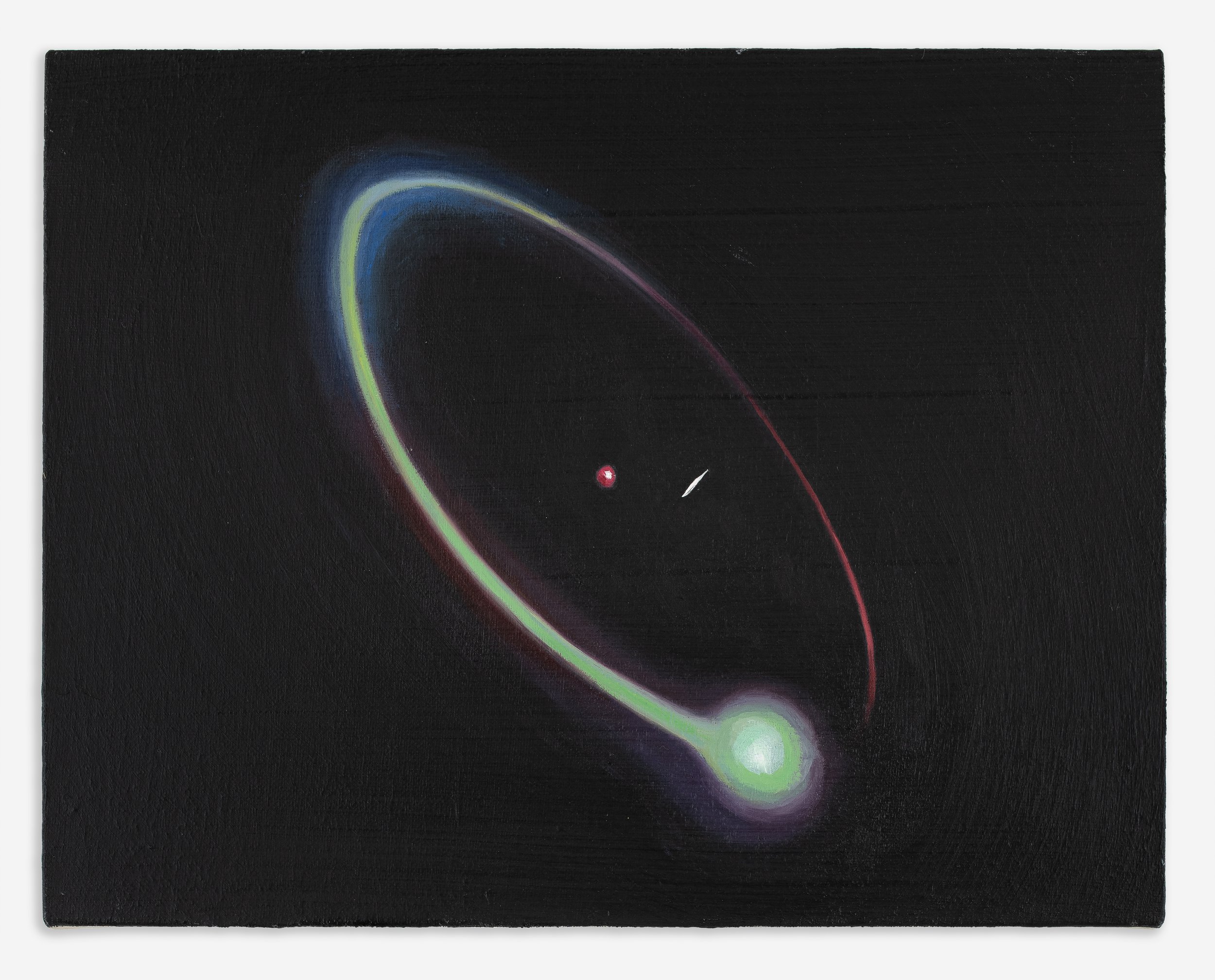
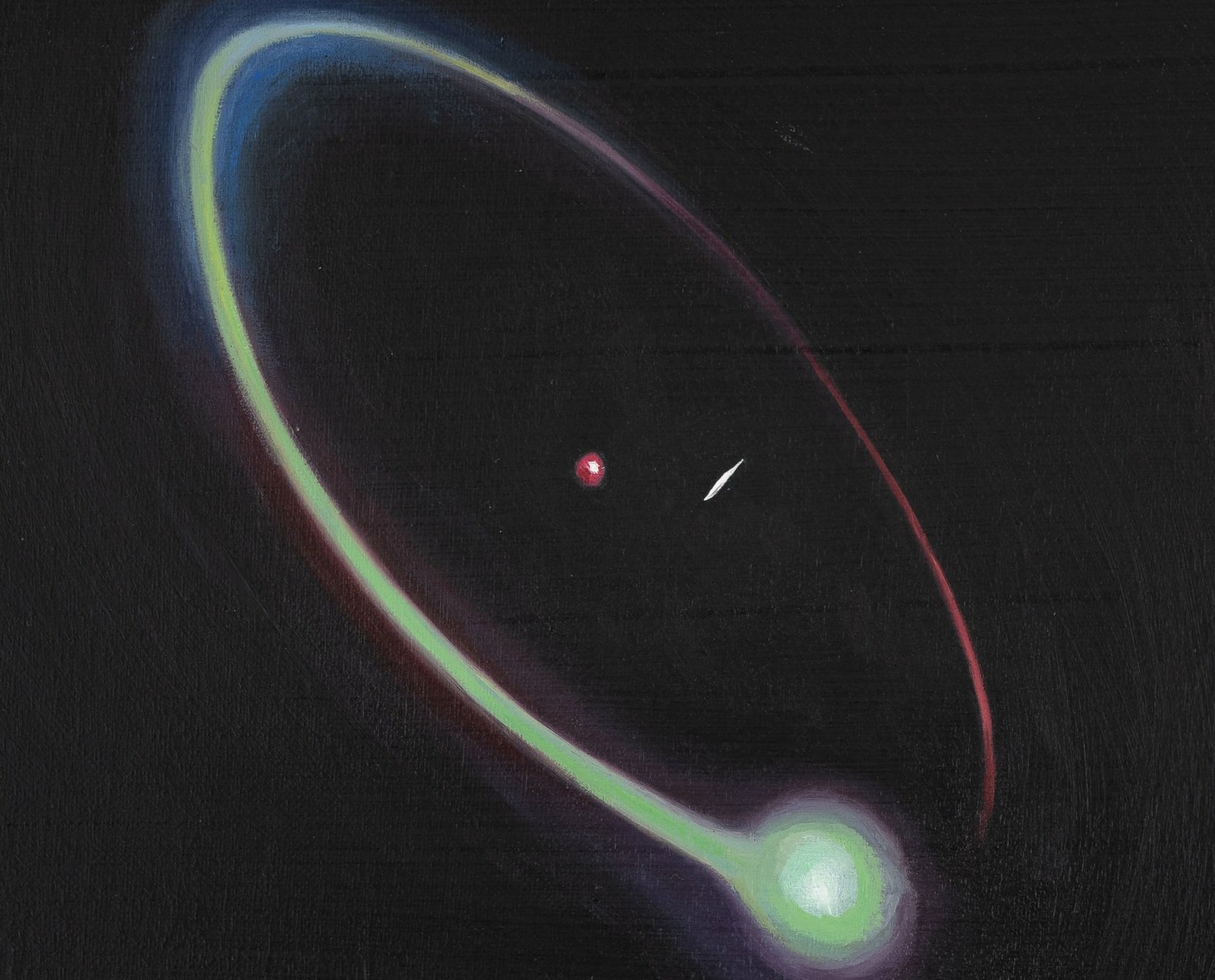
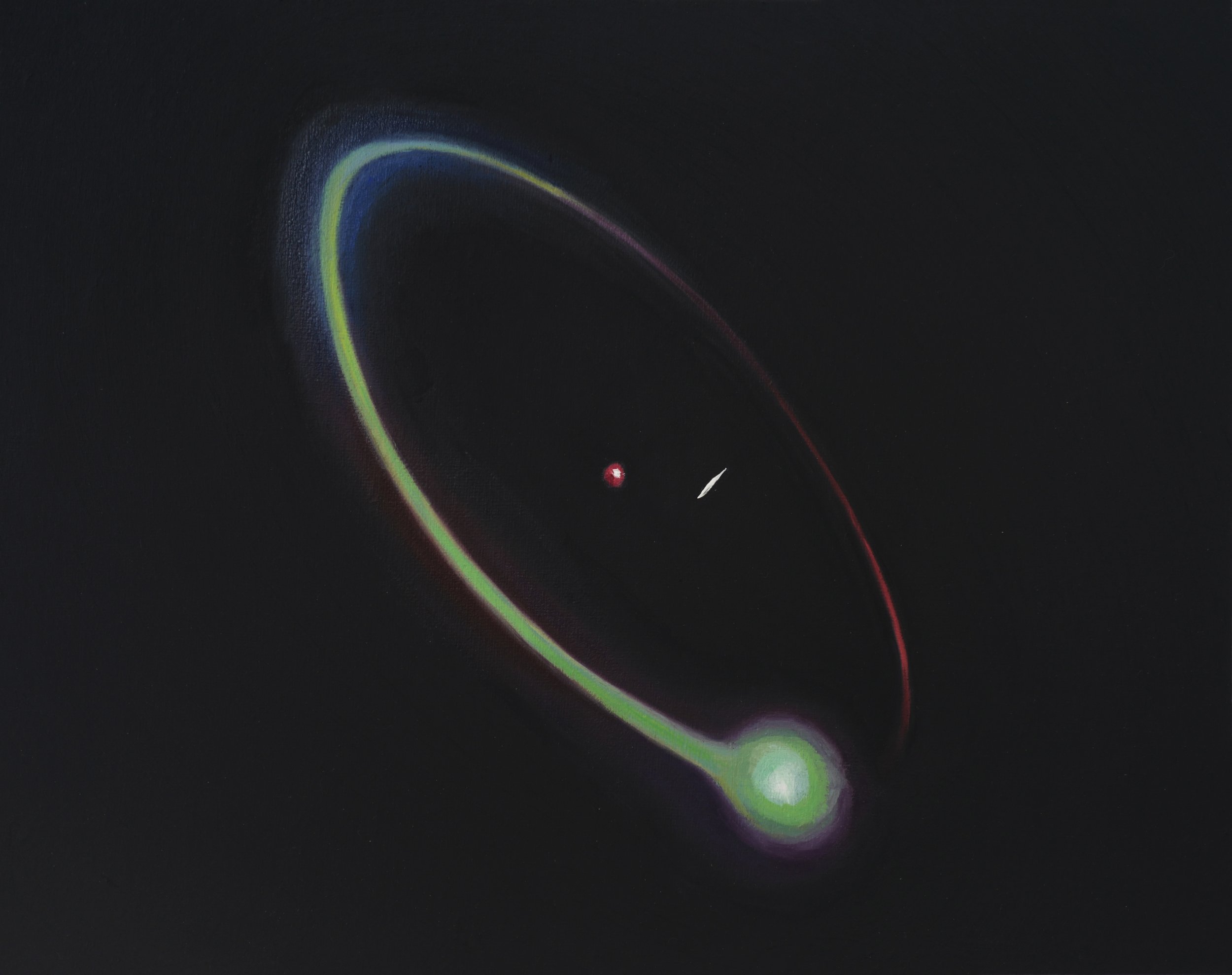
The painting is small. At 28 x 36 cm (11 x 14 inches), oil on linen, it is one of the most intimate works in Tan Mu's practice, a format that asks to be held rather than hung, examined rather than surveyed. The intimacy is appropriate. The atom is the smallest unit of an element that retains the chemical properties of that element. The painting of the atom is a small painting of a small thing. The central visual element is a prominent circle, the nucleus, surrounded by dynamic trajectories that suggest the movement of electrons and their energy levels. These trajectories are not the neat, concentric rings of the Bohr model. They are flowing lines that curve outward from the nucleus and loop back, that cross and re-cross, that thicken where the electron is most likely to be found and thin where it is least likely, that carry halos of color at their edges, blues and pinks and pale golds, that evoke the energy fluctuations of electron orbits without illustrating any single orbital in particular. The painting does not depict an orbital. It evokes the experience of looking at an orbital diagram and recognizing in it something that the diagram itself cannot convey: the sense that the electron is not a dot on a line but a presence in a region, a probability that manifests as color, a wave that manifests as line.
The background of the painting is dark, but not the absolute black of Antimony (2020) or the deep field of Moldavite (2020). It is a dark that contains color, a deep indigo that reads as black at first glance but reveals itself, on closer inspection, to be composed of multiple thin layers of paint, each one a slightly different tone, producing a spatial depth that the pure black of Antimony deliberately refuses. This depth matters. Where Antimony isolates its crystal in an infinite void, Atom places its orbital structure in a space that has thickness, that recedes, that could contain other atoms, other nuclei, other electrons, other orbital shapes. The dark ground of Atom is not a void. It is a medium, a substrate in which the atom exists, and the atom is not alone in it. The flowing lines that emanate from the nucleus suggest connections to something beyond the frame, as if the electron paths that curve outward are reaching toward adjacent atoms, toward the bonds that will form molecules, toward the chemical properties that will emerge from the interaction of this atom with its neighbors. The painting shows an atom in the process of becoming something larger than itself, an atom that is not self-contained but relational, that defines its identity not by its internal structure alone but by the connections it makes with the atoms around it.
Wassily Kandinsky painted Several Circles in 1926, during his tenure at the Bauhaus in Dessau, a period when his work had moved decisively from the expressionistic landscapes of his Munich years toward a geometric abstraction that he understood as both a formal and a spiritual project. The painting shows overlapping circles of varying size and color, some transparent, some opaque, floating against a dark ground that is not black but a deep blue-grey, a color that Kandinsky described as belonging to the "cosmic" register of his color theory. The circles are not arranged in a pattern that suggests a solar system or an atomic model or a mathematical theorem. They are arranged according to an inner logic that Kandinsky called "inner necessity," a term he used to describe the compulsion that drives the artist to place a form where it belongs rather than where convention or calculation dictates. The circles overlap, they float, they recede and advance, and they produce a space that is not the space of the physical world but the space of the painting itself, a space that is generated by the relationships between the forms rather than existing before them as a container.
The resonance with Atom is not in the shared motif of the circle, though both paintings make the circle their central form. It is in the shared conviction that the circle is not merely a geometric shape but a carrier of meaning that operates at a register below the discursive, below the explanatory, below the level at which words like "orbital" and "probability distribution" and "wave function" can reach. Kandinsky argued in Point and Line to Plane (1926) that the circle is the most spiritual of all geometric forms because it is the most self-sufficient: it has no beginning and no end, no direction and no orientation, no hierarchy of parts. It is complete in itself, and this completeness gives it a resonance that the square, the triangle, and the line do not possess. Tan Mu's circle, the nucleus at the center of Atom, shares this self-sufficiency. It is not a dot or a point or a disc. It is a circle, a form that closes on itself and contains its own logic, and the trajectories that emanate from it do not break its completeness but extend it, the way a magnetic field extends from a magnet without diminishing the magnet's integrity. The painting proposes that the atom is not an assemblage of parts but a center that generates a field, and the field is the region where the electron's probability is distributed, and the distribution is the shape that the painting traces with its flowing lines and halo-like colors.
The subject of Atom, as Tan Mu describes it, is the dynamic movement of atomic structure and its connection to larger systems. "When I first began drawing atoms in 2019," she writes, "I was not entirely sure why I felt so strongly drawn to the subject, but I sensed that it carried significance. It was only later, when I painted my first miniature MRI image of the brain in 2021, that a clearer connection emerged. I began to think about how consciousness forms links and patterns. As I continued painting, I realized that atomic structures were connected to this idea and could be extended to larger, interconnected systems." The trajectory she describes, from atom to brain to universe, is not a metaphor but a structural observation. The atom is the smallest unit of an element. The brain is an organ composed of approximately 86 billion neurons, each one a cell that operates through electrochemical signals that are themselves the result of atomic-scale interactions: ions crossing membranes, electrons transferring between molecules, photons triggering retinal responses. The universe is the largest structure we can observe, and its large-scale distribution of galaxies, clusters, and voids follows patterns that, when visualized, resemble the distribution of electrons around a nucleus: dense nodes connected by filaments, with vast empty regions in between.
The connection that Tan Mu identifies between the microscopic and the macroscopic is not an analogy. It is a formal resonance that has been noted by physicists and cosmologists since the early twentieth century, when the development of quantum mechanics revealed that the atom is not a miniature solar system, as the Bohr model suggests, but a system of probability distributions that has more in common with the statistical description of galaxy clusters than with the deterministic orbits of planets. The electron does not orbit the nucleus like a planet orbits a star. It occupies a region of space defined by a probability function, and this function produces shapes that are not circles but spheres, dumbbells, and clovers. When cosmologists map the distribution of matter in the universe, they produce images that show dense clusters connected by filaments of dark matter, surrounded by vast voids. The visual resemblance between an orbital diagram and a cosmological map is not a coincidence. Both are representations of probability distributions in space, one at the scale of angstroms and the other at the scale of megaparsecs. The painting holds both scales in the same visual field, the way a photograph of a cell culture taken at low magnification can resemble a photograph of a galaxy cluster taken at high magnification, not because they are the same thing but because the mathematical structures that describe them are the same.
Hilma af Klint painted The Ten Largest, No. 2, Childhood in 1907, as part of a series of ten monumental canvases that she produced in a state of mediumistic trance, guided, she said, by spirits who instructed her to create a temple that would house paintings representing the stages of human life from birth to old age. The series was unprecedented in the history of art. Af Klint was producing large-scale abstract paintings five years before Kandinsky's first acknowledged abstractions, six years before the Armory Show introduced European modernism to American audiences, and a full decade before the publication of Bohr's atomic model gave the world a new visual vocabulary for the structure of matter. The paintings of The Ten Largest are dominated by circular and spiral forms, concentric rings that expand outward from centers of concentrated color, organic shapes that suggest both biological growth and cosmic expansion, and a palette of pastel yellows, pinks, and blues that af Klint associated with the spiritual dimensions of childhood and innocence.
The structural resonance with Atom is in the way both paintings present circular forms as carriers of meaning that operate at multiple scales simultaneously. In af Klint's painting, the circles are both biological, suggesting the cell, the embryo, the developing organism, and cosmic, suggesting the orbit, the cycle, the return. The painting does not choose between these registers. It holds them in suspension, allowing the viewer to see the biological and the cosmic in the same form, the way Tan Mu's flowing lines allow the viewer to see the orbital and the neural pathway and the galactic filament in the same trajectory. Af Klint's circles are also explicitly spiritual. She believed that her paintings were guided by higher beings who communicated through her hand, and the circular forms in her work are intended as symbols of the unity of all scales of existence, the microcosm and the macrocosm, the atom and the galaxy, the individual and the divine. Whether or not one shares her metaphysical convictions, the paintings make a visual argument that is difficult to refute: the same form can describe the orbit of an electron and the orbit of a star and the cycle of a life, and the repetition of this form across scales is not a coincidence but a consequence of the way the universe organizes itself at every level of magnitude.
This is the argument that Tan Mu makes in Atom, and it is the argument that she extends in her later works. When she observes, in her Q&A, that "when I read The Geometry of Concepts: Sparse Autoencoder Feature Structure, I became deeply inspired by how multidimensional structures connect the microscopic scale of atoms and particles with the macroscopic scale of galaxies and the universe," she is describing the same structural insight that af Klint arrived at through spiritual practice and that Kandinsky arrived at through formal analysis: the circle, the orbit, the orbital, the distribution, the probability cloud, these are not different things. They are the same shape appearing at different scales, and the shape is the shape of organization itself, the pattern that matter follows when it arranges itself into structures that persist, that maintain themselves against entropy, that produce the conditions for their own continuation. The atom is one such structure. The brain is another. The galaxy is a third. The painting does not depict all three. It depicts one, and it does so in a way that makes the other two visible in the same form, not as an analogy but as a consequence of the fact that the same mathematical structures describe all three.
Li Yizhuo, in her 2022 essay "Imaginary of an Image: On Tan Mu's Recent Paintings," describes Tan Mu's practice as one of "examining and discerning objects of various scales and conditions," a formulation that draws on the Confucian principle of ge wu zhi zhi, investigating things to extend knowledge, which Tan Mu encountered during her training at the Fine Arts School Affiliated to China Central Academy of Fine Arts in Beijing. The principle is precise: knowledge is not acquired through abstract reasoning alone but through the patient, disciplined examination of specific things, and the knowledge acquired from examining one thing extends to other things that share its structure. The examination of the atom extends to the examination of the brain because both are systems of distributed processing, networks of nodes that exchange signals and produce emergent behavior that cannot be predicted from the properties of any single node. The examination of the brain extends to the examination of the cosmos because both are systems of self-organizing complexity, networks of networks that produce structures at every scale from the molecular to the galactic. This is not mysticism. It is structural analysis, and it proceeds by the same logic that allows a physicist to see in the mathematical description of electron distribution around a nucleus the same equations that describe the distribution of galaxies around a supercluster.
Tan Mu describes her work as "a form of documentation, almost like an archive or an archaeological record of our time," and this description is more precise than it first appears. The archaeological record preserves fragments, not wholes. It preserves the shard of a pot, not the pot. It preserves the impression of a leaf, not the leaf. It preserves the trace of a structure, not the structure itself. Atom preserves the trace of the orbital, not the orbital. The orbital is a mathematical function that describes a probability distribution in three-dimensional space. The painting is a two-dimensional surface covered in oil paint that traces curves and halos of color around a central circle. The trace is not the thing, but it carries information about the thing, the way a fossil carries information about the organism that left it, the way a seismogram carries information about the earthquake that produced it, the way a photograph carries information about the light that entered the lens at the moment of exposure. The painting is a document of an encounter with a scientific image, and the encounter has transformed the image into something that the image alone could not be: a visual object that holds the orbital and the brain and the galaxy in the same field, that makes them visible as instances of the same organizational principle, and that does so not through argument but through the immediate, unmediated perception of form.
The flowing lines that emanate from the nucleus in Atom are not trajectories in the scientific sense. A trajectory is the path of a particle through space over time. The lines in the painting do not describe a single path. They describe multiple paths, overlapping and intersecting, as if the electron had taken every possible route simultaneously and left a trace of each one on the canvas. This is closer to the quantum mechanical description than the Bohr model. In quantum mechanics, the electron does not follow a single path. It follows all possible paths, and the probability of finding it at any given point is the sum of the amplitudes of all the paths that pass through that point. Richard Feynman formalized this insight in his path integral formulation of quantum mechanics in 1948, and the result is a picture of the electron not as a dot moving along a line but as a cloud of possibilities that occupies the entire orbital simultaneously. The painting's flowing lines, their multiplicity, their overlap, their varying thickness and color, are closer to the Feynman picture than the Bohr picture, and they are closer not because Tan Mu set out to illustrate quantum mechanics but because she set out to paint an atom, and when you paint an atom honestly, you paint it as a cloud of possibilities rather than a dot on a line, because that is what the atom is.
The halo-like colors that Tan Mu describes in the artwork page text, the "flowing lines and halo-like colors" that "evoke energy fluctuations in electron orbits," are not decorative additions to the composition. They are the painting's way of representing energy, and energy in quantum mechanics is not a quantity that attaches to a particle like a label on a box. It is a property of the system that determines the shape and size of the orbital, the distance of the electron from the nucleus, the probability of finding the electron in a given region of space. When an electron absorbs a photon, it jumps to a higher energy level, and the orbital changes shape. When it emits a photon, it drops to a lower energy level, and the orbital changes shape again. The halo of color around the flowing lines in Atom is the trace of these transitions, the visual residue of energy changes that the painting cannot show as a sequence but can show as a simultaneous presence, a layering of multiple energy states on the same surface, the way a long-exposure photograph layers multiple moments on the same film. The painting holds the transitions still. It allows the viewer to see the orbital and the halo and the nucleus at the same time, which is precisely what cannot be seen in reality, because in reality the electron is in one state or another, never in all of them at once, and the painting shows all of them at once because it is not a photograph of an atom but a painting of an atom, and a painting can hold time in a way that reality cannot.
The small format of the painting, 28 x 36 cm, is not incidental to its argument. A large painting of an atom would make the atom monumental, and the atom is not monumental. It is the smallest unit of an element, the most fundamental building block of matter, and it is small in a way that defeats imagination. The number of atoms in a single grain of sand is approximately 10 to the 17th power, a number so large that it has no intuitive meaning. The painting's intimate scale is a corrective to the tendency of scientific visualization to enlarge the atom to the point where it becomes a diagram, a teaching aid, a piece of explanatory graphics. Tan Mu's atom is not an explanation. It is an encounter. It is small because the atom is small, and it asks you to lean in, to bring your face close to the surface, to see the paint and the linen and the flowing lines and the halos of color at the scale at which they were made, at the scale of the hand that made them. This closeness is the painting's version of the microscope. It brings you close enough to see what cannot be seen, and what cannot be seen is not the atom itself but the way the atom connects to the brain that is looking at it, the brain that is composed of atoms, the atoms that are arranged in the orbital shapes that the painting traces, the orbital shapes that are the same shapes that appear in the distribution of galaxies across the observable universe, the universe that is made of the same atoms that the painting depicts, the atoms that are, every one of them, a center that generates a field that extends to the edge of everything.