The Corridor That Closed: Tan Mu's Isolation and the White Cube That Became a Ward
In March 2020, the Jacob K. Javits Convention Center on the west side of Manhattan stopped hosting exhibitions and started admitting patients. The 840,000-square-foot glass hall that had been the site of the International Auto Show, the Armory Show, the Functional Fabric Fair, and the Cannabis World Congress and Business Expo was divided into individual treatment bays separated by white curtains, each bay a small rectangle of privacy in a vast rectangle of exposure, each curtain a membrane between one patient and the next, between illness and illness, between the sick and the people who came to treat them. The conversion took four days. On March 23, 2020, the United States Army Corps of Engineers completed the installation of 2,500 beds in the convention hall. On March 27, Governor Andrew Cuomo announced that the facility would be used to treat non-COVID patients, freeing up hospital beds elsewhere for the surge of coronavirus cases that was then overwhelming the city's emergency rooms. By the time the facility closed in May, it had treated over a thousand patients. Tan Mu was in New York during this period, working from her apartment because her studio was inaccessible, and she watched the transformation of the building from a place where people gathered to see and be seen into a place where people were separated in order to survive. Isolation (2020) is a painting of this transformation. It is a painting of a building that changed its function overnight, and in doing so revealed that the architecture of exhibition and the architecture of quarantine share a structural logic that the pandemic made impossible to ignore.
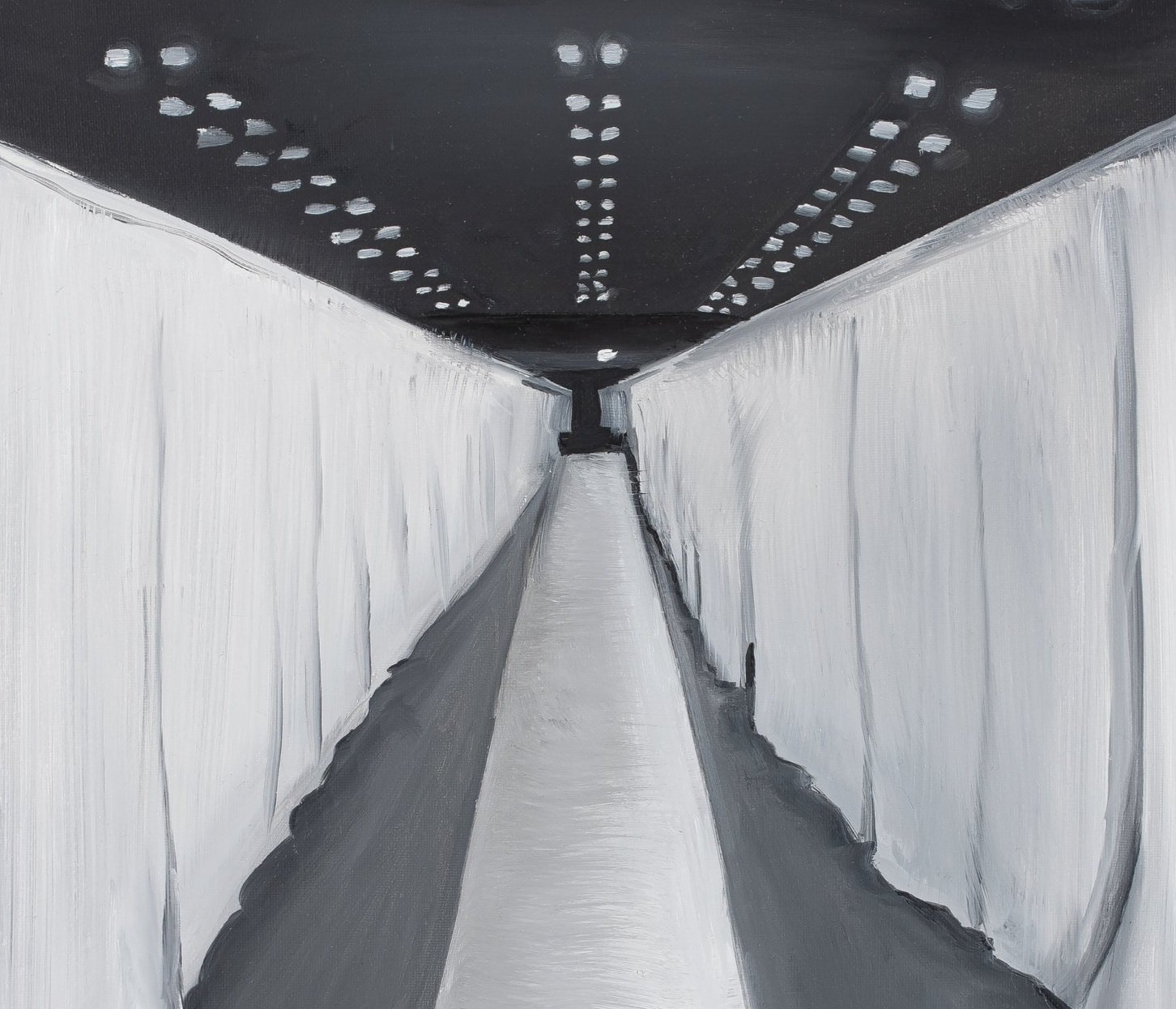
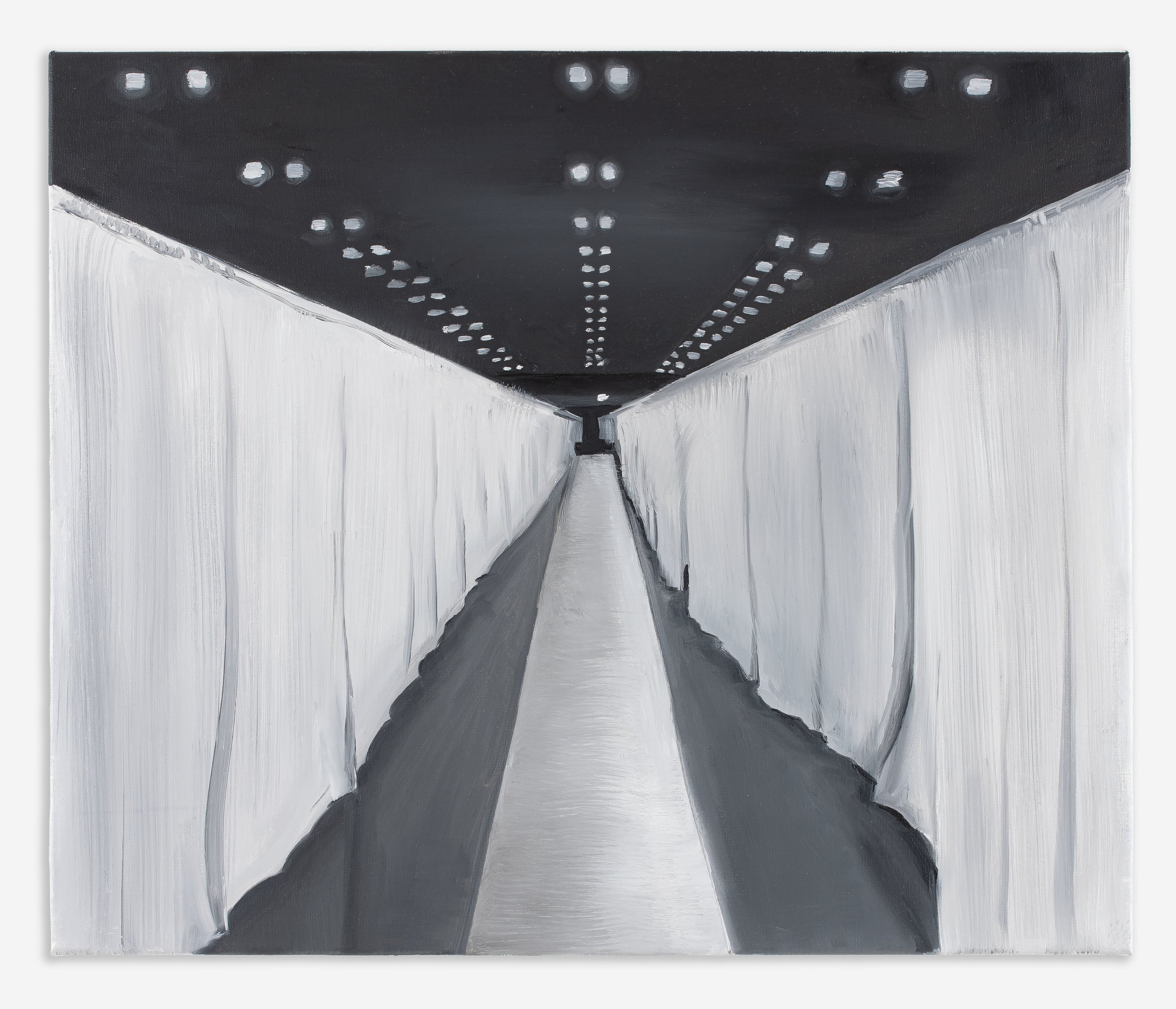
The painting is 51 x 61 cm (20 x 24 in), oil on linen, a size that is neither intimate nor monumental, neither small enough to hold nor large enough to enter. It occupies a middle register of scale that matches the building it depicts: too large to be domestic, too small to be civic, a space that is public in its dimensions but private in its arrangement. The composition is divided into three vertical registers. On the left, a wall of white curtains hangs from a track that runs the length of the space, each curtain panel identical in width and tone, a uniform off-white that reads as clinical, institutional, and clean. On the right, the same wall of curtains, mirrored, creating a bilateral symmetry that compresses the central corridor into a narrow channel. The corridor itself is the third register, a band of darker tone that recedes toward a vanishing point at the center of the painting, a point so dark it reads as black, an aperture that could be a door or a window or the terminus of a perspective that extends infinitely into the depth of the hall.
The monochrome palette is deliberate and total. Tan Mu has described her choice of black and white as a way to "remove color and create a sense of distance from everyday reality," and in Isolation the removal is not aesthetic but architectural. Color in a hospital is functional. It codes departments, identifies hazards, marks the difference between a clean zone and a contaminated one. Color in an exhibition hall is commercial. It brands booths, highlights products, attracts the eye of the visitor. In both contexts, color is a system of information. By removing it, Tan Mu strips the space of its informational content and leaves only its structural logic, the logic of the corridor, the curtain, the bay, the grid. The result is a space that could be either an exhibition hall or a hospital ward, and this ambiguity is the painting's central argument: that the architecture of exhibition and the architecture of quarantine are not opposites but variations of the same spatial principle, the principle of dividing a large volume into small units and arranging those units along a central axis that distributes traffic, attention, and airflow.
The paint surface is smooth and controlled, with none of the textural variation that distinguishes Tan Mu's paintings of natural phenomena such as Antimony (2020) or Moldavite (2020). The curtains are rendered in thin, even layers of white and pale grey, with no visible brushwork that would individualize one panel from another. The corridor is built from graduated layers of grey that darken toward the vanishing point, creating an illusion of depth that is more perspectival than atmospheric, more constructed than observed. The absence of expressive brushwork is itself a form of expression. The building that Tan Mu is painting was not built by hand. It was engineered by the Army Corps of Engineers in four days, using prefabricated partitions, standardized curtains, and a floor plan that was designed for efficiency rather than comfort. The painting's surface mirrors this efficiency. There are no gestures of sympathy in the paint application, no thick impasto that would suggest the artist's emotional response to the suffering contained within the curtains. The suffering is implied by the architecture, not depicted in the surface. The surface is as flat and functional as the walls it represents.
Gustave Caillebotte painted Paris Street; Rainy Day in 1877, depicting a broad intersection in the new Paris that Baron Haussmann had carved out of the old medieval city. The painting shows a dozen figures distributed across a paved plaza, each one walking alone or in pairs, each one separated from the others by a measured interval of space that the painting treats as its true subject. The rain does not fall on any of the figures in particular. It falls on the plaza itself, on the cobblestones and the umbrellas and the wet surfaces that reflect the grey light of an overcast afternoon. The figures are not caught in a downpour. They are caught in a spatial arrangement that makes proximity impossible, or at least unlikely, because the new Parisian boulevard was designed for traffic, not for lingering, and the wide sidewalks and deep perspectives that Haussmann imposed on the city were intended to move people through space rather than allow them to gather in it. The painting's composition, with its dramatic off-center perspective and its rigorous separation of the figures into individual zones of movement, makes the spatial logic of the boulevard visible in a way that a photograph or a map could not. The boulevard is not a background for the figures. It is the condition of their separation. The wide perspective that makes the boulevard grand also makes it impossible for the figures to be close to one another, and the painting holds this contradiction without resolving it, allowing the viewer to see the beauty of the space and the loneliness of the figures simultaneously.
Isolation shares this logic of the architectural determination of social distance. In Caillebotte's painting, the Haussmann boulevard structures the separation of the figures. In Tan Mu's painting, the Javits Center structures the separation of the patients. The corridor that runs down the center of the painting is not a Haussmann boulevard, but it functions in the same way: it is a channel for movement that prevents the people on either side of it from connecting with each other. The curtains that line the corridor are not Haussmann facades, but they function in the same way: they are surfaces that define private zones within a public volume, walls that create the illusion of enclosure without providing actual privacy, partitions that separate one body from another without blocking sound or smell or the knowledge that other bodies are suffering on the other side of the fabric. Caillebotte's painting makes the Haussmann boulevard visible as an instrument of social organization. Tan Mu's painting makes the Javits Center visible as an instrument of medical organization. Both instruments organize space in a way that determines the social relations of the people who move through it, and both paintings make this determination legible without editorializing about it. The paintings do not argue that the space is good or bad. They show what the space does, and they let the viewer draw the conclusion.
The Javits Center was designed by I.M. Pei's firm and completed in 1986. Its most distinctive architectural feature is its glass facade, a curtain wall of translucent panels that floods the interior with natural light during the day and turns the building into a luminous box at night. In normal operation, this glass wall is a symbol of transparency and openness, the architectural expression of a democratic public space where commerce, culture, and community converge. When the building was converted into a hospital, the glass wall became a symbol of a different kind of transparency: the transparency of a medical ward where patients could be seen, monitored, and tracked by staff moving through the corridor. The glass wall that once displayed the latest model cars and the newest contemporary art now displayed the rows of beds and the white curtains that divided them. Tan Mu's painting does not show the glass wall. It shows the interior, the curtains, the corridor, the vanishing point. But the painting's monochrome palette, its pale whites and deep greys and the black point at the center of the composition, evoke the quality of light that passes through a glass facade, the flat, even, shadowless light of a building that is illuminated from without rather than from within, the light of a space that was designed to be looked into and that now, in its new function, is also designed to be looked into, but for entirely different reasons.
The pandemic's restructuring of public space was not limited to the Javits Center. Every convention center in every major city was converted into a field hospital or a vaccination site or a temporary morgue. The logic was the same in every case: a large, flat, open floor plan divided into small units arranged along a central corridor. This is the logic of the trade show booth, the hospital ward, the refugee camp, the prison block, the slaughterhouse, the factory floor. It is the logic of the grid applied to human bodies, and it is one of the most persistent spatial arrangements in the history of architecture. The grid is efficient. It allows maximum density with minimum circulation. It allows surveillance from a single point. It allows the rapid reconfiguration of space to suit changing needs. It is the arrangement that the Army Corps of Engineers chose for the Javits Center because it was the arrangement that the building was already designed to support. The exhibition hall was already a grid of booths. The conversion to a hospital did not change the grid. It changed the function of the grid, from the display of products to the treatment of patients, from the encouragement of interaction to the enforcement of separation. The grid remained. The curtains changed.
Andreas Gursky's 99 Cent (1999) is a photograph of the interior of a 99-cent store, shot from a high vantage point that transforms the aisles of shelving into a grid of color so dense and so regular that it becomes almost abstract. The products on the shelves, candy bars and detergent bottles and canned vegetables, are reduced by the scale of the image to colored rectangles that read as data points in a visual spreadsheet, cells in a matrix of consumption that extends to the edges of the frame and beyond. The photograph is nearly six feet tall and eight feet wide, a scale that overwhelms the viewer with the sheer density of the commercial environment it depicts. There is no center of attention, no focal point, no single product that draws the eye more than any other. The composition is all-over, the way a Jackson Pollock painting is all-over, and the effect is similar: the viewer is immersed in a field of visual information that has no hierarchy, no beginning and no end, only the endless repetition of the same unit, the same shelf, the same product, the same price.
The structural parallel with Isolation is in the shared logic of the grid as a spatial arrangement that organizes human bodies for the convenience of the institution. Gursky's 99-cent store and Tan Mu's field hospital are both spaces where the grid is the dominant spatial logic, where the individual is reduced to a unit within a larger system of circulation, and where the architectural arrangement determines the social relation. In Gursky's store, the relation is between consumer and commodity. In Tan Mu's hospital, the relation is between patient and treatment. In both cases, the individual is placed in a cell within a grid, and the cell is small enough to define a private zone but not large enough to provide actual privacy, and the corridor that runs through the center of the grid is designed for the efficient movement of staff, whether the staff are shop employees checking inventory or nurses checking vital signs. The grid does not care about the difference. The grid is indifferent to the function it serves. It serves whatever function the institution requires, and the institution, whether commercial or medical, uses the grid to manage the bodies that move through it. Tan Mu's painting makes this indifference visible by stripping the space of color, of sign, of any marker that would identify it as specifically medical or specifically commercial. The white curtains could be the walls of a trade show booth. The corridor could be the main aisle of a supermarket. The vanishing point could be the entrance to a convention center or the emergency exit of a hospital. The painting holds all of these possibilities in the same space, and it asks the viewer to recognize that the architecture of consumption and the architecture of care are not as different as we would like them to be.
Yiren Shen, writing in 10 Magazine in August 2025, describes Tan Mu's practice as one that "transforms data cables into gestural constellations that oscillate between calculation and intuition," a formulation that applies to Isolation with particular force. The painting transforms the spatial data of the Javits Center, its dimensions, its divisions, its grid of bays and corridors, into a visual constellation that oscillates between the calculation of the Army Corps of Engineers, who designed the layout in four days, and the intuition of the painter, who recognized in that layout a formal structure that could carry the weight of a historical moment. The calculation is in the architecture. The intuition is in the decision to paint it in black and white, to remove the color that would have identified the space as specifically medical or specifically commercial, and to leave only the grid, the corridor, and the curtains, the three elements that the exhibition hall and the hospital ward share.
Tan Mu has written that "the contrast between an exhibition space designed for communication and a medical space structured around separation re ects the tension between connection and disconnection, a theme that has long been central to my work." The painting makes this contrast visible by making it architectural. The Javits Center is not a metaphor for disconnection. It is a building that was designed for connection and repurposed for disconnection, and the repurposing did not require the construction of new walls or the installation of new doors. It required only the erection of curtains, thin white membranes that divided the open floor into small bays and transformed a space of gathering into a space of isolation. The curtains are the only element in the painting that is not part of the original architecture. Everything else, the floor, the ceiling, the corridor, the vanishing point, was already there, already designed for the movement of large numbers of people through a space organized along a central axis. The pandemic did not impose a new spatial logic on the building. It revealed the logic that was already there.
The vanishing point at the center of the composition, the black aperture that draws the eye into the depth of the hall, is not a door. It is the point where the parallel lines of the curtains converge according to the rules of linear perspective, the point where the corridor becomes too narrow to distinguish individual panels, too dark to see what lies beyond. In the actual Javits Center, this point would be the far end of the hall, where the glass facade faces west over the Hudson River and the late afternoon light floods the interior with a flat, even illumination that eliminates shadows and makes every surface appear equally bright. In the painting, the vanishing point is dark, not bright, and this reversal is the painting's most compressed argument. The light that made the Javits Center a symbol of openness and transparency during its years as an exhibition hall is absent. In its place is a darkness that reads as both the depth of the corridor and the depth of the crisis that converted the building from a place of display to a place of treatment. The painting does not depict the light. It depicts the space that the light once filled, and it fills that space with darkness, and the darkness is not the absence of light but the presence of something that the light concealed: the grid, the corridor, the curtain, the architecture of separation that was always embedded in the architecture of exhibition, waiting for the crisis that would make it visible.
After the pandemic, Tan Mu returned to the Javits Center to participate in the Armory Show. She has described the experience as feeling "like a continuation of my artistic investigation," a phrase that registers the building as a site that accumulates layers of meaning rather than shedding them. The space that had been a hospital was again an exhibition hall, and the traces of its medical function had been erased, the curtains removed, the beds dismantled, the floor cleaned and polished, but the architecture remained, and the architecture was the same architecture that had served both functions, the grid, the corridor, the open floor plan, the glass walls, the flat light. The building did not change its shape when it changed its purpose. The building retained its shape, and the shape was neutral, and the neutrality was the point. The same spatial logic that organized the trade show organized the field hospital. The same corridor that distributed visitors to their booths distributed nurses to their patients. The same curtains that divided one product display from another divided one patient from another. The grid does not care what it contains. It only cares that it contains. And the painting, by rendering this grid in black and white, by stripping it of the color that would identify its current function, by reducing it to its structural essentials, makes the neutrality of the grid visible as a condition of the architecture itself, not a defect of the pandemic response but a feature of the spatial logic that makes buildings like the Javits Center useful for both exhibition and quarantine, for both the display of commodities and the treatment of disease, for both the encouragement of connection and the enforcement of separation. The corridor that runs down the center of the painting is the corridor that runs down the center of every trade show, every hospital ward, every supermarket, every prison block, every refugee camp. It is the corridor that distributes bodies in space, and it does not discriminate between the bodies it distributes or the purpose for which they are being distributed. It is a channel, and the channel is open, and the channel is closed, and the channel is the same channel whether it carries visitors to booths or nurses to beds, and the painting holds this doubleness without resolving it, without choosing between the exhibition and the ward, without deciding whether the building is a place of connection or a place of isolation, because the building is both, and the corridor is both, and the grid is both, and the white curtains are both, and the painting is a record of the moment when they became the same thing.