The Grid Below the Air: Tan Mu's Horizons 03 and the Megacity Seen From Orbit
At 28,000 kilometers per hour, the International Space Station completes one orbit of the Earth every ninety minutes. In that time, the astronauts on board witness a sunrise and a sunset every forty-five minutes, and they see the entire surface of the planet shift from day to night and back again in a rhythm that bears no relation to the rhythm of terrestrial life. What they also see, in the hours between the sunrise and the sunset, are the lights of cities. From an altitude of four hundred kilometers, a city at night is not a collection of buildings and streets and vehicles and people. It is a pattern of light on a dark field, a constellation of amber and white and pale gold that follows the lines of the highways and the rivers, that concentrates at intersections and disperses along the coastlines, that forms a shape that no mapmaker drew and no urban planner intended, a shape that emerges from the aggregate decisions of millions of people turning on lights in their homes and offices and cars, a shape that is simultaneously the record of human settlement and the most visible evidence that the planet has been altered by the species that lives on it. The pattern of city lights seen from orbit is the signature of the Anthropocene written in photons, and it is this pattern that Tan Mu's Horizons 03 (2024) translates into oil on linen.
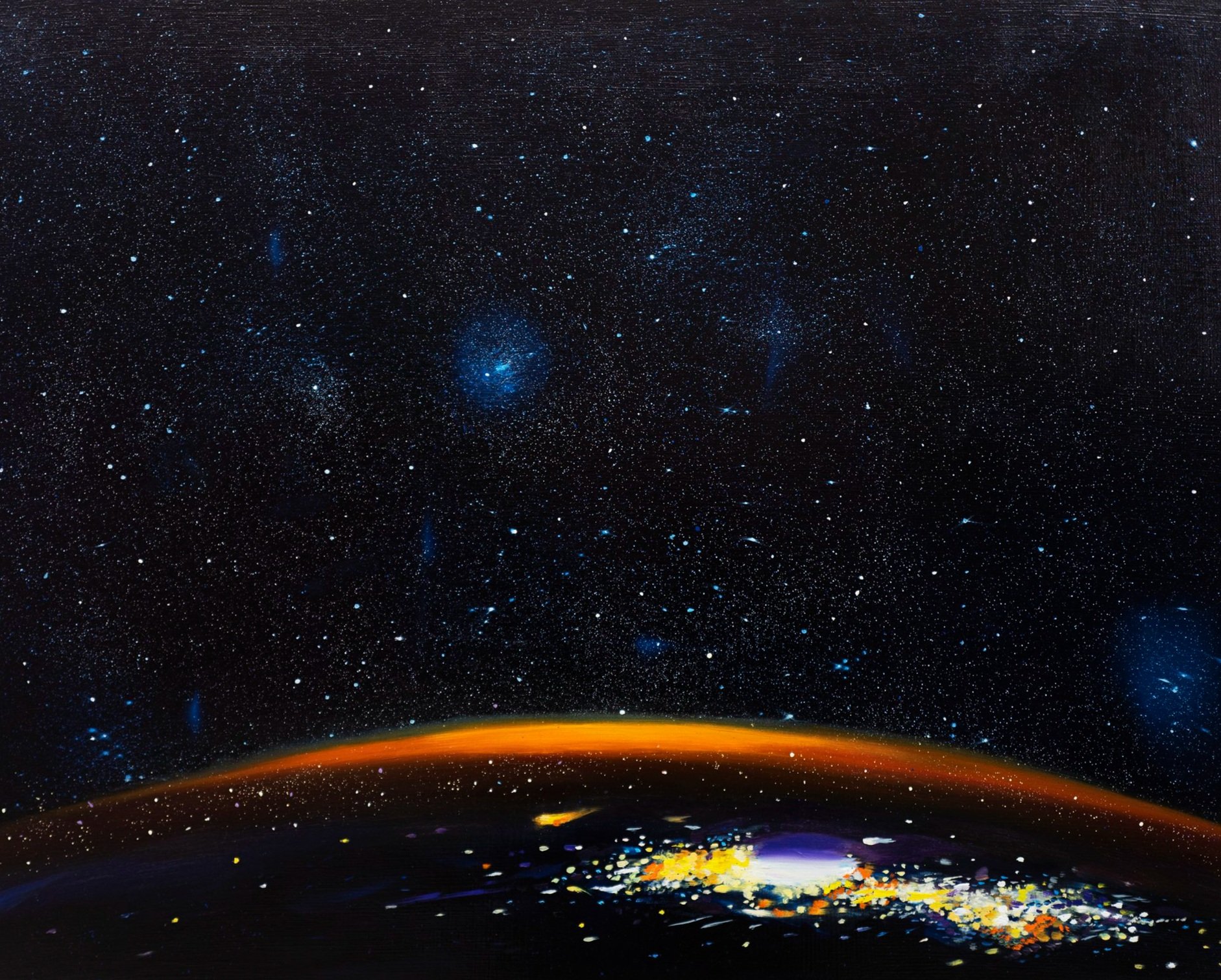
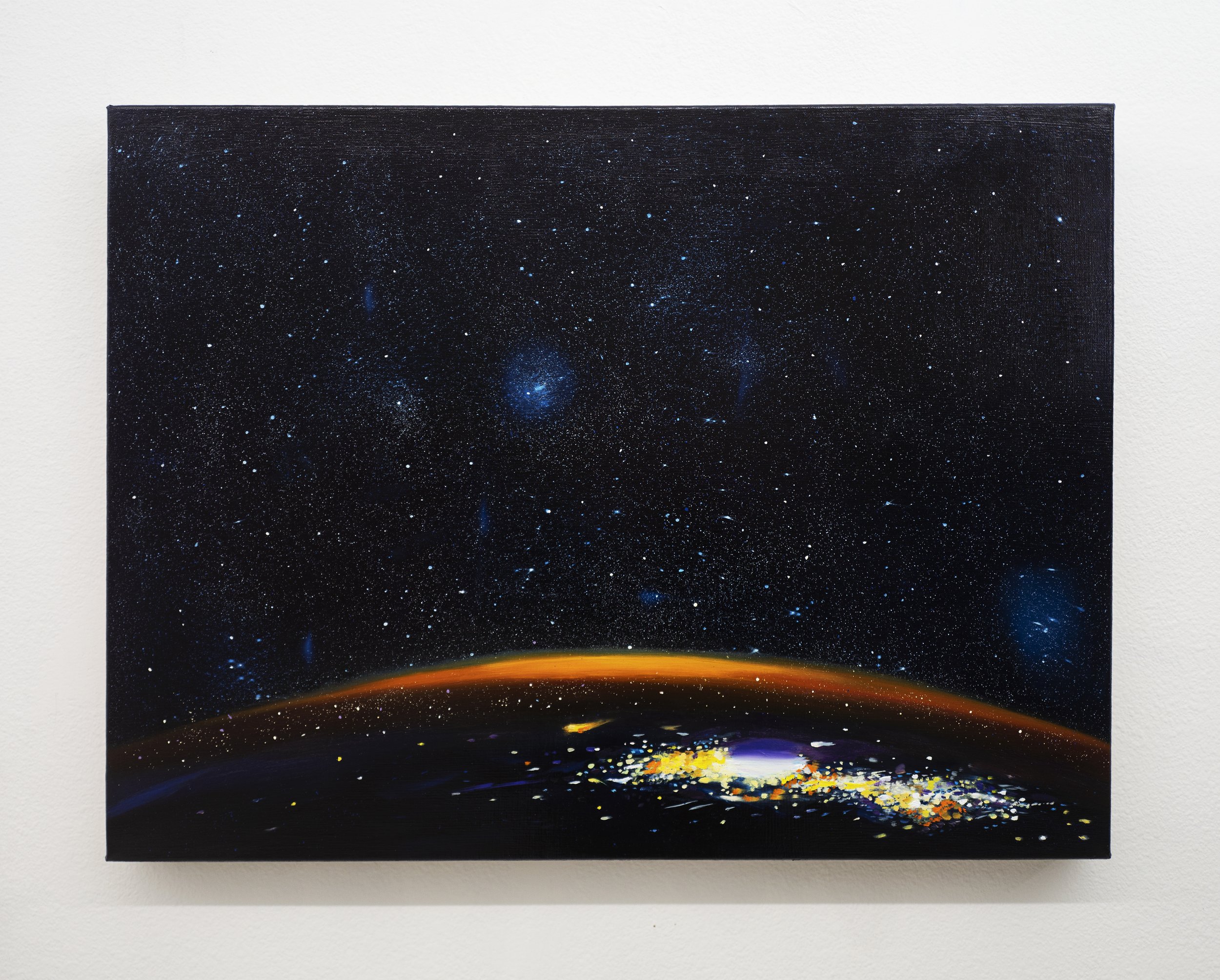
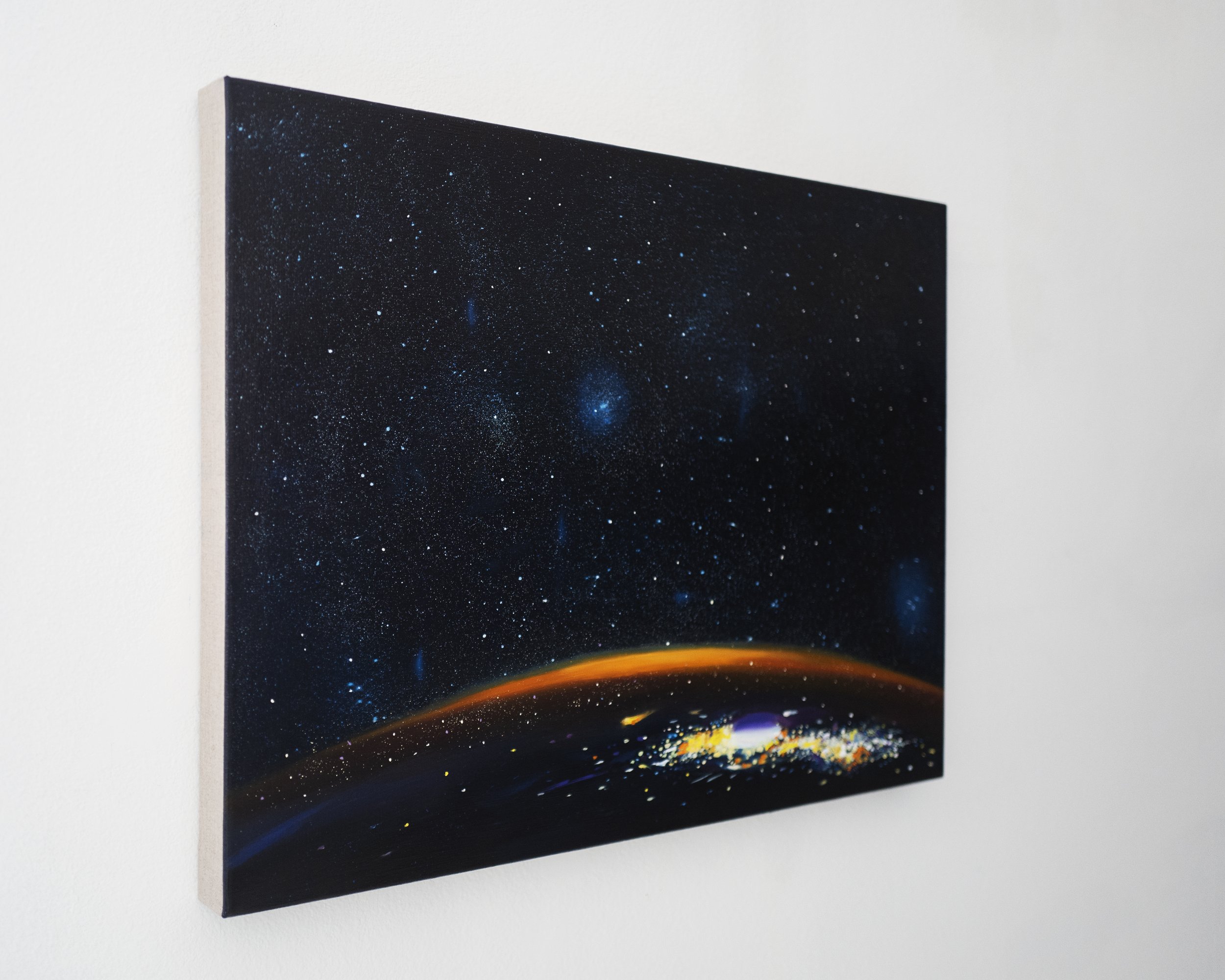
Horizons 03 is oil on linen, 46 x 61 cm (18 x 24 in), a format that belongs to the tradition of the cabinet landscape, the small-scale painting of a panoramic view that a collector could hold in the hand and examine at close range. The composition is divided horizontally into two registers. The upper register is a band of atmospheric color that graduates from a deep blue-grey at the top edge through shades of teal and turquoise and pale green to a thin line of luminous gold at the horizon. The lower register is a field of darkness punctuated by points and clusters of light, the amber and white and pale gold of the megacity grid as it appears from orbital altitude. The horizon line itself is the narrowest element in the painting, a thread of light that separates the atmosphere above from the city below, and it is the element that gives the series its name. In every painting of the Horizons series, the horizon is the structural hinge, the line where the atmosphere meets the earth, where the natural meets the artificial, where the envelope of air that makes life possible meets the grid of light that makes life visible from space.
The atmospheric band in the upper register is painted in thin, translucent layers that allow the linen ground to show through in places, creating a sense of luminosity that comes not from the paint itself but from the light that passes through the paint and reflects off the prepared surface beneath it. This technique, which oil painters call glazing, produces a quality of light that is distinct from the light produced by opaque paint applied in thick layers. The glaze allows the viewer to see into the painting, not through it to the wall behind but into the layers of color that lie beneath the surface, and this sense of depth within the paint mirrors the sense of depth within the atmosphere that the paint represents. The atmosphere is not a surface. It is a volume. It extends from the ground to the edge of space, and its colors change continuously as the density of the air changes and the angle of the sunlight shifts. The painting captures this continuous change through a continuous graduation of color that never hardens into a stripe or a band but flows from one tone to the next without a visible boundary, the way the atmosphere itself flows from one density to the next without a visible boundary, without a line in the sky that says here the troposphere ends and the stratosphere begins.
The lower register, the city, is painted in a different technique. The points of light are applied as small dots of thick, opaque oil paint, each one a distinct mark on the dark ground, each one placed with the kind of precision that comes from a brush held perpendicular to the canvas and pressed once to deposit a bead of pigment. This is not the glazing of the atmosphere. This is a pointillist technique, but one that serves a different purpose than the pointillism of Seurat or Signac. Those painters used dots of color to mix optically, to produce the sensation of a color that was not on the canvas by placing two colors side by side and allowing the viewer's eye to blend them at a distance. Tan Mu's dots do not mix. They remain distinct, each one a separate source of light, each one a separate decision, each one a separate mark that represents a separate point of illumination on the surface of the earth. The dots do not blur into a continuous field at viewing distance. They remain discrete, because the city lights themselves remain discrete from orbital altitude. The astronaut looking down does not see a continuous field of illumination. She sees a pattern of individual lights, each one a building or a street lamp or a car headlight, and the pattern that these lights form is the pattern of the city, the pattern of the roads and the intersections and the neighborhoods and the industrial zones, a pattern that no cartographer drew and no central planner designed but that emerged from the aggregate decisions of millions of people over decades and centuries of settlement.
Caspar David Friedrich's Wanderer Above the Sea of Fog (c. 1818) is the most cited painting in the history of the German Romantic sublime, and the reason for its citation is always the same: the figure who stands on the rocky promontory, his back to the viewer, looking out over a landscape that is half fog and half mountain peak, is not observing the landscape in the way that a topographer observes it, with the intention of mapping it, or in the way that a tourist observes it, with the intention of describing it to friends at home. He is occupying the position of the viewer who stands at the boundary between the known and the unknown, the solid ground beneath his feet and the formless expanse that stretches before him, and his posture, his raised shoulders, his cane, his green coat, all of these details register the sensation of standing at an edge where the visual field expands beyond the capacity of the mind to process it, and the mind responds not with comprehension but with awe.
Horizons 03 inverts this structure. Friedrich's figure stands on the earth and looks out at the atmosphere. Tan Mu's viewer, positioned by the painting at the altitude of the International Space Station, stands above the atmosphere and looks down at the earth. The figure in Friedrich's painting is a man in a green coat on a rock. The viewer of Horizons 03 is implied by the perspective, not depicted within it, and this implication is the painting's most radical departure from the tradition of the landscape. The landscape painting has always presumed a viewer on the ground. Even the most elevated viewpoints in the history of the genre, the bird's-eye views of Venice by Jacopo de' Barbari (1500) or the aerial perspectives of the Netherlandish cartographers, presume a viewer who is elevated but still terrestrial, still connected to the ground by the thread of gravity and the habit of walking. Horizons 03 presumes a viewer who is not on the ground at all, who is in orbit, who is weightless, who is seeing the earth from a position that no human being occupied before April 1961, when Yuri Gagarin became the first person to see the planet from space. The painting does not depict this viewer. It constructs this viewer through its perspective, and the perspective is the perspective of the camera on the International Space Station that transmits the images that Tan Mu uses as her source material. The painting is not a landscape. It is an orbital view, and the orbital view is a category that the history of landscape painting did not include until the twentieth century made it possible.
The source material for Horizons 03, as Tan Mu describes it on her website, is the real-time video transmission from the International Space Station, specifically the footage that shows the lights of megacities and the atmospheric envelope that encircles the earth. The ISS transmits this footage continuously, and anyone with an internet connection can watch it, which means that the orbital perspective that was once available only to astronauts is now available to anyone with a screen. Tan Mu describes this as a "panoramic gaze" that "fosters collective awareness and redefines landscape art, offering a cosmic-scale reexamination of human existence." The term "panoramic gaze" is precise. The panorama was a nineteenth-century invention, a circular painting that surrounded the viewer with a 360-degree view of a city or a battlefield or a natural wonder, and its purpose was to produce the sensation of being present at a scene that the viewer could not visit in person. The ISS video feed is the twenty-first century's panorama, and it produces the same sensation: the viewer is present at a scene that she cannot visit in person, the surface of the earth seen from four hundred kilometers above it, and the sensation is not one of detachment but of recognition, the recognition that the pattern of lights on the dark ground is the pattern of human settlement, the pattern of the species that has covered the planet with its illumination, and that this illumination, seen from orbit, is the most visible evidence that the planet has been altered by the presence of the species that lit it.
The megacity grid that forms the lower register of Horizons 03 is not an abstraction. It is a specific pattern that corresponds to a specific geography, and the geography is the geography of the eastern seaboard of the United States as seen from the ISS, where the corridor of light that runs from Boston to Washington, D.C. is one of the brightest features on the planet, a continuous ribbon of amber and white that traces the route of Interstate 95 and the Amtrak Northeast Corridor and the commuter rail lines that connect the cities of the northeast into a single megalopolis, a term coined by the geographer Jean Gottmann in 1961 to describe exactly this phenomenon: the merger of separate cities into a continuous urban region linked by transportation networks and illuminated at night by a continuous grid of artificial light that is visible from orbit as a single luminous form. The painting does not identify this geography by name. It does not label the cities or mark the highways. But the pattern of light is specific enough that anyone who has seen the ISS footage of the eastern seaboard will recognize it, and the recognition is not a matter of cartographic knowledge but of visual memory, the memory of having seen this pattern on a screen and having understood, perhaps for the first time, that the place where you live, the place whose streets you walk and whose buildings you enter and whose lights you switch on every evening, is a point in this pattern, a single point of illumination among millions of others, and that the pattern as a whole is the shape that the species makes when it settles a coastline and connects its settlements with roads and rails and power lines.
Gerhard Richter's Seascape series, produced between 1969 and 1998, is a body of work that operates at the boundary between painting and photography, and the boundary at which it operates is the horizon. The seascapes are based on Richter's own photographs of the North Sea coast, and they are painted with a precision that mimics the resolution of a photograph, every wave rendered with the clarity of a lens, every cloud described with the tonal range of a silver gelatin print. But the precision is not the point. The point is the horizon line, the thin strip where the sea meets the sky, and the way this line divides the canvas into two registers, the water below and the air above, that are painted in exactly the same technique but that read as fundamentally different spaces, one solid and navigable and the other gaseous and infinite. The horizon in Richter's seascapes is not a dramatic event. It is a fact of the visual field, the line where two substances meet, and the painting's force comes from the way it holds this fact without embellishing it, without turning it into a symbol or a metaphor, allowing the horizon to be what it is in the visual field, the line where the eye registers a change in the quality of light and the mind registers a change in the quality of substance.
The horizon in Horizons 03 operates in the same register, but the substances that it separates are not water and air. They are atmosphere and illumination. The line where the teal graduates to gold in Tan Mu's painting is not the line where the sea meets the sky. It is the line where the atmosphere meets the surface of the earth, and the surface of the earth, at this altitude, is not solid. It is a pattern of light. The city grid does not have the solidity of the North Sea coast. It has the ephemerality of a signal, a constellation of photons that is generated by the combustion of fossil fuels and the flow of electricity through tungsten filaments and the activation of light-emitting diodes, a constellation that appears every evening and disappears every morning and reappears the next evening with the same configuration, the same streets and intersections and neighborhoods, the same amber and white and pale gold, because the people who turn on the lights turn them on in the same places every night, and the pattern that their collective illumination produces is the most reliable and the most visible evidence that the planet is occupied by a species that reshapes its environment at the scale of the entire surface.
Li Yizhuo, in her 2022 essay "Imaginary of an Image: On Tan Mu's Recent Paintings," describes Tan Mu's practice as one of "examining and discerning objects of various scales and conditions," drawing on the Confucian principle of ge wu zhi zhi, investigating things to extend knowledge. The Horizons series extends this principle to its largest possible object: the surface of the earth as seen from orbit. The investigation is not conducted from the ground, where the earth is too large to see and too close to perceive as a whole. It is conducted from the altitude of the ISS, where the earth is small enough to see in its entirety and far enough away to perceive as a single object, and the object that the investigation reveals is not the natural earth of the landscape tradition but the illuminated earth of the Anthropocene, the earth whose surface is covered by the light of its own making, the earth that glows in the dark like a coal that has been heated from within, the earth that is visible from space not because the sun illuminates it but because the species that lives on it has covered it with a network of artificial illumination that is as visible from orbit as the aurora borealis or the ring of volcanic fire that traces the edges of the Pacific plate.
The painting's title, Horizons 03, places it within a series, and the series context matters because it means that this is not a single view but a position within a sequence of views, each one taken from the same altitude but at a different angle, a different time of day, a different weather condition. The number 03 indicates that this is the third in a sequence that could, in principle, continue indefinitely, because the ISS orbits the earth sixteen times a day and produces a new view every ninety minutes, and each view is different from the one before it because the planet is rotating beneath the station and the angle of the sun is always changing and the cloud cover is always shifting and the cities are always turning their lights on and off. The series structure registers this contingency. The painting is not a definitive view of the earth from space. It is one view among many, and the fact that it is numbered rather than named suggests that the series could be extended, that Horizons 04 and Horizons 05 and Horizons 06 are not different paintings of the same thing but different views of a thing that is always changing, a thing that produces a new appearance every time the station passes over it, a thing that is not a static object but a dynamic process, the process of a planet being illuminated by the species that lives on it, the process of the Anthropocene expressing itself as light.
Tan Mu describes the Horizons series as capturing "the radiant lights of megacities and the dreamlike reflections of Earth's atmosphere," and the word "dreamlike" is doing more work than it first appears. The atmosphere at orbital altitude does not look the way it looks in a photograph. The colors are more saturated, the gradations are more continuous, the boundary between the atmosphere and the void of space is sharper than any camera can reproduce, because the camera compresses the tonal range of the real scene into the narrower tonal range of the image, and the painting, which is not constrained by the tonal range of a photograph, can reproduce the colors of the atmosphere at orbital altitude with a fidelity that the photograph cannot match. The thin line of gold at the horizon in Horizons 03 is the color that the atmosphere actually is at the point where the sunlight passes through the densest layer of air before reaching the observer's eye. It is not a decorative choice. It is an observation. And the observation is possible only from the position that the ISS makes available, the position above the atmosphere, the position from which the atmosphere is seen as a thin shell of gas surrounding a dark planet, the position from which the shell of gas glows gold at the horizon because the sunlight is passing through it at a low angle and the scattering of the shorter wavelengths of blue and violet light leaves only the longer wavelengths of gold and orange and red, the same physics that produces a sunset at ground level but seen from an altitude that transforms the sunset from a local event into a planetary phenomenon, a ring of gold that encircles the entire globe and marks the boundary between the air that sustains life and the vacuum that does not.
The painting holds two scales in the same frame. The atmospheric band at the top of the canvas is the scale of the planet, the scale at which the earth is a sphere wrapped in a thin shell of gas, and the gas is colored by the physics of scattering, and the color changes continuously as the angle of the sun changes, and the change is gradual and continuous and visible as a graduation of tone from dark blue to gold. The city grid at the bottom of the canvas is the scale of the street, the scale at which each point of light is a building or a car or a street lamp, and the pattern that the points form is the pattern of human settlement, and the pattern is discontinuous and specific and visible as a constellation of amber and white and pale gold. The horizon line between them is the line where the planetary scale meets the local scale, where the atmosphere that wraps the globe meets the illumination that covers the city, where the physics of scattering meets the chemistry of combustion, where the natural meets the artificial, where the envelope of air that makes life possible meets the grid of light that makes life visible from four hundred kilometers above. This line is the subject of the painting. Not the atmosphere above it and not the city below it but the line itself, the line where two systems of illumination, one natural and one artificial, one produced by the sun and one produced by the species, one continuous and one discontinuous, one gradual and one punctuated, meet and produce the boundary that the painting calls a horizon, and that the astronaut calls home.