The Mark That Joins the Ring: Tan Mu's Sagittarius A* and the Synthesis of Fragments
A printmaker begins with a block of wood. The grain is there, the surface is flat, and the image does not yet exist. The first cut removes material that will never hold ink. The second cut removes more. Each stroke of the gouge is a decision made in negative, a subtraction from the field of possibilities until only the lines that will carry pigment remain. The print that emerges from this process is not a direct record of the block. It is a transfer, a translation of the carved surface into ink on paper, and the ink distributes itself across the paper in a way that the carver can predict but never fully control. The grain of the wood accepts ink differently from the cut passages. The pressure of the baren or the press creates variations that no hand can reproduce exactly. Every print is the same image and a different image, produced by the same block and inseparable from the material conditions of its making.
Tan Mu has described the process that produced the first image of Sagittarius A* as feeling similar to printmaking, where fragmented information is gradually consolidated into a complete image. The comparison is not decorative. It is structural. The Event Horizon Telescope, the network of eight radio telescopes positioned across the globe that produced the image of the supermassive black hole at the center of the Milky Way, operates by a logic of accumulation and synthesis that is, at its core, the same logic that produces a woodblock print from a carved surface. Each telescope collects a fragment of the data. No single telescope can see the black hole on its own. The image only becomes visible when the fragments are combined, processed, and reconstructed through algorithms that fill in the gaps between observations. The ring of orange light that appeared on screens around the world on May 12, 2022, was not a photograph. It was a synthesis. It was a print, pulled from a distributed plate that spanned the diameter of the earth.
Tan Mu's painting of Sagittarius A* applies this same logic of accumulation to the act of painting itself. Each brushstroke is a data point. Each layer of paint is an observation. The painting does not represent the black hole. It represents the image of the black hole, and the image of the black hole is itself a representation assembled from fragments. The painting adds one more layer of synthesis to a chain that already contains several: the radio waves emitted by the gas orbiting the event horizon, the telescopes that collected those waves, the algorithms that converted the collected data into a visual form, and now the hand that translates that visual form into oil paint on linen. At every stage, the question is the same: how do fragments become a whole, and what is gained or lost in the consolidation?
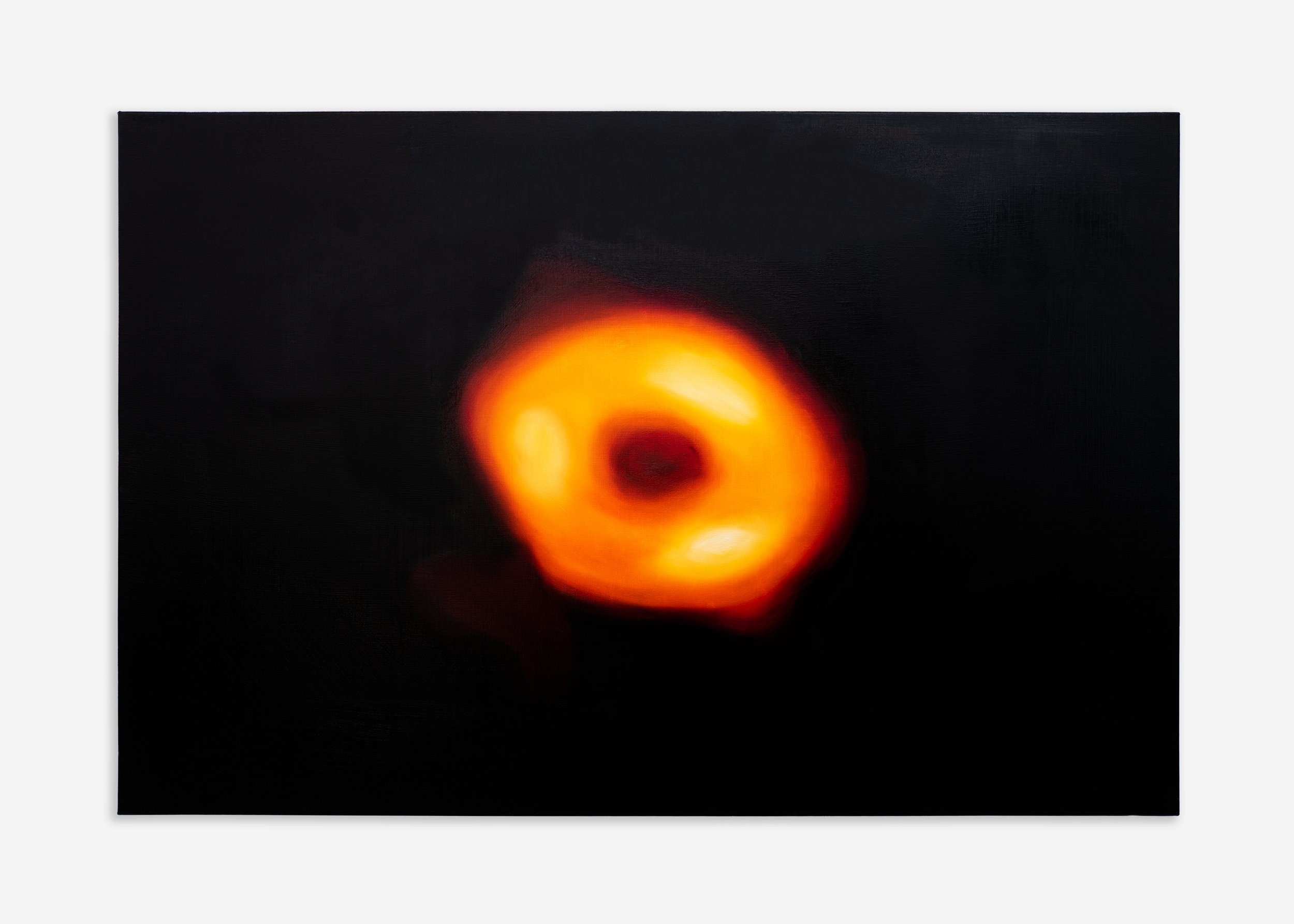
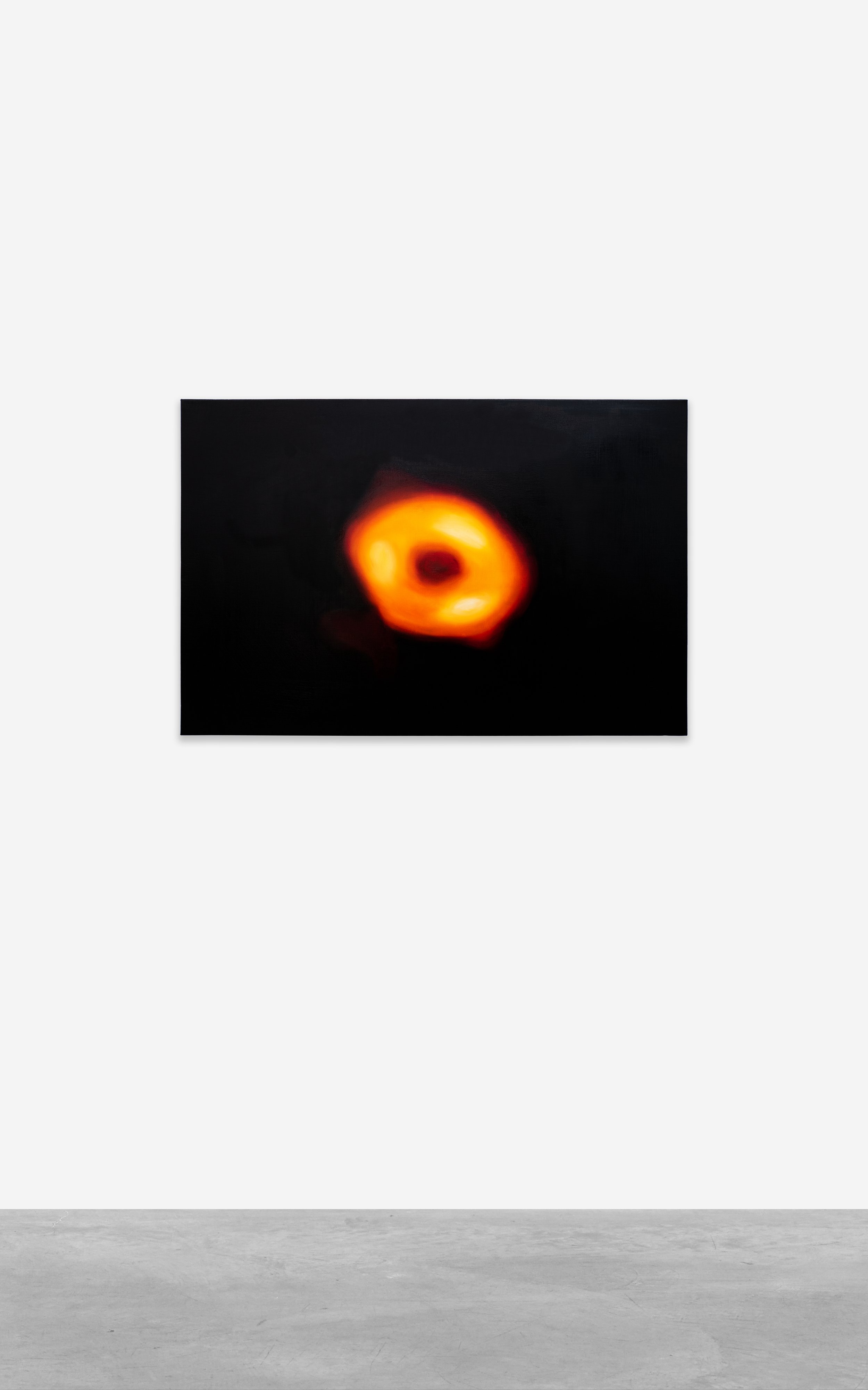
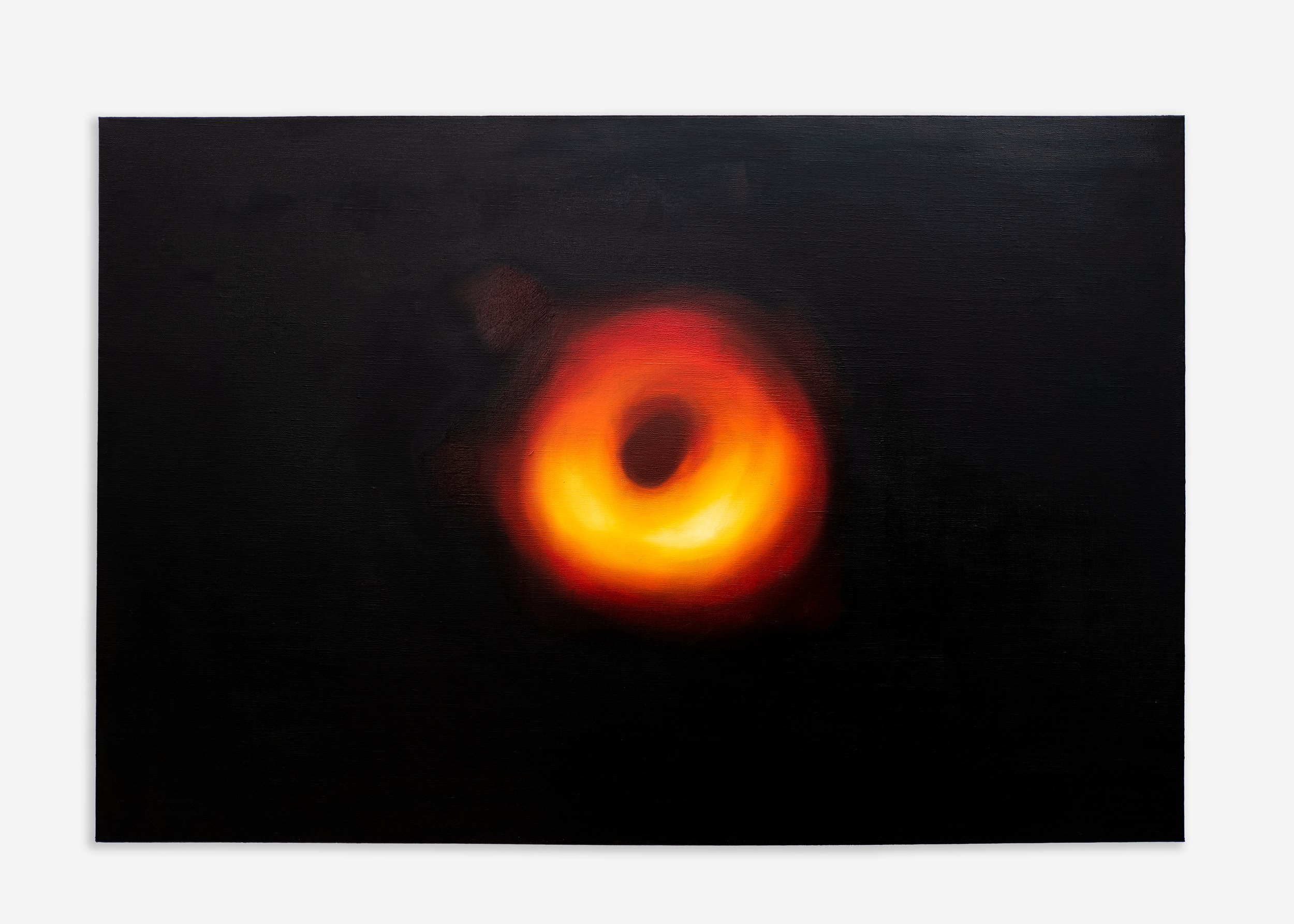
Sagittarius A* is painted in oil on linen, measuring 61 x 91 cm (24 x 36 in), a horizontal format that accommodates the ring shape of the accretion disk without crowding. The black ground is not applied as a single uniform wash. It is built up from many thin layers of dark pigment, each one slightly different in tone from the one beneath it, producing a depth that a flat black could never achieve. At the center of the painting, the shadow of the black hole occupies roughly a quarter of the surface. Around it, the accretion disk glows in gradations of orange, amber, and pale gold, with the brightest region concentrated on the lower right of the ring, where the relativistic beaming effect makes the gas appear most luminous. The ring is not uniform. Its brightness varies from one segment to another, and the asymmetry is faithful to the source image: the gas moving toward the observer appears brighter than the gas moving away, and the painting preserves this directional emphasis.
Close to the surface, the paint reveals its process. The orange passages are not applied in a single sweep but accumulated from many small marks, each one a distinct decision about color, density, and position. Some marks overlap. Some sit on top of earlier layers with enough impasto to cast tiny shadows when the light rakes across the surface. Others are thin enough that the dark ground shows through, producing the effect of a luminous haze that is not mixed on the palette but generated by the eye's inability to separate the orange from the black at the boundary where one yields to the other. This boundary is where the painting most closely enacts its subject. The event horizon is the boundary between the region from which light can escape and the region from which it cannot. The edge of the orange ring, where pigment meets the dark ground, is the painting's version of that boundary: a zone where visibility itself becomes uncertain, where the eye cannot tell whether it is seeing light on a dark surface or a thinning of the dark to reveal the light beneath.
The linen weave is visible in the black passages, especially at the corners and edges where the paint has been applied more thinly. This is not an oversight. The weave provides a texture that a smooth surface would not, a fine grid of regular intersections that gives the darkness a material presence it would otherwise lack. Without the weave, the black would be a void. With it, the black is a surface, a thing made of cloth and pigment, and the painting reminds the viewer that the darkness it depicts is not an absence but a presence, the presence of a mass four million times that of the sun, compressed into a region smaller than the orbit of Mercury. The painting insists on its own materiality at precisely the moments when the subject it depicts is most immaterial, most resistant to visualization, most dependent on the algorithms and instruments that make it visible at all.
Albrecht Dürer published his Apocalypse woodcut series in 1498, a suite of fifteen prints that depicted the visions of the Book of Revelation with a ferocity and narrative density that transformed the medium of woodcut from a vehicle for devotional images into a vehicle for sustained artistic ambition. The technical innovation of the series is inseparable from its expressive achievement. Dürer cut his blocks with a fineness of line that had previously been impossible in woodcut, producing tonal gradations, atmospheric depth, and figural complexity that rivaled engraving and approached the subtlety of drawing. The woodcut had always been a reproductive medium, a way of making an image that could be printed in multiple copies and distributed to an audience far larger than any single patron or church could reach. Dürer understood this distribution mechanism as part of the medium's meaning, not merely its economics. The Apocalypse was a story about revelation, about the moment when hidden knowledge becomes visible to all, and the woodcut, which multiplied a single carved image into hundreds of impressions, was the technological expression of that revelation. The block is carved once. The print is pulled many times. The singular vision becomes a public possession.
The structural parallel to Sagittarius A* is exact. The Event Horizon Telescope functions as a kind of astronomical printmaking apparatus. Each telescope in the network records a fragment of the data, a partial impression of the radio emission from the black hole's accretion disk, and the fragments are combined through computational algorithms into a single composite image that no individual telescope could produce on its own. The block is distributed. The print is synthesized. Dürer's woodcuts transform the carved block into ink on paper through the physical pressure of the press. The EHT transforms collected radio data into a visual image through the computational pressure of image reconstruction algorithms. Both processes require the fragment to be assembled into the whole, and both processes introduce artifacts in the assembly that are not present in the source. The grain of the wood leaves its trace in the print. The gaps in the telescope coverage leave their trace in the reconstructed image. The final product is always the result of a negotiation between what was collected and what was inferred, between the fragment and the whole, between the visible and the reconstructed. Tan Mu's painting, which adds one more layer of transformation to this chain, carries the trace of each previous transformation within its own surface. The brushstrokes are not smooth because the source image was not smooth. The ring is not uniform because the data that produced it was not uniform. The painting preserves the character of its source, and in doing so it preserves the character of the process that generated the source, which is a process of distributed observation and synthetic assembly that Dürer would have recognized as his own.
The Event Horizon Telescope is not a single instrument. It is a network of eight radio telescopes located across six sites on four continents, from the South Pole to the Sierra Nevada, from the Atacama Desert to the French Alps. The telescope has no single dish large enough to resolve the black hole. Instead, it uses a technique called very-long-baseline interferometry, or VLBI, which combines the signals received by each dish into a synthetic aperture the size of the earth. The principle is elegant: two telescopes separated by a continent will receive the same radio signal from the black hole at slightly different times, and the time difference between their arrivals encodes information about the angular size and structure of the source. The more telescopes in the network, the more pairs of baselines, and the more complete the image that can be reconstructed. But the earth is not covered in telescopes. There are gaps in the coverage, regions of the virtual aperture where no instrument exists to collect data, and these gaps mean that the reconstructed image is always an interpolation, a best estimate derived from incomplete information. The orange ring around the shadow of Sagittarius A* is not a direct observation. It is a reconstruction, assembled from fragments collected by instruments separated by thousands of kilometers, processed through algorithms that make choices about how to fill in the gaps, how to weight the data, how to distinguish signal from noise. The image is both accurate and interpreted, both a record of what was observed and a construction of what was inferred. This is the condition that Tan Mu has identified as central to her work: the tension between accuracy and uncertainty, between the data and the interpretation, between the fragment and the synthesis. "There is always a tension between accuracy and uncertainty," she has said. "Although these images are grounded in precise data, they still involve human interpretation. Colors are added to enhance clarity. Adjustments are made to reveal structure."
The painting records this condition in its own material. The orange of the ring is not a single color but a range of oranges, from the deep amber of the dimmer segments to the bright gold of the most luminous, and the variation is not arbitrary. It follows the source image, which follows the data, which follows the physics of relativistic beaming. The gas in the accretion disk orbits the black hole at close to the speed of light, and the portion of the disk moving toward the observer appears brighter due to relativistic effects, while the portion moving away appears dimmer. The asymmetry in the ring is a physical fact encoded in the data, and the painting encodes it in the distribution of its pigment. But the painting also does something the data cannot do. It makes the accumulation visible. The EHT image, for all its revolutionary significance, appears on a screen as a finished product, a ring of orange around a dark center, and the process that produced it, the years of observation, the petabytes of data, the months of processing, the arguments among the collaborators about how best to present the result, are invisible in the final image. The painting, by contrast, makes the accumulation tangible. Each brushstroke is a visible decision. Each layer of paint is a visible addition to the field. The viewer can see the painting being built, mark by mark, layer by layer, in a way that the EHT image, smooth and seamless on the screen, conceals.
Mark Tobey began making the paintings he called "white writing" in 1935, developing a practice that would occupy him for the next three decades. The earliest of these works, including Broadway (1935-36), were inspired by the visual density of New York, the way the lights and signs and traffic of the city at night produced a field of intersecting marks that could not be read as individual characters but only as a tissue of simultaneous activity, a visual field in which no single mark took precedence over any other and the whole existed as a kind of writing that could not be deciphered because it was not meant to be deciphered. It was meant to be experienced as a surface of accumulated marks, each one a record of a moment of attention, a brief instant in which the hand moved across the canvas and deposited a calligraphic stroke that then became part of a larger field of similar strokes, all of them layered and interwoven, all of them moving across the surface in directions that followed no single axis but created instead a web of intersecting trajectories that covered the canvas from edge to edge without establishing a center or a hierarchy.
The structural connection between Tobey's white writing and Tan Mu's Sagittarius A* is not visual. Tobey's surfaces are calligraphic, linear, and pale against a colored ground. Tan Mu's ring is circular, luminous, and warm against a black ground. The connection is procedural. Both artists build their images through the accumulation of discrete marks, and in both cases the mark is the unit of meaning, not the image. A single Tobey stroke, isolated from its field, would be a calligraphic fragment with no particular significance. A single Tan Mu brushstroke, isolated from its ring, would be a dab of orange paint with no particular reference. The meaning of each mark emerges only in relation to the others, only in the field that they collectively produce. This is the logic of accumulation, and it is the logic that Tobey and Tan Mu share: the image is not drawn. It is assembled. The marks are not placed in service of a preexisting outline. They are the outline. They are the image. There is nothing beneath or behind them. The field is the content.
The difference between the two practices illuminates what is specific about Tan Mu's project. Tobey's marks are abstract. They refer to no external subject. They are writing in the sense that they are calligraphic, but they are white writing, writing that cannot be read, writing that has shed its referent and exists only as a visual field. Tan Mu's marks are not abstract in this way. They refer to an external subject, the image of the black hole, and they are assembled in the service of a representational goal. But the relationship between the mark and the subject is not one of direct transcription. It is one of analogical accumulation. Each brushstroke corresponds to a portion of the source image, and the source image corresponds to a portion of the data, and the data corresponds to a portion of the radio emission from the accretion disk. Each mark in the painting is a link in a chain of transformations that connects the gas orbiting the black hole to the pigment on the linen, and at no point in this chain is there a moment where the representation is complete, where the data become the image without interpretation, where the brushstroke becomes the subject without mediation. The accumulation is the point. The process is the content. The painting enacts, in its own material, the same logic of distributed assembly that produced the image it depicts.
Nick Koenigsknecht, writing in the catalog for Tan Mu's 2025 exhibition at BEK Forum in Vienna, observes that "while observing technology, are we not looking at ourselves? Therefore perhaps these works function more as self portraits, rather than depictions of external, scientific milestones." The observation applies to Sagittarius A* with a particular precision. The painting does not depict a black hole. No one has ever seen a black hole. The painting depicts an image of a black hole, and that image was produced by a network of human instruments operated by human scientists working across human institutions, and the painting itself was produced by a human hand applying pigment to linen in a studio, and at each stage the question of what is being represented is inseparable from the question of who is doing the representing and with what tools. Koenigsknecht's suggestion that these works function as self-portraits is not a metaphor. It is a description of the structure. The EHT image is a portrait of the black hole in the same way that the painting is a portrait of the EHT image: both are records of the process that produced them, and the process is a human process, a collective process, a process that depends on instruments designed by human minds and operated by human hands and interpreted by human algorithms. The brushstrokes in Sagittarius A* are not approximations of the accretion disk. They are approximations of the data that approximates the accretion disk, and the distance between the approximation and the thing approximated is the distance between human perception and the cosmos, which is the distance that all of Tan Mu's paintings measure.
Tan Mu lived near Stull Observatory at Alfred University, one of the oldest private observatories in the United States, with six telescopes housed in domes and a fiber-fed spectrograph that splits starlight into its component wavelengths. She attended weekly observation sessions. She looked through the eyepiece and watched the moon fill her field of view with a clarity that no photograph had prepared her for. The experience of standing in a dome at night, aligning the instrument, waiting for the atmosphere to steady, collecting the light of a distant object through a tube of glass and steel, is an experience of mediated observation that is structurally identical to the experience of standing in a studio, aligning the brush, mixing the pigment, applying the mark. In both cases, the observer is not seeing the thing directly. She is seeing the thing through an instrument. The telescope is an instrument. The brush is an instrument. The EHT is an instrument. The algorithm is an instrument. Each instrument introduces its own biases, its own limitations, its own characteristic artifacts, and each instrument produces a version of the thing that is faithful to the instrument's capacities rather than to the thing itself. This is not a limitation. It is a condition. It is the condition that Sagittarius A* inhabits and makes visible: the condition of all observation, scientific or artistic, that the thing observed is always mediated by the means of observation, and the means of observation is always a human construction, carrying within it the marks of the humans who built it.

The painting measures 61 by 91 centimeters, a modest scale for a subject of such magnitude. The black hole at the center of the Milky Way has a mass four million times that of the sun. Its event horizon spans roughly 24 million kilometers. The light from its accretion disk takes 26,000 years to reach the earth. The painting that depicts this object could be held under one arm and carried up a flight of stairs. The disparity between the scale of the subject and the scale of the painting is not an oversight. It is a statement about the nature of translation. The EHT image was assembled from data collected by telescopes spanning the diameter of the earth. The painting was assembled by one person working in a studio, applying pigment to linen, mark by mark. Both are translations of an object that cannot be seen directly into a form that can be seen, and both translations reduce the object to a scale at which it can be comprehended by the human eye, which is the only instrument that can look at a painting and understand it. The modest size of the canvas is not a limitation. It is an acknowledgment that the translation from the cosmic to the human always involves reduction, and that reduction is not a loss but a condition of understanding. The black hole cannot be seen at its own scale. It can only be seen at ours.
Tan Mu has said that "through the accumulation of brushstrokes, layered one after another, I try to convey this invisible collective labor." The collective labor she names is the labor of the EHT team, the scientists and engineers and technicians who operated the telescopes and processed the data and argued about the best way to present the image. But the collective labor is also the labor of the printmakers who came before her, who understood that an image assembled from fragments is never a simple copy of an original but always a new thing, a thing that carries the marks of its assembly within its surface. Dürer's Apocalypse prints carry the grain of the wood. Tobey's white writing carries the rhythm of the hand. The EHT image carries the gaps in the telescope coverage. And Sagittarius A* carries the texture of the linen, the thickness of the pigment, and the accumulation of the brushstrokes that built the ring from nothing, mark by mark, until the image emerged from the dark ground the way the radio emission emerges from the event horizon, visible at the boundary and invisible at the center, a ring of light around an absence that no mark can fill because the absence is the point, and the point is that the absence is where the painting and the black hole meet, each in its own medium, each at its own scale, each defined by the ring of marks that surrounds it and the darkness that it cannot represent but can only leave empty, because the emptiness is the most accurate thing in the painting, and the most accurate thing in the image, and the most accurate thing that any instrument, whether it is a telescope or a brush, can say about a black hole, which is that it is there, and that we cannot see it, and that the ring of light around it is the only evidence we have, and that this evidence was assembled from fragments, and that the fragments were collected by many hands, and that the many hands are the subject of the painting as much as the black hole is, because the painting is about the process that makes the invisible visible, and the process is always a human process, and the human process is always a collective process, and the collective process is what the brushstrokes, mark by mark, layer by layer, on a piece of linen 61 by 91 centimeters, are trying to convey.