The Six Panels Between Water and Fire: Tan Mu's The Splash of a Drop 1 and the Scale of Erasure
A drop of milk falls from a height of three centimeters and strikes the surface of a shallow pool. The impact lasts roughly fifty milliseconds. In that interval, the liquid rises into a crown, the crown folds inward, a central jet erupts from the crater, the jet reaches its peak and begins to descend, and the whole structure collapses back into the surface from which it came. The entire event, from first contact to final dissolution, takes less time than a single blink. Arthur Mason Worthington, the English physicist who devoted decades to the study of splashes, first observed this sequence with his own eyes and a mechanical spark illuminator of his own design. By the time he published The Splash of a Drop in 1895, he had conducted the same experiment hundreds of times, each time adjusting the height, the liquid, the illumination, and each time recording what he saw in meticulous hand-drawn illustrations. The frontispiece of his book includes three photographs of a milk splash, but the remaining images are drawings, because the photographic technology of 1895 could not resolve the finer stages of the descent. The camera was not yet fast enough. The hand was still more precise. This is the moment that Tan Mu's six-panel painting enters: not the moment of the splash itself, but the moment when the camera fails and the hand takes over, when the technology of recording reaches its limit and the older technology of drawing must supplement what the newer technology cannot yet see.
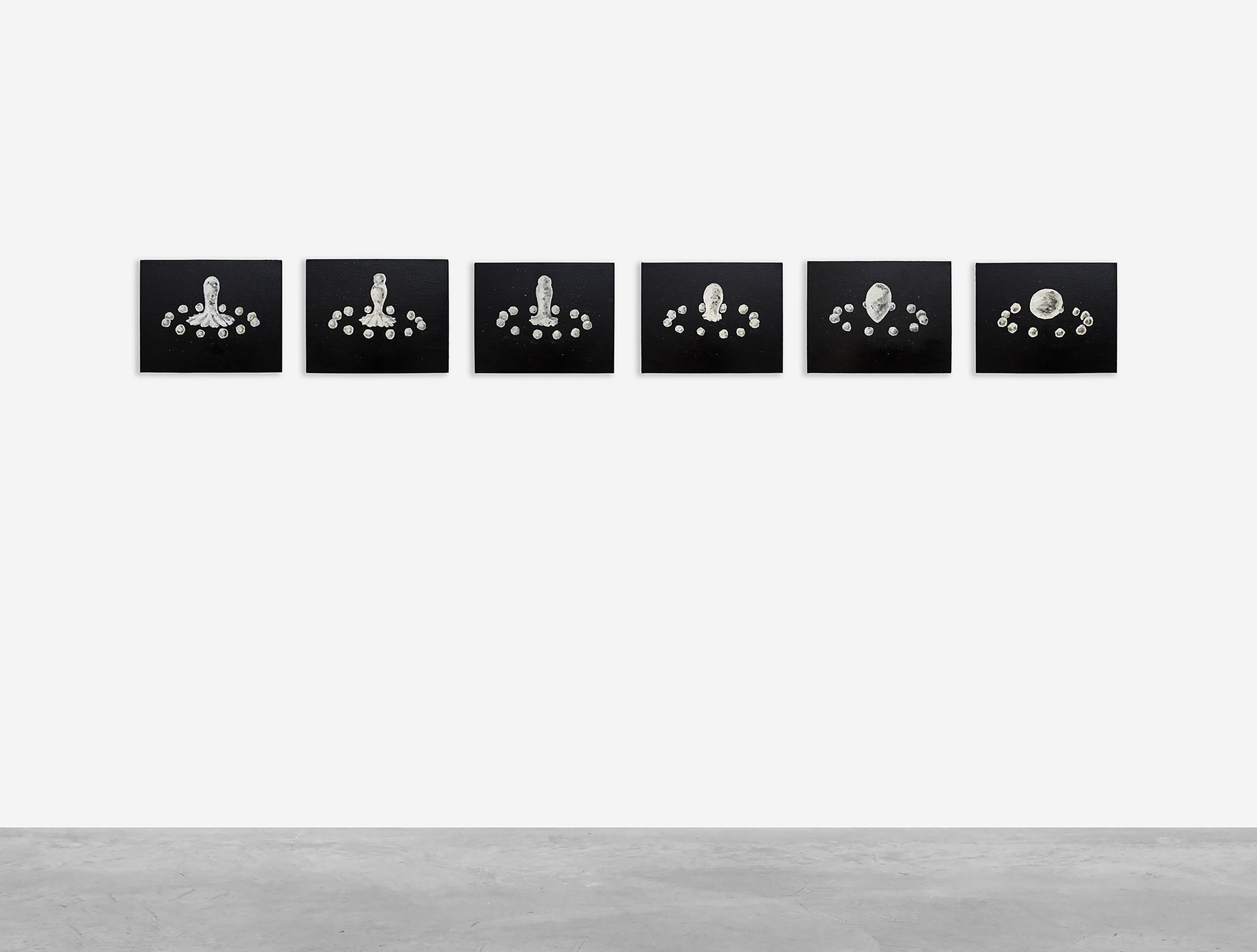
The Splash of a Drop 1 (2022) is painted in oil on linen across six panels, each measuring 28 x 36 cm (11 x 14 in), arranged in a horizontal sequence that spans an overall dimension of 28 x 216 cm (11 x 84 in). The six panels read left to right like a sentence, or more precisely like a strip of film, each frame capturing a different stage of the splash. The first panel shows the moment of impact: a dark circle against a pale gray ground, the surface barely disturbed. The second panel shows the crown forming, the liquid rising around the point of contact in a symmetrical rim that curves outward and upward. The third panel shows the crown at its peak, an open corona of thin walls and thick rim, with a central column beginning to rise from the crater floor. The fourth panel shows the collapse: the crown folding inward, the central jet ascending while the outer structure disintegrates. The fifth panel shows the jet at its maximum height, a thin vertical column rising from a surface that has begun to settle. The sixth panel shows the aftermath: the surface flat again, a few concentric ripples spreading outward, the column descended and the splash absorbed back into the body of the liquid from which it came.
The paint is applied with a precision that follows the source material closely. Each panel uses a limited palette of grays, whites, pale blues, and the faintest suggestion of warmth in the areas where the liquid catches an imagined light. The background of each panel is a smooth mid-tone gray, neither light nor dark, functioning as the neutral field against which the splash becomes visible, the way Worthington's own background was a neutral field against which the milk or water could be observed. The surface of the linen is visible in the gray passages, giving the background a slight texture that prevents it from reading as photographic or mechanical. The liquid forms are painted with thin, controlled strokes that follow the contours of the splash at each stage, building volume through gradations of light and shadow rather than through thick impasto. The highlights on the crown and the jet are applied with a brighter white that sits slightly above the surrounding paint, catching the actual light in the room and making the painted highlights function as real highlights, a small but effective confusion between the depicted illumination and the physical illumination of the gallery.
The six panels are separated by narrow gaps, and the gaps are part of the composition. They function as the intervals between the frames of a film, the spaces where the eye must interpolate what happened between one stage and the next. Worthington's own illustrations presented the stages of the splash as separate images on a single plate, each one labeled with a number and a brief description. Tan Mu's panels reproduce this format with a structural fidelity that is almost archaeological: the six panels are not six variations on a theme but six sequential documents of a single event, each one showing a different moment in the same continuous process. The gaps between the panels are the time that passes between one moment and the next, the time that the camera could not capture and the hand had to infer. The painting does not fill those gaps. It leaves them empty, and the empty spaces between the panels are as much a part of the work as the painted surfaces.
Andy Warhol's Death and Disaster series, produced between 1962 and 1964, is among the most sustained engagements with photographic repetition in American art. The series includes car crashes, electric chairs, race riots, suicides, and atomic bombs, each image sourced from newspaper photographs and screen-printed onto canvas in variations of color and cropping. The Green Car Crash (Green Burning Car I) (1963) shows a overturned automobile engulfed in flames, the body of the driver pinned beneath the chassis, the image repeated twice on a single canvas against a vivid green background that makes the violence of the scene more visible, not less. The Atomic Bomb (c. 1965) shows the mushroom cloud in the same silk-screened repetition, the same image printed across the surface in a grid that drains each individual cloud of its uniqueness and transforms catastrophe into pattern. The mechanism is the same in both cases: repetition without variation, or with only the minimal variation that the screen-printing process introduces, turns the singular event into a unit of information, a piece of data that can be reproduced, distributed, and consumed with the same detachment as any other commodity image.
Warhol understood something that Worthington also understood, though Worthington arrived at it from the opposite direction. Worthington repeated his experiment hundreds of times because he wanted to understand the splash, to map its stages, to make the fleeting permanent. Warhol repeated his images because he wanted to demonstrate that the fleeting had already been made permanent by the camera, and that this permanence had drained the event of its singularity. A car crash is photographed, printed in a newspaper, seen by millions, and discarded. The same image, transferred to canvas and hung in a gallery, is seen again, but now the context has changed. The repetition that was invisible in the newspaper becomes visible on the canvas. The viewer who might have glanced at the car crash photo and turned the page is forced to look again, and to look at the looking itself, at the habit of consumption that makes catastrophe into content. Warhol's repetition is a form of critique. It exposes the numbness that photographic reproduction produces. The splash of a drop and the explosion of a bomb are not the same event, but they are the same kind of event in Warhol's framework: they are events that have been photographed, reproduced, and consumed, and the act of reproduction has transformed them from experiences into images, from moments into data points.
Tan Mu's serial structure operates differently from Warhol's, but it arrives at a related conclusion. The six panels of The Splash of a Drop 1 do not repeat the same image. They show six different stages of the same event. The repetition is not spatial but temporal. It is the repetition of observation across time, not the repetition of a single image across a surface. And yet the effect of seeing the six panels arranged in sequence is not unlike the effect of seeing Warhol's screen-prints arranged in a grid: the viewer becomes aware of the act of comparison, of the impulse to move from one panel to the next and back again, to see what has changed and what has stayed the same, to measure the interval between one stage and the next. The panels invite the viewer to become a reader of time, to construct the continuous event from the discrete fragments, to fill in the gaps that the camera could not capture and the painting chooses to leave empty. The emptiness between the panels is the space where the viewer's understanding of the event is constructed, and it is also the space where the limitations of every recording technology, whether camera or brush, become visible.
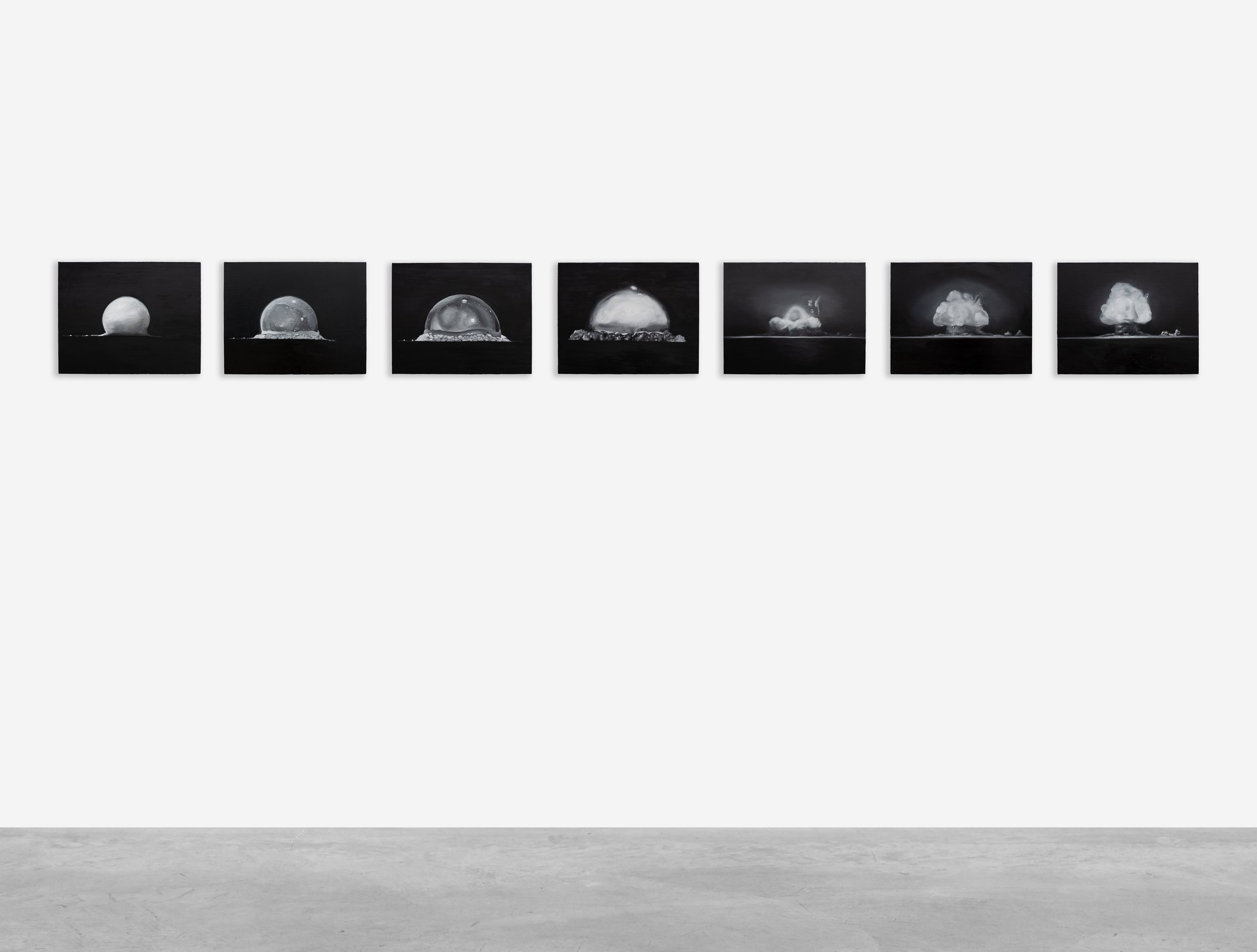
The splash of a water droplet lasts approximately fifty milliseconds. The initial flash of the Trinity test, the world's first nuclear detonation, occurred on July 16, 1945, at 5:29 AM in the Jornada del Muerto desert in New Mexico. The fireball expanded to a diameter of roughly two hundred meters within one second. The mushroom cloud rose to a height of twelve kilometers within three minutes. The energy released was equivalent to approximately twenty thousand tons of TNT. A water droplet and a nuclear explosion exist at opposite extremes of scale and consequence, and yet Tan Mu has painted them in the same format, with the same dimensions, the same number of panels, and the same serial structure. The Splash of a Drop 1 (2022) and TRINITY TESTING (2020) were exhibited together in Berlin, and their visual resemblance is immediate and deliberate. Each consists of six panels, each panel measuring 28 x 36 cm, each depicting a stage of a rapid transformation that the unaided human eye cannot follow in real time. The palette of the two works is also similar: cool grays, pale whites, and subtle gradations of tone against a neutral ground. The difference is not in the form but in the subject, and the similarity of form makes the difference in subject more visible, not less. When the two works are seen together, the viewer cannot avoid comparing a droplet of water and a weapon of mass destruction, and the comparison is not forced. It is structural. It is what the format demands.
The physics of the splash and the physics of the explosion share a property that makes them suitable subjects for the same painterly treatment: both are events that unfold too quickly for direct human observation. The human eye can resolve events at approximately twenty-four frames per second under optimal conditions. The splash occurs in roughly one two-thousandth of that duration. The initial stages of a nuclear explosion occur in fractions of a microsecond. Neither event can be seen without technological mediation. The splash requires a camera with a shutter speed measured in microseconds. The explosion requires cameras triggered by the flash of the detonation itself, with exposures timed in nanoseconds. Both events are made visible by technology, and both are made visible in sequence, as a series of images that must be assembled into a temporal narrative because no single image can contain the full duration of the event. The six panels of The Splash of a Drop 1 and the six panels of TRINITY TESTING are both sequences of this kind: records of events that exceed the capacity of unaided perception, translated into a format that allows the viewer to see what could not be seen in the moment of its occurrence.
Tan Mu has described the connection explicitly: "The Splash of a Drop 1 relates closely to my earlier work TRINITY TESTING. Both works document transformations that occur within extremely short spans of time. They were exhibited together in Berlin and share the same dimensions. While TRINITY TESTING captures the immense energy of a nuclear explosion associated with heat and destruction, The Splash of a Drop 1 focuses on subtle variations within a water droplet's movement. Despite their contrasting subjects, both works examine how technology allows us to observe and archive transient events that would otherwise escape human perception." The key word in this statement is "archive." The painting is not a representation of the splash or the explosion. It is an archive of the process by which these events become visible, a record of the translation from technological observation to painterly observation, from the camera's eye to the hand's eye, from data to pigment. The six panels do not reproduce the splash. They archive it. They preserve it in a form that the photograph, for all its precision, cannot achieve alone, because the photograph freezes a single moment while the painting, even when it depicts a single moment, carries within its surface the time of its own making, the hours and days of brushwork that accumulate on the linen and become part of the image.
Danni Shen, in her 2024 studio visit with the artist for Emergent Magazine, observed that Tan Mu's works "serve as a kind of witness to human socio-technological histories," and that the paintings reflect "the trajectory and continuum of bodily and mediated presence through human technical developments." The Splash of a Drop 1 is precisely this kind of witness. It does not merely depict a splash of water. It witnesses the history of attempts to record that splash, from Worthington's hand-drawn illustrations to the high-speed cameras that eventually replaced them, and now to the painting that returns to the hand as the instrument of recording, not because the hand is more precise than the camera but because the hand carries within its operation a duration that the camera's instantaneous shutter speed eliminates. The painting takes time. The splash does not. The painting takes longer to make than the event it depicts takes to occur, and this asymmetry is not a deficiency. It is the point. The painting extends the fifty-millisecond event across the hours of its own production, and in doing so it reverses the ratio between the event and the record, making the record longer than the event, making the observation more durable than the observed, making the archive outlast the thing archived.
The serial format of the six panels makes this reversal visible. Each panel is a complete painting, capable of standing alone, but the sequence is what gives the work its argument. A single panel of The Splash of a Drop 1 would be a still life of a water droplet. Six panels in sequence are a narrative of transformation. They show that the splash is not a single moment but a process, not a state but an event, not a thing but a change. The same is true of TRINITY TESTING. A single panel of that work would be an image of a fireball. Six panels in sequence are a narrative of detonation, expansion, and aftermath. The format transforms the subject from a noun to a verb, from a thing that is to a thing that happens, and this transformation is the contribution that painting makes to the history of recording that photography, with its dependence on the single frame, has always struggled to achieve. The camera takes a picture. The painting takes a position. The position that The Splash of a Drop 1 takes is that the event is not the splash but the seeing of the splash, the recording of the splash, the making visible of the splash, and that this seeing and recording and making visible are acts that take place over time, in the studio, with a brush, on a surface that will outlast the event by years and perhaps by centuries, because paint on linen is more durable than milk on a photographic plate, and the hand that records is more patient than the shutter that clicks, and the six panels that hang on the wall will still be showing their stages of the splash long after the last splash has been photographed and the last photograph has faded and the last camera has been replaced by something faster and more precise, and the painting will still be there, still taking its time, still demanding that the viewer look at all six panels in sequence, still insisting that the event is not the moment but the duration, not the splash but the seeing, and not the seeing but the record of the seeing, and not the record but the painting that holds the record in a form that no technology can render obsolete because the painting was never the most precise recording of the event in the first place. It was the most patient, and patience is a quality that no camera possesses.