The Body That Cast Three Shadows: Tan Mu's Projection: Light and Shadow and the Light That Replaced the Sun
At six inches from the canvas, the first thing you notice is the blue. Not a single blue but a field of them: cerulean where the light falls directly on the environment, ultramarine where the ground recedes from the source, a thin wash of phthalo that puddles in the low areas of the linen weave like standing water on a floor. The blue is the environment itself, the ground on which the figure stands, and it is also the color of projected light, the tinted wash that a video projector casts across a wall before the image arrives. It is the color of a screen that is turned on but not yet displaying, the color of a signal that is present but not yet carrying information. Over this field, the figure's shadows appear as three distinct forms: one dense and opaque, one semi-transparent, and one barely visible, a ghost of a ghost. Each shadow has a different edge. The first is sharp, as though cast by a point source. The second blurs at its perimeter, as though the light source has some width. The third dissolves almost entirely into the blue ground, more absence than presence. Three shadows, three lights, three versions of the same body.
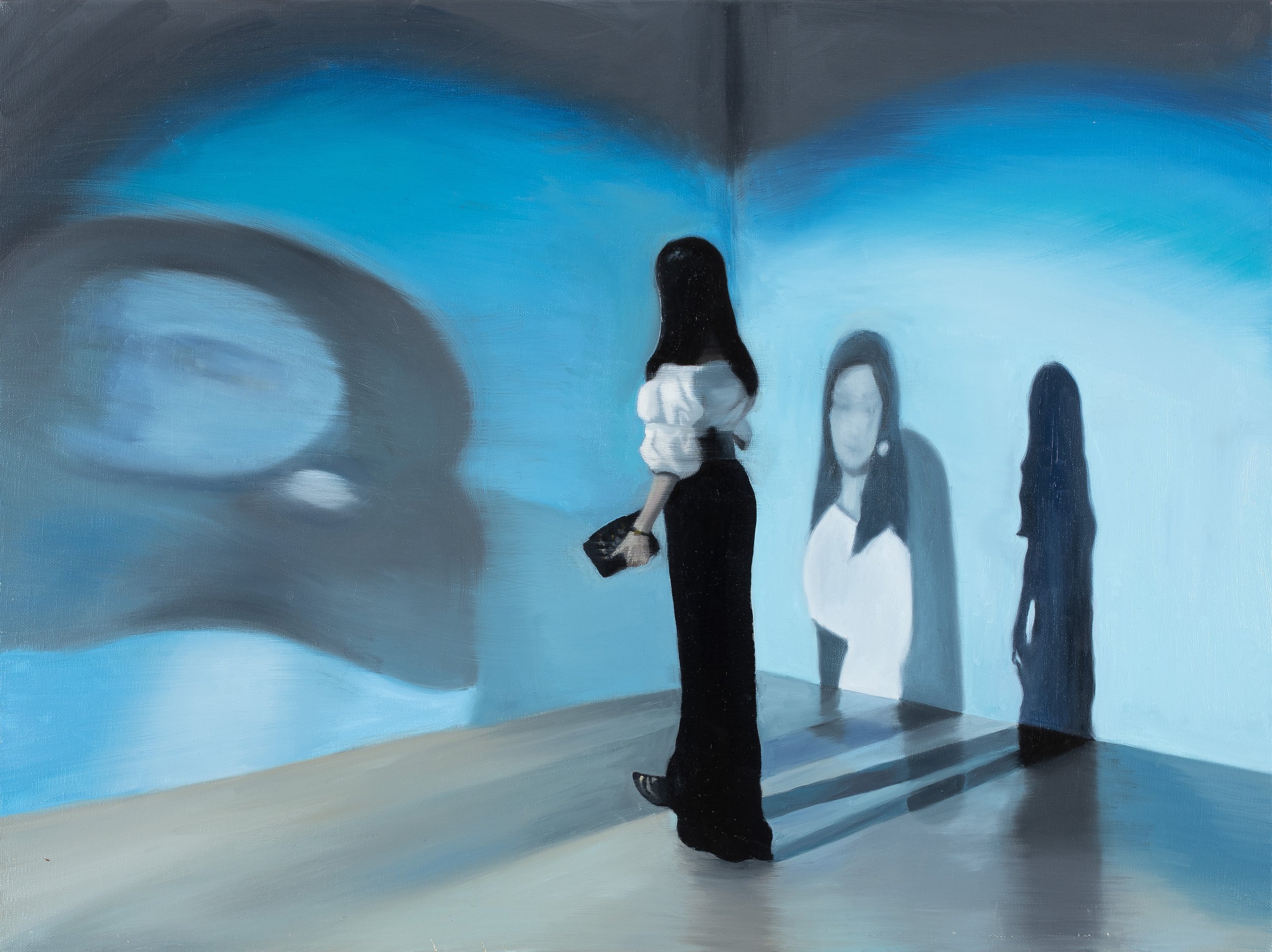
Projection: Light and Shadow (2021), oil on linen, 46 x 61 cm (18 x 24 in), is one of the most intimate paintings in Tan Mu's practice, and one of the most structurally ambitious. Its subject is real-time video recording and projection, and its argument is that the history of light in painting, from sacred illumination to digital projection, is also the history of identity, from the unified self to the multiplied, mediated, fragmented self that the digital age has produced. The figure at the center of the composition stands on a blue-toned environment, generating multiple iterations of shadow. These shadows, one solid, one translucent, and one faint, reflect how light has evolved as both a tool and a subject in artistic expression. The painting does not illustrate this evolution. It compresses it into a single composition, where the three shadows coexist on the same surface, in the same moment, as though Caravaggio's single candle and the fluorescent tubes of Dan Flavin and the pixel grid of a video projector were all shining on the same body at the same time.
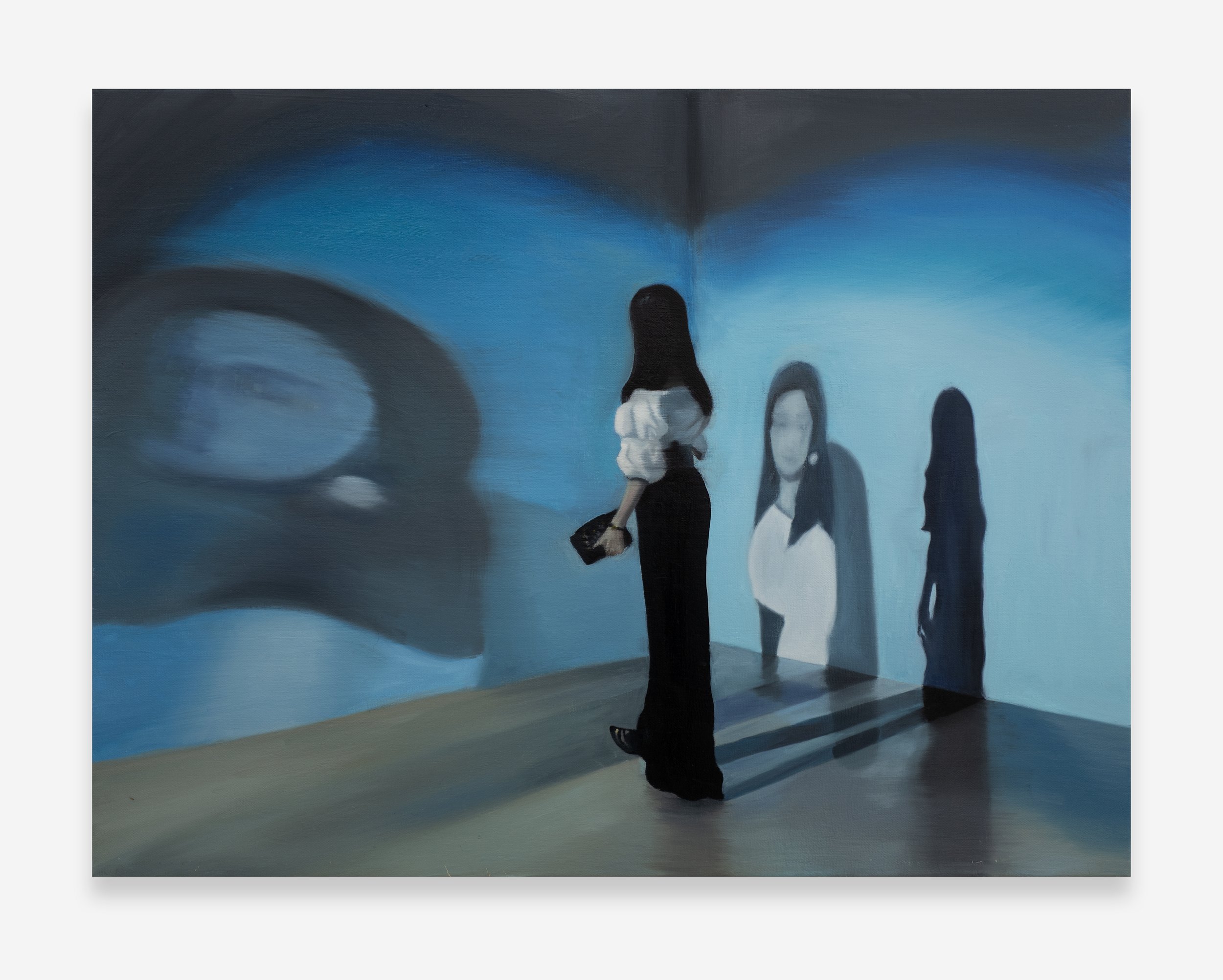
The physical object is small enough to hold in the hands, were it not on a stretcher bar. At 46 x 61 cm, it occupies roughly the space of a laptop screen, a proportion that is unlikely to be coincidental given the painting's subject. The scale positions the viewer at reading distance, close enough to see individual brush marks and the texture of the linen, close enough to register the painting as a handmade object before it resolves into a depiction of a technologically mediated scene. The linen shows through the thinnest passages, its woven structure providing a faint rectilinear grid that rhymes with the pixel grid of the projected image without replicating it. The oil paint is applied in layers: a thin ground of blue, over which the figure and its shadows are built up with increasing opacity and specificity. The densest shadow, the one cast by what appears to be the brightest and most focused light source, is rendered in a dark blue-gray that approaches black at its center and lightens toward its edge, where it meets the blue ground in a transition that is sharp but not mechanical. The brush has made this edge, not a mask, and the slight irregularity of the line is what distinguishes a painted shadow from a digital one. The second shadow is built with thinner paint, the blue ground visible through it, giving it the translucency that the artist describes. The third shadow is barely more than a stain, a shift in the value of the blue that the eye registers as presence only because the first two shadows have taught it where to look.
The figure itself is rendered with the same layered attention. It is not a portrait. No face is visible, no identifying features distinguish it from any other standing body. It is a silhouette with volume, a form defined by the shadows it casts and the light it receives, and this is the painting's point. In the regime of projection, the body is not defined by its interior but by its surface, not by what it contains but by what it blocks. The light that falls on it and the shadows it casts are the only information the painting provides about who or what this figure is. Identity, in this composition, is an effect of illumination. Change the light and you change the self. Each shadow is a different version of the same body, produced by a different source, and none of them is more real than the others. They are all projections.
In Caravaggio's The Calling of Saint Matthew (1599-1600), the light that enters the Roman tax office from an unseen source at the upper right is not natural illumination. It is divine light, the light of Christ's call, and it falls on Matthew and his fellow tax collectors with the specificity of a spotlight picking out a single figure on a dark stage. The shadow that this light casts is singular and decisive. Each body in the composition casts one shadow, and the direction of each shadow points back to the same source, the same origin, the same divine command. The light in Caravaggio is not ambient. It does not fill the room. It selects. It chooses Matthew from among the group at the table, and the shadow that Matthew casts is the proof of his having been chosen, a dark shape on the wall that confirms the direction and the authority of the light that has found him. There is no ambiguity in this system. One source, one shadow, one meaning. The relationship between light and identity is causal: the light calls, the body responds, the shadow records the encounter.
Caravaggio's chiaroscuro, which established the visual grammar of dramatic illumination for the entire Western tradition that followed, operates on the assumption that light is singular and that shadow is its consequence. Where there is one light, there is one shadow per body. The shadow is the body's testimony that the light exists. This logic persists through the history of painting even as the sources change: candlelight in Georges de La Tour, window light in Vermeer, open air in the Impressionists. In each case, the number of shadows corresponds to the number of sources. A figure lit by a single candle casts one shadow. A figure standing in open sunlight casts one shadow. The shadow is always secondary, always subordinate, always the body's admission that something brighter than itself is present. Tan Mu's painting breaks this contract. The figure in Projection: Light and Shadow casts three shadows because three lights are shining on it simultaneously, and none of them is the sun. The light sources are technological, and the shadows they produce are not testimony to a divine presence but evidence of a surveillance, a recording, a projection. Each shadow is a different system's version of the same body. Each is accurate. None is complete. The multiplication of shadows does not mean the light is brighter. It means the body is more visible, more recorded, more reproduced, and in that increased visibility, something is lost that Caravaggio's single shadow preserved: the knowledge that the shadow belongs to the body and not to the apparatus that produced it.
The subject of the painting, as Tan Mu describes it, is "the complex dialogue between technology and human existence through the medium of real-time video recording and projection." The progression she traces runs from "the sacred illumination in religious paintings to the intimate glow of candlelight in Renaissance works, the revolutionary impact of natural light in plein air painting, and finally, to our contemporary era of digital projection." This is not a neutral art historical survey. It is an argument about what light has become. In the sacred tradition, light is a sign of divine presence. In the Renaissance, it is a tool for modeling form. In plein air painting, it is the subject itself, the thing that the painter goes outdoors to capture. In the era of digital projection, light is no longer natural or even artificial in the old sense. It is electronic, algorithmic, transmitted through fiber and pixel. It does not illuminate a preexisting scene. It generates the scene. The projection does not reveal what is there. It creates what is seen. And the shadows it casts are not the body's testimony to the light but the light's testimony to the body, evidence that the system has registered a presence, captured a form, recorded a shape for later retrieval.
Tan Mu developed this work during what she describes as "a period of personal uncertainty surrounding memory and identity." The phrasing is careful. She does not say she was uncertain about her identity. She says she was uncertain about identity itself, about the category, about what it means to have one in an era where the self is "increasingly shaped by images, data, and screens rather than by the physical body alone." This is not the freediving narrative, though it shares its concern with the fragility of self-knowledge. It is a different register of the same question: what remains when the conditions that define the self change faster than the self can adapt? In the diving accident, the loss was neurological, a blackout that erased memory temporarily. In Projection: Light and Shadow, the loss is technological, a proliferation of representations that multiplies the self into so many versions that no single version can claim authority. The three shadows are not three memories of the same event. They are three simultaneous constructions of the same body, and they coexist in the painting the way that the social media self, the surveillance self, and the data-driven self coexist in the world: overlapping, inconsistent, all accurate, none complete.
Olafur Eliasson's installation Your Uncertain Shadow (colour) (2010) provides a contemporary structural parallel. In this work, visitors to a gallery walk through a darkened room illuminated by colored spotlights, red, green, blue, and yellow, positioned at different angles. Each light casts a separate shadow of the visitor's body on the far wall, and because the lights are colored and positioned at different points, the shadows separate and overlap, producing a composite image in which the body is simultaneously present in red, green, blue, and yellow, its outline repeated and offset, its shape multiplied into a chromatic constellation. The visitor becomes the medium. Without a body in the room, there are no shadows. The installation is empty when no one is there, just as a projection system produces no image without something to project onto. The light is always on, but the shadows only appear when a body enters the field.
Eliasson's installation and Tan Mu's painting share a formal logic: multiple light sources producing multiple shadows from a single body. But they differ in a crucial respect. Eliasson's work is an installation, a room that the viewer enters and in which the viewer's own body becomes the subject. The experience is immediate and embodied. You see your own shadows multiplying on the wall. Tan Mu's work is a painting, a representation of a scene that the viewer cannot enter. The figure in the painting is not you. It is someone else, or no one in particular, a body that stands in for all bodies subjected to projection. The painting records a condition that Eliasson's installation enacts in real time, and in recording it, it makes the condition legible as a history. Eliasson shows you what it feels like to be projected. Tan Mu shows you what it looks like when someone else is. This difference matters. The installation is an experience. The painting is a document. And in the context of Tan Mu's broader practice, which consistently positions painting as a form of witnessing, the painting is not just a document but a witness: testimony that the condition of multiplied identity exists, that it has a specific visual form, and that it can be recorded, analyzed, and preserved through the deliberate, time-consuming, material process of oil on linen.
Li Yizhuo, in her 2022 essay "Imaginary of an Image," observes that Tan Mu's canvases "do not aim at diagnosing the modern spectacles from a distance. They conjure up a kind of vitality and depth of their own." The observation applies to Projection: Light and Shadow with particular force. The painting does not diagnose the condition of digital identity. It does not stand outside the projection and point to it as a problem. It enters the projection, occupies its logic, and finds within it a vitality that a purely diagnostic approach would miss. The three shadows are not symptoms of a disorder. They are forms of life, versions of the body that have their own depth, their own substance, their own claim on the viewer's attention. The faintest shadow is not the least real. It is the most transparent, and in its transparency, it reveals the blue ground beneath it, the color of the projected environment, the color of the screen that is always already there before the image arrives. That shadow is not a failure of representation. It is a condition of projection, the shadow that the weakest light casts, and in its faintness it tells the viewer something that the densest shadow cannot: that the ground exists independently of the light that falls on it, that the environment persists even when the projection fades.
Tan Mu's own account of the work insists on the relationship between projection and identity with a directness that the painting itself, by virtue of being a visual object, cannot quite match. "In this work, projection functions not only as a visual phenomenon but also as a metaphor for identity. In the digital age, our sense of self is increasingly shaped by images, data, and screens rather than by the physical body alone." She names the three contemporary versions of the self explicitly: "the self on social media, the self captured by surveillance systems, the data-driven self. Each of these versions is part of who we are, yet none of them fully defines us." The painting does not illustrate this statement. It translates it into form. The three shadows are the three selves, and the figure that casts them is the body that precedes all three, the physical presence that the projections depend on but cannot capture. The body is not a self. The self is what the projections make of the body. And the painting, by placing all three projections on the same surface, in the same moment, refuses to prioritize any of them. There is no central shadow. There is no master projection. The figure stands at the center, and the shadows radiate outward in different directions, each one a complete but partial account of the body that cast it.
What the painting finally argues is that the history of light in painting is not a story of progress from darkness to illumination but a story of multiplication from singularity to proliferation. Caravaggio's single light produced a single shadow and a single identity: the body as the light chose it. Eliasson's colored spotlights produce multiple shadows and a multiplied identity: the body as each light sees it. Tan Mu's projected video light produces shadows that are not cast by the sun or by theatrical lamps but by electronic systems that record, transmit, and reconstruct the body in real time. The shadow is no longer a byproduct of illumination. It is a product of surveillance, a record of having been seen. And the painting that depicts this condition is itself a record of having been seen, an object made by a hand that spent hours translating a digital scene into oil on linen, adding to the projections that the model provided the additional layer of material presence that only paint can give. The painting is the fourth shadow, the one the artist casts.