The Field That Harvests Light: Tan Mu's Solar Farm and the Grid That Replaced the Crop
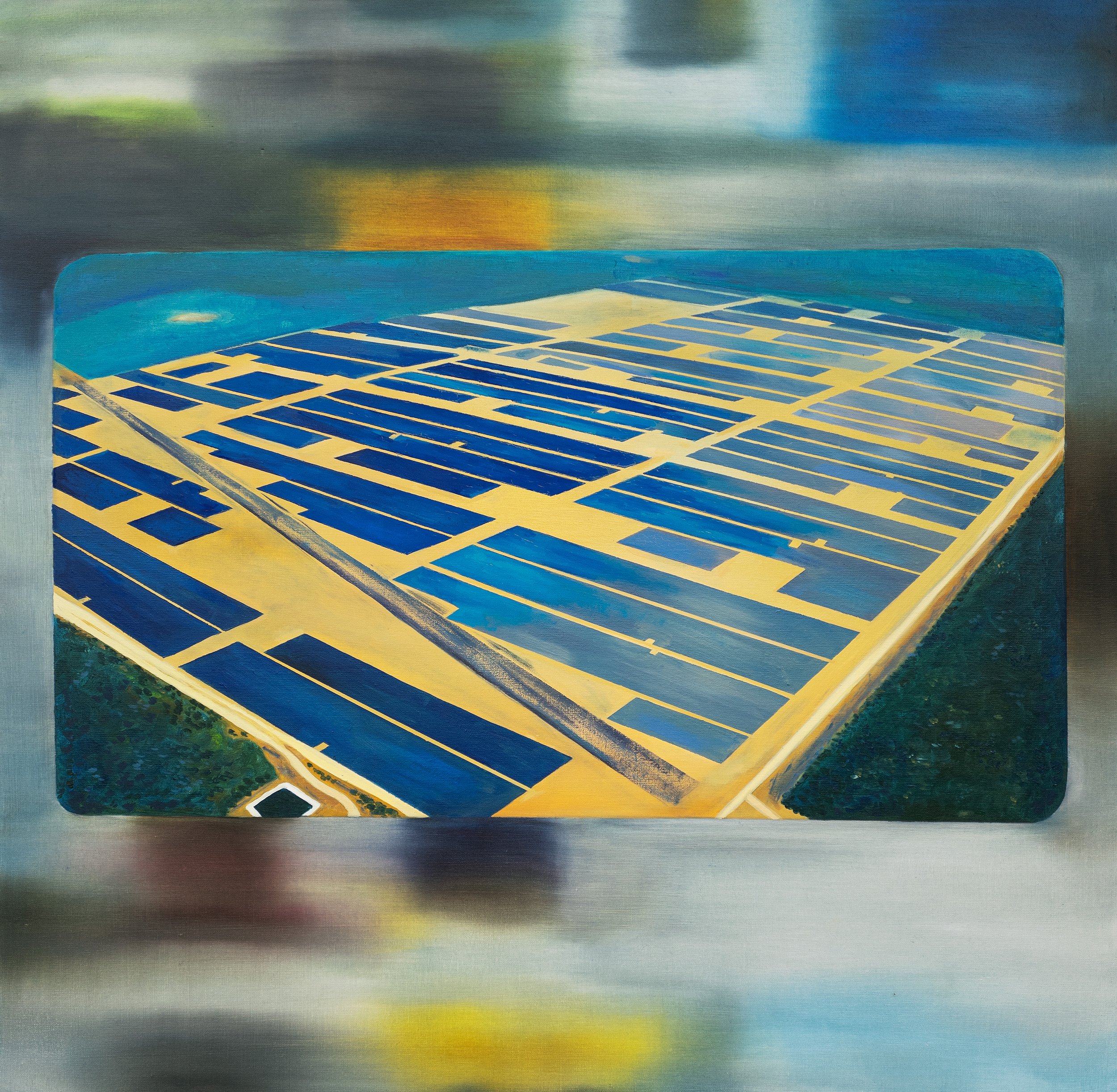
Tan Mu was living in Florida when she started this painting. The state receives more sunlight than almost anywhere in the continental United States, and along the highways and near the airports, vast fields of photovoltaic panels stretch across land that was recently farmland, cattle pasture, or scrub. She saw them from the car window and from the airplane seat, and she saw them on her phone, where news about energy policy and environmental collapse arrives in the same feed as photographs of friends and screenshots of real estate listings. Solar Farm (2022), oil on linen, 76 x 76 cm (30 x 30 in), begins in that overlap: the place where the landscape seen from a moving vehicle and the landscape seen on a screen become indistinguishable, where the solar panels that harvest sunlight and the screen that displays their image draw from the same source. The painting is square. The format is not incidental. It is the shape of the phone screen, the shape of the solar panel, the shape of the Instagram crop. In a practice dominated by horizontal formats, the square stands out, and its significance is not compositional but conceptual. It declares, before the viewer has registered a single brushstroke, that the painting's subject includes the device through which the subject was seen.
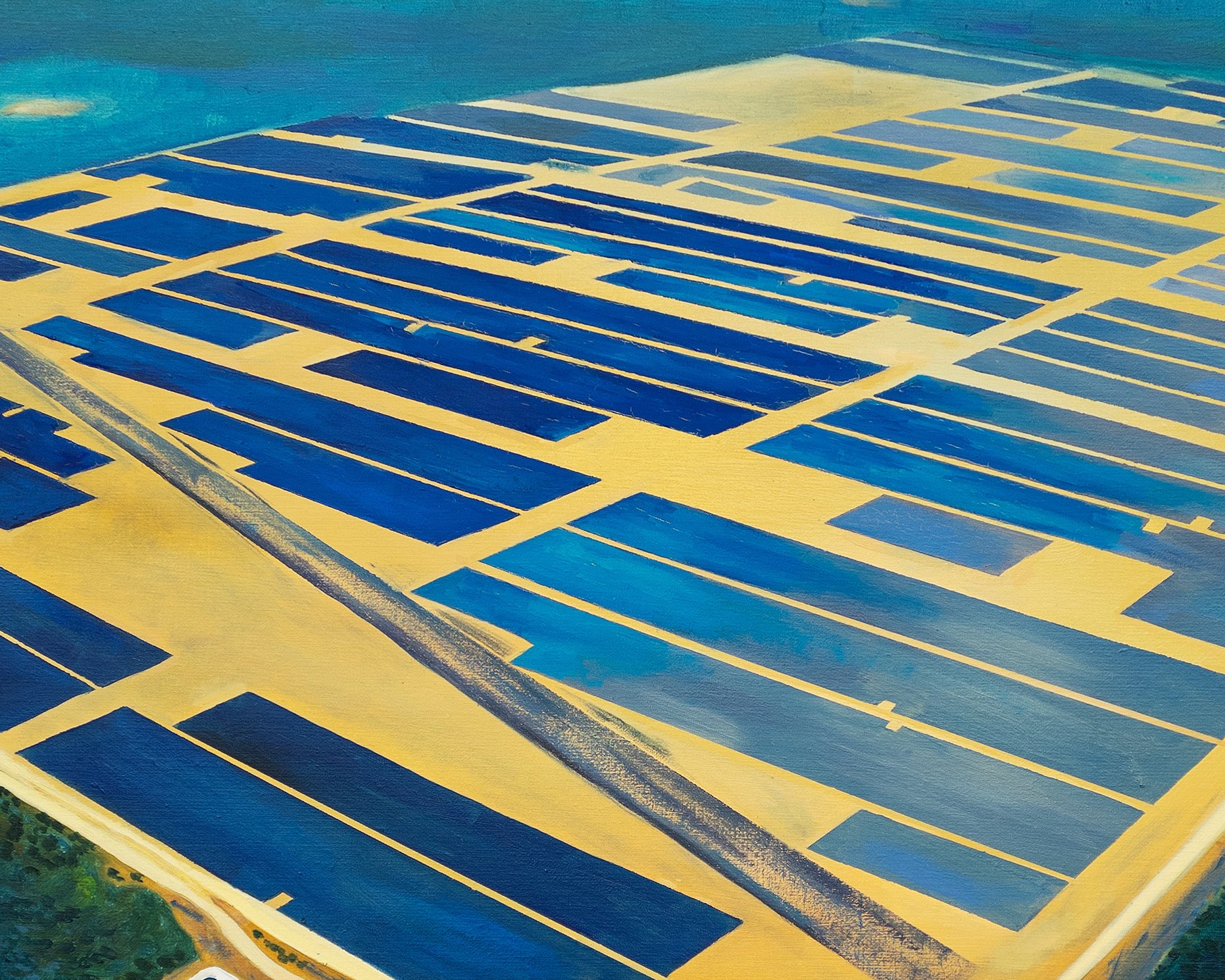
The painting presents an aerial view of a solar farm, rendered from a slightly elevated perspective, what Tan Mu describes as "similar to what one might see from an airplane window or within a video game interface." The solar panels fill the central register of the composition, their dark, reflective surfaces arranged in a rigid grid that dominates the middle and lower sections of the canvas. Each panel is a near-rectangle of deep blue-black, catching light at a slightly different angle, producing subtle variations in tone that shift from a near-mirror brightness at one edge to a matte absorption at the other. The grid they form is regular, orderly, geometric, the kind of pattern that a satellite would register as infrastructure and a farmer would recognize as the shape of a harvest that does not come from the ground. Around the panels, the terrain appears in softer, more gestural passages: patches of green and brown that suggest vegetation, roadways that cut between the panel arrays, and a horizon line that sits high in the composition, keeping the sky visible while allowing the vast scale of the installation to dominate the visual field.
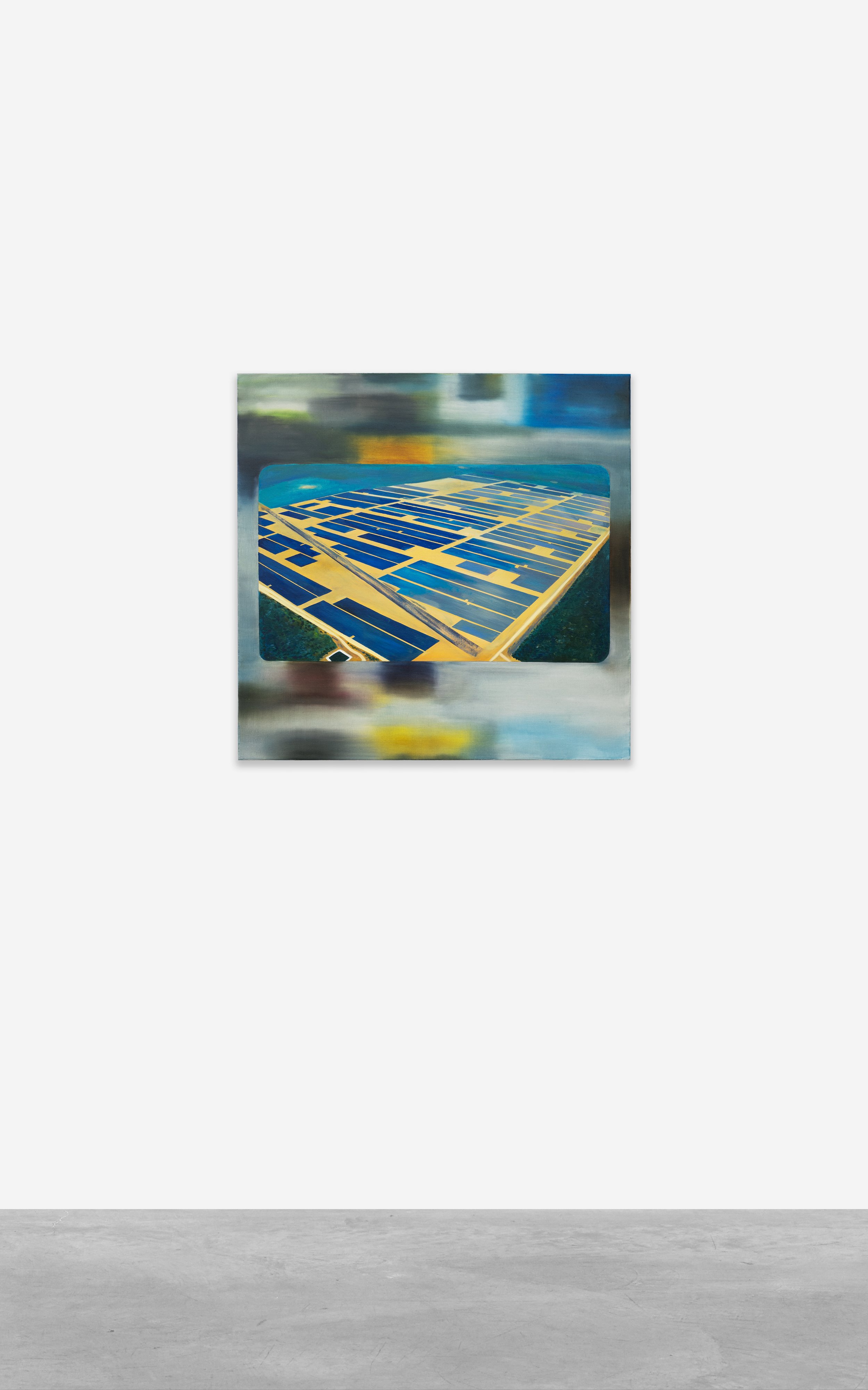
At three meters, the painting reads as an aerial photograph of an installation. At thirty centimeters, the surface reveals its stratigraphy. The linen support shows through in the areas of terrain and sky, its woven texture providing a warm, organic ground that contrasts with the hard-edged geometry of the panels. The panels themselves are built up in thin layers of oil, each one a small field of near-uniform color that nonetheless carries the trace of the brush that laid it down. The edges of the panels are not masked. They are painted freehand, and the slight irregularity of their borders distinguishes them from the mechanical precision of the objects they represent. This is a painting about a grid, made by a hand that cannot help but introduce variation into repetition, a hand that paints each panel individually even as each panel is supposed to be identical to its neighbor. The terrain beneath and between the panels is rendered in looser, more gestural marks, as though the land resists the geometry that has been imposed on it. The contrast is not subtle. Where the panels are rectilinear and precise, the ground is soft and irregular. Where the panels absorb light, the ground reflects it in the warm ochres and greens of vegetation. Where the panels are systematic, the ground is organic, and the painting makes the viewer feel the tension between these two orders without resolving it.
Superimposed on this aerial view is a second layer, a visual element that distinguishes Solar Farm from every other painting in Tan Mu's practice. Tan Mu has incorporated a screenshot from her phone into the composition. The solar farm appears, in her description, "as an archived image, while blurred visuals from my photo gallery dissolve into the background, symbolizing the overwhelming digital landscape." These blurred photographs, fragments of the camera roll that sits beneath the solar farm image on the phone screen, drift across the lower portion of the painting like half-erased memories, their subjects indistinct but their rectangular formats legible as the visual grammar of the smartphone interface. The phone is not depicted as an object. It is not held in a hand or shown as a device. It is present as a frame, a layer, a way of seeing that has been folded into the painting's own way of seeing. The viewer looks at a solar farm through a screen that is itself inside a screen of other images, and the painting does not attempt to resolve this nesting. It holds all the layers simultaneously, the solar farm and the camera roll and the paint and the linen, and asks the viewer to occupy a position that is simultaneously aerial and digital, detached and mediated.
Claude Monet's series of paintings of the Gare Saint-Lazare, painted in 1877, are the most sustained artistic encounter with industrial energy infrastructure in the nineteenth century, and they remain the reference point against which any subsequent painting of energy generation must be measured. In Arrival of the Normandy Train, Gare Saint-Lazare (1877), Monet positions the viewer inside the station itself, surrounded by the iron architecture of the train shed, looking out through the glass and iron canopy toward the locomotive that fills the center of the composition with steam. The steam is the painting's true subject. It billows upward in white and gray clouds, dissolving the iron ribs of the roof, softening the hard geometry of industrial architecture into something approaching atmosphere. The train is secondary. The station is a frame. The steam is what Monet was painting: the visible evidence of energy conversion, the coal burning in the locomotive's firebox, heating water into steam, driving the pistons that turn the wheels, propelling the train forward. The steam is what the energy looks like when it escapes the system that contains it, and Monet gives it the compositional space that a landscape painter would give to a cloud or a sunset, treating it as a natural phenomenon rather than a mechanical byproduct.
Monet painted the Gare Saint-Lazare seven times in 1877, returning to the station from different angles and at different times of day, producing variations that emphasized the way the steam changed with the light, the way the iron structure caught and held the sun, the way the modern industrial interior could be made to yield the same atmospheric effects that he had previously found in the Seine at Argenteuil or the cliffs at Etretat. The series was not a documentary project. It was a formal investigation into what happens when you apply the methods of plein air painting, the study of light, atmosphere, and color, to a subject that is not natural but industrial, not a landscape but a machine for moving people and burning coal. The results demonstrated that the methods worked. The station could be painted like a cathedral. The steam could be painted like a cloud. The train could be painted like a river. Industrial modernity, in Monet's handling, became a landscape, and the locomotive became a force of nature.
The structural parallel with Solar Farm is precise. Monet took the energy infrastructure of his era, the steam locomotive and the iron train shed, and painted it using the visual language that had been developed for natural landscapes. Tan Mu takes the energy infrastructure of her era, the photovoltaic array and the digital screen, and paints it using the visual language that has been developed for industrial aerial views. In both cases, the painting converts infrastructure into landscape. In both cases, the artist's decision to treat the subject as a landscape rather than as a technological curiosity, as something to be seen and felt rather than simply documented, transforms the viewer's relationship to it. Monet's viewers, accustomed to seeing steam trains as noisy intrusions into pastoral life, were forced to see them as phenomena of light and atmosphere. Tan Mu's viewers, accustomed to seeing solar farms as either symbols of ecological hope or blights on agricultural land, are forced to see them as compositions, as patterns of dark rectangles arranged against a field of green and brown, as visual events that have a specific and demanding geometry.
Tan Mu herself cites this connection. "I often think about Impressionist painters such as Claude Monet, who documented industrial transformations in their time. His paintings of train stations and factories not only captured new technologies but later became valuable historical records. Scholars now study those works to understand environmental conditions and technological shifts of the nineteenth century." The citation is not decorative. It locates Solar Farm within a tradition of artists who have recognized that the visual vocabulary of their era is being reshaped by energy infrastructure, and who have chosen to paint that infrastructure not as an aberration in the landscape tradition but as the landscape itself, the thing that the land has become. Monet's steam is Tan Mu's grid. Both are the visible form of invisible energy conversion. Both are what the landscape looks like when the landscape has been repurposed to generate power rather than to grow food or to provide pasture. The train station replaced the meadow. The solar farm replaces the field. The painting records the replacement without mourning the original, because the original is no longer what the landscape is for.
The subject of Solar Farm, as Tan Mu describes it, is environmental change and clean energy development, presented through an aerial view of "the landscape's transformation from traditional agriculture to modern solar power farms." The structured arrangement of solar panels "forms an abstract electrical grid, symbolizing the shift in renewable energy while reflecting the fusion of technology and nature." But the painting does not merely symbolize this shift. It enacts it. The grid of panels on the canvas is itself a grid, a regular arrangement of dark rectangles that organizes the viewer's visual field in the same way that the solar panels organize the landscape. The panels divide the land into productive units. The painting divides the canvas into productive units. The analogy between agricultural harvesting and energy harvesting is not metaphorical. It is structural. Both the farm and the solar array take something that falls from the sky, sunlight, and convert it into something useful, food or electricity. Both require land. Both reshape the terrain to serve their purpose. Both produce patterns that are legible from above, the furrows of a plowed field and the rows of a photovoltaic installation, and both are best understood from the elevated perspective that the painting adopts.
The phone screenshot that overlays the aerial view is not an afterthought. It is the painting's most radical formal decision. By incorporating a screenshot from her phone into the composition, Tan Mu does not simply acknowledge that the source image was mediated by a digital device. She embeds the device's interface within the painting's own visual field. The blurred images from her photo gallery that "dissolve into the background" are fragments of other moments, other photographs, other screenshots that sit beneath the solar farm image in the phone's visual stack. They represent the way information is consumed on a phone: not as a single, focused encounter with a single image but as a scroll through an undifferentiated feed where news about renewable energy sits next to a photograph from last week, where a solar farm appears above a friend's dinner and below a headline about a pipeline spill. The painting incorporates this stacking, this layering of unrelated visual information, and makes it part of the composition rather than apologizing for it. The solar farm is not presented as a pristine landscape. It is presented as an image on a screen, one image among many, competing for attention in a feed that does not distinguish between the important and the trivial.
Danni Shen, writing in Emergent Magazine in 2024, observed that Tan Mu's works "serve as a kind of witness to human socio-technological histories," reflecting "the trajectory and continuum of bodily and mediated presence through human technical developments." The formulation applies to Solar Farm with particular clarity. The painting is a witness to a specific technological transition, from agriculture to energy harvesting, and it is also a witness to a specific perceptual transition, from seeing the landscape from a window to seeing it through a screen. These two transitions are not separate. The solar farm is itself a product of the same technological regime that produces the phone, the screenshot, and the infinite scroll. Renewable energy and digital mediation are not coincidental developments. They are parallel expressions of the same industrial and informational infrastructure. The solar panels harvest sunlight. The phone harvests attention. The painting, made with oil and linen, harvests something else: the time and the care that the screen cannot provide.
The Bechers' typological grids of industrial structures, photographed from the 1960s through the 1990s, provide a second structural parallel for Solar Farm. Bernd and Hilla Becher spent decades photographing cooling towers, blast furnaces, gas tanks, and mineheads across Europe and North America, always from the same angle, in the same light, with the same dispassionate precision. When they arranged these photographs into grids, nine cooling towers in three rows of three, or fifteen gas tanks in five rows of three, the individual structures became instances of a type, and the grid became the argument: that industrial architecture has a grammar, that the grammar is constrained by function, and that function produces forms that are more regular, more systematic, and more visually legible than any ornamental tradition. The Becher grid makes industrial structure into a language, each structure a word, each grid a sentence, and the sentence always says the same thing: this is what industry looks like when you strip away the context and leave only the form.
Tan Mu's grid of solar panels operates in a related register. The panels in Solar Farm are not individuated. They are not depicted with the photorealist precision that would allow a viewer to distinguish one panel from the next by its scratches or its mounting brackets. They are a system, a pattern, a grammar of dark rectangles arranged in rows, and their visual power comes from their regularity, from the way the grid imposes order on the terrain beneath it. But where the Bechers' grids are archival, collecting examples of disappearing structures and preserving them in a neutral, documentary format, Tan Mu's grid is painterly. The panels are rendered in oil, with brush marks visible at close range, and the terrain beneath them is gestural, organic, resisting the geometry that has been laid on top. The Bechers present industrial form as a found object, something to be documented before it disappears. Tan Mu presents it as something that is actively replacing the landscape, not disappearing but arriving, not an artifact of a dying industry but the infrastructure of an expanding one. The solar panels are not ruins. They are the opposite of ruins. They are the newest thing on the land, and the painting records their arrival with the same formal attention that Monet gave to the steam engine and the Bechers gave to the cooling tower.
The square format of Solar Farm, unusual in Tan Mu's practice, encodes the phone screen into the painting's proportions. It is not a landscape format, which would invite the eye to travel horizontally across a vista. It is not a portrait format, which would center a single object against a ground. It is a square, the aspect ratio of the smartphone screen, the Instagram post, the app icon. The square says: this is how you see the world now. This is the frame through which the landscape arrives. The aerial view and the phone screen are not in conflict. They are the same view, seen through the same device, at the same distance. The painting does not ask you to choose between the landscape and the screen. It asks you to recognize that the screen is the landscape, that the mediated view is the view, and that the solar farm, which converts sunlight into electricity, and the phone, which converts sunlight into an image, are both devices that harvest light and turn it into something else. The field that grows food has been replaced by the field that grows electricity. The window that frames the view has been replaced by the screen that delivers it. And the painting, made with oil on linen in a square format that mirrors the phone, converts both the field and the screen back into pigment, back into something that a hand made and an eye can see without swiping.