The Window at Dusk: Tan Mu's Sunset and the Hour When Light Changes Hands
There is an hour, ten minutes long in summer and barely a minute in winter, when the sky is still bright enough to see the river but the buildings across the water have already turned on their lights. The sun has dropped below the horizon but has not yet surrendered the atmosphere. The artificial lights have not yet taken command but have already announced themselves, pinpricks of yellow and white along the far shore, premature stars in a sky that is still more blue than black. For that hour, or that minute, two systems of illumination coexist. The sun is still responsible for what you see, and the grid is already responsible for what you will see. This is the moment Tan Mu's Sunset (2021) occupies. It is not a painting of a sunset. It is a painting of the moment when the sunset hands authority to the city.
Sunset, oil on canvas, 31 x 31 cm (12 x 12 in), is small and square, a format that matches the proportions of a window, a phone screen, or a viewfinder. The painting depicts a view near Tan Mu's studio overlooking the East River in downtown Manhattan. The composition is divided between an interior space, visible as a narrow strip of wall and window frame in the foreground, and an exterior vista of river, sky, and the distant lights of the city across the water. The horizon glows with the warm amber and orange of a sun that has already set, its residual light spread across the sky in a band that softens from deep gold at the horizon line to a cooler blue-gray above. Below the horizon, the river reflects this light in broken, horizontal strokes that suggest both the surface of the water and the movement of the current. And across the river, on the far shore, the city has already begun to light: small points of illumination, individual windows and streetlamps, that dot the darker mass of the buildings and shoreline with the same regularity as the signal points in Tan Mu's submarine cable paintings.
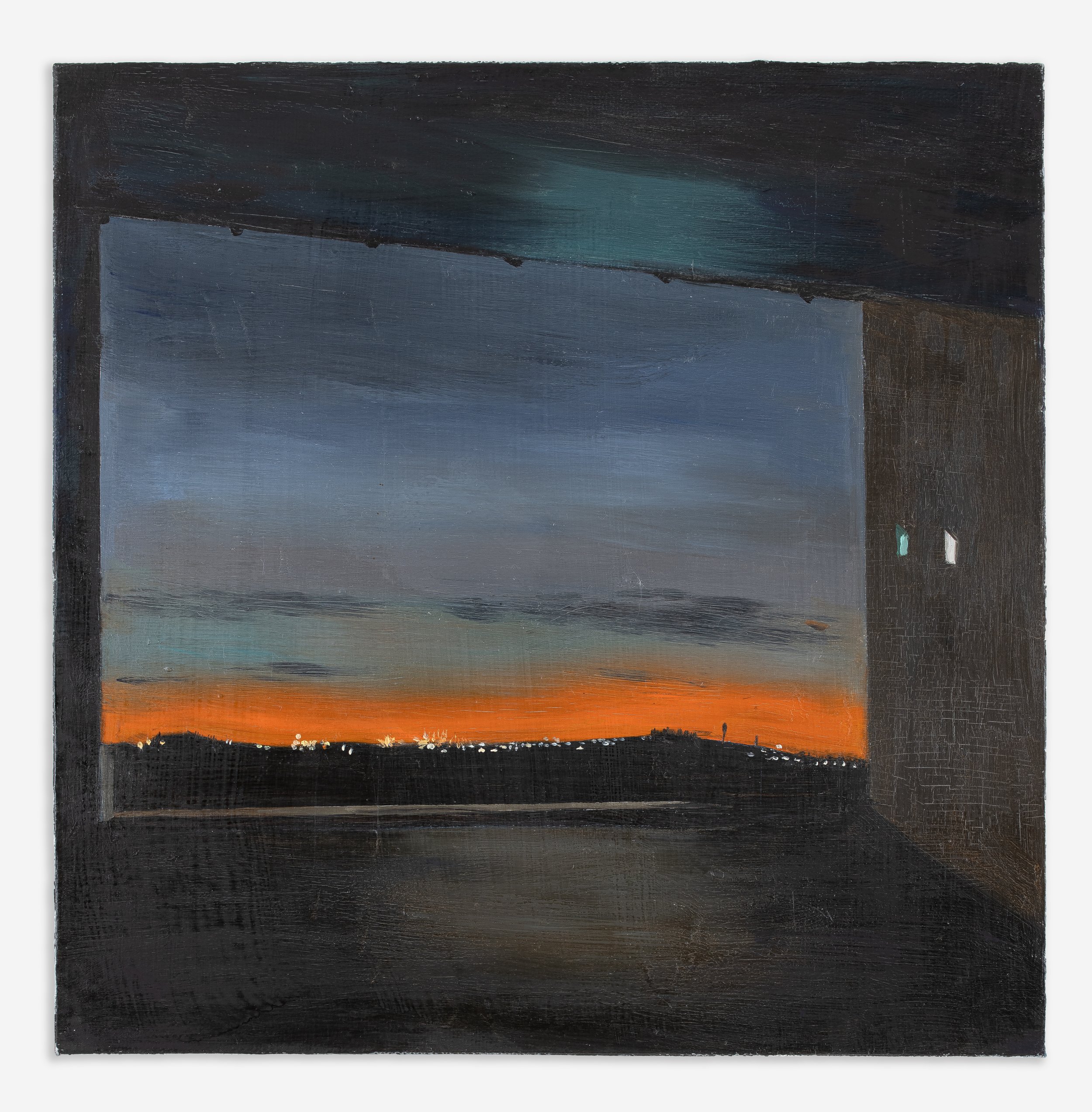
The canvas is small enough to hold in two hands. At 31 x 31 cm, it is the size of a framed photograph that might sit on a desk, or the screen of a tablet held at reading distance. The intimacy of the format is not incidental. This is a painting about a private view, the view from a studio, the view that belongs to the person who stood at the window and watched the light change. The square format eliminates the panoramic sweep that a horizontal canvas would provide and the vertical emphasis that a portrait format would impose. It simply frames what was there: a section of sky, a stretch of river, a strip of interior wall, and the distant lights that mark the presence of a city that is already turning itself on for the night. The linen, or rather the canvas weave, is visible in the thinnest passages, its texture providing a faint grid that rhymes with the regular spacing of the distant lights without imitating them. The paint is applied with a looseness that distinguishes the hand from the photograph. The reflection on the water is a series of horizontal strokes, each one a decision about where the light falls, each one distinct from the smooth gradient of a sunset captured by a camera. The amber band along the horizon is built up in layers of warm pigment, cadmium orange over a ground of golden ochre, with touches of alizarin crimson where the light is most intense. The sky above is a mix of ultramarine and titanium white, the blue deepening as it rises, the transition from warm to cool handled in a single breath of graduated tone. The city lights across the river are rendered as small dots and dashes of pale yellow and white, each one placed individually, not splattered or masked but painted with a fine brush, each point of light a deliberate mark that insists on the presence of a window, a room, a person who has turned on a lamp or a screen.
The interior wall, visible at the bottom and side of the composition, is painted in a cooler register, grays and muted whites that anchor the warm exterior in the domestic space of the room. Small lights are visible on this interior wall, reflections or fixtures that echo the distant lights across the river. This mirroring, as Tan Mu describes it, "creates a connection between the interior space and the exterior landscape." The interior lights are not the same as the city lights. They are closer, warmer, more domestic. But they rhyme with them. They establish a pattern of illumination that extends from the lamp on the studio wall to the skyline on the far shore, connecting the private space of the room to the public space of the city through the shared fact of having turned on a light because the natural light is no longer sufficient. The painting does not say which came first, the interior lamp or the city window. It simply presents them as coexisting, as participants in the same transition, the same handover of authority from the sun to the grid.
Edward Hopper's Room in New York (1940) is the most direct American precedent for a painting that places the viewer inside a room, looking at an interior that contains a window, and through that window, at the exterior of a city at dusk. The composition is tight and geometric: a man in shirtsleeves sits reading a newspaper, a woman in a red dress sits at a piano, and the open door to the hallway reveals a grid of lit windows across a courtyard. The painting is 29 by 36 inches, a scale that, like Sunset, keeps the viewer at arm's length from the scene, close enough to see the details but far enough to feel like a voyeur. Hopper's interior is not cozy. The light is bright and clinical, the furniture is minimal, and the two figures do not interact. The man reads. The woman plays. The door is open. The city beyond the door is visible as a series of illuminated rectangles, each one a window in someone else's room, each one suggesting a private life that the viewer cannot enter. The painting's subject is not the room or the figures but the threshold between them and the city, the door that connects the interior to the exterior, the private to the public, the domestic to the urban.
Hopper returned to this threshold throughout his career: the window at night, the lit interior seen from the street, the couple in a diner isolated from the darkness outside, the office worker bathed in fluorescent light while the city glows beyond the glass. In each case, the threshold is where the meaning accumulates. The interior is not a refuge from the city. It is a version of the city, a room that is lit the same way, powered by the same grid, subject to the same systems of energy and information. The woman at the piano and the man reading the newspaper are not escaping from New York. They are New York, compressed into a single room, performing the city's functions, reading, playing, working, at the same hours, under the same light. Tan Mu's Sunset operates in a related register but with a different emphasis. Where Hopper paints the threshold as a condition of urban isolation, a wall that separates the figures from each other and from the city, Tan Mu paints the threshold as a condition of connection, a window that joins the interior to the exterior, the private lamp to the public grid, the observer to the observed. The small lights on the studio wall do not isolate the viewer. They link the viewer to the city across the river. The interior is not a retreat from the network. It is a node in it.
The subject of Sunset, as Tan Mu describes it, is "a view near Tan Mu's studio, based on a photograph she took overlooking the East River in downtown Manhattan," capturing "a fleeting moment when the city transitions from day to night, as natural light recedes and artificial illumination begins to emerge." This transition is not merely atmospheric. It is structural. The moment when the sun sets and the city lights turn on is the moment when the city's illumination system changes hands, when the responsibility for visibility passes from a natural source, the sun, 93 million miles away, to an artificial network, the electrical grid, powered by generating stations and distributed through transmission lines that run beneath the streets and across the river. This is the moment that Tan Mu's distant lights become "signals," as she calls them, "markers of human presence and activity within the environment," transforming the city "into a network of energy and information, gradually replacing natural rhythms with technological ones." The transition is not visible as an event. You cannot see the grid turning on. What you see are the lights, individual points of yellow and white that appear one by one across the darkening skyline, each one a decision made by a person in a room to turn on a lamp, each one a data point in the network that the city is becoming. By the time the sky is fully dark, the network is complete. Every window is a node. Every streetlamp is a signal. The sun has been replaced by the grid, and the painting, which captures the moment when both systems are active at once, shows the handover in progress.
The square format of 31 x 31 cm reinforces this reading. The square is not the format of the landscape tradition. It is the format of the photograph, the screen, the viewfinder. It is the shape of the window that the interior frame defines. It is the shape of the phone screen on which Tan Mu would have seen the photograph that became the source for this painting. The painting's source is a photograph taken near the studio, and the square format acknowledges that mediation. The view did not arrive at the canvas directly from the window. It arrived through a lens, through a screen, through the digital camera of a phone, and the square format, which matches the proportions of the phone's viewfinder rather than the proportions of the window, records this passage. The painting is not a transcription of what Tan Mu saw. It is a transcription of what the phone saw, or more precisely, of what the phone recorded, and the phone recorded a scene that includes both the sunset and the city lights, both the natural and the artificial, both the river and the reflection, both the interior wall and the distant shore, all compressed into a single frame that the phone, unlike the eye, can hold still long enough to examine.
Caspar David Friedrich's Woman at a Window (1822) is the canonical European painting of a figure at a threshold between interior and exterior, and its structure informs Sunset even though Friedrich's painting includes a human figure and Tan Mu's does not. In Friedrich's small oil on canvas, a woman in a green dress stands at an open window, her back to the viewer, looking out at a river where several sailing ships are moored. The window frame divides the composition into clear zones: the dark interior wall on either side, the bright exterior of sky and water and boats in the center, and the figure who occupies the threshold, turned away from the room and toward the world outside. The painting is 44 by 37 cm, intimate in scale, and its composition is as geometric as Tan Mu's: the vertical lines of the window frame, the horizontal line of the sill, the bright rectangle of the open world framed by the dark interior, and the figure who stands at the exact point where the room becomes the river.
The structural parallel with Sunset lies in the threshold. Friedrich's painting, like Tan Mu's, is not about what is outside the window. It is about the window itself, the frame that separates the interior from the exterior, and the figure, or in Tan Mu's case, the viewer, who stands at that frame, occupying both zones simultaneously. Friedrich's woman is looking out. Tan Mu's viewer, standing before the painting, is also looking out, through a frame that is the painting itself, at a scene that includes both the studio interior and the river exterior. But where Friedrich places a human figure at the threshold, Tan Mu removes the figure entirely and replaces it with the viewer's own body. The painting does not show someone looking. It makes the viewer into the person who looks. This is not a painting of a view. It is a painting that the viewer inhabits, standing at the same window, at the same hour, seeing the same transition from natural to artificial light. The interior wall in Sunset is Friedrich's window frame, the architectural element that defines the boundary between inside and outside. The lights on the wall are Friedrich's sailing ships, the distant objects that draw the eye across the threshold and into the world beyond the room. And the sunset itself, the band of amber light along the horizon, is Friedrich's sky, the natural phenomenon that fills the framed opening with color and atmosphere and makes the act of looking worthwhile.
Saul Appelbaum, writing about Tan Mu's 2025 Vienna exhibition, introduced the concept of "arbitration," drawn from his architectural thesis "Architectonic Silence: Arbitrating Noise." Appelbaum argues that Tan Mu's paintings "unfold through a process of arbitration: deciding, judging, mediating between input and output." In Sunset, the arbitration occurs at the threshold between natural and artificial light, between the interior and the exterior, between the photograph and the painting. The viewer stands at the window and arbitrates between the two systems of illumination, deciding which is more real, which is more beautiful, which is more authoritative. The answer, of course, is that neither system is final. The sunset will fade. The city lights will remain. The painting captures the moment when both are present, when the choice has not yet been made, when the handover is still in progress and the viewer can see both sources of light at once, the last light of the sun and the first light of the grid, and recognize them not as opposites but as partners in a single system of visibility.
The painting's quietness is its argument. Sunset is, as Tan Mu acknowledges, "quieter and more intimate than some of my other works," yet it "shares the same underlying concerns. The distant lights across the river resemble points of data or signals, similar to the visual language I use in works about networks and information systems." The network is present even in the most domestic of scenes. The city lights across the river are not decorative. They are the nodes of an information system that operates continuously, that does not sleep, that replaces the sun when the sun sets and remains lit through the night until the sun returns. The painting captures the network at the moment of transition, when it is taking over from the natural cycle but has not yet completed the transfer. This is why the painting is set at dusk and not at midnight. At midnight, the network is the only source of light, and the view would be a pure data visualization, points of light against a dark field, indistinguishable from the signal maps in Tan Mu's submarine cable paintings. At noon, the sun would dominate and the network would be invisible. Dusk is the hour when both systems are legible, when you can see the infrastructure and the atmosphere in the same glance, when the city lights are bright enough to notice and the sunset is still bright enough to see. It is the hour when the painting can show you what the city looks like as a network without reducing it to a network, and what the sunset looks like as a natural phenomenon without pretending that the network is not there.
What remains after the sunset has faded and the painting has been absorbed is not a choice between nature and technology but the recognition that they share the same field, the same view, the same window, the same hour. The lights on the studio wall and the lights across the river are illuminated by different sources, one by a lamp, the others by a grid, but they appear in the same composition, reflected in the same surface, visible from the same threshold. The painting does not ask you to prefer one over the other. It asks you to see them as simultaneous, as coexistent, as two phases of the same system of visibility. The sun sets. The grid activates. The lights appear. The room gets dark. The lamp turns on. The painting holds all of these moments in a single frame, and in doing so it holds the hour when the world changes hands and the viewer stands at the window, watching the exchange.