The Hourglass Behind the Curtain: Tan Mu's Stage and the Time That Flows Between Fiction and Reality
There is a shape hidden in Stage that most viewers will never see. Tucked into the folds of the theater curtain, visible only from a specific angle and only if you know where to look, is a clepsydra shaped like an hourglass. The artist placed it there deliberately. It is not announced, not labeled, not framed by a caption or a pointer. It is concealed behind the curtain the way that time itself is concealed behind the events that fill it, invisible in its passage but present in its effects. The clepsydra is the painting's secret argument, and the curtain is its subject. Together, they propose that the threshold between reality and fiction is not a wall but a membrane, and that time is the substance that passes through it.
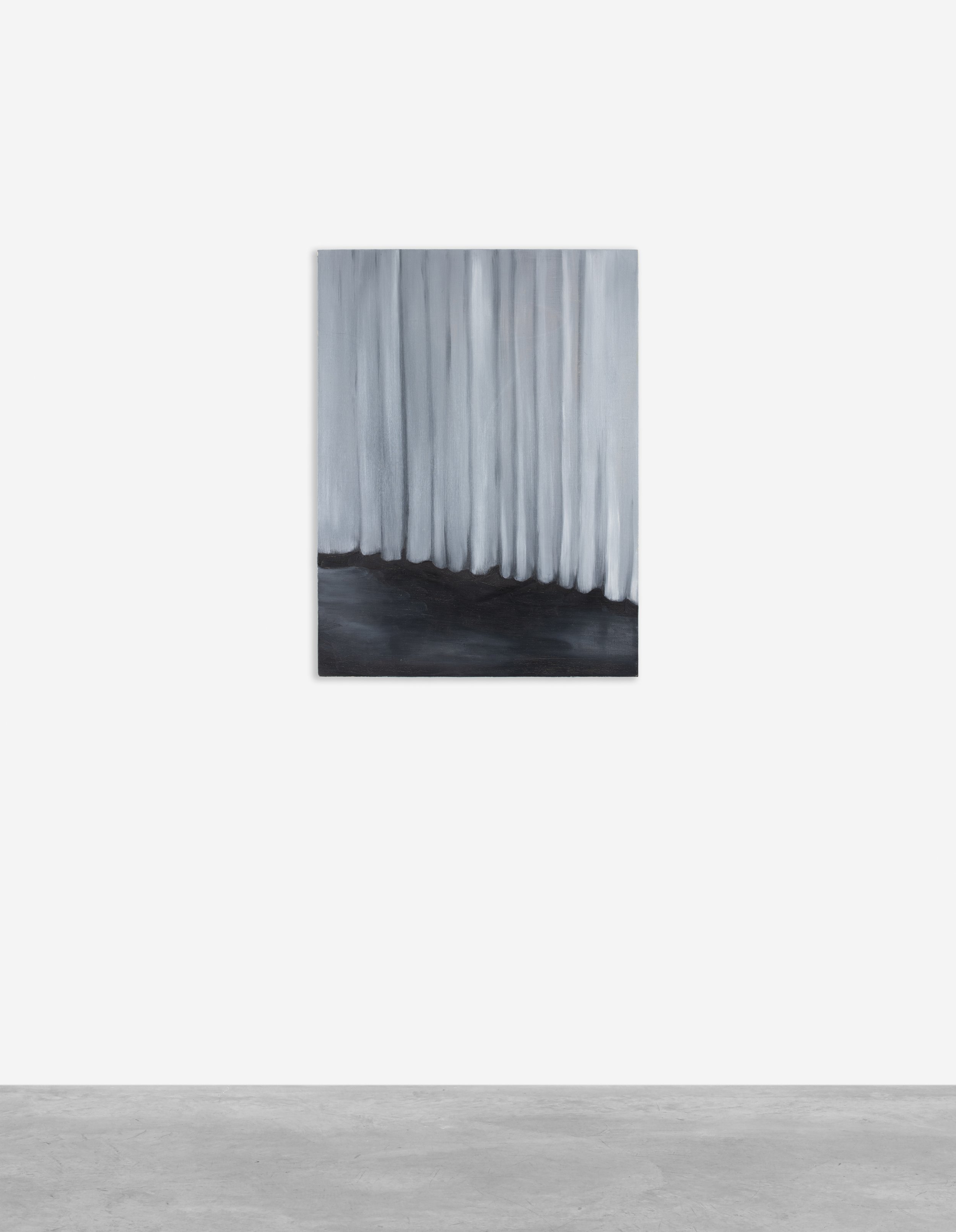
Stage (2021), oil on linen, 24 x 18 inches (61 x 45.7 cm), depicts a theater curtain rendered from a black-and-white photograph that Tan Mu took approximately ten years before she painted it. The photograph became a print, and the print became a painting, and at each stage of this translation across mediums, the image accumulated new layers of meaning that were not present in the original capture. The painting is vertical, a portrait format that emphasizes the height of the curtain and the narrowness of the stage it conceals. The curtain fills most of the canvas, its heavy folds descending from above in parallel verticals that suggest the weight and opacity of theatrical drapery. The fabric is rendered in tones of dark gray and black, with lighter passages where the folds catch an unseen light source from the left. The surface of the linen is visible beneath the thinnest passages of paint, its woven texture providing a subtle grid that underlies the composition like the threads of the curtain itself.
The curtain is closed. Nothing is visible beyond it. No actors, no set, no narrative, no resolution. The painting presents the threshold without the crossing, the moment before the performance begins or the moment after it has ended, and in this suspension the curtain becomes not a barrier that conceals something behind it but an object in its own right, a surface that demands attention rather than patience. The folds are painted with a directness that resists the illusion of fabric. At a distance, the curtain appears photographic, its tonal range and its chiaroscuro modeling producing the convincing impression of heavy velvet hanging in a dark theater. Up close, the paint reveals itself as a series of deliberate marks, each fold a single brushstroke or a small cluster of strokes, laid side by side with the precision of a printmaker who understands that every mark is a decision that cannot be unmade.
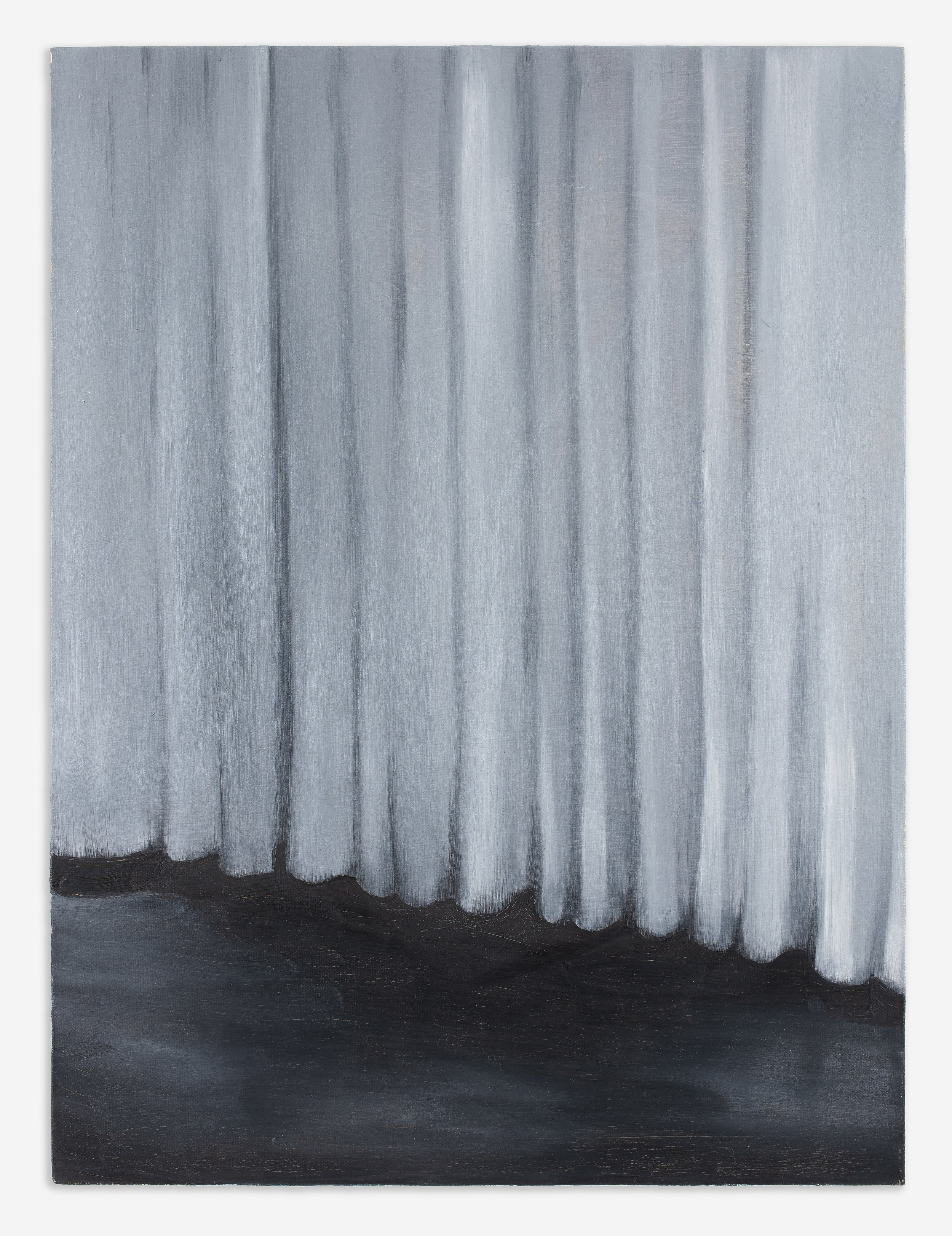
The clepsydra, the hourglass shape concealed in the folds, is the painting's most explicit gesture toward time, but it is not the only one. The medium itself is a record of time's passage. Tan Mu describes the origin of the work as a black-and-white photograph taken about ten years before the painting was made. The photograph was then transformed into a print, and the print was then translated into oil on linen. Each transformation required time. The photograph captured a moment in a fraction of a second. The print required the setup of a press, the preparation of a plate, the running of proofs, the adjustment of ink. The painting required weeks of studio work, layering oil paint over a prepared linen surface, building the curtain fold by fold, and then concealing the clepsydra in the drapery where only a viewer who knew to look would find it. The painting is not a representation of the photograph. It is a representation of the photograph that has been through two additional mediations, each of which has left its trace on the image, and each of which has required time that the photograph, in its instantaneity, did not.
The color of the painting is the color of a black-and-white photograph, translated into the warm and cool grays of oil paint. There are no reds, no blues, no saturated hues. The palette is restricted to the tonal range of silver gelatin printing paper: blacks that approach pure pigment, grays that shift from warm in the highlights to cool in the shadows, and whites that are not the white of the linen but the pale gray of a photographic highlight. This restricted palette is itself a form of time travel, a way of making the painting look like it belongs to the era of the photograph rather than the era of its making. The black-and-white photograph, which Tan Mu took ten years before she painted it, was already a document of a moment that had passed. By the time the painting was finished, the moment had passed twice: once when the shutter clicked, and once when the brush set down its final mark. The clepsydra, hidden in the folds, marks this double passage. Time flows through the curtain the way sand flows through an hourglass, invisibly, continuously, and without regard for the events that the curtain is supposed to frame.
René Magritte's La condition humaine (1935) is a painting about a painting, or more precisely, a painting about the condition of representation, and it provides the most direct structural precedent for Stage's preoccupation with the threshold between what is seen and what is concealed. In Magritte's composition, a canvas on an easel stands in front of a window, and the painting on the canvas depicts exactly the landscape that is visible through the window behind it. The edge of the painted landscape aligns with the edge of the real landscape, so that the painting appears to continue the view seamlessly, as though the representation were an extension of the thing it represents rather than a copy of it. The viewer cannot tell where the painting ends and the landscape begins. The threshold between representation and reality has been erased, or rather, it has been made visible as a threshold precisely by the act of painting over it. The painting within the painting does not conceal the landscape. It completes it. The representation is not a substitute for the real thing. It is the real thing, seen from a different angle, rendered in a different medium, occupying the same space as the landscape and claiming the same authority.
Magritte's painting, like Tan Mu's, is a closed loop. The representation faces the viewer, and behind it is the landscape, and behind the landscape is the window, and behind the window is the world. The loop is not infinite. It is bounded by the frame of the painting, the frame of the window, and the frame of the canvas on the easel. But within these frames, the representation and the thing represented are indistinguishable. The viewer is asked to accept that the painting is both a representation and a presence, both a picture of the landscape and the landscape itself, and this acceptance, this willingness to hold two contradictory truths simultaneously, is what Magritte calls the human condition. Tan Mu's Stage operates a similar loop, but with a crucial inversion. Where Magritte makes the representation continuous with the thing it represents, so that the painting disappears into the landscape, Tan Mu makes the representation conceal the thing it represents, so that the curtain is all the viewer can see. In La condition humaine, the painting on the easel reveals the landscape. In Stage, the curtain conceals the stage. Magritte's threshold is permeable: the painting and the landscape flow into each other. Tan Mu's threshold is opaque: the curtain hides what is behind it, and the clepsydra, hidden in the folds, is the only evidence that something is there.
The subject of Stage, as Tan Mu describes it, is "the performative nature of everyday life, using the curtain as a metaphor for a moment suspended between past and future, concealing the unknown beyond." The curtain is not a neutral object. It is a piece of theatrical architecture with a specific function: to separate the audience from the stage, to mark the boundary between the real world and the fictional world of the performance, and to signal, by its rising or falling, that time has been organized into a narrative with a beginning and an end. When the curtain rises, the story begins. When it falls, the story ends. The curtain is the temporal instrument of the theater, and the clepsydra, the hourglass hidden in its folds, is the temporal instrument of the painting. Together, they propose that the boundary between fiction and reality is not a philosophical abstraction but a physical object, a piece of fabric that can be raised and lowered, and that the passage of time is not a metaphysical mystery but a measurable quantity, the sand falling through the neck of a glass, the water dripping through a valve, the curtain descending at the end of a scene.
The clepsydra, from the Greek words for water and theft, is one of the oldest timekeeping devices in human history, predating the mechanical clock by millennia. The earliest known water clocks appeared in Egypt around 1500 BCE, where stone vessels with small outflow holes were used to measure the passage of hours during the night when the sun could not be observed. The Greeks refined the design, adding float mechanisms and gear trains that transferred the steady descent of water into the rotation of a dial face. By the time the theater tradition that produced the curtain was established in Athens in the fifth century BCE, the clepsydra was already an established technology for measuring time in courts, where it regulated the length of speeches, and in military encampments, where it marked the watches of the night. The relationship between the clepsydra and the theater is not metaphorical. It is architectural. Greek theaters were open-air structures built into hillsides, and their performances were timed by water clocks that ensured each playwright received an equal share of the daylight. The clepsydra was present at the birth of Western theater not as a symbol but as a technology, a device for ensuring that fiction, like everything else, occupied a measured and finite amount of time. When Tan Mu hides a clepsydra in the folds of a theater curtain, she is not adding a decorative element. She is restoring a connection that has been present since the beginning, the connection between the organization of theatrical time and the technology that made that organization possible.
Tan Mu's description of the work's genesis emphasizes the passage across mediums. "This work originated from a black-and-white photograph I took about ten years ago, also titled Stage. I later transformed that image into a print and eventually into an oil painting. Moving the image across different mediums allowed me to revisit it from multiple perspectives and uncover layers of meaning that were not immediately visible before." The movement from photograph to print to painting is not a linear progression from less mediated to more mediated. Each medium adds its own layer of mediation: the photograph captures a moment in time; the print multiplies that moment into an edition, making it reproducible; the painting transforms the reproducible image into a unique object, adding the texture of linen and the body of oil paint to what was previously a flat, tonal surface. Each transformation is also a translation across time. The photograph was taken ten years before the painting. The print was made sometime between the photograph and the painting. The painting was made over weeks or months. Each medium carries its own temporality, and the clepsydra hidden in the curtain folds is the symbol of this accumulated time, the time it took to see, to print, to paint, to conceal, to find.
Yiren Shen, writing about Tan Mu's practice in 10 Magazine in 2025, observed that "the canvases do not aim at diagnosing the modern spectacles from a distance. They conjure up a kind of vitality and depth of their own." The observation applies to Stage with particular force. The painting does not diagnose the condition of the theater or the condition of representation. It does not stand outside the curtain and point to it as a symptom of something else. It enters the curtain, occupies its folds, and finds within them a vitality that a purely diagnostic approach would miss: the vitality of the hidden clepsydra, the hourglass that is not visible but is present, marking the passage of time behind the fabric that conceals the stage. The vitality is not in what the curtain reveals. It is in what the curtain withholds, and in the way that the withholding itself becomes a form of presence, a form of depth, a form of time.
Shen's formulation also illuminates the relationship between the three mediums through which Stage has passed. The photograph, the print, and the painting are not three versions of the same image. They are three distinct encounters with the same subject, each one producing a different kind of vitality. The photograph captures the instant, the decisive moment when the curtain hangs in a specific configuration of folds, lit by a specific light source, in a specific theater, at a specific time. The print multiplies this instant, making it reproducible, distributing it across time and space, giving it the capacity to appear in multiple locations simultaneously. The painting slows the instant down, extending the moment of the photograph across the weeks or months of its making, adding layers of meaning that the photograph could not contain, and concealing within those layers the clepsydra, the mark of the time it took to make. Each medium conjures its own vitality. The photograph conjures the vitality of the moment. The print conjures the vitality of reproduction. The painting conjures the vitality of duration.
Tan Mu's own account of the theatrical curtain, drawn from her training in theatrical theory and her longstanding fascination with the boundary between fiction and reality, locates the curtain at the precise point where the audience enters a constructed world. "In theater, the curtain plays a critical role," she writes. "It is both a physical barrier separating the stage from the audience and a conceptual threshold between the real world and a fictional narrative. When the curtain rises, the audience enters a constructed reality. Although the actors are real people, the audience understands that what unfolds is a story." The curtain is the membrane through which the real passes into the fictional and the fictional passes back into the real. It is the place where time is organized into narrative, where the unstructured flow of lived experience is given a beginning, a middle, and an end. The clepsydra hidden behind it is not a decorative symbol. It is the engine of the organization. Time is what the curtain manages. Time is what the hourglass measures. Time is what the painting, with its three mediums and its ten-year span between photograph and completion, has taken and transformed and made visible by concealing.
The closed curtain in Stage is not an invitation to wait for the performance to begin. It is the performance. The folds of the fabric, the hidden clepsydra, the restricted palette that borrows its tonal range from silver gelatin paper, the linen weave that shows through the thinnest passages: these are the elements of a composition that is not about what will happen when the curtain rises but about what is happening now, in the moment of concealment, in the interval between the last performance and the next, when the theater is empty and the curtain hangs in the dark and time passes through the hourglass in the folds, silently, invisibly, without an audience, without a narrative, without a beginning or an end. The painting holds this interval open. It refuses to raise the curtain. It leaves the viewer standing in front of a surface that conceals what is behind it, and it asks the viewer to find, in that concealment, not frustration but depth, not absence but presence, not a barrier but a threshold through which time is flowing, sand through glass, water through a valve, curtain through a frame, toward a stage that the painting will never reveal because the painting is the stage.