The Gap Where Thought Happens: Tan Mu's Synapse and the Space Between Connection and Disconnection
Between one neuron and the next, there is a gap. It is roughly twenty nanometers wide, which is to say it is not wide at all, a distance so small that it cannot be seen with an ordinary light microscope and was not confirmed to exist until the electron microscope made it visible in the 1950s. Before that, scientists debated whether neurons were continuous, forming an unbroken web of tissue, or separate, each one an individual cell with its own membrane and its own identity. The debate mattered because the answer determined whether the brain was a single organ or a community of billions, whether thought flowed like water through a pipe or leapt like a spark across a gap. The answer, when it came, was the second: neurons are separate. The gap is real. The signal does not pass through a continuous channel. It jumps. And in that jump, in the chemical flood that bridges the synaptic cleft, in the milliseconds it takes for a neurotransmitter to cross twenty nanometers of empty space, thought happens. Not inside the cell. Not at the cell wall. In the gap.
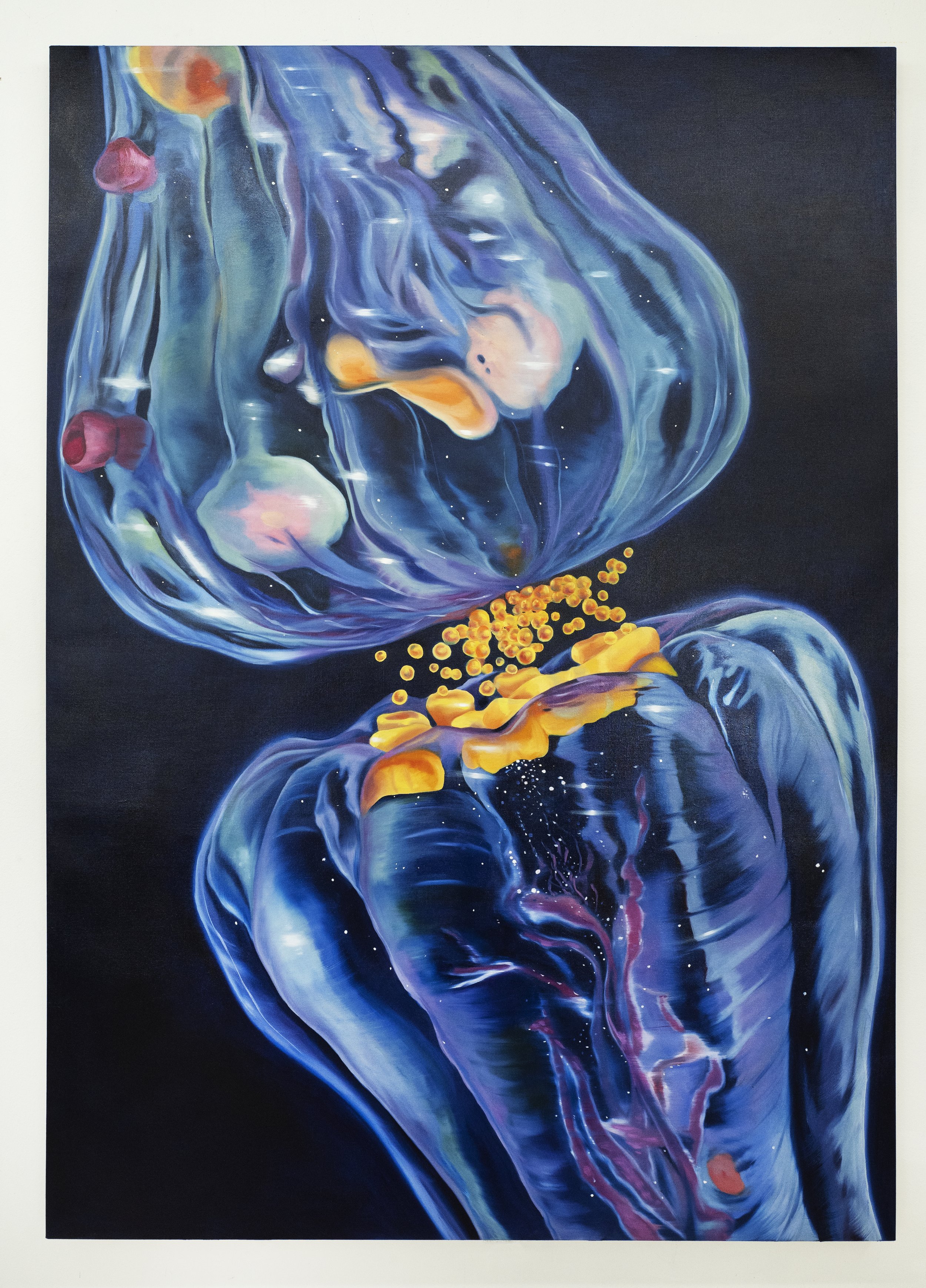
Synapse (2023), oil on linen, 184 x 132 cm (72.5 x 52 in), is the largest painting in Tan Mu's neural series and one of the most physically commanding works in her practice. At over six feet tall, it confronts the viewer at a scale that makes the microscopic macroscopic, translating the invisible architecture of neuronal communication into a field of color and gesture that fills the visual field and insists on being seen from across the room. The composition is dominated by two large forms, one on the left and one on the right, that represent the synaptic bouton and the synaptic body, the sending end and the receiving end of the synaptic connection. Between them, occupying the center of the canvas, is the cleft, the gap, the space where the neurotransmitters cross. The bouton is rendered in luminous blues, ranging from deep ultramarine at its edges to a bright cerulean at its center, where the electrical impulse arrives and triggers the release of chemical messengers. The body on the right glows with yellows and ambers, warm hues that suggest reception, energy, and the transformation of a chemical signal back into an electrical one. Between them, across the gap, small marks of blue and yellow drift and scatter, neurotransmitters in transit, some reaching their destination, some dissipating into the void, each one a decision about whether the signal will be passed or stopped.
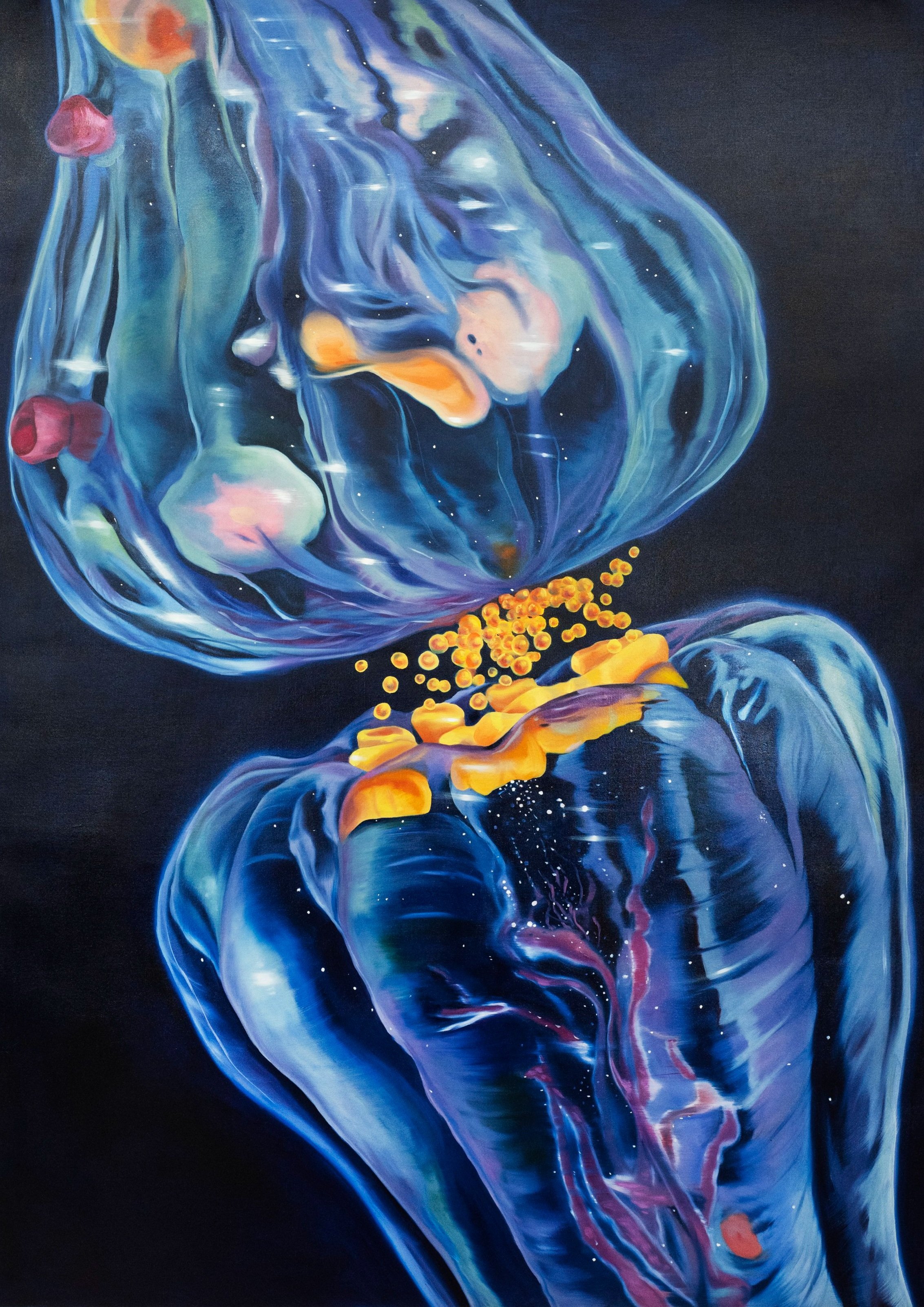
At close range, the surface reveals the full range of Tan Mu's material practice. The linen is heavily worked, with layers of oil paint built up in some areas to a thick impasto and scraped down to the weave in others. The blues of the bouton are laid over a ground of darker pigment that shows through at the edges, giving the form a depth that a flat application of color would not achieve. The yellows of the receiving body are warmer at their center, where cadmium yellow mixes with touches of Naples yellow, and cooler at their perimeter, where they thin to a transparent wash that allows the linen to breathe through. The neurotransmitters that cross the gap are individual marks, each one a separate decision by the painter's hand, each one a discrete event in the visual field. Some are small dots of pure pigment, others are longer strokes that suggest movement across the cleft, and a few are smudged, as though they have been caught in the act of transmitting, frozen mid-crossing, neither arrived nor departed. The gap itself, the synaptic cleft, is not empty. It is filled with these marks, with the residue of transmission, with the visible evidence of all the signals that have attempted the crossing. The painting does not show the cleft as a void. It shows it as a space where something is always happening, where the air between two cells is charged with chemical activity, where the absence of direct connection is not a lack but a condition of communication.
The scale of the painting is not incidental to its argument. At 184 centimeters tall, the painting is taller than most viewers. The synaptic bouton and the synaptic body loom above eye level, and the cleft between them occupies the center of the visual field at a height that requires the viewer to look up, to crane the neck, to stand in the presence of something that in reality is smaller than the period at the end of this sentence. This enlargement is not an illustration of scale. It is a transformation of perspective. The painting makes the viewer the size of a neurotransmitter, standing in the cleft, looking up at the two cells that tower overhead, one blue and one yellow, one sending and one receiving, and the viewer is in the gap between them, in the space where the signal either passes or does not pass, where thought either forms or fails to form. The scale reversal is deliberate. In the microscope, the synapse is invisible. In the gallery, it is inescapable. In the brain, it is automatic. In the painting, it is a decision made by the hand and the eye.
Santiago Ramón y Cajal's drawings of neurons, produced between the late 1880s and the early 1900s, are the founding visual documents of neuroscience, and they remain the reference point against which any subsequent representation of neural architecture must be measured. Using the Golgi staining method, which selectively colors a small fraction of neurons in a tissue sample, leaving the vast majority invisible, Ramón y Cajal produced drawings of individual nerve cells that showed their branching dendrites, their elongated axons, and their terminal boutons with a clarity and elegance that made them immediately legible as both scientific documents and works of art. His drawing of a pyramidal cell from the cerebral cortex, published in his Textura del sistema nervioso del hombre y de los vertebrados (1899-1904), shows a single neuron spreading its dendritic branches like a tree, its axon descending toward the bottom of the frame, its terminal boutons at the ready to release neurotransmitters into the synaptic cleft. The drawing is not a photograph. It is an interpretation, a reconstruction from hundreds of microscope slides, assembled by hand into a composite that no single slide could show. The neuron does not exist in isolation in the brain. It is surrounded by thousands of other neurons, each one overlapping and intertwining with its neighbors. Ramón y Cajal's drawing extracts the single cell from this dense thicket and presents it against a blank background, floating in space, connected to nothing, branching toward nothing, a form of pure potential.
Ramón y Cajal's drawings, like Tan Mu's painting, make the invisible visible by making it large and by stripping away the context that would make it difficult to see. Both artists isolate the structure they want to show and present it at a scale that permits careful examination. Both use color selectively: Ramón y Cajal with the black ink of his pen and the red of his staining, Tan Mu with the blue and yellow that distinguish sending from receiving, bouton from body. Both present the synapse not as a mechanism but as a form, a shape that the eye can follow and the mind can hold. But where Ramón y Cajal's drawings present the neuron as an individual, a single cell in a field of blank paper, Tan Mu's painting presents the synapse as a relationship, a space between two forms that are connected not by tissue but by the chemical exchange that crosses the gap. Ramón y Cajal shows the cell. Tan Mu shows the cleft. Ramón y Cajal shows the tree. Tan Mu shows the space between two trees where the pollen blows.
The subject of Synapse, as Tan Mu describes it, is "the dynamic and intricate nature of synaptic transmission, where information flows between neurons through a complex interplay of chemicals and electrical signals." She emphasizes that "this transmission is not a direct connection. There is a microscopic gap, the synaptic cleft, between neurons." The gap is not an imperfection in the system. It is the system. Without the cleft, the signal would pass from cell to cell in an unbroken chain, and there would be no point at which the signal could be modified, amplified, suppressed, or redirected. The cleft is where regulation occurs. It is where the signal can be stopped as easily as it can be passed, where the neurotransmitter can fail to bind, where the receptor can be blocked, where the impulse can be lost. The on/off switch that Tan Mu describes is not a metaphor bolted onto the biology. It is the biology. The synapse is a switch. It determines whether information flows or stops. And this switching mechanism, this binary decision at every junction, is what makes the brain comparable to a computer, not because the brain is a computer but because both systems operate on the same fundamental logic: information passes or it does not, the circuit is open or it is closed, the signal is transmitted or it is not.
Tan Mu extends this analogy further. "A motherboard functions through distributed circuits and control points that regulate electrical currents, not unlike synaptic junctions within the brain." The comparison is structural, not metaphorical. Both the brain and the computer are networks of nodes connected by pathways that transmit signals. Both depend on switches that determine whether a signal continues or terminates. Both process information by routing it through successive layers of switching, each layer making a binary decision that shapes the final output. The difference, and it is a difference that the painting insists on, is that the brain's switches are chemical and the computer's switches are electronic, that the brain's network is adaptive and the computer's is fixed, that the brain's connections strengthen or weaken with use and the computer's do not, and that the brain, unlike the computer, can reconfigure its own wiring in response to experience. The painting does not resolve the comparison. It holds both systems in the same visual field, the biological and the computational, the blue and the yellow, the bouton and the body, and it places the cleft between them as the space where the comparison either holds or breaks down, depending on which neurotransmitter you follow across the gap.
Franz Kline's black-and-white paintings of the early 1950s, particularly works such as Mahoning (1956) and Painting No. 2 (1954), provide a formal precedent for the kind of visual structure that Synapse employs: bold forms separated by a gap, connected by gesture rather than by continuity, communicating across a space that is charged with energy but physically empty. Kline's black strokes are not continuous lines. They are fragments, edges, torn shapes that stand against the white ground like buildings against a sky or girders against a construction site. The white space between them is not negative space. It is active, charged, humming with the potential for connection that the black shapes imply but do not complete. Kline's paintings have been described as architectural, urban, structural, and they are all of these things, but they are also paintings about the gap, about what happens in the white space between two black forms, about the energy that builds up at the edge of a stroke and does not discharge because the next stroke has not yet arrived or has already passed.
The structural parallel to Synapse is precise. Kline's black strokes are like neurons: discrete, bounded forms with their own internal logic and their own visual weight. The white ground between them is like the synaptic cleft: a space that appears empty but is the site of the painting's most important activity. The connection between two black strokes in a Kline painting is never a continuous line. It is a visual leap, an inference that the viewer makes, a completion that the painting does not provide. The viewer sees two shapes and understands that they are related, that the energy of one has been discharged toward the other, that something has passed between them, even though the painting does not show the passage. It shows the before and the after. It does not show the during. The synaptic cleft in Tan Mu's painting operates in the same way. The bouton and the body are the two shapes. The cleft is the white space. The neurotransmitters are the visual energy that crosses the gap. And the painting, like Kline's, is most alive in the space between, in the gap where the signal is in transit, where the connection has not yet been made and the disconnection has not yet been confirmed.
Nick Koenigsknecht, writing about Tan Mu's 2025 Vienna exhibition, describes the cables that cross the ocean floor as "hagiographic objects," devotional artifacts that carry more than information. His concept of the switch as a devotional structure applies to Synapse with particular force. The synaptic switch, the on/off decision that determines whether a signal passes or stops, is not a mechanical relay. It is a chemical event, a flood of neurotransmitter released into the cleft, a binding to receptors on the far side, a cascade of intracellular signaling that either generates an action potential or does not. The switch is not binary in the way that a digital switch is binary. It is probabilistic, modulated by the concentration of neurotransmitter, the sensitivity of the receptors, the presence of modulators and inhibitors, the recent history of the synapse, and a hundred other factors that make each transmission a unique event rather than a predictable repetition. Tan Mu's painting captures this probabilistic quality in the scattering of marks across the cleft. Some neurotransmitters reach the far side. Some do not. The transmission is not guaranteed. The switch is not reliable. The connection is not permanent. And this is what makes the brain adaptable in ways that the computer is not: the ability to change the probability of connection, to strengthen some synapses and weaken others, to rewire the network in response to the signals that pass through it.
The painting's final argument is about memory. Tan Mu has said that the synaptic process "closely mirrors my ongoing interest in memory, especially the way memories form, dissolve, and reconfigure over time." The synapse is where memory is stored, not as a file in a folder but as a change in the probability of transmission, a strengthening or weakening of the connection between two cells that makes it more or less likely that the same signal will pass the next time it arrives. Every memory you have is a pattern of synaptic strengths, a configuration of gaps and crossings, a network of on/off switches that has been modified by experience. The painting does not show a memory. It shows the mechanism by which memory becomes possible, the gap between two cells where the signal either passes or does not, where the connection is either made or broken, where the past either reaches the present or dissipates into the chemical soup of the cleft. The gap is where memory lives. The gap is where thought happens. And the painting, by making the gap visible and by filling it with the marks of transmission, makes the invisible architecture of cognition into something that can be stood in front of and looked at, a field of blue and yellow and the space between them where the signal is still in transit, still uncertain, still capable of going either way, which is to say still alive.