The View From the Summit: Tan Mu's Horizons 05 and the Night the Stars Looked Back
She was at four thousand meters. The air was thin enough that every breath required effort, and the cold was the kind that reaches the bones through whatever layers you have wrapped around yourself. Mauna Kea, on the Big Island of Hawaii, rises 4,207 meters above sea level, and at its summit, above the inversion layer that traps the clouds below, the atmosphere is so thin and so dry that the stars do not twinkle. They hold steady, pinpoints of light in a sky so dark that the Milky Way resolves from a haze into a structure, a river of light that stretches from one horizon to the other, dense with stars in its center and thin at its edges where the spiral arms dissolve into the interstellar void. Tan Mu took a photograph here in 2019, standing near the observatory, and that photograph became the source for Horizons 05 (2024), oil on linen, 46 x 61 cm (18 x 24 in). Unlike the other works in the Horizons series, which adopt a satellite or orbital perspective looking down at Earth from above, this painting looks up. It reverses the direction of the series. Where the other Horizons paintings observe the planet from space, this one observes the cosmos from the planet, and in that reversal, it finds something that the downward view cannot provide: the experience of being small beneath an immensity that does not acknowledge your existence.
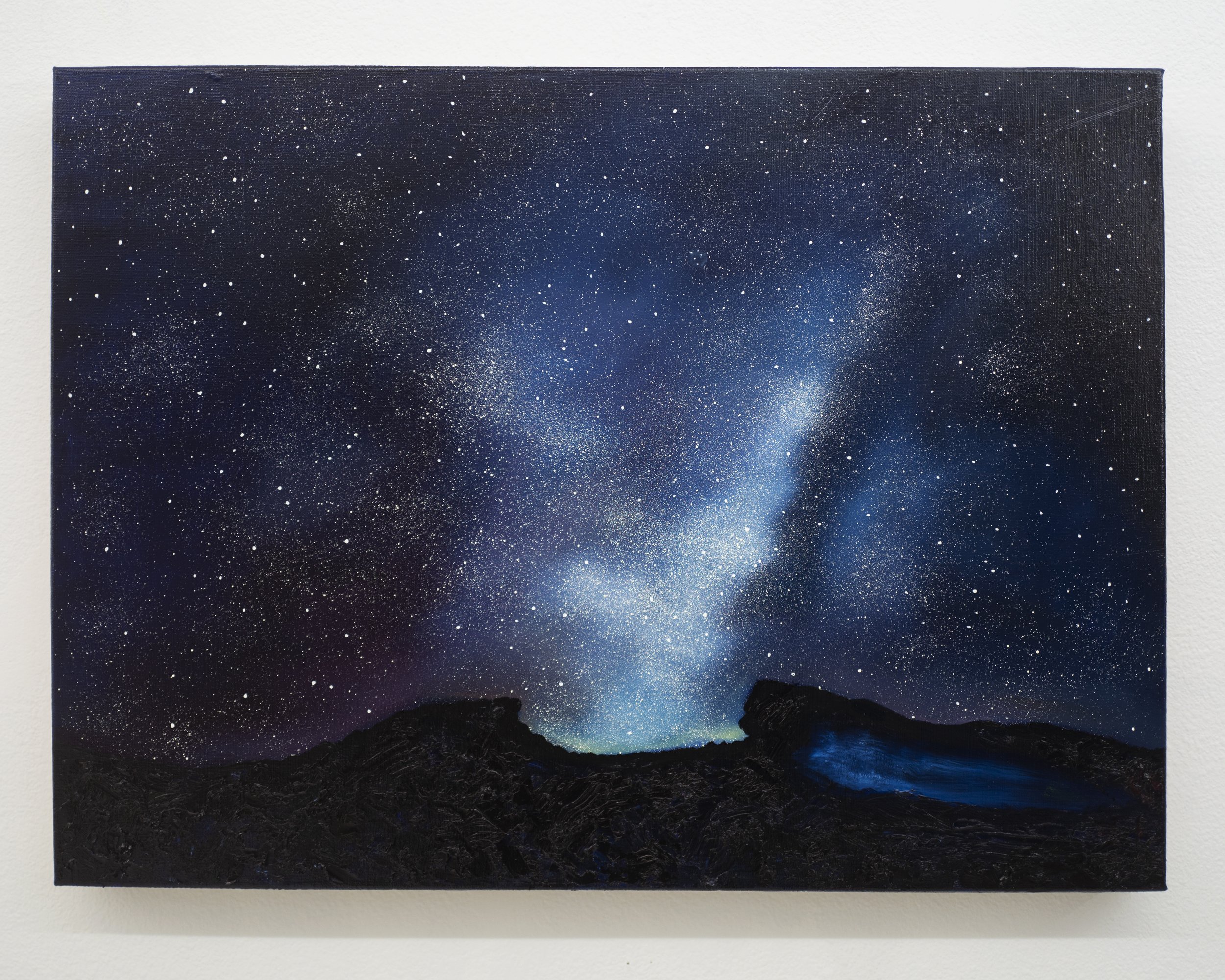
The painting depicts the night sky as seen from the summit of Mauna Kea, with the Milky Way arching across the upper two-thirds of the composition in a dense band of pale blue-white light that resolves, at close range, into thousands of individual stars rendered as small points and clusters of pigment. The lower third of the canvas is occupied by the dark silhouette of the volcanic landscape, a shape so black that it reads as an absence, a void where the stars are not, a line of demarcation between the earth and the sky that is as sharp as a knife edge. The horizon is visible only as the boundary between these two registers: the luminous chaos of the galaxy above and the absolute darkness of the mountain below. There are no city lights in this painting, no glowing atmosphere, no evidence of human habitation except the observatory structures that are implied by the title and the location but are not depicted. The painting is the sky and the mountain and nothing else, and the silence it evokes is the silence of a place where the only sound is the wind and the only light is the light that has traveled for millions of years to reach the retina at this particular moment on this particular night.
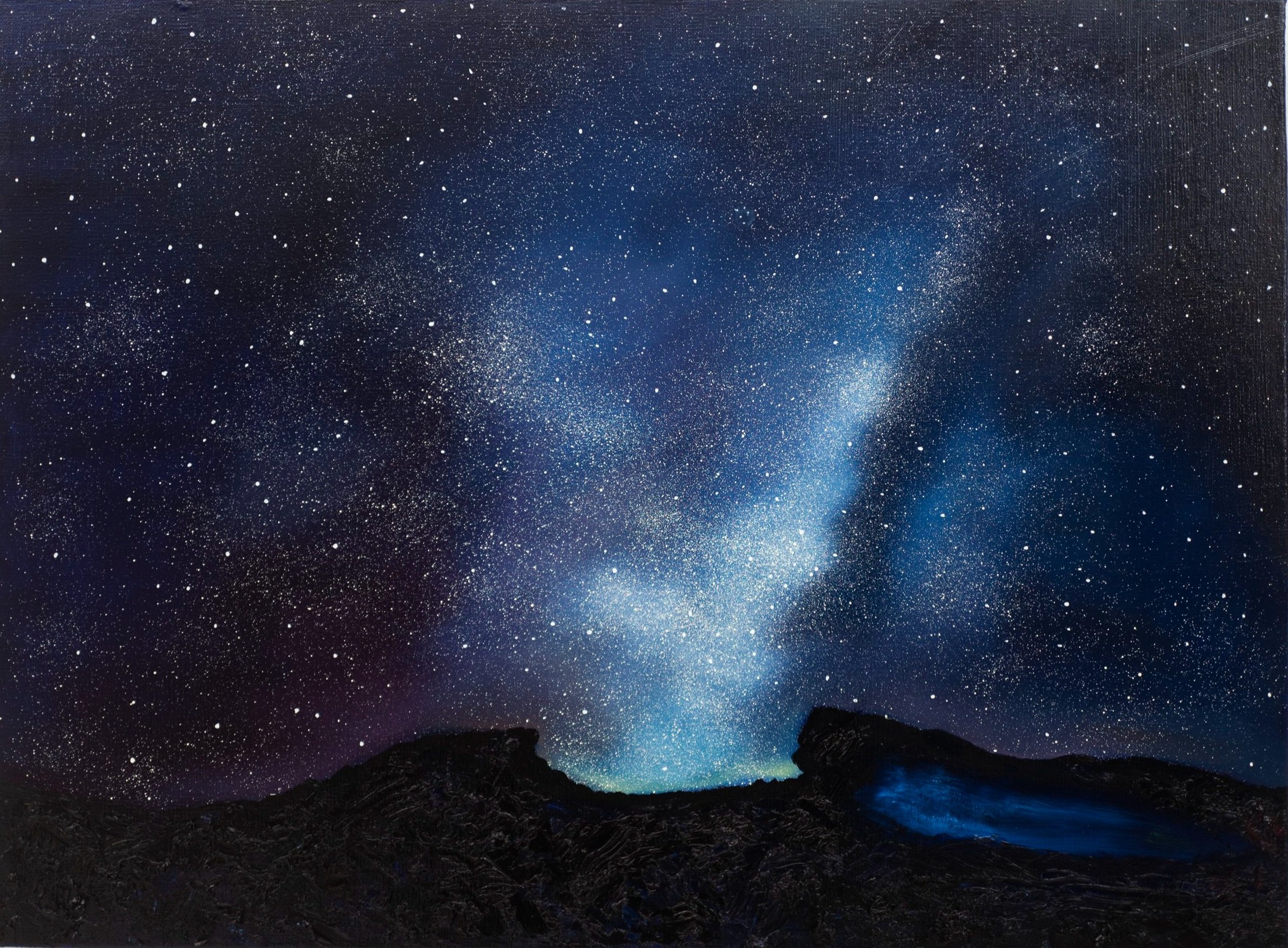
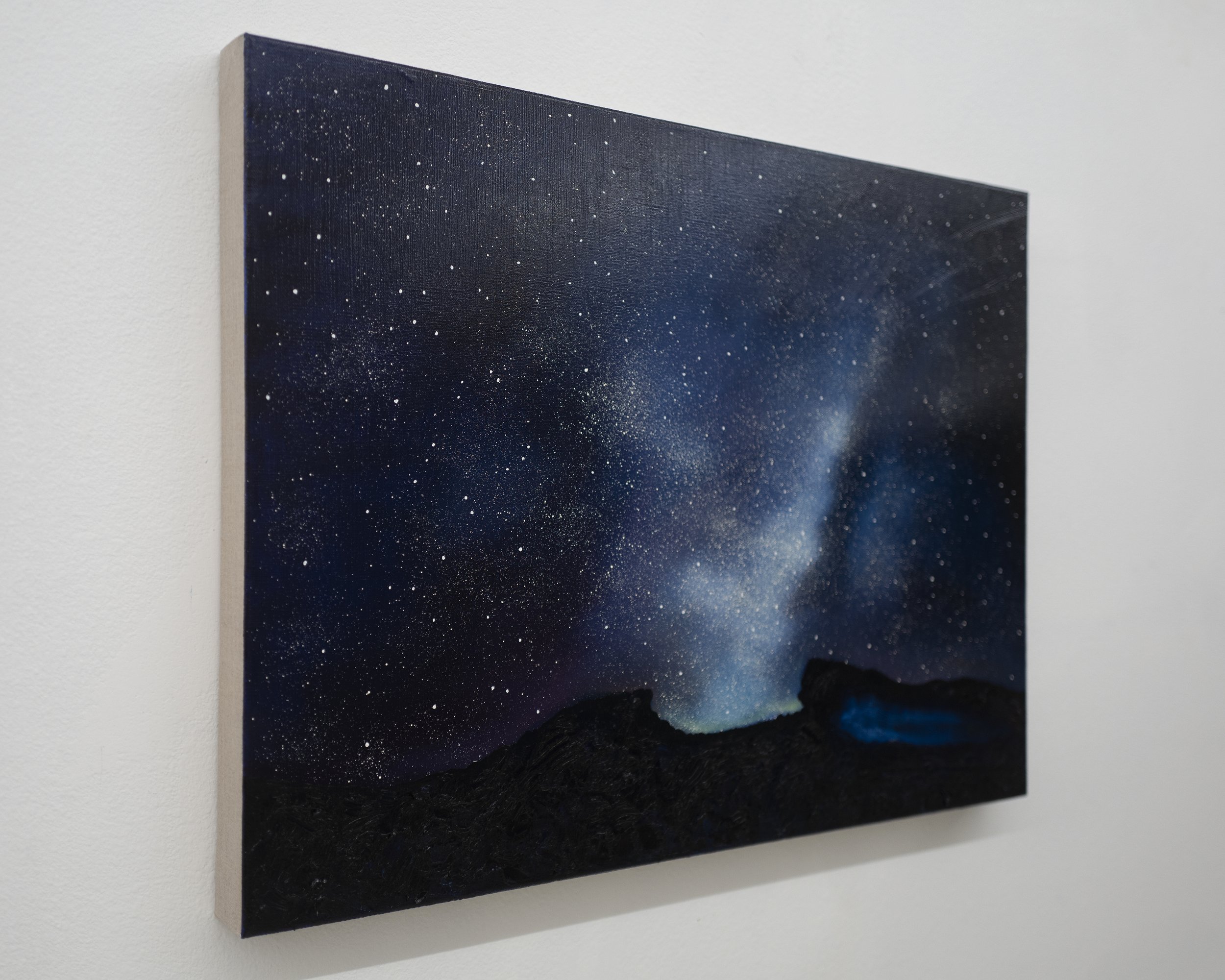
At the scale of the painting, 46 by 61 centimeters, the Milky Way is a dense river of marks that runs diagonally across the canvas from the upper left to the lower right, its center brightest where the galactic core is concentrated and its edges thinning into the darkness of deep space. Tan Mu has rendered the stars not as uniform points of light but as individual marks of varying size, brightness, and color. Some are warm, a pale gold that suggests the red giants and aging stars that populate the galactic center. Others are cool, a blue-white that suggests the young hot stars in the spiral arms. A few are large enough to register as distinct brush marks, single touches of a round brush loaded with pigment and placed on the linen with the precision of a pointillist who knows that each mark represents a sun. The majority are smaller, barely visible at arm's length, and they accumulate into the luminous band that the eye reads as the Milky Way only when it steps back far enough to see the pattern emerge from the noise. The linen shows through in the darkest passages, its warm brown weave providing the blackest areas of the sky with a depth that pure pigment on a white ground could not achieve, a darkness that is not the absence of paint but the presence of a support that has been allowed to breathe through the thinnest washes of ultramarine and mars black.
The mountain silhouette at the bottom of the canvas is rendered as a single, unbroken shape that extends from the left edge to the right, rising in a gentle curve that suggests the volcanic cone of Mauna Kea without depicting it. There are no details on the mountain. No buildings, no telescopes, no roads, no snow. It is the shape of the horizon as seen from the summit at night, when everything below the sky line is invisible and the mountain is known only by its outline against the stars. The paint here is at its thinnest, a wash of near-black over the linen that allows the weave to show through, giving the mountain a texture that is distinct from the smooth, star-filled sky above it. The mountain is not painted. It is withheld. The paint that covers the sky is dense and layered, built up over many passes, but the mountain is a single transparent coat, and the difference in paint handling between the two registers is the difference between the fullness of the cosmos and the emptiness of the ground, between the abundance of light and the absence of it, between a sky that gives and a mountain that takes away.
Peder Balke's paintings of the northern sky, produced in the 1860s and 1870s, are among the most sustained encounters with the night as a subject in nineteenth-century European painting, and they provide a direct precedent for Horizons 05's confrontation with the cosmos from the surface of the earth. Balke, a Norwegian painter who traveled to the far north of Scandinavia in the 1830s and spent the rest of his career revisiting the landscapes he had seen there, produced a series of small paintings of the aurora borealis, the midnight sun, and the star-filled night sky over the Arctic that are remarkable for their scale, their simplicity, and their willingness to let the sky dominate the canvas. In Northern Lights (c. 1870s, National Museum, Oslo), the sky occupies three-quarters of the composition. The aurora arcs across the upper register in a band of pale green and blue, and the landscape below is a dark mass of mountain and sea that provides a ground for the sky but does not compete with it. The painting is small, approximately 28 by 37 centimeters, and its intimacy intensifies the contrast between the immensity of the sky and the modesty of the format. Balke does not attempt to paint the aurora as it actually appears, with its shifting curtains of light and its unpredictable movements. He paints it as a structure, a band of luminous color that crosses the sky from one side to the other, a river of light that has the same formal logic as the Milky Way in Tan Mu's painting: a dense center that thins at the edges, a band of luminosity that is distinct from the surrounding darkness, a visible structure in a sky that is otherwise formless.
Balke's northern sky paintings, like Tan Mu's, are paintings of a view from a specific place at a specific time, made by an artist who has stood at the edge of the world and looked up. The experience of standing at Mauna Kea at four thousand meters, or at North Cape at seventy-one degrees north, is not an abstract encounter with the cosmos. It is a physical experience of altitude, cold, and thin air that makes the body aware of its own limitations while the eye takes in a spectacle that exceeds the body's capacity to comprehend it. Balke's paintings convey this physical experience through their format. The small size of the canvas forces the viewer to approach closely, to stand in front of the painting at arm's length, the same distance at which one might stand at the edge of a precipice, looking out. The landscape at the bottom provides the ground, the place where the viewer stands, and the sky above is what the viewer sees when they look up. Tan Mu's Horizons 05 operates in the same register. The mountain silhouette at the bottom is the place where the viewer stands. The Milky Way above is what the viewer sees. The painting does not offer an orbital view. It offers a view from the ground, and the ground is as essential to the composition as the sky. Without the mountain, the sky would have no scale, no horizon, no point of reference. Without the sky, the mountain would be a shapeless mass in total darkness, indistinguishable from the void. The painting holds both registers in tension, and the tension between them, the luminous and the dark, the cosmic and the terrestrial, the infinite and the finite, is the experience it offers.
The subject of Horizons 05, as Tan Mu describes it, is a view from Earth's surface rather than from space, a reversal of the perspective that governs the rest of the Horizons series. Where the other works in the series adopt a satellite or orbital point of view, looking down at the planet from above, this painting looks up from the planet toward the stars. The inspiration was a personal experience at Mauna Kea Observatory in 2019, where, at an altitude of approximately four thousand meters, she observed the Milky Way with a clarity that she describes as transformative. "It was freezing, but the experience was unforgettable. With no light pollution, the night sky was ablaze with stars, and the Milky Way stretched across the heavens in breathtaking clarity. I was utterly speechless, feeling as though my world had changed at that moment." The painting is based on a photograph she took near the observatory, and the source image, a photograph taken in extreme conditions at the summit of a volcano, carries the memory of that physical experience: the cold, the altitude, the thin air, the silence, and the overwhelming spectacle of the galaxy seen from one of the best observation points on the planet's surface.
The Mauna Kea Observatory complex is not incidental to the painting's argument. It is the technological apparatus that makes the view possible, not because the telescopes are depicted in the painting but because the summit of Mauna Kea, with its exceptional atmospheric conditions, is itself a product of the same technological civilization that launches the satellites whose downward view the other Horizons paintings adopt. The observatory and the satellite are two instruments of the same impulse: the desire to see beyond the horizon, to extend human vision beyond the limits of the body, to observe the cosmos from a vantage point that the unaided eye cannot reach. The telescope looks up. The satellite looks down. Both are technologies of the panoramic gaze, and both are enabled by the same infrastructure of science, engineering, and institutional support that makes it possible to place a person at four thousand meters with a camera or a telescope at five hundred kilometers with a sensor. Horizons 05 does not depict the telescope. It depicts what the telescope sees, and what the naked eye sees when it is placed at a point where the atmosphere is thin enough and the light pollution is low enough that the Milky Way resolves into a structure rather than a haze. The telescope and the satellite are not in the painting. They are the conditions of the painting's possibility.
Danni Shen, writing about Tan Mu's practice in Emergent Magazine in 2024, observed that the works "serve as a kind of witness to human socio-technological histories," reflecting "the trajectory and continuum of bodily and mediated presence through human technical developments." The formulation is precise. The paintings do not simply depict technological objects. They witness the histories that produced those objects and the conditions that made them possible. Horizons 05 witnesses the history of astronomical observation, from the earliest star maps drawn by navigators to the photographic plates of the nineteenth century to the digital sensors of the twentieth and twenty-first, and it places this history within the continuum of bodily presence: the body standing at the summit, the body that is cold, the body that is breathing hard, the body that is speechless before the galaxy. The technology extends the vision, but the body is still there, still experiencing the cold and the altitude and the silence, still producing the experience that the painting records. The mediated presence, the presence made possible by the road that leads to the summit and the telescope that sits at the top, does not replace the bodily presence. It enables it. The body reaches the summit because the technology has built the road. The eye sees the galaxy because the technology has eliminated the light pollution. The painting records the experience because the hand has been trained to translate what the eye sees into what the brush can hold.
Tan Mu's own account of the series' origin situates the panoramic gaze within a longer history of technological extension. "The idea of the panoramic gaze developed from my long-term interest in how technological vision transforms human understanding. It began with Peek, where I reinterpreted the first photograph of Earth taken from space in 1946. That image marked the first moment humanity saw its planet from beyond its surface, suspended against the darkness of space." The first photograph of Earth from space, taken by a V-2 rocket launched from White Sands, New Mexico on October 24, 1946, showed the planet as a curved line against a field of black, the horizon visible for the first time as an arc rather than a straight edge. This photograph, grainy and small and barely legible, was the beginning of the panoramic gaze, the moment when the species that had always looked up at the stars from the surface of its planet saw its own planet from the stars' perspective, and Horizons 05 is the reversal of that moment. It is the stars looking back. It is the view from the planet at the moment when the planet has just learned to see itself from outside, and it reminds the viewer that the perspective from outside, the satellite view, the orbital gaze, is not the only way to see the cosmos. There is also the view from the summit, from the cold and the dark, from the place where the atmosphere ends and the stars begin, and this view, which is as old as the species itself, is not diminished by the fact that we now have instruments that can see further. It is enriched. The telescope and the satellite do not replace the eye. They remind the eye of what it is capable of seeing when the conditions are right.
What remains after the Milky Way has been painted and the mountain has been withheld is not a landscape and not a star chart but a threshold. The horizon line in Horizons 05 is the line where two immensities meet: the immensity of the cosmos above and the immensity of the mountain below. The viewer stands at this line, neither in the sky nor in the earth but at the boundary between them, looking up at a structure that took billions of years to form and will take billions more to dissolve, and looking down at a mountain that is older than any human structure and will outlast every observatory built on its summit. The painting holds this threshold open. It does not resolve the view into a single perspective. It offers the view from below and leaves the view from above to the other works in the series, and in doing so it completes the series' argument: that the panoramic gaze is not a single perspective but a capacity, the capacity to see from wherever you are standing, whether that is on the surface of the planet looking up or in orbit around it looking down, and that the view from the summit, the view from the place where the stars hold steady and the Milky Way resolves into a structure, is as much a technological achievement as the view from the satellite, because the road that leads to the summit and the observatory that crowns it are the same infrastructure of human ingenuity that launches the rockets and places the cameras that photograph the planet from space. The stars did not look back at Tan Mu on Mauna Kea. The stars do not have eyes. But the painting, by reversing the direction of the series and looking outward instead of downward, gives the stars the courtesy of being seen from the place where they are most visible, and it gives the viewer the experience of standing at the threshold between the earth and the sky and understanding, for the length of time it takes to look at the painting, that this threshold is where all observation begins, whether the instrument that extends it is a telescope on a mountain or a camera in orbit, and that the view from the summit is the view that makes all other views possible.