The Silence That Followed the Explosion: Tan Mu's Eruption and the Cable That Connected the World
On January 15, 2022, at 5:14 pm local time, the Hunga Tonga-Hunga Ha'apai submarine volcano in the South Pacific produced the most powerful eruption of the twenty-first century. The explosion was heard in Alaska, six thousand miles away. The shockwave circled the Earth multiple times. The ash plume reached thirty-six kilometers into the stratosphere. The tsunami it generated crossed the Pacific and caused damage as far as Japan and the Americas. And then, within hours, the undersea cables that connected Tonga to the rest of the world went silent. No phone calls. No internet. No way for the islands to tell the outside world what had happened, and no way for the outside world to find out. For nearly a month, Tonga existed in informational darkness, visible only by satellite, its condition unknown to everyone beyond its shores. The eruption was a geological event. The silence was an infrastructural one. The volcano did not merely destroy buildings and flood coastlines. It severed the cables that carried 99 percent of international data traffic, the thin fibers that ran along the ocean floor between Fiji and Tonga, and in doing so it revealed, in the most violent way possible, how fragile the global communication network actually is.
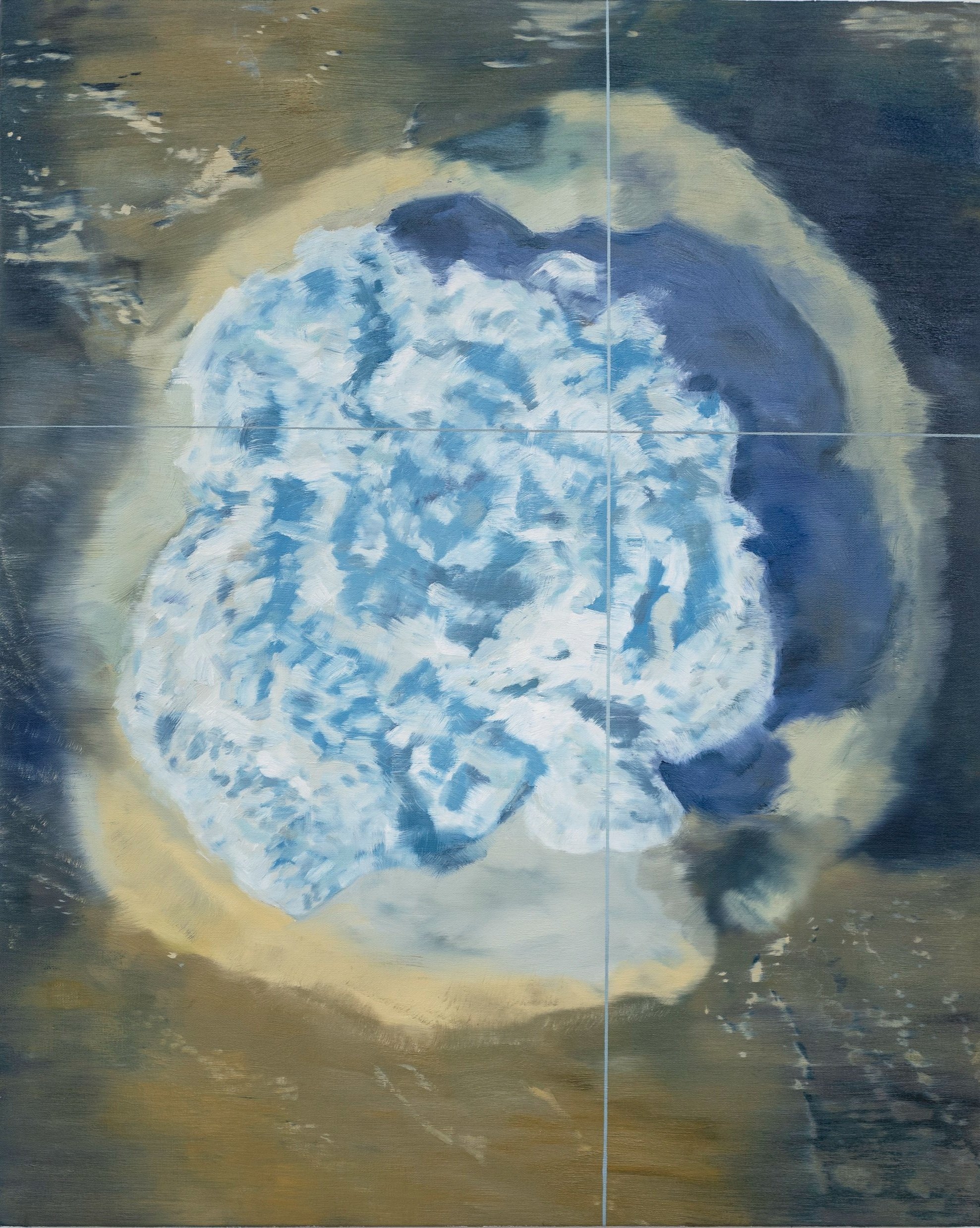
Eruption (2022), oil on linen, 76 x 61 cm (30 x 24 in), is Tan Mu's painting of this event, and it is also the beginning of her sustained engagement with undersea cables as a subject. The composition is dominated by a mushroom cloud that rises from the lower center of the canvas, expanding upward and outward in a shape that is at once volcanic and nuclear, a plume of ash and steam that billows against a dark sky in tones of gray, white, and pale ochre. The cloud is rendered with the atmospheric turbulence that a volcanic eruption produces: the edges are not clean but feathered, dissolving into the surrounding atmosphere, the inner core denser and more opaque than the outer envelope. Over this cloud, two intersecting lines form a cross that spans the full height and width of the canvas, dividing the composition into four quadrants. The vertical line runs from top to bottom through the center of the cloud, and the horizontal line crosses it at approximately the midpoint, creating a cross shape that reads simultaneously as a meteorological marker, a satellite grid reference, and a point of alignment between natural force and human measurement.
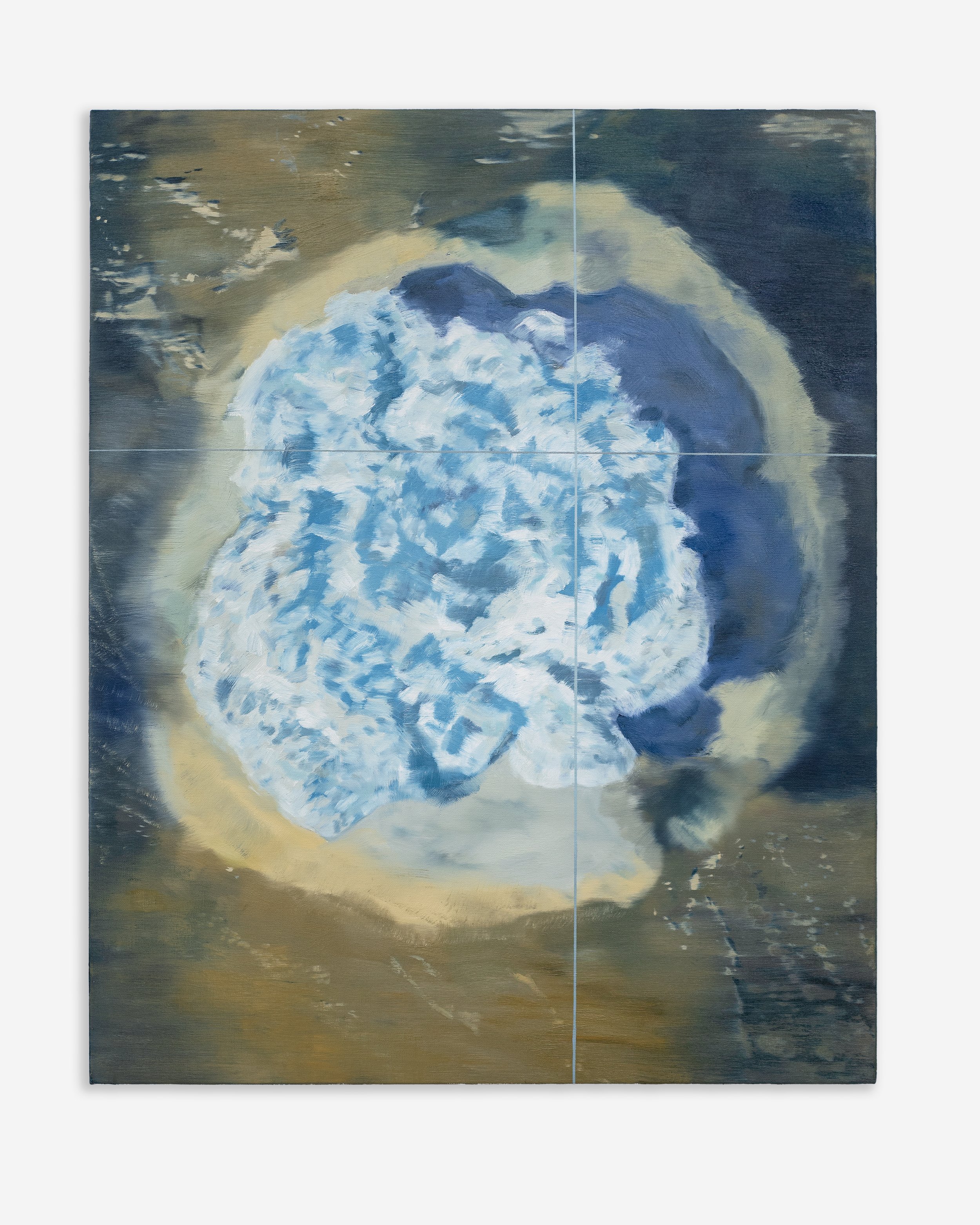
The cross is painted in a thin, precise line that contrasts with the atmospheric rendering of the cloud. It is not blurred or diffused. It is sharp, mechanical, the kind of line that a computer would draw, not the kind that a volcano would produce. This contrast between the organic turbulence of the eruption and the geometric precision of the overlay is the painting's central formal tension. The cloud is nature: chaotic, expanding, dissolving at its edges, following the physics of heat and pressure and atmospheric drag. The cross is technology: measured, aligned, imposed on the scene from above, the product of a satellite or a meteorological station that has observed the eruption and placed a marker on it, reducing the event to a set of coordinates on a grid. The painting does not choose between these two registers. It holds them both simultaneously, the natural and the technological, the event and its measurement, the explosion and the system that recorded it, and in holding them both it asks the viewer to see the eruption not as a pure natural phenomenon but as an event that was already mediated by technology before it was even finished happening, already seen from above before the ash had settled, already being measured and mapped and analyzed before the islands had finished shaking.
The palette is dominated by grays, whites, and blacks, with the pale ochre of the volcanic ash providing the only warm tone in the composition. The sky above the cloud is a deep, near-black gray that suggests the atmospheric dimming caused by the ash plume, the kind of sky that witnesses to major eruptions have described as an artificial twilight, a darkness that falls in the middle of the day. The ocean below is rendered in darker tones, slate gray and blue-black, with the surface disturbed by the shockwaves that radiate outward from the eruption site in concentric rings that are visible only from above. The linen shows through in the thinnest passages, its warm brown weave providing a ground note that anchors the composition and prevents the grays from becoming monotonous. The paint handling varies between the cloud and the cross: the cloud is built up in layers of impasto and glaze, with the thickest paint at the core of the plume where the heat is most intense, and the cross is a single thin line of pigment, almost flat, almost diagrammatic, a mark that belongs to a different order of representation than the turbulent atmosphere that surrounds it.
J.M.W. Turner's paintings of volcanic eruptions and atmospheric turbulence, particularly Snow Storm: Steam-Boat off a Harbour's Mouth (1842), provide the most direct art historical precedent for a painting that sets a natural catastrophe against a sky filled with violent atmospheric movement and asks the viewer to experience the event from within the chaos rather than at a safe distance. In Turner's composition, a steamboat struggles in a vortex of wind, water, and snow, its mast visible as a thin vertical line at the center of the composition while the surrounding atmosphere swirls in a circular motion that threatens to engulf the vessel. The painting is 91 by 122 centimeters, large enough to surround the viewer, and its surface is so heavily worked that the paint appears to be in motion, still swirling, still churning, still in the process of becoming the storm it depicts. Turner exhibited the painting with a subtitle that described the artist as having been "in this storm on the night the Ariel left Harwich," suggesting that he had tied himself to the mast of the steamboat in order to experience the storm directly, a claim that may or may not be true but which establishes the painting's central claim: that it was made by someone who was there, who saw the storm from inside it, who felt the wind and the spray and the chaos of the elements.
Whether Turner actually tied himself to the mast is less important than the claim itself, which asserts that the painting is not a representation of a storm seen from the shore but a record of a storm experienced from within. The steamboat mast at the center of the composition is the same kind of vertical marker that Tan Mu's cross provides: a thin, precise line imposed on a field of atmospheric turbulence, a point of reference that allows the viewer to locate themselves within the chaos. Turner's mast is the human element in the storm, the evidence that someone was there, watching, recording, surviving. Tan Mu's cross is the technological element in the eruption, the evidence that the event was being measured even as it was happening, that satellites were already imaging the plume, that meteorological stations were already tracking the shockwave, that the global infrastructure of observation and communication was already active even as the cables that connected Tonga to that infrastructure lay broken on the ocean floor. The cross does not diminish the eruption. It frames it. It gives the viewer a way into the composition, a line to follow through the turbulence, a point of orientation in a field of atmospheric chaos. And it does something else: it reminds the viewer that the eruption was not only a natural event but an infrastructural one, an event that was being watched even as it was happening, and that the watching itself was part of the story.
The subject of Eruption, as Tan Mu describes it, is the 2022 Hunga Tonga-Hunga Ha'apai volcanic eruption and the severing of undersea cables that followed, which "highlighted the critical role undersea cables play in global information transmission and modern society's reliance on them." The painting is also, and this is explicit in the artist's account, the origin of her sustained engagement with undersea cables as a subject. "Eruption marked a turning point in my practice," she writes. "It was the beginning of my sustained exploration of undersea cables as critical global infrastructure." The work that followed, including Twenty Thousand Leagues Under the Seas and the Signal series, traces a path from the moment of rupture to the system that was ruptured, from the explosion that cut the cable to the cable itself, from the event to the infrastructure that the event exposed. Eruption is the hinge. It is the painting where the cable enters the practice not as a subject but as an absence, a void, a connection that has been broken, a line that has gone silent.
The personal dimension of the painting is not incidental. Tan Mu was planning a trip to Tonga to dive with humpback whales when the eruption occurred. Her grandfather was a marine engineer involved in port construction and land reclamation, and growing up around marine engineering gave her, as she describes it, "an early understanding of how human systems interact with the ocean." When Tonga went silent, she understood the significance of the severed cables not as an abstraction but as an event that had disrupted a system she knew intimately, a system of underwater infrastructure that she had been thinking about since childhood. The planned diving trip, which had to be canceled, gives the painting an additional layer of personal urgency. The eruption did not happen at a distance. It happened in a place she had intended to be, in water she had intended to enter, among the humpback whales she had intended to swim with. The silence that followed the explosion was not only the silence of a nation cut off from the world. It was also the silence of a trip that did not happen, a dive that was not taken, a connection that was not made. The cables that lay broken on the ocean floor were the same kind of cables that carry the data that makes modern diving possible: weather reports, tide tables, satellite images, communication with the surface. When the cables went down, the infrastructure that supports human presence in the ocean went down with them, and the ocean became, for a month, as opaque and inaccessible as it had been before the cables were laid.
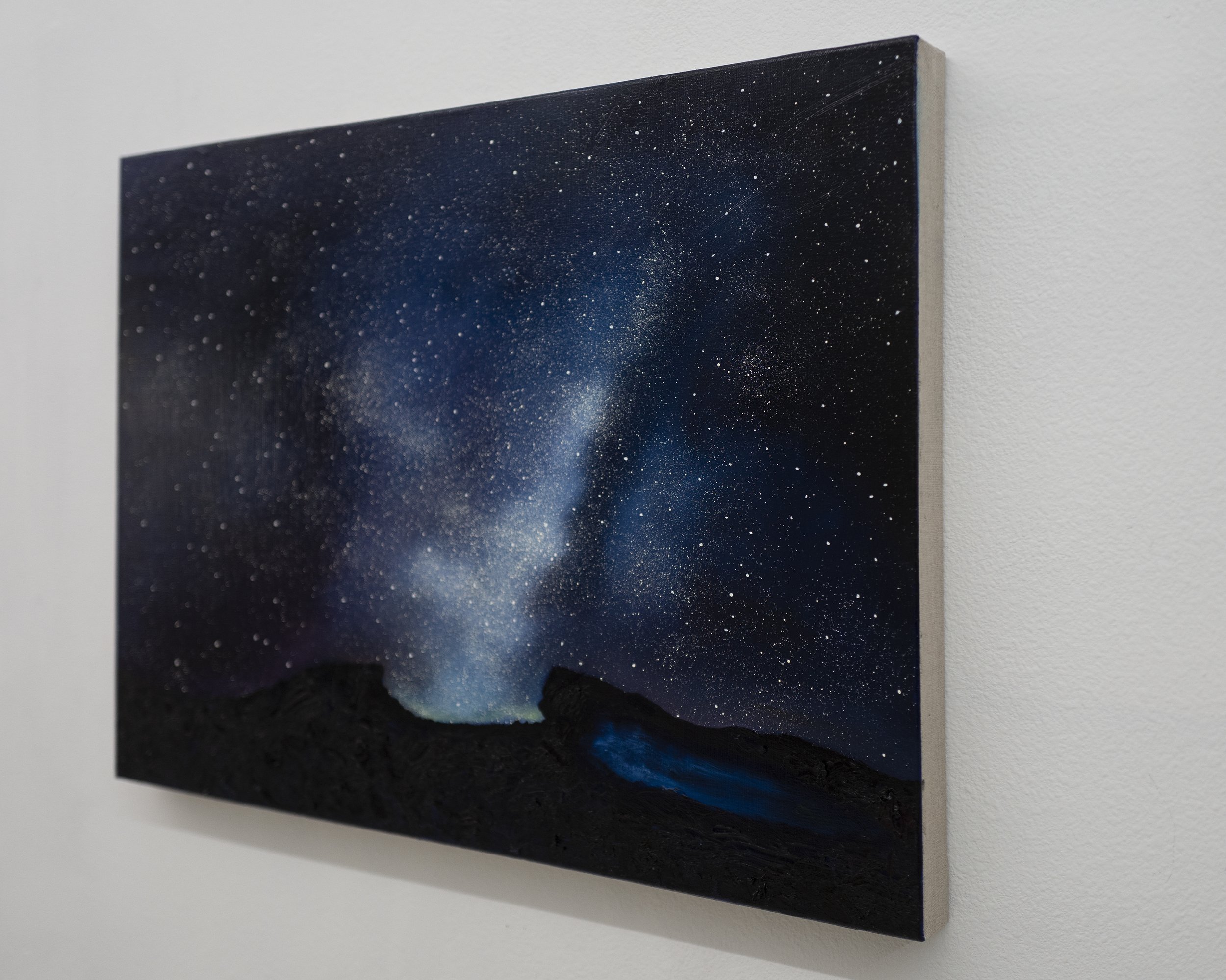
Gerhard Richter's September (2005) is a painting of a photograph of a catastrophe that was seen through technology before it was seen with the naked eye, and its structural logic provides the second precedent for Eruption's mediation of a natural disaster through technological observation. Richter's painting depicts the World Trade Center towers in the moments after the planes have struck, seen from a distance that suggests a camera lens rather than a human eye. The image is blurred, as though it were a photograph taken in motion, or a still from a video that was never meant to be paused, or a memory that is already fading even as it is being recalled. The blur is not accidental. It is the painting's argument. Richter is not painting the towers. He is painting the image of the towers, and the image is already mediated, already filtered through the camera, already reduced to pixels and data before it reaches the painter's hand. The blur is the distance between the event and the representation, the space where the technology of seeing inserts itself between the viewer and the thing that is being seen.
Tan Mu's Eruption operates in a related register but with a crucial difference. Richter's painting is about an event that was seen live on television by millions of people, an event that was already a media event before it was a historical one. The mediation was the experience. Tan Mu's painting is about an event that was not seen by anyone at the time it happened, because the technology that would have transmitted the images was the same technology that the event destroyed. The undersea cables that would have carried the video feeds from Tonga to the rest of the world were severed by the eruption. The satellites that imaged the ash plume from above could see the cloud but could not see what was happening below it. The island was hidden beneath the ash, and the cables that connected it to the global network were broken, and for nearly a month, the only information available was what the satellites could provide: infrared images of the plume, atmospheric measurements of the shockwave, data points that confirmed the eruption had happened but could not say what it had done to the people who lived beneath it. Eruption is a painting of an event that was both over-documented and under-reported, an event that was seen from above but not from below, an event that was measured in real time but not witnessed in real time, an event that produced more data than understanding.
Saul Appelbaum, writing about Tan Mu's 2025 Vienna exhibition, introduces the concept of "arbitration," drawn from his architectural thesis on noise and signal. For Appelbaum, Tan Mu's works "unfold through a process of arbitration: deciding, judging, mediating between input and output." In Eruption, the arbitration occurs at the cross. The cross is the point where the natural event meets the technological system that measures it, where the explosion meets the satellite, where the chaos meets the grid. It is the point of arbitration between the raw data of the eruption and the processed information that the global communication network produces. The eruption, seen from above by a satellite, is a data point: coordinates on a map, a heat signature, a plume height measurement. The eruption, seen from the ground by the people who lived through it, is a catastrophe: destroyed homes, contaminated water, severed cables, no phone, no internet, no way to call for help. The cross in Eruption is the line where these two views intersect, where the satellite's view and the survivor's view meet at the same point on the same surface, and the painting holds them both without resolving the tension between them. The explosion did not ask whether it was being watched. The cables did not ask whether they were important. The arbitration is not the eruption's. It is the viewer's. And the painting, by placing the cross over the cloud, by imposing the grid on the chaos, by measuring the unmeasurable, makes the viewer decide what they are looking at: a natural event or an infrastructural crisis, a volcanic eruption or a communication blackout, a mushroom cloud or a broken cable, an explosion or a silence.
The silence that followed the explosion lasted nearly a month. During that month, while the satellites continued to orbit and the data continued to accumulate, the people of Tonga were cut off from the system that was measuring their disaster. The cables that lay on the ocean floor between Fiji and Tonga, thin as a garden hose and carrying more data than all the satellites in the sky combined, were broken in two places by the force of the eruption and the subsequent tsunami. Repair ships were dispatched from other parts of the Pacific, and the cables were spliced and restored, and the connection was reestablished, and Tonga came back online, and the world could see what had happened, and the data could flow again, and the images could arrive, and the news could be reported, and the aid could be coordinated, and the infrastructure could resume its function of connecting the islands to the network that had been watching them from above even as it could not reach them from below. Eruption is the painting of the moment before the connection was restored, the moment when the cables were still broken and the data was still flowing only one way, from the satellite to the ground station, from the measurement to the archive, from the observation to the record, and not from the island to the world, not from the people who needed help to the people who could provide it, not from the silence to the response. The cross is the line that marks the spot on the map. The cloud is the thing that happened at that spot. And the painting, by holding both in the same frame, asks whether the line and the cloud are describing the same event or two different ones, whether the satellite's view and the survivor's view are compatible, whether the grid that measures the explosion is the same grid that connects the islands to the world, and whether, when the cables that carry the data are broken by the event that the data describes, the measurement is still the event, or whether the event has become something else, something that the grid cannot reach, something that exists in the silence between the explosion and the restoration, in the month when the data flowed only one way and the people on the ground were as invisible as the cables that lay broken on the ocean floor.