The Hands That Fed the Machine: Tan Mu's The Binary Dream and the Women Who Made Computing Possible
The IBM 704 was introduced in 1954. It was the first mass-produced computer with floating-point arithmetic hardware, the first to use core memory instead of vacuum-tube drums, the first to run FORTRAN, the language that would make scientific programming accessible to engineers and physicists who were not themselves programmers. It was also, by the standards of the era, enormous: a room-filling array of cabinets, consoles, tape drives, and card readers that weighed tons and consumed enough electricity to power a small neighborhood. Operating it required a team of specialists who understood its idiosyncrasies, who could load the magnetic tape and thread the punch cards and flip the switches and read the indicator lights and interpret the output as it emerged from the printer in strings of numbers that meant nothing to anyone who had not written the program. Most of those specialists were women. Their names do not appear in the histories of computing. Their faces appear in the photographs, standing at the console, hands on the keyboard, eyes on the output, performing the physical labor of making a machine think. The Binary Dream (2024), oil on linen, 76 x 46 cm (30 x 18 in), is a painting of one of those women, and it is also a painting of the machine she operated, and it is also a painting of the color that IBM chose to paint its products, the color that gave the company its nickname, Big Blue, the color that has come to mean computation itself.
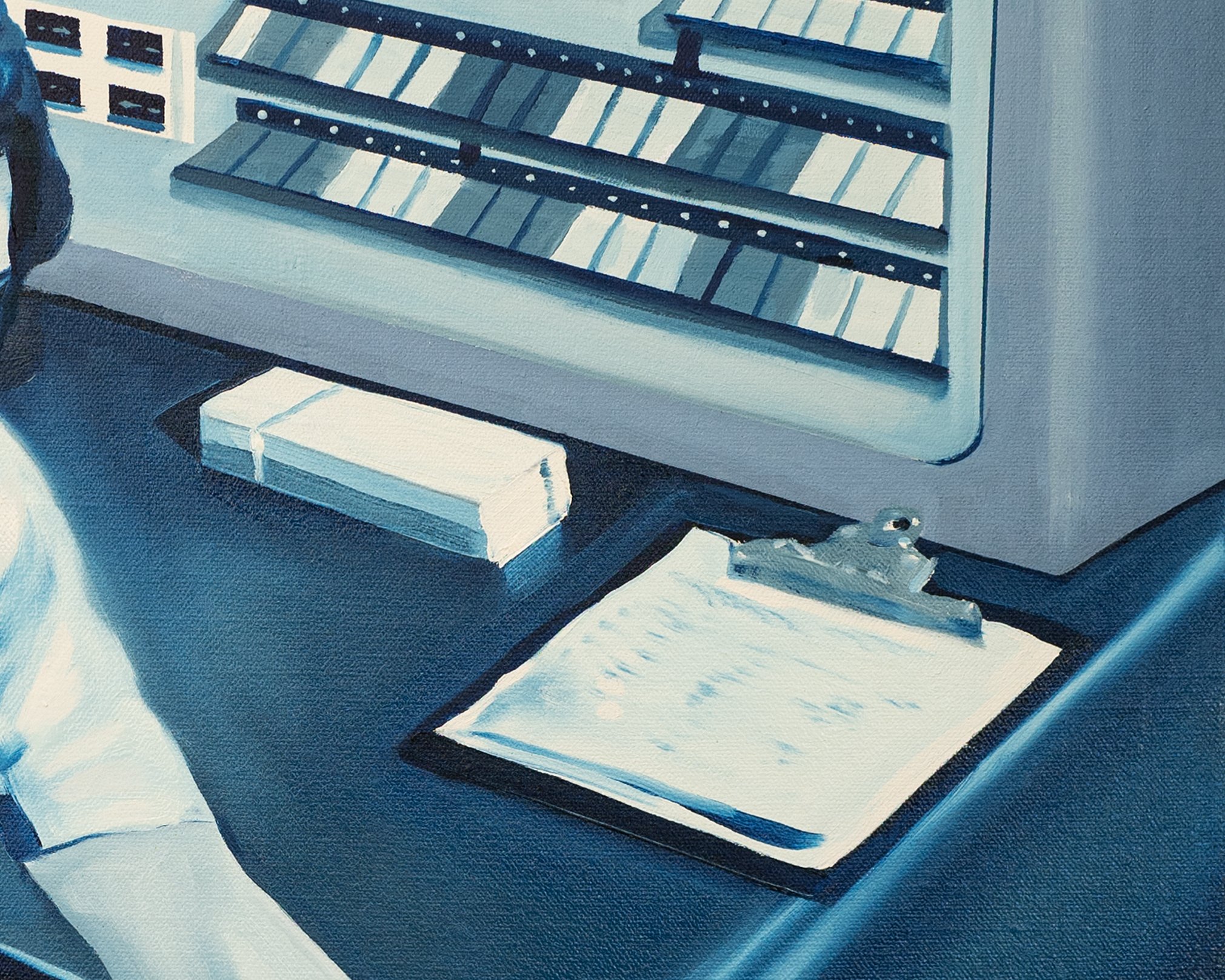
The composition is vertical and narrow, 76 centimeters tall and only 46 wide, a portrait format that emphasizes the height of the IBM 704 and the relative smallness of the woman who stands before it. The machine occupies the right two-thirds of the canvas, a towering array of cabinets, switches, tape drives, and indicator panels that fills the vertical space from top to bottom. The woman stands on the left, her body turned slightly toward the machine, her right hand resting on the console, her gaze directed at something outside the frame, perhaps a printout, perhaps a screen, perhaps a problem she is working through in her mind. The entire painting is rendered in a monochromatic blue palette that ranges from pale cerulean in the highlights to deep Prussian blue in the shadows, with occasional passages of near-black where the deepest tones of the machine's cabinets absorb all the light. This is not the blue of sky or water. This is the blue of IBM, the blue of institutional computing, the blue of the corporate identity that made the computer a brand before it was a household object.
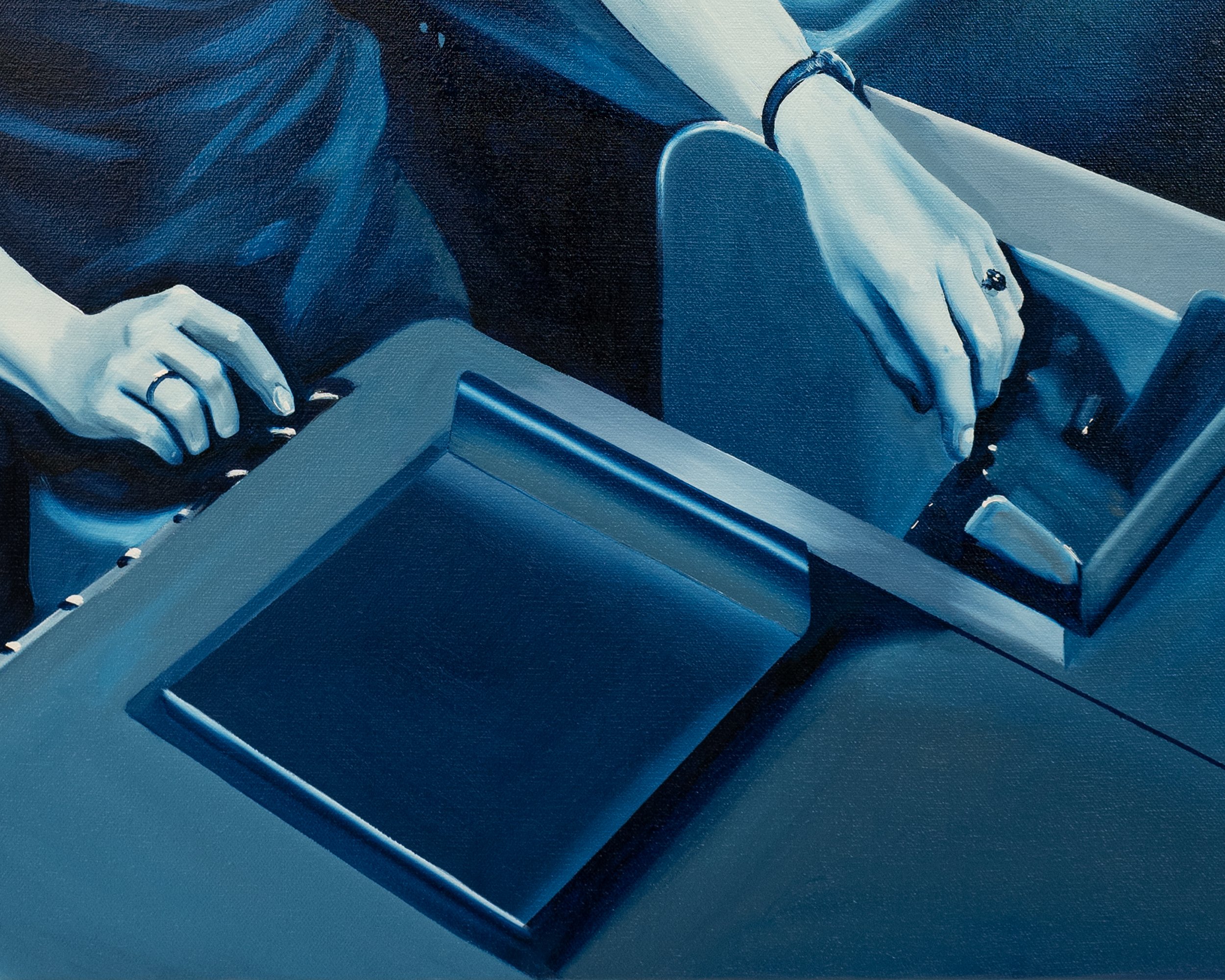
The blue is not uniform. It shifts in value and intensity across the surface, lighter where the fluorescent lights of the computer room illuminate the machine's front panels, darker where the cabinets recede into shadow, warmest where the woman's skin and the fabric of her dress catch the ambient light. The linen shows through in the thinnest passages, its warm brown providing a ground note that prevents the blue from becoming cold or clinical. The machine is rendered with a precision that approaches photorealism at mid-range distances, the switches and dials and tape drives legible as specific objects, each one painted with the attention of a portraitist who is painting a face. Up close, the precision dissolves into brush marks, and the machine becomes a field of blue pigment, a surface of oil and linen that has been worked and reworked until the image emerges from the paint rather than being laid on top of it. The woman's figure is painted with the same attention to material presence. Her posture is not idealized. She stands with the slight lean of someone who has been working at a console for hours, one hand resting on the machine, the other at her side, her weight shifted to one hip in a stance that suggests fatigue, concentration, and familiarity. She is not posing for the camera. She is working. The machine is not a prop. It is her instrument, and her hand on the console is the hand of a musician on a keyboard, a driver on a wheel, a worker at a station.
Tan Mu's own account of the work emphasizes the relationship between the human figure and the machine. "The scene in the painting is based on a historical photograph showing NASA's early use of IBM computers for complex calculations. What drew me to this image was not only the presence of the machine itself, but the people around it. The photograph reveals how computation, at that stage, was inseparable from human labor." The word "inseparable" is the key. In the 1950s and early 1960s, computing was a physical activity. The operator's hands were required to load the tape, thread the cards, flip the switches, read the lights, and interpret the output. The machine could not think without the hands that fed it. The program could not run without the body that initiated it. The calculation could not be completed without the person who stood at the console and watched the numbers emerge from the printer and decided, based on what she saw, whether the result was correct or the program needed to be run again. Computing, at this stage, was not an abstraction. It was a craft, and the craft was practiced by women whose names have been largely forgotten by the history that celebrates the machines they operated and the men who designed them.
Margaret Bourke-White's industrial photography of the 1930s and 1940s established the visual vocabulary for representing human figures alongside massive machinery, and her photograph of the Fort Peck Dam, published as the cover of the first issue of LIFE magazine on November 23, 1936, is the most influential single image in that vocabulary. The photograph shows the dam's massive concrete spillway under construction, with human figures distributed across the foreground and the middle distance, their smallness emphasizing the scale of the structure behind them. The dam is not a backdrop. It is the subject, and the people are present to provide scale, to demonstrate that the structure is as large as the claim implies, to prove that this is not a model or a drawing but a real thing made of real concrete by real hands. The people in Bourke-White's photograph are not individuals. They are scale markers. They are there to show how big the dam is. Their anonymity is part of the composition. They are workers, not portraits, and the photograph does not distinguish between them because the photograph is not about them. It is about the dam.
Bourke-White's industrial photographs, like Tan Mu's painting, place the human figure in a specific relationship to the machine. But the relationship is different. In Bourke-White, the person is small and the machine is large, and the composition emphasizes the disparity in scale. The dam dwarfs the workers. The blast furnace dwarfs the steelworkers. The turbine dwarfs the engineers. The machine is the subject, and the person is the scale marker. In The Binary Dream, the relationship is inverted. The woman and the machine are comparable in scale. She is not dwarfed by the IBM 704. She stands next to it, her hand on its console, her body aligned with its cabinets, and the composition does not emphasize her smallness but her proximity. She is close enough to touch it, close enough to operate it, close enough to be the thing that makes it work. The painting does not ask you to marvel at the size of the machine. It asks you to notice the hand on the console, the person at the station, the body without which the machine is just a cabinet full of wires. Bourke-White's workers are anonymous. Tan Mu's operator is present, specific, and engaged. The difference is the difference between a photograph that documents an industrial achievement and a painting that recovers the labor that made the achievement possible.
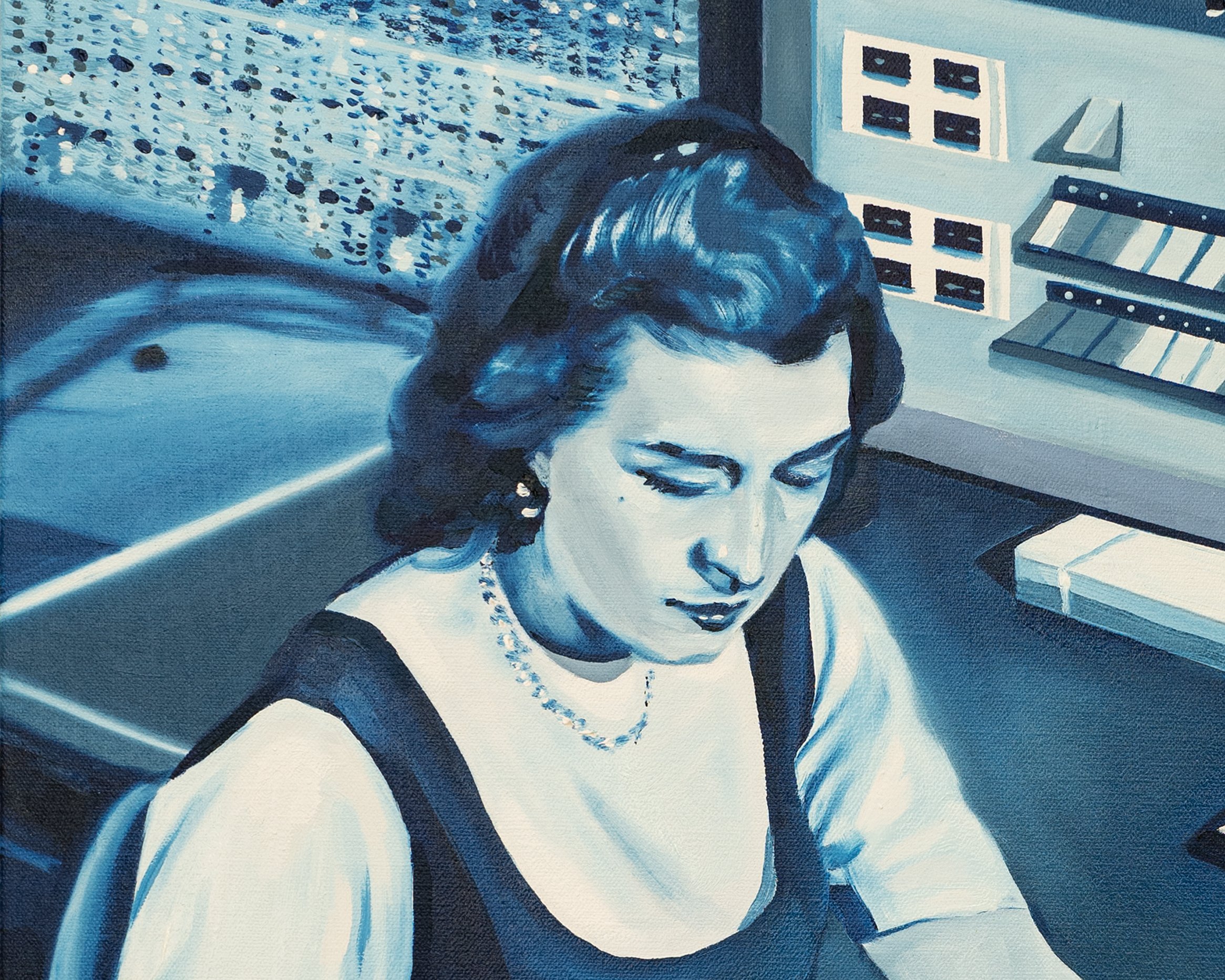
The monochromatic blue palette is, as Tan Mu explains, a deliberate reference to IBM's corporate identity. "Blue immediately evokes IBM, often referred to as Big Blue, and carries associations with rationality, order, and institutional authority. From the IBM 704 to Deep Blue, this color has become closely tied to the visual language of computing." The choice is not merely chromatic. It is conceptual. By rendering the entire composition in IBM blue, Tan Mu places the scene inside the corporate identity of the machine's manufacturer, as though the IBM brand had expanded to fill the entire visual field, the room, the air, the light, the skin of the operator, the surface of the console, the cabinets of the computer. Everything is blue because everything is IBM, and IBM is everything in this room: the machine, the furniture, the lighting, the institutional authority that determines what is calculated and why, and the color that makes the calculation visible as a product of a specific corporation rather than a neutral intellectual activity. The woman in the painting is not computing in the abstract. She is computing on an IBM 704, in an IBM facility, wearing the blue that IBM has chosen to represent itself, and her labor, which might otherwise be invisible, is made visible by the same color that makes the machine visible, as though the blue were a medium that reveals the connection between the hand and the console, the operator and the operated, the person and the corporation that employs her.
Tan Mu extends the argument beyond the specific machine to the history of women in computing. "Women were essential to early computing, particularly in data input, programming, and calculation. In many cases, they were the ones operating and maintaining these complex systems. The woman in the photograph represents a broader, largely unacknowledged history of female labor in technology." This is not the first time Tan Mu has made this argument. She cites The Note G (2022) and Punched Card 1 (2022) as earlier works in the same line of inquiry, and she frames the present painting not as a departure but as a continuation: "For me, this is an ongoing line of inquiry rather than a closed chapter. By painting these moments, I am not only revisiting history but also creating an archive for the future, one that recognizes how technological progress has always depended on human hands, attention, and care." The archive is the painting. The painting is the record of a moment that the official histories have largely omitted, the moment when a woman stood at a console and made a machine compute, and the machine was IBM, and the color was blue, and the labor was invisible, and the painting, by rendering all of these in the same monochromatic palette, makes the labor as visible as the machine, as visible as the brand, as visible as the computation itself.
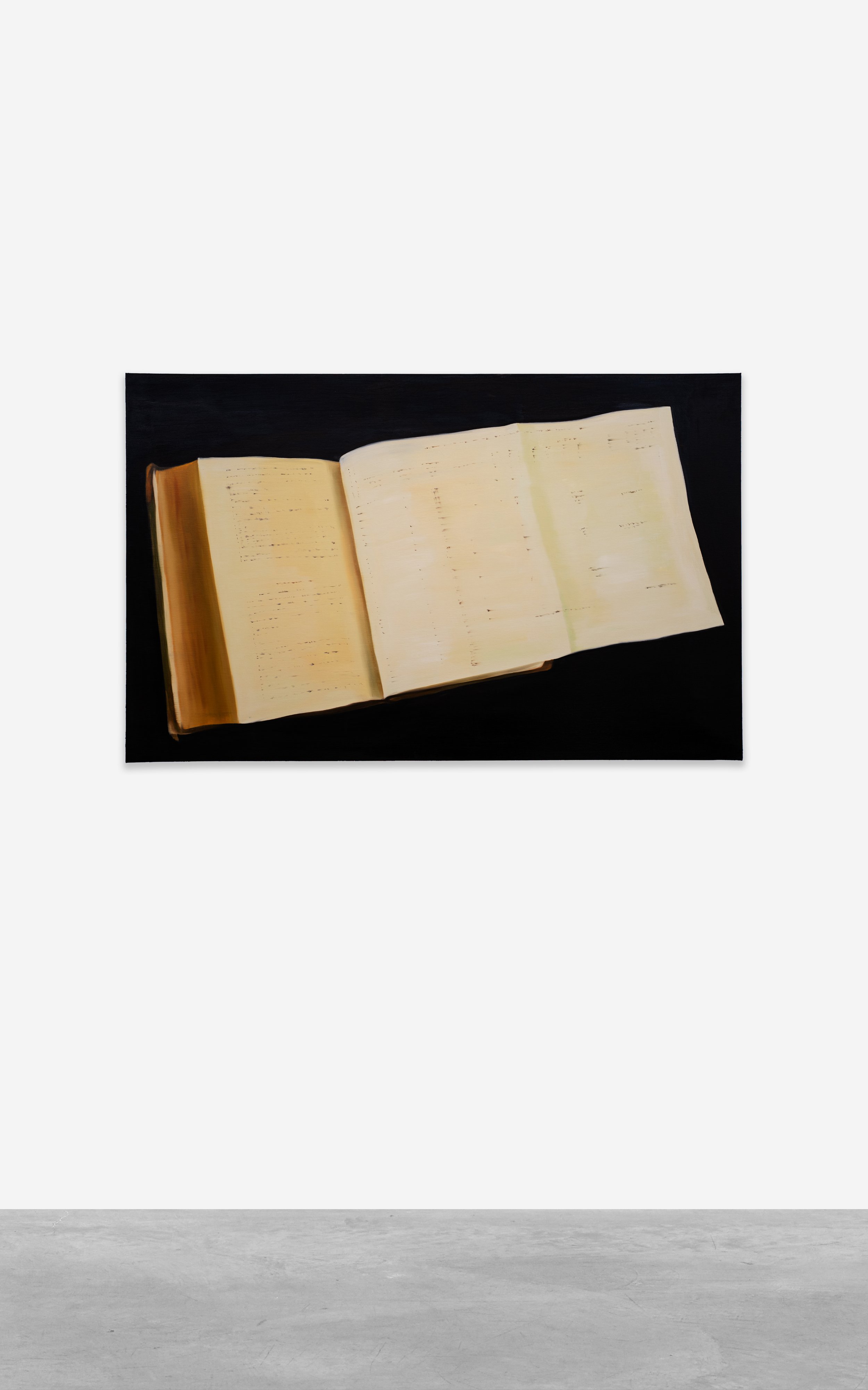
Vera Molnar's Des Ordres (1974) is one of the earliest works of computer-generated art, and its relevance to The Binary Dream lies not in its visual similarity but in its structural parallel: a woman using a computer to make art, and in doing so, becoming one of the first to demonstrate that the computer was not only a tool for calculation but a medium for aesthetic expression. Molnar, born in Budapest in 1924, began working with computers in 1968, when she gained access to a research laboratory in Paris that had a mainframe she could use during its off-hours. She wrote programs in FORTRAN, the same language that the IBM 704 had been the first to run, and she used the computer to generate geometric compositions that she then drew by hand on paper, plotting the points that the program calculated and connecting them with lines that the program specified. The result was not a printout. It was a drawing made by a human hand following instructions generated by a machine, a collaboration between the body and the algorithm that produced images that neither the body nor the algorithm could have produced alone. Molnar described her process as "une methode imaginaire," an imaginary method, a way of working that did not exist before she invented it, and the invention was not the algorithm but the interface between the algorithm and the hand.
The structural parallel with The Binary Dream is that both works place a woman at a computer and ask what her presence means. In Molnar's case, the woman is the artist, and the computer is the tool that generates the instructions that the artist follows. In Tan Mu's case, the woman is the operator, and the computer is the machine that she operates. In both cases, the woman's hands are the interface between the human and the computational, the point where the algorithm becomes an action, where the program becomes a process, where the data becomes a result. Molnar's hands plotted the points that the program calculated. The operator's hands flipped the switches that the program required. Both sets of hands were necessary. Both sets of hands were invisible in the official history, which records the machine and the language and the corporation but not the person who sat at the console and made it work. Tan Mu's painting, by rendering the operator and the machine in the same monochromatic blue, by making them part of the same visual field, by refusing to let the machine dominate the composition or the figure recede into the background, corrects this omission. The woman is not a scale marker. She is not a decoration. She is the operator. The machine does not think without her. The program does not run without her hands. The blue that surrounds her is the blue of the machine that she operates, and it is also the blue of the institution that employed her, and it is also the blue of the archive that Tan Mu is creating, one painting at a time, to preserve the record of a labor that the official histories have left out.
Li Yizhuo, writing about Tan Mu's practice, observes that the canvases "do not aim at diagnosing the modern spectacles from a distance. They conjure up a kind of vitality and depth of their own." The formulation applies to The Binary Dream with particular precision. The painting does not diagnose the condition of women in computing. It does not stand outside the machine and point to the operator as a victim of institutional neglect. It enters the room, stands next to the woman, places its hand on the console beside hers, and paints what it sees: a person at work, a machine in operation, a color that fills the space, and a moment in the history of technology when the hands were still visible, the labor was still physical, and the connection between the body and the computation was still something you could see. The painting conjures up a vitality that the historical photograph, for all its documentary value, does not provide. The photograph shows a woman at a machine. The painting shows a woman whose hand is on the console and whose gaze is directed at a problem she is solving, and in that hand and that gaze, the painting finds the depth that the photograph, by its nature, cannot reach: the depth of concentration, the depth of skill, the depth of the knowledge that the machine will not compute unless the hands that feed it are present, are attentive, and are capable, and that when those hands are removed, when the operator is replaced by a program and the console is replaced by a screen and the room is replaced by a cloud, something is lost that the blue cannot recover, something that was once visible and is now invisible, something that the painting, by the act of painting it, is trying to give back.