The Negative Where the Hand Was: Tan Mu's Touch and the Trace That Outlasts Contact
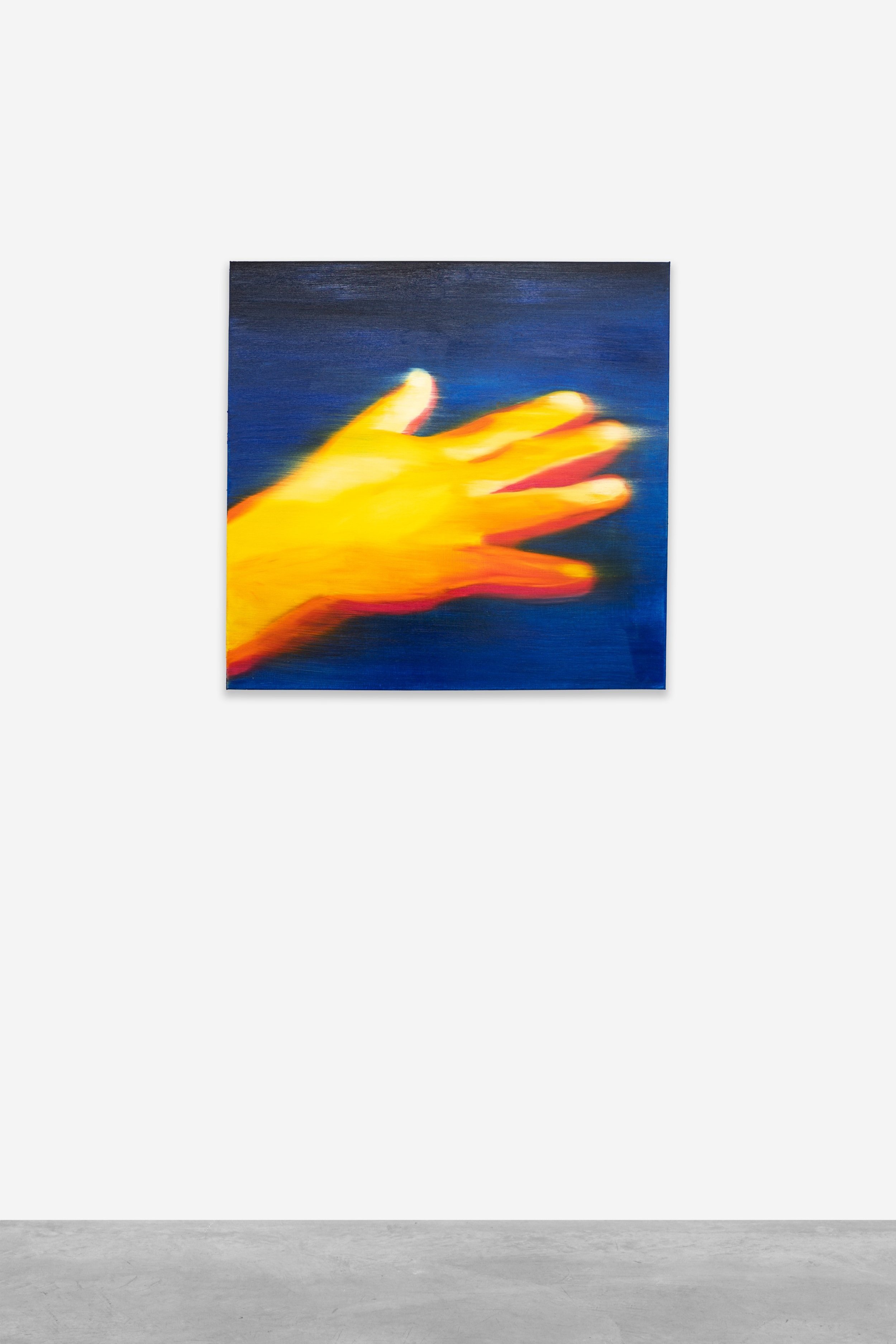
Move close enough and the hand dissolves. At six inches from the surface, the warm yellows and burnt oranges that define the palm reveal themselves as clusters of individual marks, each one a discrete decision by the painter's own hand, pressed into linen with the deliberation of someone placing pigment where warmth should be. The fingers spread across the square format of the canvas, five extensions radiating outward from a central mass of amber and gold. The edges of each finger are soft, blurred, as though the heat they carry is bleeding into the dark field around them. At arm's length, those same strokes resolve into a thermographic hand, the kind of image a thermal camera produces when it reads the infrared radiation radiating from a living body. The painting reads first as heat, then as hand, then as both at once. Touch (2022) is an oil on linen painting, 76 x 76 cm, that takes the thermographic handprint as its subject and asks what happens when the most tactile of human senses is translated into a visual spectrum measured in degrees rather than felt in pressure.
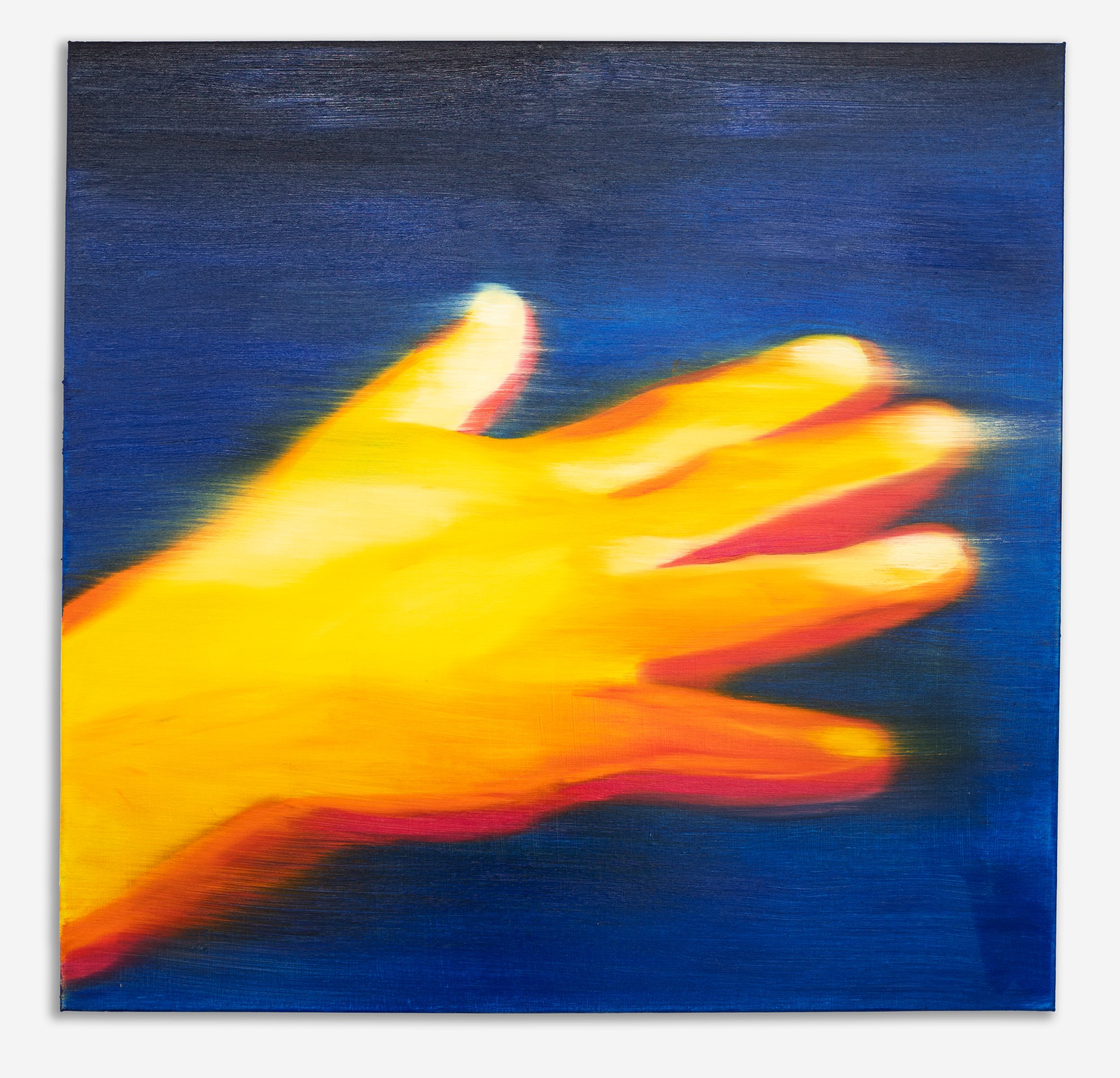
The square format is deliberate. At 76 by 76 centimeters, the painting occupies the same dimensions as many of Tan Mu's most focused single-subject works: the 30-by-30-inch square that concentrates the eye on one thing and refuses to let it disperse across a landscape or a narrative. The linen ground is visible at the margins, its weave catching light in a way that reminds the viewer that this is a constructed object, paint on fabric, not a screen or a printout. The background is not black but a deep, cool ultramarine that reads as night, as depth, as the color space on a thermal camera that indicates the absence of warmth. Against this blue, the hand glows. The palm is rendered in the warmest tones: cadmium yellow mixed with Naples yellow and touches of orange, the specific combination that a thermal imaging system assigns to the highest temperature range. The fingers cool slightly as they extend outward, shifting from orange into cooler yellows and then into the green-yellow of moderate heat, before bleeding at their tips into the blue field. This gradient is how a thermal camera actually renders a human hand: hottest at the center, cooler at the extremities, fading into the ambient temperature of the surrounding environment. The blur at the edges is not impressionistic softness. It is thermographic accuracy. A thermal camera does not produce sharp outlines because heat does not have sharp outlines. Heat radiates. It disperses. It bleeds into the air around the body that generates it. Tan Mu has reproduced this physical property in oil paint, using the medium's capacity for blending and layering to make the edges of the hand behave the way heat behaves: with uncertainty, with diffusion, with a gradual loss of definition that makes the boundary between the body and its environment a zone rather than a line.
The surface texture reinforces the argument. In the center of the palm, where the temperature reading would be highest, the paint is laid on thickly, with a wax-heavy impasto that raises the surface above the surrounding field. This is the same technique Tan Mu uses in her Signal series to render the landing points of submarine cables, those nodes of concentrated data that sit on the ocean floor like soldered connections on a circuit board. Here, the raised surface serves a different purpose. It makes the warmest part of the painting the part that catches the most light, the part that physically protrudes toward the viewer, the part that insists on being touched even as it depicts an image produced by a technology that renders touch unnecessary. The thick paint at the center of the palm is the painting's answer to the thermographic camera. The camera says: you do not need to touch this body to know its temperature. The paint says: this body is here, it is warm, it is raised above the surface, and if you could reach through the glass of the screen you would feel it.
The handprint stencils in the Cueva de las Manos, the Cave of Hands in Santa Cruz Province, Argentina, were made between seven and ten thousand years ago by people who placed their hands against the rock face and blew pigment over them, leaving a negative silhouette where the hand blocked the paint. The cave contains hundreds of these silhouettes, the left hands of men, women, and children preserved in mineral pigments of red, orange, brown, and white, each one the exact size of the hand that made it, each one a record of a specific body pressing against a specific wall at a specific moment. The technique is simple enough that a child can produce it, and it may have been produced by children. The result is uncanny. The handprints in Cueva de las Manos do not depict hands. They register the absence that a hand left in a field of pigment. They are, in the strictest sense, negatives: the shape of the hand is the shape where the paint is not. The hand was there, the paint went around it, the hand was removed, and what remains is the trace of a contact that happened thousands of years ago. The hand that made the stencil has been dead for millennia. The stencil is still there, still legible, still unmistakably human, still the exact size of a palm and five fingers that once pressed against stone in a gesture that could have been greeting, claim, prayer, or play.
This is the reference Tan Mu names when she discusses Touch: the Cueva de las Manos handprints and the thermographic hand, brought together on the same canvas, separated by ten thousand years of technological development but united by the same impulse. "The handprints in the Cueva de las Manos are among the earliest traces of human presence," she says. "Created through a stencil process, they record the physical act of placing a hand against a surface and leaving behind a negative image. These marks preserve a moment of touch across thousands of years." The thermographic image, by contrast, "belongs entirely to the present. It converts bodily warmth into digital color, translating physical sensation into abstract data." The structural parallel is exact. Both the cave stencil and the thermal camera produce an image of the hand by removing the hand. The stencil removes the hand by painting around it. The thermal camera removes the hand by converting its warmth into a color map that can be read without touching the body. Both techniques produce a legible trace. Both techniques make it possible to know something about the hand without being in contact with it. And both techniques, in making the hand legible at a distance, raise the same question: what is lost when touch becomes data?
Thermography is a technology of medical and military origin. It was developed in the mid-twentieth century for applications that required detecting heat signatures without physical contact: military surveillance, industrial inspection, medical diagnosis. A thermal camera does not see the body. It sees the infrared radiation that the body emits. It translates that radiation into a color spectrum where temperature corresponds to hue: white and yellow for the hottest zones, red and orange for moderate heat, blue and purple for the coldest. The resulting image is legible, precise, and entirely detached from the tactile experience it represents. You can read a thermal image and know that someone's hand is 34 degrees Celsius without ever feeling the warmth of that hand. The technology was designed for this purpose: to make warmth visible at a distance, to make the body legible as data, to convert the most intimate and immediate of human sensations, the feeling of another person's skin against your own, into a color on a screen that any stranger can interpret.
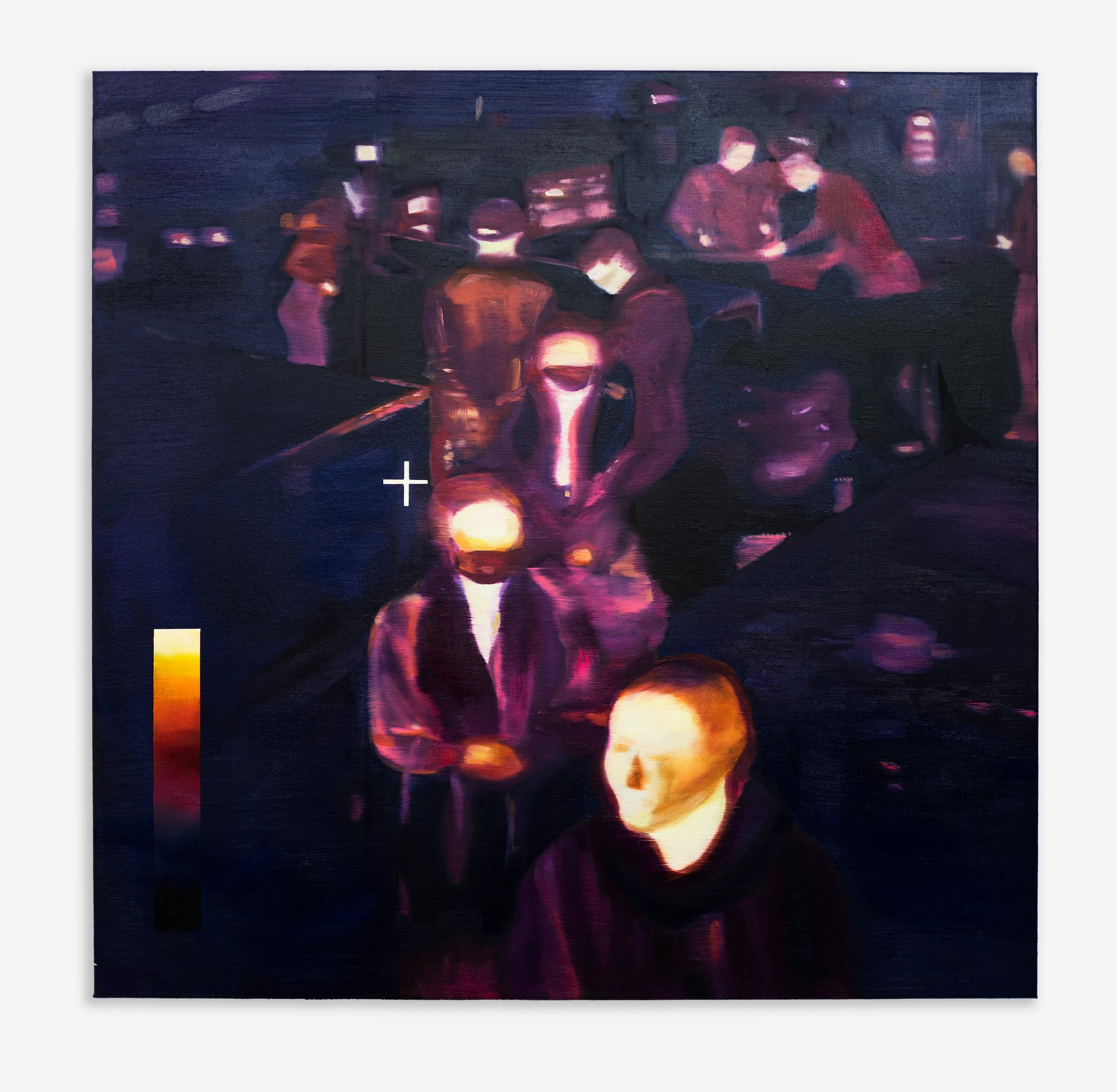
During the COVID-19 pandemic, thermographic imaging became ubiquitous. Temperature checks appeared at the entrances of buildings, airports, hospitals, and schools. Thermal cameras scanned crowds, identifying individuals whose body temperature exceeded a threshold. The forehead, the inner corner of the eye, the temples: these were the sites where the cameras focused, reading the heat that radiated from a body as it passed through a doorway or stood in a queue. The technology was deployed in the name of public health, but its effect was to make every body a data point, every temperature a metric, every encounter with another person a mediated event. Tan Mu describes this period: "During the pandemic, as daily life shifted heavily toward virtual interactions, physical contact and bodily presence became increasingly absent. Touch was replaced by screens, and warmth was reduced to data." The thermographic hand in Touch is a product of this moment. It is the image of a body that is being measured, monitored, and converted into information, at the precise historical moment when actual touch became dangerous, regulated, and rare.
The painting's structure registers this displacement. The hand in Touch is not touching anything. It floats against the dark blue ground, detached from any body, disconnected from any surface, suspended in the thermographic color space that a camera assigns to it. There is no other hand to meet it. There is no face to cup, no shoulder to rest on, no object to grasp. The hand radiates warmth into emptiness. It is a transmitter with no receiver. The painting makes visible the specific loneliness of a technology that renders intimacy as information: you can see the warmth, you can measure it, you can assign it a color on a spectrum, but you cannot feel it. The thermal camera, designed to detect heat at a distance, produces an image that contains every possible fact about the temperature of the body and none of the experience of touching it. Tan Mu's painting reproduces this paradox by making the thermographic image in oil paint, the most tactile of mediums, the one that requires the artist to touch the surface with her own hand, to mix pigment with her fingers or a brush held in her grip, to build up the warm center of the palm in layers of wax-heavy impasto that catch the light and physically protrude from the canvas. The painting is a thermographic image made by hand. It is a document of touch made in a medium that requires touch. It is an image of distance produced through intimacy.
Rachel Whiteread's casts make visible the same category of thing that the Cueva de las Manos stencils make visible: the negative space left by a body that is no longer there. In Ghost (1990), Whiteread cast the interior of a room in plaster, filling the negative space of a Victorian living room until the air between the walls, the floor, and the ceiling became a solid object. When the cast was removed from the room, what appeared was the shape of the space that the room's occupants had moved through: the imprint of the fireplace, the indentations of the door and windows, the texture of the wallpaper pressed into plaster. The room itself, the positive space with its walls and its windows and its furnishings, was not the subject. The subject was the space the room contained, the volume of air that the people who lived there had breathed and moved through and filled with the warmth of their bodies. Whiteread's cast makes absence architectural. It takes the space where life happened and turns it into an object that can be looked at, walked around, and recognized as the exact dimensions of a particular absence.
The connection to Touch is structural. The Cueva de las Manos stencils are also casts of absence. The pigment was blown over the hand, and when the hand was removed, what remained was the negative shape of the palm and fingers, the exact outline of a body that had pressed against the rock and then withdrawn. The thermographic image operates in the same register. It registers the heat that the body emits into the space around it, the infrared radiation that extends outward from the skin like a halo, filling the area immediately around the body with warmth that gradually dissipates into the ambient temperature. The thermal camera captures this aura and translates it into color. The hand in Touch is surrounded by a gradient of cooling hues that bleed from the fingers into the blue field, reproducing the way heat dissipates in a thermal image. This gradient is the thermographic equivalent of the cave stencil's negative space. It is the zone where the hand was, the area that the hand's warmth filled, the shape that the body leaves in the air around it. Whiteread's casts, the Paleolithic stencils, and the thermal camera all produce images of the same thing: the trace left by a body that has departed, the shape that presence leaves behind in its absence.
The difference, and it is the difference that Tan Mu's painting insists on, is that the cave stencil and Whiteread's cast are produced by physical contact. The hand pressed against the rock. The plaster filled the room. The trace was made by touch. The thermographic image is produced by technology that makes touch unnecessary. The camera reads the heat from a distance. No contact is required. No body needs to press against anything. The warmth is captured, measured, and displayed without any physical encounter. The technology is more precise, more efficient, more hygienic than touch. It is also, by definition, more distant. It produces knowledge about the body without producing contact with the body. It makes the body legible as data while making it unnecessary to feel the body's warmth with your own skin. Tan Mu's painting holds both registers simultaneously: the register of touch, represented by the impasto surface that the artist's hand built up in layers of oil paint, and the register of distance, represented by the thermographic color scheme that converts warmth into a visual code readable by anyone, anywhere, without requiring them to be in the same room as the body that generated it.
Danni Shen, writing about Tan Mu's practice in Emergent Magazine in 2024, observed that the works "serve as a kind of witness to human socio-technological histories," reflecting "the trajectory and continuum of bodily and mediated presence through human technical developments." The formulation is precise for Touch. The painting witnesses two moments in the continuum of mediated presence: the moment when a hand pressed against a cave wall and left a stencil that is still visible ten thousand years later, and the moment when a thermal camera scanned a body and converted its warmth into a data point that could be read without touching the skin. The continuum Shen describes is not a story of progress from primitive to advanced. It is a story of transformation in which the fundamental impulse remains the same but the medium changes. The hand pressed against the cave wall wanted to leave a mark. The thermal camera pointed at the hand wanted to read the warmth. Both produced a legible image of the hand. Both made it possible to know something about the body without touching it. The difference is one of degree, not of kind. The cave stencil is a low-resolution thermal image. The thermal image is a high-resolution cave stencil. Both register the presence of a body by recording what that body emits: pigment in one case, infrared radiation in the other. Both produce a trace that outlasts the contact that generated it. Both make it possible to see a hand that is no longer there.
The deep blue that fills the ground of Touch is not neutral. In the thermal spectrum, blue indicates cold, the absence of heat, the ambient temperature of the environment against which the body's warmth registers. In Tan Mu's painting, the blue serves a dual function. It is the thermal camera's reading of the space around the hand, the zone where no body is radiating, the negative field against which the positive image of the hand becomes legible. It is also the blue of a screen, the blue of a digital display, the blue of the interface that sits between the viewer and the body being measured. The hand floats in this blue like a body in deep water, surrounded by an element that it cannot breathe, emitting warmth into a medium that carries it away. The pandemic reference is specific. Tan Mu describes moving her painting practice from her studio in New York back to her home during the lockdown, experiencing isolation while witnessing collective upheaval through screens. The screens that replaced physical contact, the temperature checks that replaced handshakes, the thermal cameras that replaced the feeling of another person's skin: all of these technologies operated in the blue field of mediated distance, reading the body as data while the body sat alone in a room, radiating warmth into empty space.
But Touch is not a painting about the failure of technology. It is a painting about the persistence of the hand's impulse to leave a trace, across every transformation of the medium that carries that trace. The hand in the Cueva de las Manos pressed against rock. The hand in Tan Mu's painting is read by a thermal camera. Between these two moments, ten thousand years of technological development have changed the instrument but not the gesture. The hand still reaches out. The hand still wants to be seen. The hand still generates warmth that can be detected, measured, and recorded. The thermographic camera is the latest in a long line of technologies that the hand has used to make itself legible, from mineral pigment blown through a reed to infrared sensors that convert radiation into color. The medium changes. The impulse does not. Tan Mu's painting insists on this continuity by making the thermographic image in the most tactile medium available, oil paint applied by hand, one stroke at a time, each mark a physical act of contact between the painter's hand and the surface that receives it. The painting is a thermographic image that was made by touch. It is a document of distance that was produced through intimacy. It is a record of the hand's warmth, painted by a hand that was warm.
The impasto at the center of the palm is the painting's argument made material. In a thermal image, the center of the palm is the warmest zone. In Tan Mu's painting, it is also the most physically present zone, the part of the canvas where the paint rises highest above the linen, the part that catches the most light, the part that the viewer's eye is drawn to first and that lingers longest. The paint is thick because the warmth is concentrated. The warmth is concentrated because the hand is there. The hand is there because the painter put it there, one brushstroke at a time, building up the surface until it approximated the thermographic camera's reading of a body radiating heat into the space around it. The impasto does not illustrate warmth. It performs it. It makes the painting itself warm in the sense that it gives the center of the palm a physical prominence that the surrounding field does not have, a raised surface that the viewer can see from across the room and recognize as a point of intensity, a node of concentration, a place where the body's heat is most available and most legible. This is not a painting about warmth. It is a painting that produces the visual and material conditions of warmth, using the thickness of oil paint to approximate the thickness of infrared radiation, using the protrusion of impasto to approximate the protrusion of heat into the space around the body.
Around 9,000 BCE, someone placed their left hand against a wall of volcanic rock in a canyon in what is now southern Argentina, and someone else, or perhaps the same person, blew a mixture of mineral oxides and water over the hand, and when the hand was removed, the negative silhouette remained. Around 7,000 years later, a thermal camera pointed at a hand in a hospital corridor produced a color map of that hand's temperature, converting the warmth of skin into a spectrum that a machine could read without touching the body. The hand in Touch holds both of these moments in the same square of linen. It is a stencil made in paint. It is a thermal map built up by hand. The blur at the edges, where warmth bleeds into the blue field, is the zone where contact used to happen and where data now circulates, and the painting dwells in that zone with the patience of a medium that knows the difference between making a mark and being read, and refuses to let the difference collapse into equivalence, because the mark that is made by hand carries the memory of the hand that made it, and the reading that is done by machine carries the memory of the machine that did the reading, and between these two kinds of memory, the painting sits, radiating.