The Grid That Replaced the Field: Tan Mu's Solar Farm and the Landscape After Agriculture
A field of panels is not a field of wheat. The distinction sounds obvious until you stand at the edge of one and notice that the same word, farm, applies to both. The solar farm produces energy where the agricultural farm produced food. Both require flat land, abundant sunlight, and the systematic organization of a repeating unit across a large area. Both alter the surface of the earth to extract something from the sky. The solar panel is the new crop. The grid is the new furrow. The electricity is the new harvest. Tan Mu's Solar Farm (2022) takes this substitution as its subject, and it does so from an elevated position that mirrors the way most people now encounter such landscapes: through the window of a car on a highway, through the window of a plane descending toward an airport, or through the screen of a phone scrolling past an image that was captured and consumed in the space of a swipe. The painting is not about solar energy. It is about the act of watching a landscape change its purpose, and about the technology that mediates that watching.
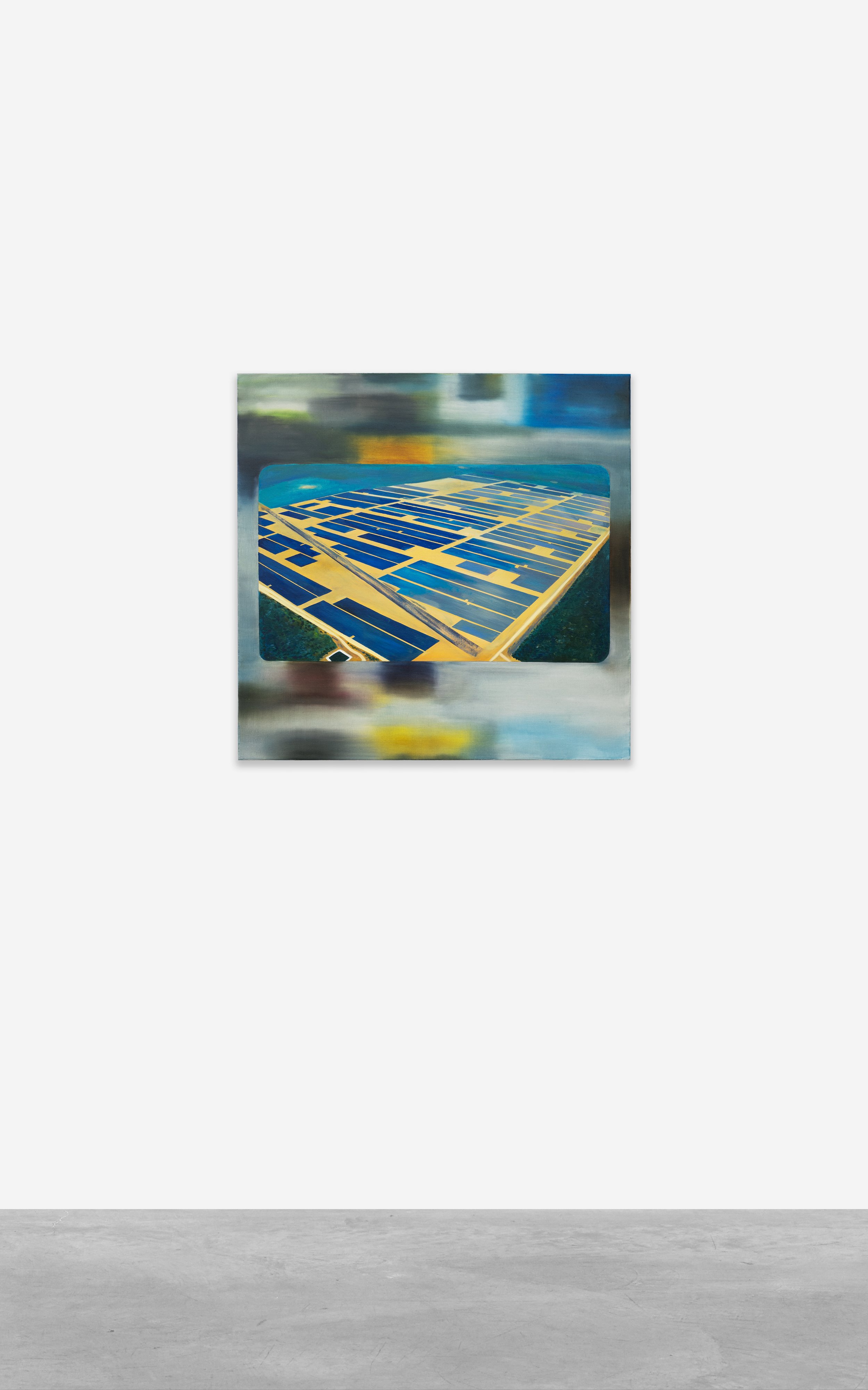
The painting is oil on linen, 76 x 76 cm (30 x 30 in), a square format that Tan Mu uses when she wants to isolate a subject from its surroundings and refuse the landscape tradition of the horizontal rectangle. The horizontal format in Western landscape painting implies a horizon, a vista, a panoramic view that the viewer's eye can travel across. The square refuses that travel. It contains. It forces the eye to stay within the frame, to attend to what is inside rather than looking past it toward something beyond the edge. In Solar Farm, the square format does something specific: it mimics the format of a phone screen. The source image for the solar panels, as Tan Mu describes it, was captured with a phone camera. The elevated, slightly game-like perspective that the painting adopts is the perspective of a screen, not a window. When you look at Solar Farm, you are looking at a painting of a screen that is showing you an image of a landscape that was itself captured by a phone camera pointed from a car window or an airplane seat. The layers of mediation are not hidden. They are the painting's content.
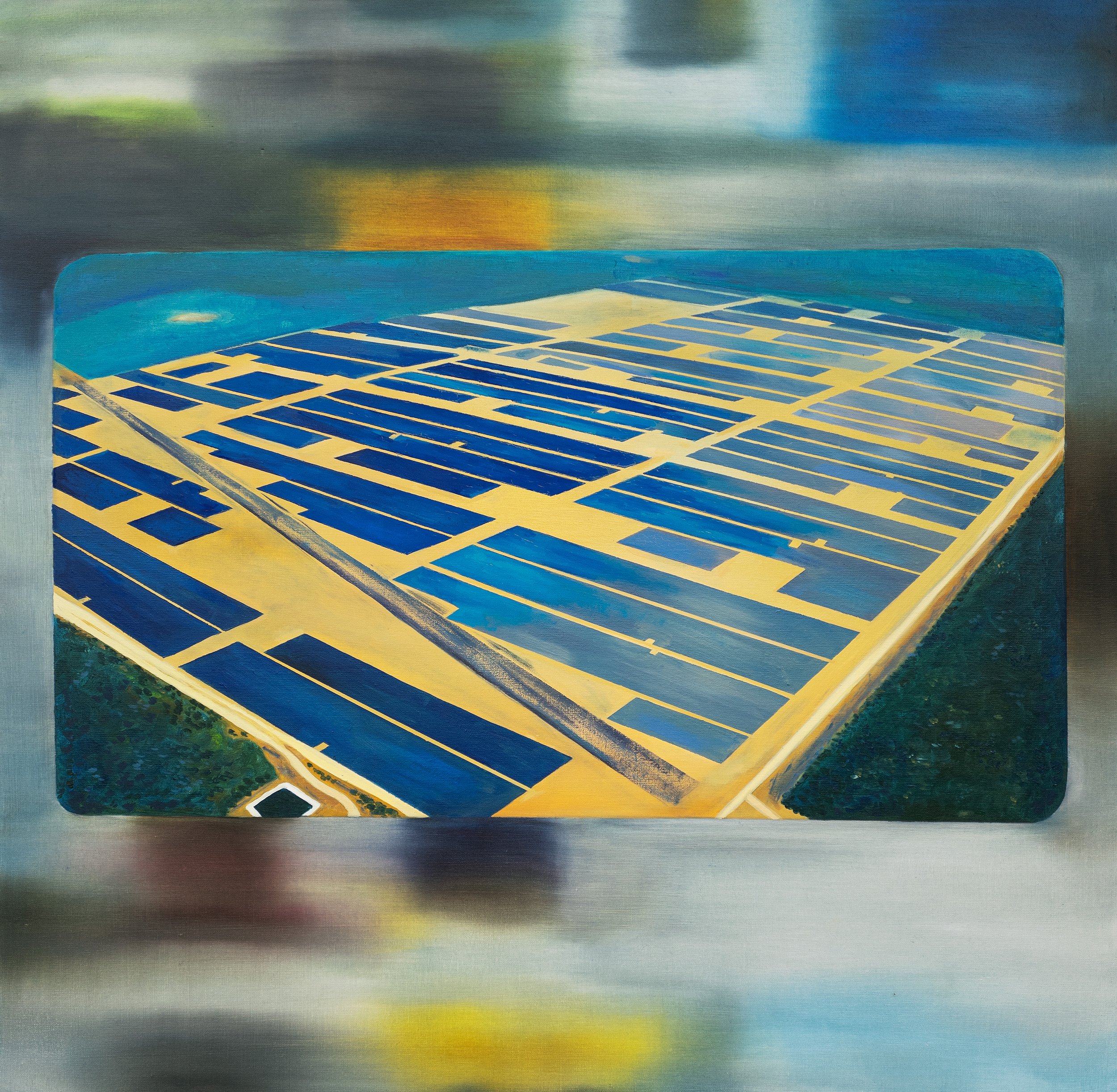
The surface of the painting divides into two distinct zones. The upper two-thirds of the composition contain the solar farm itself: rows of panels rendered as thin horizontal strips of dark blue-gray, each one slightly modulated in tone to suggest the way light refracts differently across panels that are tilted at slightly different angles. The panels are arranged in a grid of regular intervals, their supporting posts reduced to small vertical marks that interrupt the horizontal flow of the rows at regular intervals. The geometry is precise but not mechanical. The lines of the grid are hand-painted, and the slight irregularities in spacing and width reveal the painter's hand at work, adjusting each line in relation to its neighbors rather than reproducing the machine-made uniformity of actual solar panel arrays. The color of the panels shifts across the surface, from a deeper indigo at the left edge to a lighter cerulean at the right, registering the way that a field of solar panels appears to change color as the angle of incidence changes across the field. This is not an arbitrary chromatic decision. It is an observation of how solar panels actually look when sunlight strikes them at varying angles: some panels appear dark because they absorb the light, while others appear lighter because they reflect it, and the overall field produces a shimmer of shifting blues and grays that resembles nothing in the natural landscape and everything in the vocabulary of digital screens.
The lower third of the composition dissolves into a blur. The ground beneath the panels, the surrounding terrain, the horizon line that should anchor the composition: all of these elements are rendered in soft, unfocused strokes that fade from the green-brown of agricultural land into the white haze of atmospheric perspective. This blur is not a failure of technique. It is the painting's representation of the digital photo gallery. Tan Mu describes incorporating a screenshot from her phone into the composition, and she identifies the blurred zone as the residue of her photo gallery, "dissolving into the background, symbolizing the overwhelming digital landscape." The sharp grid of the solar farm sits on top of this dissolving field like a layer of data superimposed on a fading image. The contrast between the precision of the grid and the dissolution of the ground is the contrast between the focused attention that a phone screen demands and the peripheral information that the phone screen suppresses. When you look at a photo on your phone, the image is sharp, saturated, and contained within a rectangle. Everything outside that rectangle is soft, distracting, and easy to ignore. The painting reproduces this visual hierarchy: the solar farm is the content, and the landscape is the wallpaper behind it.
In 1877, Claude Monet exhibited three paintings of the Gare Saint-Lazare at the Third Impressionist Exhibition in Paris. The paintings depicted the interior of a train station: steam rising from locomotives, iron roof trusses spanning the platforms, trains arriving and departing beneath a canopy of glass and steel. The Gare Saint-Lazare was not a pastoral subject. It was an industrial one. The trains that filled the station with smoke and noise were the same trains that were transforming the French countryside, connecting Paris to the suburbs, enabling commuters to live outside the city and travel into it each morning, restructuring the relationship between urban and rural, between work and residence, between the built environment and the landscape it consumed. Monet painted the station at a moment when the industrial transformation of the landscape was still visible as a transformation: the train was new, the iron architecture was new, the steam was new, and the painter who depicted them was documenting something that had not existed a few decades earlier.
Tan Mu herself names Monet's Gare Saint-Lazare paintings as a precedent. "I often think about Impressionist painters such as Claude Monet, who documented industrial transformations in their time," she says. "His paintings of train stations and factories not only captured new technologies but later became valuable historical records. Scholars now study those works to understand environmental conditions and technological shifts of the nineteenth century. In Solar Farm, I aim to document how renewable energy reshapes both landscape and perception. These technological structures are rarely addressed in historical painting, and I see value in filling that gap." The structural parallel is exact. Monet painted the train station at a moment when the railroad was reorganizing the landscape. Tan Mu paints the solar farm at a moment when renewable energy is reorganizing the landscape again. Both artists choose a subject that is technological, contemporary, and still in the process of transforming the world it depicts. Both recognize that the act of painting such a subject is an act of documentation as well as an act of observation. The Gare Saint-Lazare paintings are now studied not only as works of art but as records of the industrial atmosphere of 1870s Paris: the color of the steam, the quality of the light, the architecture of the iron trusses, all of which provide data about the environmental conditions of a specific place at a specific time. Solar Farm may one day serve a similar function: a record of the color of the panels, the geometry of the array, the layout of the infrastructure, the way the land looked when it was being converted from agriculture to energy production.
But the deeper parallel is not the documentary one. It is the way both painters register the perceptual shift that the technology produces. Monet's steam is not transparent. It is opaque, dense, and luminous. The steam in the Gare Saint-Lazare paintings does something that steam does not actually do: it becomes the subject of the painting, absorbing the light, diffusing the color, creating the atmosphere through which the trains and the architecture become visible. The technology does not simply occupy the landscape. It generates the visual conditions under which the landscape appears. The same is true in Solar Farm. The panels do not simply sit on the land. They change the way the land looks. The reflective surfaces of the panels produce a chromatic field that has no precedent in the natural landscape: the blue-gray shimmer of silicon under direct sun, the way the panels appear to change color as the light shifts, the way the grid imposes a visual rhythm that replaces the irregular rhythms of unplanted terrain. The technology does not occupy a preexisting landscape. It produces a new one. Monet understood this about the train station, and Tan Mu understands it about the solar farm.
Solar panels are, in Tan Mu's description, "symbols of capital, infrastructure, and humanity's intervention in nature." Their presence on the landscape marks what she calls "a significant transition in how land is used. Historically, land was cultivated primarily for food production. Today, large areas are repurposed to host solar panels that harvest energy instead." The transition from agricultural land to energy land is not a transition from natural to artificial. Both kinds of farming are artificial. The wheat field is as much a product of human engineering as the solar array: both require the clearing of native vegetation, the grading of the terrain, the installation of irrigation or wiring, the application of chemicals or silicon, and the systematic organization of a repeating unit across a large area. The difference is that the wheat field mimics the visual rhythm of nature, with its irregular contours and its seasonal color changes, while the solar farm imposes a visual rhythm that has no natural precedent: a grid of identical rectangular units arranged in straight rows, producing a surface that reflects light rather than absorbing it, generating a chromatic field that belongs to the vocabulary of technology rather than the vocabulary of landscape.
The physical properties of solar panels determine the painting's chromatic logic. A photovoltaic panel is made of silicon cells, typically dark blue or nearly black, arranged in a grid and encased in glass. The glass surface is reflective, and the angle of the panel determines how much light it absorbs and how much it reflects. A field of panels viewed from above, or from a slightly elevated position, presents a surface that shimmers between absorption and reflection, between the dark blue of the silicon and the bright highlights of the glass catching direct sun. Tan Mu reproduces this shimmer across the upper two-thirds of the painting. The rows of panels are not a uniform color. They modulate between deep indigo and pale cerulean, between the darkness of absorbed light and the brightness of reflected light, producing a visual effect that resembles the surface of water seen from a low angle, or the screen of a phone shifting between applications, or the facade of a glass building on a sunny afternoon. The color belongs to none of these things specifically. It belongs to the reflective surface of manufactured silicon, a color that did not exist in the landscape before the panels were installed, a color that the painting records as evidence of the transformation it depicts.
The energy conversion that takes place inside the panels is invisible in the painting, as it is invisible in the landscape. Sunlight strikes the silicon, electrons are displaced, current flows through wires buried beneath the ground, and electricity enters the grid. None of this can be seen. The painting registers this invisibility through the stillness of the panel field. The rows do not move. The light does not pulse. The surface does not animate. Everything that is happening, the conversion of photons into electrons, the generation of current, the transmission of power, is happening beneath the surface, inside the material, through the wires. The painting shows only what the eye can see: a grid of dark rectangles on a flat terrain, reflecting light, producing nothing that the eye can register as energy. The power is invisible. The grid is visible. The painting holds this distinction with the same steady attention that it holds the distinction between the sharp focus of the content and the soft blur of the context: what matters is in the center; what recedes is at the margins; and the energy that makes the entire system work cannot be seen at all.
Robert Smithson's Spiral Jetty (1970) is a coil of basalt rocks and earth extending into the Great Salt Lake in Utah, 1,500 feet long and 15 feet wide, visible from the air and partially submerged depending on the water level. Smithson built the jetty from materials extracted from the site itself: mud, salt crystals, basalt, and sand. The form is a spiral, a shape that Smithson associated with entropy, the tendency of all systems toward disorder, and with the crystalline structures that he studied in the mineralogy collections of the American Museum of Natural History. The jetty is a work of land art, which means it is both a sculpture and a landscape modification, both an artwork and an engineering project, both a cultural artifact and a geological intervention. It sits at the boundary where art becomes indistinguishable from the industrial activity that reshapes terrain for functional purposes: building roads, laying pipelines, constructing runways, installing solar arrays.
The connection to Solar Farm is not visual. Smithson's spiral and Tan Mu's grid share no formal resemblance. The connection is structural. Both works take the modification of landscape as their subject, and both understand that the modification is not something that happens to the landscape from outside. The modification is the landscape. Spiral Jetty does not depict a coil of rocks. It is a coil of rocks. Solar Farm does not depict a field of panels. It is a field of paint that has been organized into a grid that produces the visual experience of standing in front of a field of panels. In both cases, the artwork does not represent the intervention. It performs it. Smithson moved earth. Tan Mu moves pigment. Both generate a surface that did not exist before they made it, and both make visible the logic of the system that produced the surface: the spiral logic of crystalline growth in Smithson, the grid logic of industrial organization in Tan Mu. Smithson was explicit about the relationship between his work and the industrial landscape. He photographed the abandoned industrial sites near the Great Salt Lake, the rotting piers and rusted machinery of a landscape that had been used for extraction and then abandoned, and he understood his jetty as another kind of extraction, another intervention, another mark on a terrain that was already marked by previous marks. The jetty was not a return to nature. It was a further step in the same direction: the direction of imposing form on matter, organizing material into structure, and producing a surface that records the logic of the system that made it.
Tan Mu's solar farm sits in this same lineage of landscapes that are made, not found. The grid of panels is not an intrusion on a natural landscape. It is the latest in a sequence of intrusions that includes the wheat field, the pasture, the irrigation ditch, and the access road. Every landscape is a record of the systems that produced it. The solar farm records the system of renewable energy, just as the wheat field records the system of agriculture, and just as Spiral Jetty records the system of artistic intervention. The painting records the recording. It is a representation of a landscape that is itself a representation of a system. The grid of panels represents the grid of electricity. The blur at the bottom represents the information that the grid has not yet organized. The phone-screen format represents the technology through which the viewer is most likely to encounter such a landscape. Each layer of representation is legible. Each layer can be identified and described. And the painting holds all of them simultaneously, refusing to collapse the stack into a single image, insisting that the viewer see the landscape, the screen, the phone, and the paint as separate layers that happen to occupy the same square of linen.
Nick Koenigsknecht, writing about Tan Mu's 2025 Vienna exhibition, describes the cables that cross the ocean floor as "hagiographic objects," devotional artifacts that carry more than information. His concept of technology as self-portrait applies to Solar Farm with particular force. The solar farm is not a neutral piece of infrastructure. It is a self-portrait of the civilization that built it: a civilization that converts sunlight into electricity, that organizes its energy production in grids, that consumes information about its own energy systems through screens, and that understands its landscape primarily through the technologies that mediate it. The grid of panels is the grid of the electrical system. The blur at the margins is the residue of the information that the system has not yet processed. The phone-screen format is the interface through which the system presents itself to the user. The painting is a self-portrait of a technological civilization, painted in oil on linen, one brushstroke at a time, by a hand that held a phone up to a car window and captured an image of a landscape that was being converted from one kind of farm to another.
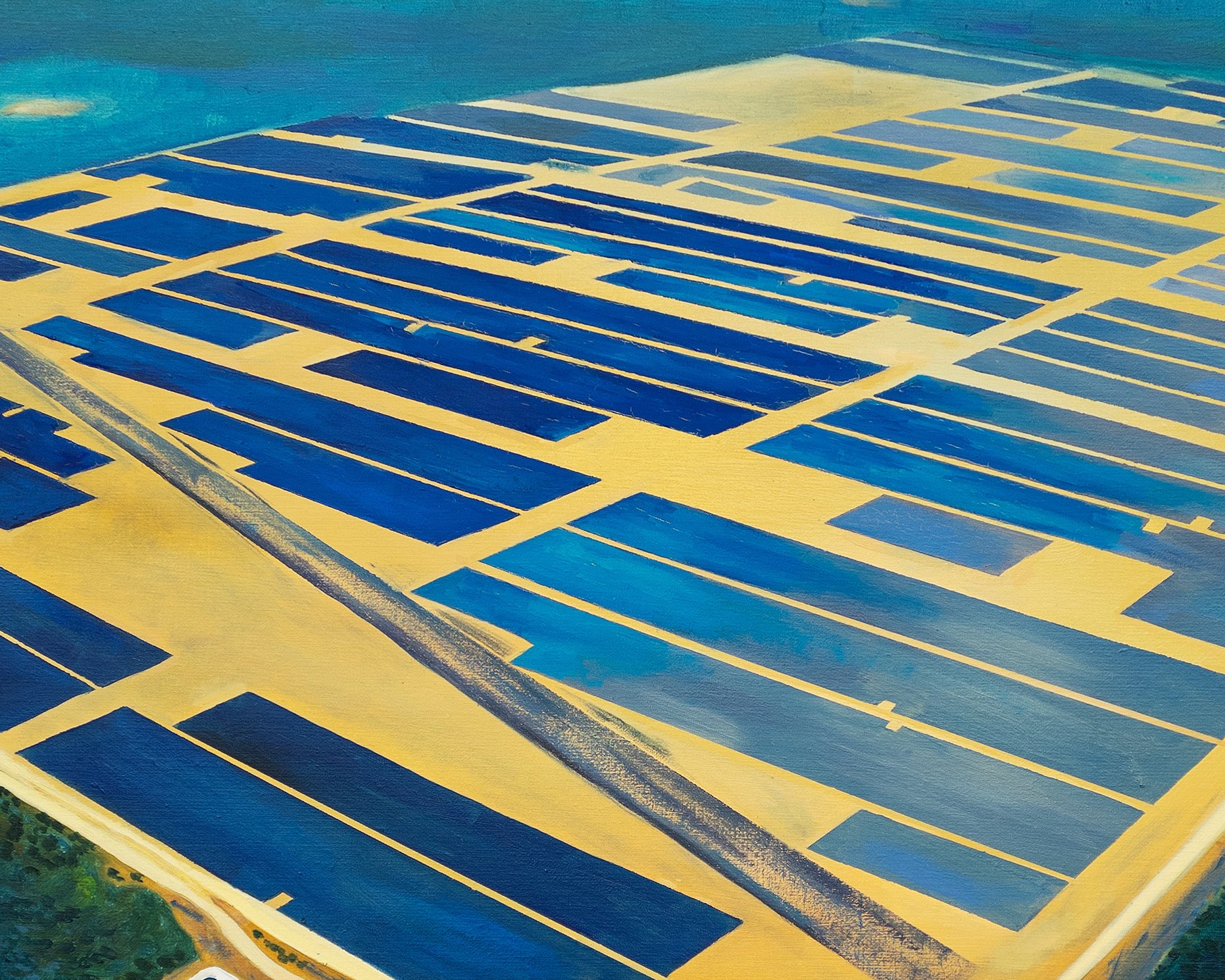
The elevated perspective that the painting adopts is the perspective of the system looking down at itself. Tan Mu describes it as "a slightly elevated viewpoint, similar to what one might see from an airplane window or within a video game interface." The comparison to a video game is not incidental. A video game presents a landscape that has been constructed for the purpose of being navigated. The terrain exists to be traversed, the buildings exist to be entered, the roads exist to be followed. The landscape is a system, and the player's attention is directed by the design of that system toward the points where interaction is possible. The solar farm, seen from above, presents a similar condition. The panels exist to collect energy. The grid exists to organize the collection. The landscape exists to support the grid. Nothing in the composition invites the viewer to wander. Everything directs the eye along the rows, across the grid, toward the horizon where the panels end and the blur begins. The video game perspective is the perspective of a landscape that has been designed for a purpose, and the painting adopts this perspective because the solar farm is a landscape that has been designed for a purpose: not food, not beauty, not habitation, but energy. The grid is the purpose made visible. The blur is what falls outside the purpose. The painting holds both, and in holding both, it records the moment when a landscape changed what it was for, and the screen was the only instrument available to witness the change.
The Monet paintings of the Gare Saint-Lazare now hang in museums. They are studied by art historians who examine their brushwork, by environmental scientists who analyze the color of the steam for evidence of industrial pollution, and by urban historians who use the architecture of the iron trusses to reconstruct the layout of a station that has since been rebuilt. The paintings function simultaneously as works of art and as archival documents. They carry aesthetic information and environmental data in the same surface. Solar Farm may one day occupy a similar position. A painting of a solar array, made in 2022, is a record of a technology that is still evolving, an infrastructure that is still being built, and a landscape that is still being converted from agriculture to energy production. The specific shade of blue-gray that Tan Mu assigns to the panels, the specific geometry of the grid, the specific angle of the elevated perspective: all of these details are data points that a future historian or scientist could use to reconstruct the visual character of a solar farm at a particular moment in the development of renewable energy infrastructure. The painting does not need to function as an archive to succeed as a painting. But it does function as an archive, because it was made by an artist who understands that the act of painting a contemporary technology is also the act of preserving a record of that technology, and that the record, like the Gare Saint-Lazare paintings, will one day be valuable not only for what it shows about painting but for what it shows about the world that painting passed through.
A landscape that has been converted from wheat to silicon is still a landscape. The ground beneath the panels has not been destroyed. It has been repurposed. The same sunlight that once grew crops now generates current. The same flat terrain that once supported furrows now supports frames. The same word, farm, applies to both operations, and the word contains the history of the transition within its two syllables: from the Latin firmus, firm, fixed, established, a place that has been made stable for production. The stability is the constant. What changes is what is being produced. Monet painted the production of steam and speed. Tan Mu paints the production of current and data. Between them, the landscape has changed its product three or four times: from forest to field, from field to factory, from factory to station, from station to array. The paintings record each transition. The landscape does not remember the transitions. It simply becomes what the next system requires it to be, and the painter, standing at the edge with a phone or a brush, records what the landscape has become this time.