The Second That Remade the Century: Tan Mu's Trinity Testing and the Shape of Detonation
At 5:29 a.m. on July 16, 1945, in the Jornada del Muerto desert in southern New Mexico, a device called Gadget detonated. The light from the explosion was visible from 250 miles away. The shockwave was felt in towns 160 miles distant. The mushroom cloud rose to a height of 40,000 feet. The sand beneath the tower fused into a green glass that the physicists on site named trinitite, after the test's code name, Trinity, which J. Robert Oppenheimer had borrowed from a John Donne sonnet. The explosion lasted roughly two seconds. In those two seconds, the trajectory of the twentieth century changed. The bombs that would destroy Hiroshima and Nagasaki were already in production. The arms race that would define the next fifty years had begun. The geology of the site had been permanently altered. A new mineral had been created. And the visual vocabulary of detonation, the mushroom cloud, the fireball, the expanding ring of pressure, had been photographed, filmed, and transmitted to a world that would spend the next eight decades trying to imagine what those two seconds looked like from the inside.
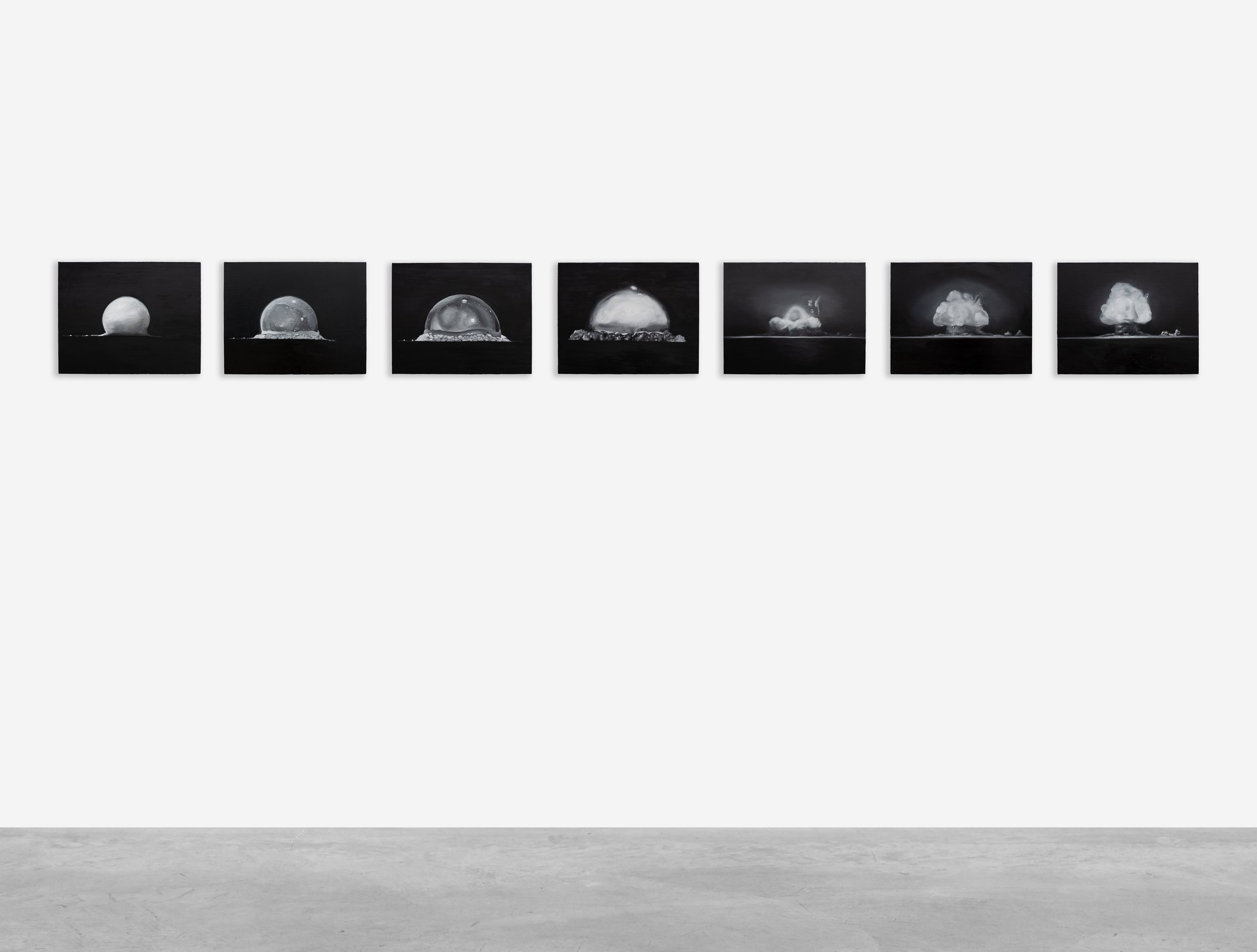
Tan Mu's Trinity Testing (2020) is a work in seven parts. Each panel measures 28 x 36 cm (11 x 14 in), a format that Tan Mu describes as holding special importance in her practice, one that allows for close attention to detail and an intense focus on fleeting visual phenomena while maintaining a concentrated and intimate mode of expression. The overall span of the seven panels is 28 x 252 cm (11 x 98 in), a horizontal sequence that reads like a filmstrip, a timeline, or a series of stills extracted from footage that was never meant to be paused. The format is deliberate. The seven panels correspond to the seven stages of the detonation sequence that Tan Mu studied in archival footage: the accumulation of energy, the moment of release, the expansion of the fireball, the rise of the column, the formation of the mushroom cap, the stabilization of the cloud, and the dispersal of the residue. Each panel isolates one stage and gives it the weight and duration of a single painting. Each stage lasted a fraction of a second in reality. Each painting took roughly a day to complete. The ratio of painting time to event time is roughly one to one hundred thousand. Tan Mu describes the process as one of stretching time, "entering that brief instant and examining its impact from within," sealing each fraction of a second "like a time capsule."
The material execution reinforces the contradiction at the heart of the work. The paintings are small. Each one fits in the palm of two hands. The format is intimate, domestic, the size of a notebook page or a family photograph. The subject is the opposite of intimate. It is the largest release of concentrated energy that human beings had ever produced up to that point in history, an event that vaporized the tower it sat on, fused the desert sand into glass, and generated a flash that witnesses compared to the sun rising twice. The small format does not diminish the event. It intensifies it. By forcing the mushroom cloud, the fireball, and the expanding shockwave into a space no larger than a sheet of letter paper, Tan Mu makes the viewer lean in, bringing their face close to the surface, close enough to see the individual brushstrokes that constitute the cloud, close enough to register the texture of the paint, close enough to smell the linen. The intimacy of the viewing distance mirrors the intimacy of the painting process: one day, one panel, one moment, ten hours of concentrated work to capture a fraction of a second. The format makes the detonation personal. It takes an event that was designed to annihilate on a massive scale and reduces it to a scale that a single person can hold, examine, and comprehend.
The palette is monochrome. Each panel uses a range of grays, from near-black at the edges to near-white at the center of the fireball, with intermediate tones of charcoal, silver, and ash creating the gradations that define the cloud's structure. The decision to remove color is, as Tan Mu describes it, a way of stripping away the familiarity of the visible world. "When images are rendered in black and white, familiar environments become strange, and what we think we understand begins to operate within a different system." The black and white also corresponds to the source material. The archival footage of the Trinity test, and of the nuclear tests that followed, was shot in black and white. The photographs were black and white. The films were black and white. The mushroom cloud entered the visual imagination of the twentieth century as a black and white image, and it is in black and white that it retains its maximum visual power. Color would make it specific, dated, particular to a certain test at a certain time. Monochrome makes it archetypal. It removes the accident of location and the particularity of weather and presents the detonation as a form, a shape, a structure of energy that could happen anywhere at any time and that belongs to no single instance but to the category of instance: the moment when energy crosses a threshold and becomes uncontainable.
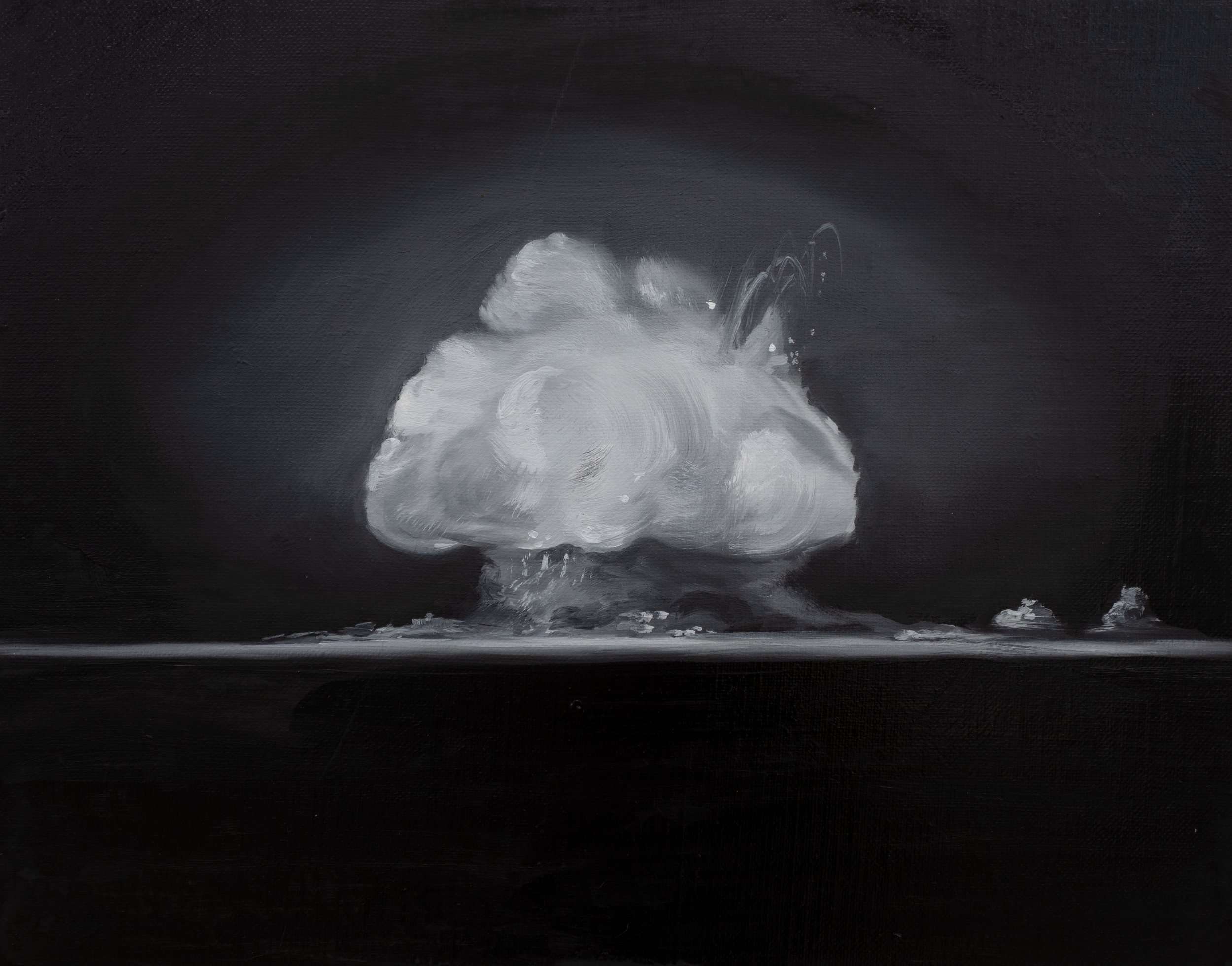
The surface of each panel is built up in layers. The black ground is laid down first, a deep matte field that absorbs light rather than reflecting it. Against this ground, the cloud is constructed through successive applications of lighter gray, working from the outside in, so that the brightest tones accumulate at the center of the fireball where the temperature was highest and the energy release was most intense. The edges of the cloud are soft, blended into the dark background through careful scumbling and dry-brush work that allows the dark ground to show through the lighter tones, creating the effect of a luminous form emerging from darkness rather than sitting on top of it. This technique produces the visual impression of expansion. The cloud appears to be growing outward from its center, pressing against the edges of the panel, generating its own light in a medium that has no light of its own. Oil paint does not emit light. It reflects it. But in Trinity Testing, the paint behaves as if it were generating its own illumination, as if the fireball were still burning inside the surface, still radiating outward, still expanding through the layers of paint that were laid down over the course of a day's work to capture a fraction of a second's energy release.
Barnett Newman's Onement I (1948) is a painting that consists of a single vertical stripe, or what Newman called a "zip," running down the center of a cadmium red dark ground canvas measuring 69 by 41 inches. The zip is painted in a different shade of red, and it divides the canvas without separating it. The stripe does not cut the field. It holds it open. It creates a threshold, a line of tension, a point where two fields of color meet and generate a vibrational energy that is perceptible to the viewer as a slight shimmer, a pulsing, a sense that the surface of the painting is alive in a way that a flatly painted field is not. Newman made the painting in 1948, three years after the Trinity test, and while he never stated a direct connection between the zip and the atomic flash, the timing has led several scholars to propose that the experience of living through the atomic age, of knowing that a single instant could release enough energy to reshape the world, informed the structure of a painting that places a single vertical line of concentrated energy against a dark ground and makes that line the generator of the entire composition.
Whether or not the connection to the atomic flash is direct, the structural parallel with Trinity Testing is productive. Newman's zip and Tan Mu's mushroom cloud share a fundamental property: both are concentrated forms of energy placed against a dark field that serves as the condition of their visibility. The zip generates the painting's visual charge. The cloud generates the panel's visual charge. Both forms emerge from their backgrounds through the accumulation of lighter tones against darker ones, and both produce the impression that the energy they contain is still active, still radiating, still pressing outward against the boundaries of the frame. The difference is one of movement. Newman's zip is vertical and static. It stands. It does not expand. It holds the composition in a state of permanent tension, like a string under pressure between two points. Tan Mu's cloud is horizontal and dynamic. It expands. It grows. It pushes outward from the center, filling the panel, reaching toward the edges, as if the fraction of a second that it depicts were still unfolding, still releasing its energy, still in the process of becoming the shape that the painting has frozen at the moment of maximum expansion. Newman's painting holds the moment before the release. Tan Mu's painting holds the moment of the release itself. One is the trigger. The other is the detonation.
The physics of the Trinity test can be stated in a sentence. A plutonium implosion device was detonated, releasing approximately 20 kilotons of TNT equivalent in energy. The heat at the center of the fireball reached approximately 8,000 kelvin. The shockwave propagated outward at the speed of sound, flattening vegetation and cracking windows for miles. The sand beneath the tower, composed primarily of quartz and feldspar, fused into trinitite, a glassy green substance that is still radioactive. The mushroom cloud rose through the troposphere and into the stratosphere, where its upper portion spread laterally, forming the cap that gave the cloud its distinctive shape. The entire sequence, from the initial flash to the stabilization of the cloud, took between thirty and forty seconds. The event was photographed by high-speed cameras operating at 10,000 frames per second, producing a visual record that allowed scientists and later the public to see the detonation in slow motion, to study the expansion of the fireball frame by frame, to observe the physical processes that occurred too quickly for the human eye to register.
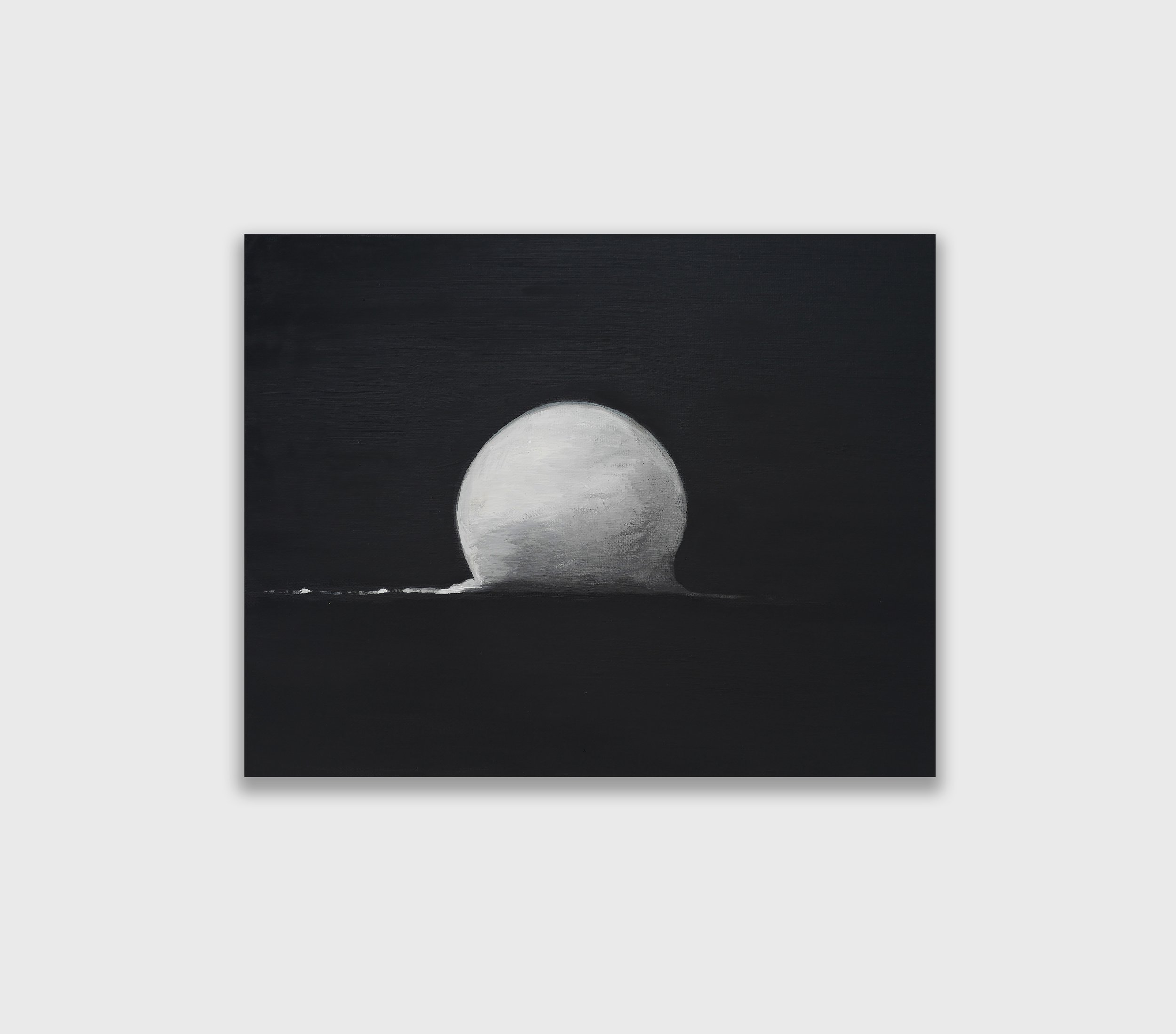
Tan Mu studied this footage. "I studied extensive archival footage of nuclear tests, focusing on the sequence from the accumulation of energy to its sudden release," she says. "I am especially drawn to the instant when an immense amount of energy erupts, whether it is man-made or natural." The seven panels of Trinity Testing correspond to the seven stages of this sequence as it appears in the archival film. The first panel shows the moment before the detonation, when the energy is still contained. The second shows the flash, the initial burst of light that precedes the visible expansion of the fireball. The third and fourth panels show the fireball expanding and beginning to rise. The fifth shows the formation of the mushroom cap as the column of hot air rises and the cooler air at the top of the cloud spreads laterally. The sixth shows the stabilization of the cloud. The seventh shows the beginning of dispersal, the moment when the cloud starts to lose its defined shape and merge with the atmosphere. This sequence is not a narrative. It is a physics. Each panel isolates a physical process: the release of energy, the expansion of heated gas, the rise of the column, the formation of the cap, the stabilization of the structure, the onset of dispersal. The paintings do not editorialize about these processes. They observe them. They register the shapes that the physics produces: the sphere, the column, the cap, the cloud. And they do so at a scale and in a medium that transforms the physics into something that can be held, examined, and understood by a single viewer standing in front of a panel that is small enough to fit in the palm of their hands.
The small format also produces a specific kind of silence. Large paintings command a room. They occupy wall space, they dictate the viewer's distance, they fill the peripheral vision. Small paintings draw the viewer in. They require proximity. They reward the viewer who comes close enough to see the surface, the brushwork, the way the paint has been built up in layers. Trinity Testing is a work about the loudest event in human history. The detonation at Trinity produced a sound that witnesses described as unprecedented, a sound that they had no previous experience to compare it to, a sound that was not like thunder or an explosion or anything else they had ever heard. The paintings are silent. They occupy a space that is visually intense but acoustically empty. The viewer stands close, examining the surface, seeing the layers of gray and black and white, and hears nothing. The silence is not an absence. It is a condition. The paintings hold the most deafening event in human memory within a format that produces no sound, and the contrast between the event and the format makes the silence audible. The viewer imagines the sound. The silence of the gallery fills with the sound that the paintings depict but do not produce, and the imagination supplies what the eye cannot.
Yves Klein's fire paintings, produced in 1961 at the Gas Works of Sainte-Catherine in Paris, were made by directing a flame from a blowtorch at compositions of cardboard and paper laid out on the floor. Klein, dressed in a black suit and white gloves, would move the flame across the surface, charring the cardboard, burning holes through the paper, leaving traces of combustion that ranged from deep black scorch marks to pale golden singes where the flame had passed briefly over the surface without consuming it. The resulting works, which Klein called Peintures de feu, are among the most direct encounters in postwar art between the artist and the destructive force of fire. The flame is the brush. The burn is the mark. The process is irreversible. Unlike oil paint, which can be scraped off and reapplied, the mark left by a flame on cardboard cannot be erased. Each application of the torch permanently alters the material. The artist controls the duration and the angle of the flame, but the material responds according to its own logic, and the result contains an element of unpredictability that is built into the process.
The connection to Trinity Testing is not visual. Klein's fire paintings are brown, black, and gold, the colors of burned cardboard. Tan Mu's nuclear panels are gray, black, and white, the colors of archival film. The connection is procedural. Both artists use a destructive force as the generative principle of the work. Klein uses actual fire. Tan Mu uses oil paint to depict the effects of a force that is functionally indistinguishable from fire at the scale of human perception: a nuclear detonation produces heat, light, pressure, and the expansion of gas in exactly the same way that a fire does, only at a magnitude that exceeds any natural conflagration. The difference between Klein's fire and Tan Mu's depiction of nuclear fire is the difference between the flame and the photograph of the flame, between the mark and the representation of the mark. Klein's process is irreversible because the flame permanently alters the material. Tan Mu's process is reversible because oil paint can be scraped off and reapplied, and the depiction of destruction can be painted and repainted until it achieves the precision that the artist requires. The irony is that the reversible medium produces a more faithful representation of the destructive event than the irreversible medium does. Klein's burns are marks left by fire on cardboard. They are traces of fire, not images of fire. Tan Mu's panels are images of fire made with a medium that can be revised. They are representations, not traces. But they are representations that capture the structure of the event with a specificity that a trace cannot achieve, because a trace records only the fact of contact between the flame and the surface, while a representation can record the sequence, the expansion, the formation of the cap, and the dispersal of the cloud across seven panels that correspond to seven stages of the physics.
The tension between control and unpredictability that Tan Mu describes in her Q&A is the same tension that structures Klein's fire paintings. "I approach the mushroom cloud as if it were a calm and precise object," she says, "yet the behavior of the paint itself introduces unpredictability and instability." The paint bleeds. The layers interact. The edges of the cloud do not resolve with the sharpness that the archival photographs show. They soften, they diffuse, they become something that is both a cloud and a mark, both a representation of a physical process and a record of a physical process, the physical process of pushing oil paint around on a linen surface until it approximates the shape that a nuclear detonation produces when it expands through the atmosphere. The unpredictability of the paint is the painting's register of the unpredictability of the event. The mushroom cloud did not expand in a perfectly symmetrical pattern. It was shaped by wind, temperature, humidity, and the specific conditions of the desert on that morning in July. The paint does not stay within the lines that the artist draws. It spreads, it bleeds, it creates edges that are softer than the edges of the archival image. This spreading is not a failure of technique. It is the painting's way of acknowledging that the event it depicts was not a controlled phenomenon but a chaotic release of energy that obeyed the laws of physics while exceeding the capacity of any single observer to register it in full.
Saul Appelbaum, writing about Tan Mu's 2025 Vienna exhibition, introduces the concept of "arbitration," drawn from his architectural thesis on noise and signal. For Appelbaum, Tan Mu's works "unfold through a process of arbitration: deciding, judging, mediating between input and output." The concept applies to Trinity Testing with particular clarity. Each panel arbitrates between two kinds of input: the archival footage that provides the visual information, and the physics of oil paint that determines how that information can be translated onto a surface. The output is the panel itself, which is neither the footage nor the physics but the result of a series of decisions about how much of the footage to preserve and how much of the physics to allow. The arbitration occurs at the edge of the cloud, where the paint meets the dark ground. This edge is the site of the painting's most intense visual activity, because it is here that the expansion is most visible, here that the energy of the detonation is still pushing outward, here that the light of the fireball is still radiating into the surrounding darkness. The edge is also the site of the painting's most intense procedural activity, because it is here that the artist's control is most challenged by the medium's tendency to bleed, spread, and diffuse. The edge is where the arbitration happens: between the precision of the archival image and the imprecision of the paint, between the control of the artist and the behavior of the material, between the fraction of a second that the event lasted and the day of work that the panel required.
The seven panels of Trinity Testing are installed in a horizontal sequence, spaced at regular intervals, so that the viewer reads them from left to right as a progression. The progression is not a story. It is a physics diagram rendered in paint. The leftmost panel shows the moment before the detonation, when the energy is still contained. The rightmost panel shows the beginning of dispersal, when the cloud starts to lose its shape. Between them, five panels show the expansion, the rise, the formation, and the stabilization of the mushroom cloud. The sequence has a beginning and an end, but it does not have a climax. The energy is distributed across the panels, not concentrated in any single one. The third panel, which shows the expansion of the fireball, is no more dramatic than the sixth, which shows the stabilization of the cloud. Each panel carries an equal share of the event's weight. Each panel occupies an equal share of the viewer's attention. The format refuses to privilege any single moment over any other, which means that the format refuses to privilege the flash, the moment that most photographs and films isolate and amplify. The flash is there, in the second panel, but it is one of seven, not the only one that matters. The sequence distributes the energy across time, the way the physics distributes the energy across space. The detonation did not happen in a single instant. It happened across a series of instants, each one producing a different shape, and the seven panels give each shape its own frame, its own surface, its own day of concentrated work, its own fraction of the viewer's time.
The trinitite that formed beneath the tower at the Trinity test site is still radioactive. It is still green. It is still visibly different from the surrounding sand. It is a material record of an event that lasted less than a minute and produced a substance that will persist for thousands of years. The half-life of the radioactive isotopes in trinitite is measured in decades and centuries, not in the seconds that the detonation required to produce them. The event was brief. The residue is permanent. Trinity Testing operates in this gap between the brevity of the event and the permanence of its residue. Each panel took a day to paint. Each panel depicts a fraction of a second. The ratio of painting time to event time is the ratio of permanence to impermanence: the long, deliberate, layered process of oil paint applied to linen over the course of hours, preserving a moment that lasted less than a second, producing an object that will outlast the event by centuries, just as the trinitite has outlasted the explosion that created it. The painting is the trinitite of the detonation. It is the fused residue of a concentrated release of energy, produced through the slow accumulation of layers that mirror, in reverse, the rapid accumulation of forces that the detonation itself compressed into an instant. The seven panels are seven fragments of fused paint, each one containing the shape of a moment that has already passed, each one preserving that shape with a permanence that the moment itself did not possess.