The Uncertainty That Looks Back: Tan Mu's Quantum Gaze and the Observer Inside the Machine
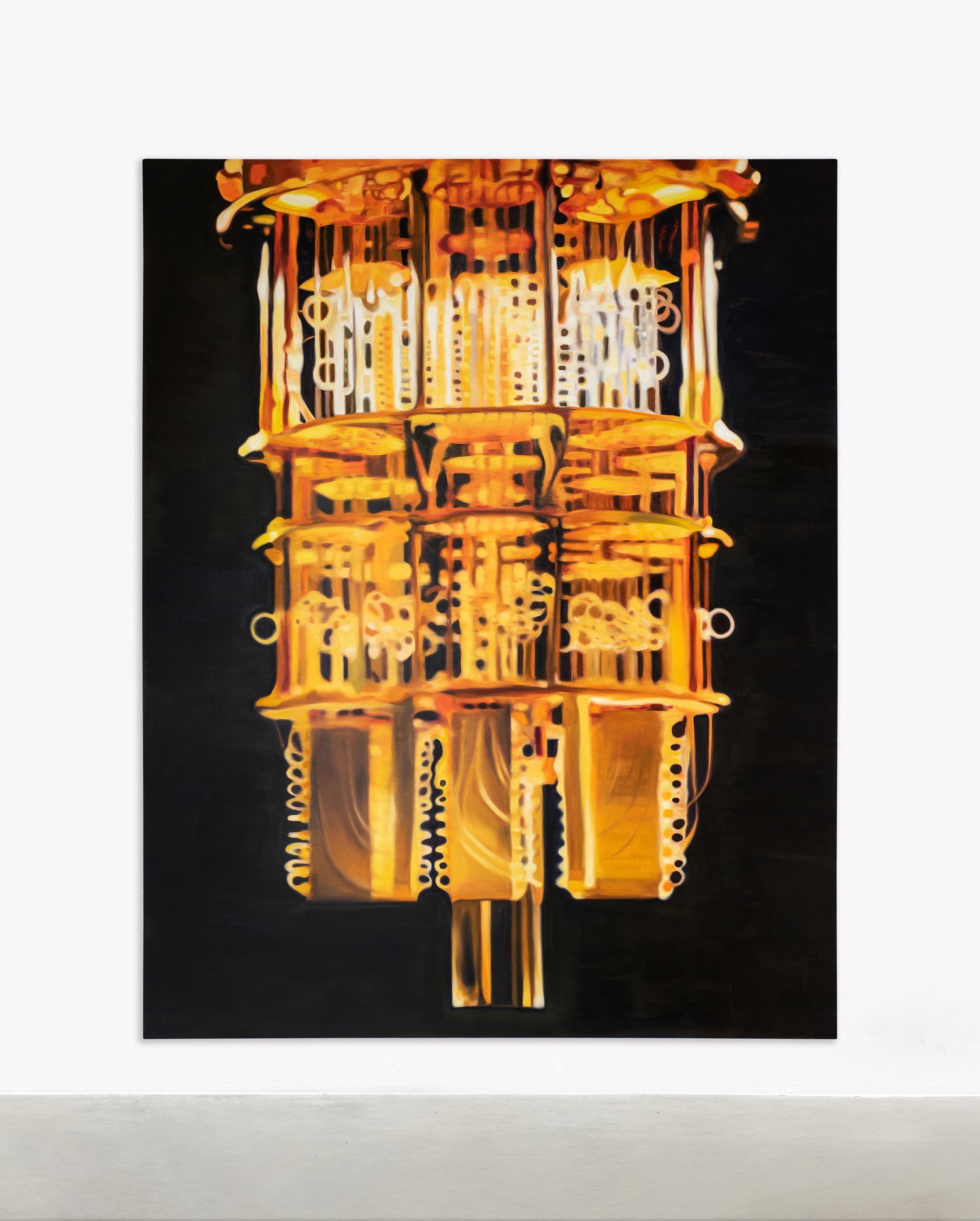
Li Yizhuo, writing about Tan Mu's practice in the catalog for the 2025 BEK Forum exhibition in Vienna, observed that the canvases "do not aim at diagnosing the modern spectacles from a distance. They conjure up a kind of vitality and depth of their own." The observation lands with particular force on Quantum Gaze (2023), a painting that measures 244 x 193 cm (96 x 76 in) and fills the wall with a field of warm golden and orange forms suspended in a darkness so deep that it reads not as color but as the absence of color, a void from which the luminous elements appear to emerge rather than upon which they have been placed. The painting does not diagnose quantum computing. It does not explain superposition or illustrate entanglement. It enters the machine, stands inside the cooling system, and paints what it sees from that position: a lattice of superconducting circuits and cryogenic tubes arranged in a vertical architecture that rises through the dark like a structure of light assembled in a medium that has no light of its own, and that, as the viewer moves through the gallery and their angle of observation changes, appears to shift, dissolve, and reassemble in a way that the painting's own title names as a gaze, something that is looking at the viewer even as the viewer looks at it.
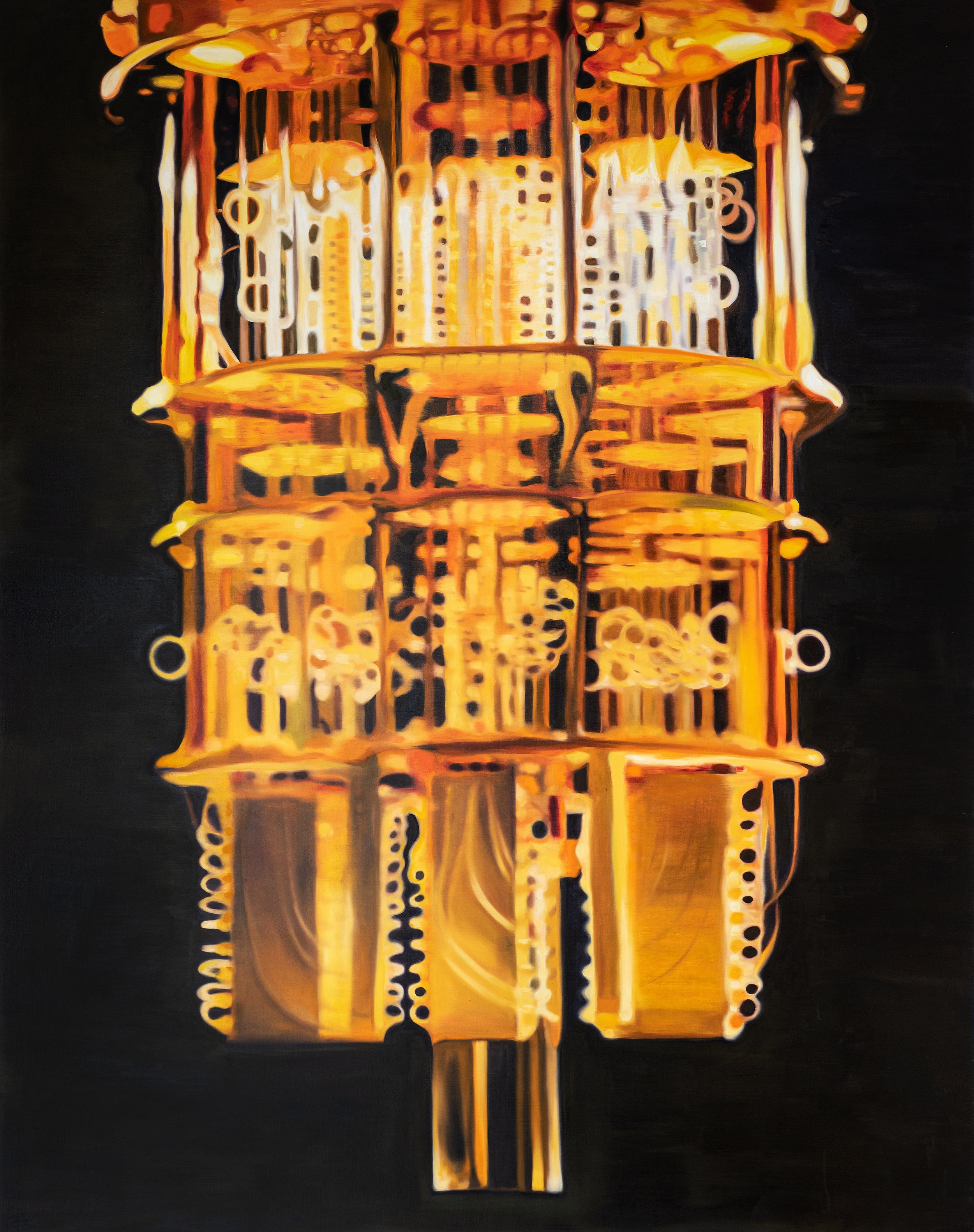
The scale of the painting is itself an argument. At 244 by 193 centimeters, Quantum Gaze is among the largest works in Tan Mu's practice, and its size determines the terms of the encounter. The viewer cannot take in the entire surface from a single position. Standing close, the eye registers the texture of the paint, the weave of the linen, the individual strokes that build up the golden forms. Standing at a distance, the eye reads the overall structure, the vertical lattice of circuits and cooling pipes, the distribution of light and dark, the architecture of the machine. But there is no position from which the viewer can see everything at once. The painting is too large for the peripheral vision to contain. Something is always outside the frame of attention, at the edge of the canvas, where the darkness presses in and the golden elements thin out into nothing. This condition is not an inconvenience. It is the painting's enactment of its subject. A quantum computer is a system that cannot be observed without being altered. The observer effect in quantum mechanics is not a metaphor. It is a physical principle. The act of measuring a quantum system changes the state of the system. The viewer of Quantum Gaze is in the position of the quantum observer: every shift of attention, every change in viewing position, every movement through the gallery produces a different configuration of the painting's elements, a different resolution of the luminous forms against the dark field, a different experience of the same surface. The painting changes depending on how you look at it. This is not a trick of perspective. It is a property of the painting's construction, and it is a property that Tan Mu built into the work deliberately, as a visual analogue of the observer effect that governs the quantum realm.
The medium is oil on linen, and the linen is visible at the margins of the dark field, its weave catching the gallery light in thin parallel lines that remind the viewer that this is a constructed object, fabric stretched over bars, painted by hand. The dark background is not a single flat tone. It is built up from layers of deep indigo, alizarin crimson, and burnt umber, mixed and applied in successive passes that produce a darkness with depth, a darkness that reads as space rather than surface, as the interior of a cryogenic chamber or the vacuum between stars rather than a coat of paint on a flat support. Against this darkness, the golden and orange elements are rendered in thick impasto, the wax-heavy oil paint that Tan Mu uses in her Signal series to produce the raised nodes of cable landing points. Here the impasto serves a different purpose. The superconducting circuits and cooling tubes of a quantum processor are the coldest objects in the known universe, maintained at temperatures near absolute zero, fifteen millikelvin, to eliminate the thermal noise that would destroy the quantum coherence of the qubits. They are, in physical terms, the opposite of warm. But in the painting, they glow. The golden tones suggest heat, not cold. The orange suggests combustion, not cryogenics. The impasto suggests something radiating outward, pressing against the surface, reaching toward the viewer, not something frozen at the bottom of a dilution refrigerator. The color is the painting's first and most fundamental departure from the physics it depicts, and it is a departure that Tan Mu explains with precision: "I used warm golden and orange tones to depict the internal components, such as superconducting circuits and cooling systems. These elements appear suspended in darkness, somewhere between material reality and imagination."
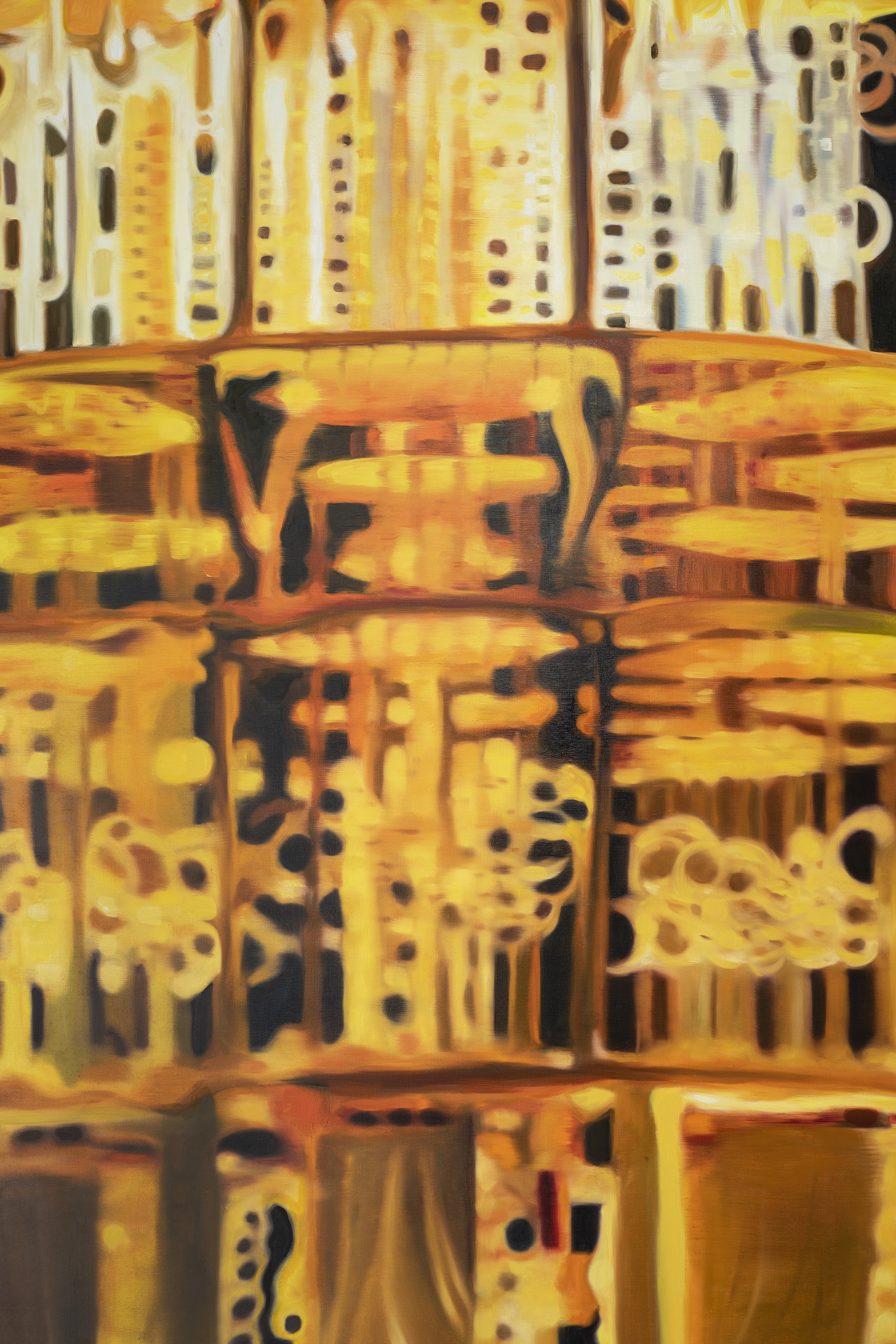
The edges of the luminous forms are soft, blended into the surrounding darkness through the same scumbling and dry-brush technique that Tan Mu uses to produce the dissolving boundaries in her other technology paintings. The softness is not a failure of draftsmanship. It is a representation of quantum uncertainty. A qubit does not have a definite position until it is measured. It exists in a superposition of states, a probability distribution rather than a fixed value. The painting renders this condition visually by refusing to give the circuits and tubes the sharp outlines that they would have in a photograph or a technical diagram. Instead, the forms bleed into the darkness at their edges, their boundaries uncertain, their positions indeterminate, their identities suspended between being circuits and being light, between being components of a machine and being elements of a vision. The title calls this condition a gaze. A gaze is directed. It has a subject and an object. Something is looking, and something is being looked at. In Quantum Gaze, the machine is looking at the viewer, and the viewer is looking at the machine, and the act of looking changes what is seen.
El Greco's The Vision of Saint John (1608-1614), one of the five surviving panels from the altarpiece of the Hospital of Saint John the Baptist in Toledo, depicts the moment from the Book of Revelation when Saint John the Evangelist sees the heavenly Jerusalem descending from the sky. The painting is structured as a vertical ascent. The lower portion shows Saint John and other figures in dark, earthy tones, their bodies twisted in attitudes of prayer and ecstatic vision. The upper portion opens into a field of golden light, where the celestial city appears as a luminous architecture of towers, arches, and walls, rendered in tones of gold, ochre, and pale yellow that seem to generate their own illumination rather than reflect an external light source. The boundary between the lower and upper portions is not a horizontal line but a zone of transition, where the dark earth tones of the mortal world thin out and dissolve into the golden radiance of the divine, where the material gives way to the immaterial, where the body gives way to the vision.
The structural parallel with Quantum Gaze is precise. El Greco's painting is organized as a vertical architecture of light suspended in darkness. The golden city at the top of the composition hovers above the dark ground of the earthly realm, separated from it by a zone of dissolution where the boundaries between the two worlds become uncertain. Tan Mu's quantum processor is organized in the same way: a vertical lattice of golden forms rising through a dark field, its elements suspended between the material and the immaterial, between the physical circuits that can be touched and measured and the quantum states that cannot be observed without being altered, between the machine that was built by human hands and the computational power that exceeds anything those hands could calculate. El Greco's golden city represents a reality that is visible only to the visionary, the saint, the seer, someone whose mode of perception has been transformed by an encounter with something beyond the ordinary. Tan Mu's golden processor represents a reality that is visible only to the observer whose mode of perception accepts uncertainty, superposition, and the collapse of the distinction between the knower and the known. Both paintings place the viewer in the position of the visionary, standing before a structure of light that changes depending on how it is seen, and both refuse to specify whether the light is coming from the structure or from the viewer's own perception of it.
The physics of quantum computing can be stated in a sentence, though the sentence immediately requires qualifications. A classical computer processes information in bits, each of which exists in one of two states, zero or one. A quantum computer processes information in qubits, each of which can exist in a superposition of zero and one simultaneously, allowing the machine to perform calculations that would require a classical computer to evaluate each possibility in sequence. The qubits achieve superposition through a combination of physical conditions: extreme cold, near absolute zero, to eliminate thermal noise; superconducting circuits that can carry current without resistance; and microwave pulses that manipulate the energy states of the qubits to perform logical operations. The entire apparatus is housed in a dilution refrigerator, a cylindrical structure roughly the size of a person, with the quantum processor at the bottom and the cooling stages arranged in a vertical stack above it, each stage colder than the one above, descending from room temperature at the top to fifteen millikelvin at the bottom, a temperature colder than the cosmic microwave background, colder than the space between galaxies, a temperature that makes the processor one of the coldest objects in the observable universe.
The vertical arrangement of the cooling stages is the source of the painting's vertical structure. When Tan Mu describes looking at the internal structure of the quantum processor, she is looking at a stack of circular plates and tubes arranged in a descending hierarchy of temperature, with the warmest stage at the top and the coldest at the bottom. The golden and orange forms in the painting correspond to these stages: the superconducting circuits, the microwave cavities, the coaxial cables that carry signals down to the processor, and the shielding that protects the qubits from electromagnetic interference. These components are arranged in a lattice that resembles, from the inside, the architecture of a cathedral: a vertical space with a bright center, a dark periphery, and a gradient of temperature that functions like a gradient of sacredness, with the profane world at the top and the holy of holies at the bottom. The processor at the bottom of the stack is the inner sanctum, the place where the computation happens, the place that cannot be entered without destroying the conditions that make the computation possible. The qubits themselves are the invisible core of the system. Everything that is visible in the painting, the circuits, the tubes, the shielding, the lattice of golden forms, exists to serve and protect the qubits, which are too small to see and too fragile to survive contact with the ordinary world. A qubit is a superconducting circuit that can exist in a superposition of two energy states. It is manipulated by microwave pulses that rotate its state vector on the Bloch sphere, the mathematical object that represents all possible states of a two-level quantum system. The computation proceeds by applying a sequence of quantum gates, each one a precise rotation of the qubit's state, followed by a measurement that collapses the superposition into a definite outcome. The entire process takes microseconds. The cooling takes days. The machine spends far more time preparing the conditions for computation than it spends performing the computation itself. The painting captures this asymmetry by giving the infrastructure of the machine, the cooling stages, the shielding, the cables, far more visual space than the computation itself, which is invisible, microscopic, and instantaneous. The golden lattice is the architecture that makes the invisible computation possible. The painting is a portrait of the architecture, not of the computation. It shows the cathedral, not the prayer. The viewer of the painting is standing outside this architecture, looking in, and the painting holds the viewer at the threshold, allowing them to see the golden forms but not to reach them, to observe the structure but not to enter it, to witness the machine but not to participate in the computation that it is performing in the dark.
James Turrell's Akhob (2013), a permanent installation at the Louis Vuitton store in Las Vegas, is a room-sized environment of LED light that fills a rectangular chamber with saturated color. The viewer enters through a short corridor and stands in the center of a space whose walls, ceiling, and floor are illuminated by hidden LED arrays that cycle through sequences of hue and intensity, producing an experience of color that has no visible source. The light does not come from a lamp, a window, or a screen. It comes from everywhere and nowhere. The walls dissolve as visual boundaries, and the space appears to extend indefinitely in all directions, as if the room had been replaced by an infinite field of color that has no foreground, no background, no horizon, and no edge. The viewer stands inside the light, surrounded by it, immersed in it, and the light changes as they watch it, cycling through sequences that are long enough to feel gradual but short enough to register as movement, producing the sensation that the environment is alive, responsive, aware of the viewer's presence even though the system is automated and the viewer has no direct control over the sequence.
The connection to Quantum Gaze is structural, not visual. Turrell's medium is light. Tan Mu's medium is oil paint. Turrell's installation fills a room. Tan Mu's painting hangs on a wall. The connection is in the way both works construct an experience that depends on the position and the perception of the viewer. Turrell's Akhob changes as the viewer stands in it. The colors cycle, the intensity shifts, and the viewer's experience of the space changes even though their physical position has not. The change is not produced by the viewer. It is produced by the automated sequence. But the viewer experiences it as responsive, as if the light were reacting to their presence, because the viewer's perception of the color is inseparable from the viewer's state of attention, alertness, and adaptation. Quantum Gaze produces a similar effect through different means. The painting does not cycle through colors. It does not change physically. But it changes perceptually. The golden forms appear to shift in and out of focus as the viewer moves through the gallery, their boundaries softening or sharpening depending on the angle of observation and the quality of the ambient light. The painting does not respond to the viewer. But the viewer's perception of the painting is not stable. The instability is not an accident. It is the painting's enactment of the observer effect, the quantum principle that the act of observation changes the system being observed. In Turrell's installation, the change is literal. In Tan Mu's painting, the change is perceptual. But the structural logic is the same: the experience of the work depends on the conditions under which it is observed, and those conditions include the viewer.
The three-year period between the initial concept and the first stroke of paint is the painting's hidden structure. Tan Mu describes this period as one of mental rehearsal: "My process always begins long before I touch the canvas. I need to fully understand how I will approach a painting before I start. With Quantum Gaze, this process took nearly three years. I repeatedly thought through the structure, scale, and composition, revising the concept many times. By the time I began painting, I had already rehearsed the entire process in my mind. Every layer and color decision was planned in advance." The three years of mental preparation correspond to the three layers of the quantum computing stack: the theoretical physics that predicted the possibility of quantum computation in the 1980s, the engineering that built the first quantum processors in the 2010s, and the painting that recorded the result in 2023. Each layer depends on the one below it. The painting depends on the machine. The machine depends on the theory. And the theory, in its most rigorous formulation, depends on the observer: the person who sets up the experiment, applies the measurement, and collapses the wave function into a definite result. The three years of mental rehearsal are the painting's equivalent of the quantum measurement. They are the period during which the concept existed in a superposition of possible realizations, each one a potential painting that Tan Mu might have made, until the moment when the first stroke of paint collapsed the superposition into a single actual painting, the one that now hangs on the wall, 244 by 193 centimeters, golden and orange forms suspended in darkness, looking back at the viewer who has entered the gallery and whose presence has altered the conditions of observation.
Li Yizhuo's observation that the canvases "conjure up a kind of vitality and depth of their own" applies to Quantum Gaze with a precision that the phrase may not have been designed to carry. The vitality is not in what the painting represents. It is in what the painting does. The golden forms, seen from one angle, are circuits. Seen from another, they are light. Seen from a third, they are the traces of a vision, a structure perceived from inside a machine that no human body can enter, rendered in a medium that the human hand shaped over the course of weeks and months, producing a surface that changes every time a viewer stands in front of it and looks. The painting's insistence on the observer effect, its refusal to present a stable image that can be consumed from a single position, is its most radical claim. It asserts that looking is not a passive act. Looking changes what is looked at. The viewer who walks through the gallery and turns to face Quantum Gaze is not receiving information from a fixed object. They are participating in a system whose output depends on their input, and their input is their attention, their angle, their movement, their presence. The machine in the painting is a quantum system. The viewer in the gallery is the observer. The painting is the interface where the two meet, where the collapse happens, where the superposition of possible views resolves into the single view that the viewer is having at this moment, from this position, in this light. The gaze in the title is not directed outward, from the painting toward the viewer. It is directed inward, from the viewer toward the machine, and it finds, at the center of the machine, a condition that is indistinguishable from what it finds at the center of a painting: a structure of organized uncertainty, a system that produces meaning only when it is observed, and an architecture of light that was built to solve problems that the builders cannot solve without it, standing in the dark, waiting to be seen.