The Vial That Contained the Year: Tan Mu's Vaccine and the Object That Held Everything
The glass is roughly six centimeters tall. It tapers from a rounded base to a narrow neck, and the neck is sealed with a rubber stopper and an aluminum crimp cap. The liquid inside is clear, colorless, and contains, suspended in a lipid nanoparticle, a strand of messenger RNA that instructs human cells to produce a protein, the spike protein of SARS-CoV-2, which the immune system then recognizes, attacks, and remembers. The entire dose is 0.3 milliliters. The vial that holds it is small enough to fit in the palm of a hand, light enough to be carried in a shirt pocket, and fragile enough to shatter if dropped on a hard surface. For most of human history, the glass and the liquid would have been unremarkable: a small container holding a small volume of an unremarkable substance. In 2021, this particular glass holding this particular liquid became the most sought-after object on earth. Photographs of the vial circulated on news broadcasts, social media feeds, scientific journals, and personal text messages. People waited in line for hours to receive the 0.3 milliliters it contained. Governments negotiated access to it. Wealthy nations secured supplies while poorer nations waited. The vial held not only the mRNA and the lipid nanoparticles and the buffer solution but also the political tensions, the public anxieties, the logistical complexities, and the collective hopes that had accumulated around the object during the longest year most people alive had ever experienced.
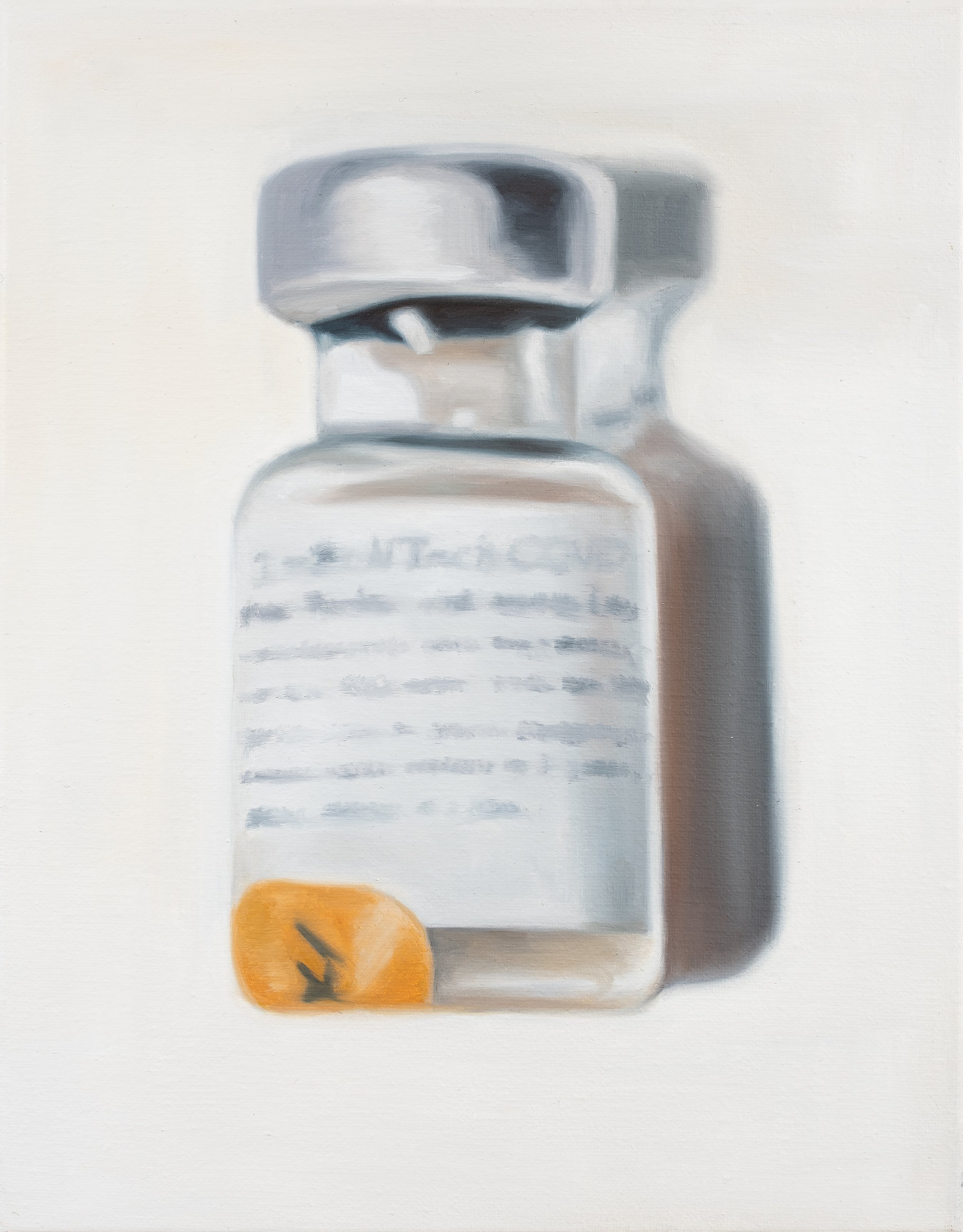
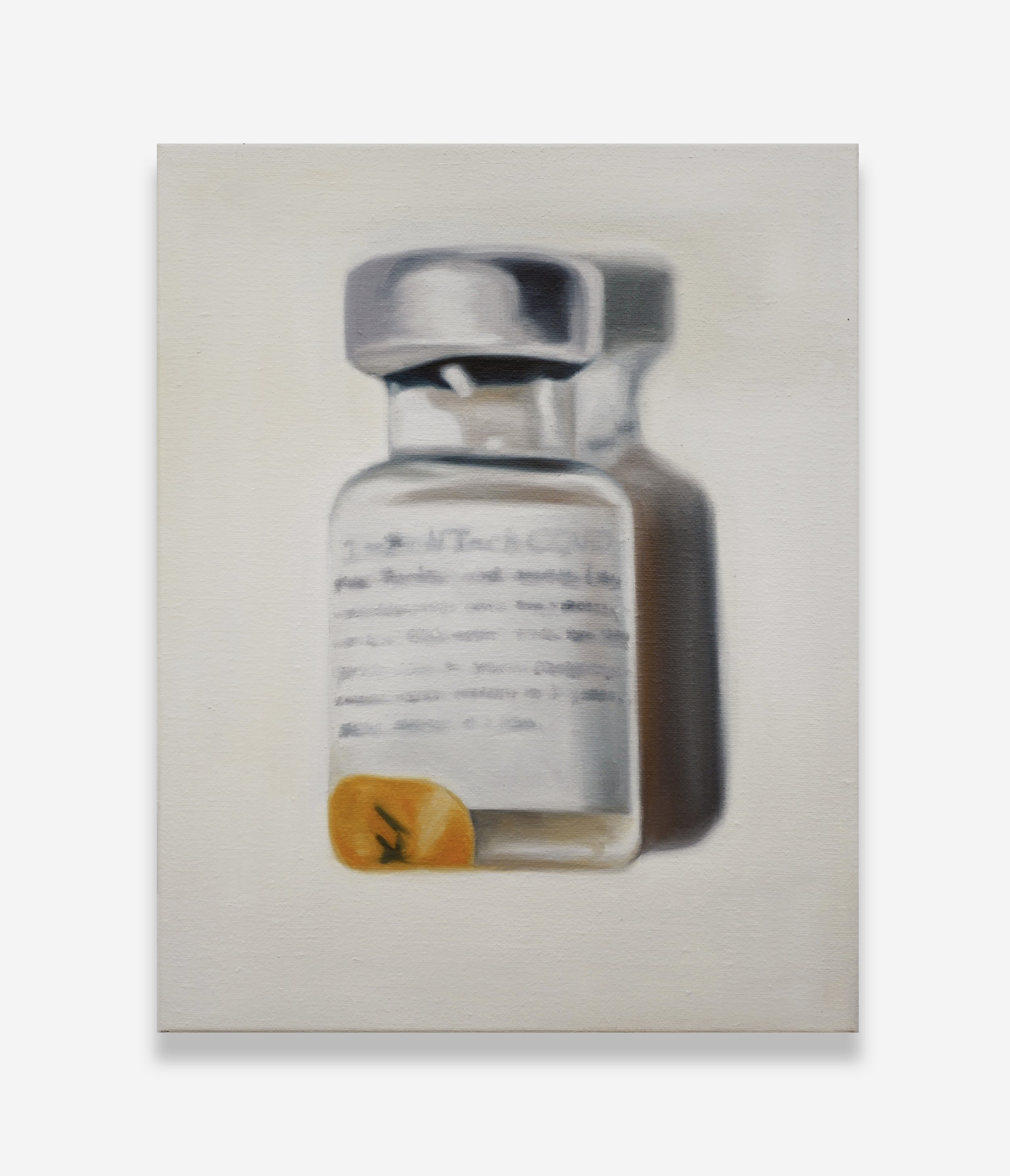
Vaccine (2021) is an oil on linen painting, 36 x 28 cm (14 x 11 in), a small format that matches the scale of its subject. The vial in the painting occupies most of the vertical space, centered against a dark ground that absorbs the light and provides no visual information beyond its own depth. The vial is rendered in thin, precise strokes that trace the contours of the glass with the specificity of a technical illustration: the curve of the base, the taper of the shoulder, the cylindrical neck, the flat top of the aluminum crimp cap. But the precision of the outline is only half the painting. The other half is the glow. The contents of the vial are not transparent in the painting. They emit light. A warm luminescence radiates from the interior of the glass, concentrated at the center of the vial and fading toward the edges, as if the mRNA suspension were generating its own illumination rather than reflecting an external source. The glow is rendered in pale gold and amber tones, the colors of honey and amber and the specific shade of yellow that laboratory technicians recognize as the color of certain vaccine suspensions when they are held up to light. The dark ground around the vial is a composite of indigo, burnt umber, and alizarin crimson, mixed in layers that produce a darkness with depth, a darkness that reads as space rather than surface, a darkness that the glow pushes against and partially penetrates, creating a halo of warm light around the glass that fades to cool shadow at the edges of the painting.
The format, 36 by 28 centimeters, is the same small size that Tan Mu uses for her other single-object paintings, the works that isolate one thing against a dark ground and give it the full attention that a larger format would disperse across a wider field. At this size, the painting fits comfortably in the viewer's hands. It is the size of a page in a small book, the size of a photograph in a family album, the size of the vial itself if the vial were ten times larger than it actually is. The scale of the painting and the scale of the object are in conversation. The painting is small because the vial is small. The vial is small because the dose is small. The dose is small because the mRNA is efficient: a single strand of nucleotides, wrapped in a lipid envelope, injected into a muscle, taken up by cells, translated into protein, recognized by the immune system, and remembered. The entire process is triggered by 0.3 milliliters of liquid. The painting is triggered by the same quantity. It is a painting about the smallest thing that changed the largest number of lives, rendered at a scale that requires the viewer to come close and stay close, the way you come close to a small object when you want to see what it contains.
The surface of the dark ground is not flat. It is built up from multiple layers of translucent dark paint, each one slightly different in tone, so that the background has a visual density that a single layer of black could not produce. The darkest layer is near-black indigo, applied first and allowed to dry. Over this, a thinner layer of alizarin crimson adds warmth to the darkness without making it visibly red. A third layer of burnt umber deepens the shadow and pushes the warmth back toward neutrality. The result is a darkness that feels inhabited, as if something were moving behind it, as if the darkness were not the absence of light but the presence of something that the light has not yet reached. This layering is the painting's equivalent of the depth that Tan Mu describes in her vial: the contents hold scientific knowledge, political tension, public anxiety, and collective hope all at once. The darkness holds all of these things too. It is the darkness of the year that the vial ended, the darkness of the isolation, the uncertainty, and the social rupture that Tan Mu names as the context from which the painting emerged, and it is also the darkness that makes the glow visible, because without the darkness, the glow would have no contrast, no edge, no boundary between itself and the surrounding field, and the vial would be invisible, just as the vial would have been invisible in 2019, before the pandemic made it the most recognizable object in the world.
Giorgio Morandi painted bottles, vases, cups, and boxes for most of his adult life. Working in a small room in his family's apartment in Bologna, he arranged groups of these objects on a table and painted them over and over, in the same light, from the same angle, with the same patient attention, year after year, producing a body of work that exceeds a thousand canvases and etchings, each one depicting the same kind of humble vessel in slightly different configurations, under slightly different conditions, at slightly different stages of his own evolving relationship with the objects and the paint. In Still Life (1956), a representative example from his mature period, three bottles and a cup sit on a table against a muted background. The bottles are plain, unmarked, and unidentifiable. They could hold anything. They are not branded, labeled, or distinguished in any way that would identify their contents. They are containers without contents, vessels without specific purpose, objects that acquire meaning only through the attention that the painter gives them and the attention that the viewer, following the painter's lead, learns to give them in turn.
Morandi's bottles are not about bottles. They are about seeing. The act of painting the same objects repeatedly, over decades, is an act of sustained attention that transforms the objects from functional containers into vehicles of perception. The bottles change each time Morandi paints them, not because they have changed physically, but because his perception of them has changed, and the painting records not the bottle itself but the act of perceiving the bottle at a specific moment, in a specific light, from a specific angle, with a specific degree of concentration. The viewer who spends time with a Morandi still life begins to notice the same things that Morandi noticed: the way the edge of one bottle aligns with the rim of another, the way the shadow cast by the cup falls across the base of the tallest bottle, the way the color of the background shifts slightly behind each object depending on the reflected light from the object in front of it. These observations are not about bottles. They are about the relationship between seeing and knowing, between the physical presence of an object and the mental act of perceiving it, between the thing itself and the attention that transforms it from an ordinary container into a subject worthy of sustained contemplation.
The connection to Vaccine is not visual. Morandi's palette is muted, his light is soft and diffuse, his surfaces are matte and restrained. Tan Mu's vial glows with an inner luminescence against a dark ground that presses in from all sides. The connection is structural and procedural. Both painters isolate a single category of object, the vessel, the container, the thing that holds something else, and give it sustained attention until the object reveals what the attention has put into it. Morandi's bottles become vehicles of perception through decades of repeated painting. Tan Mu's vial becomes a container of layered significance through the deliberate choice to isolate it, to strip away its branding and its clinical context, and to present it as a luminous form against a dark ground, the way a specimen is presented under a microscope: removed from its context, magnified, illuminated, and made available for sustained examination. The vial in Vaccine is not branded. It does not carry the Pfizer logo or the BioNTech name. It is not identified by its lot number or its expiration date. It is a generic vial, recognizable by its shape and its glow, but not specific to any manufacturer or any batch. This generic quality is what makes it a cultural artifact rather than a pharmaceutical product. It is the idea of the vaccine vial, the form that circulated across every media platform in 2021, the shape that became a visual shorthand for vulnerability, anticipation, and relief, the container that held scientific knowledge, political tension, public anxiety, and collective hope all at once.
The Pfizer-BioNTech COVID-19 vaccine, which Tan Mu names as the specific inspiration for the painting, was the first mRNA vaccine authorized for human use. The technology had been in development for decades, but no mRNA vaccine had ever been approved for any disease before the COVID-19 pandemic accelerated the timeline from years to months. The speed was unprecedented. The phase three clinical trial began in July 2020 and reported results in November 2020. The first doses were administered in December 2020, less than eleven months after the SARS-CoV-2 genome was first sequenced. The vaccine's active ingredient is a strand of messenger RNA that encodes the spike protein of the virus. The mRNA is wrapped in a lipid nanoparticle, a tiny sphere of fat that protects the fragile RNA molecule from degradation and allows it to enter human cells, where the cellular machinery translates the RNA into protein, the immune system recognizes the protein as foreign, and the body produces antibodies and T-cells that will recognize and attack the actual virus if it is encountered in the future. The entire process, from the injection of the mRNA to the establishment of immune memory, takes approximately two weeks. The dose is 0.3 milliliters. The vial is small enough to hold in one hand.
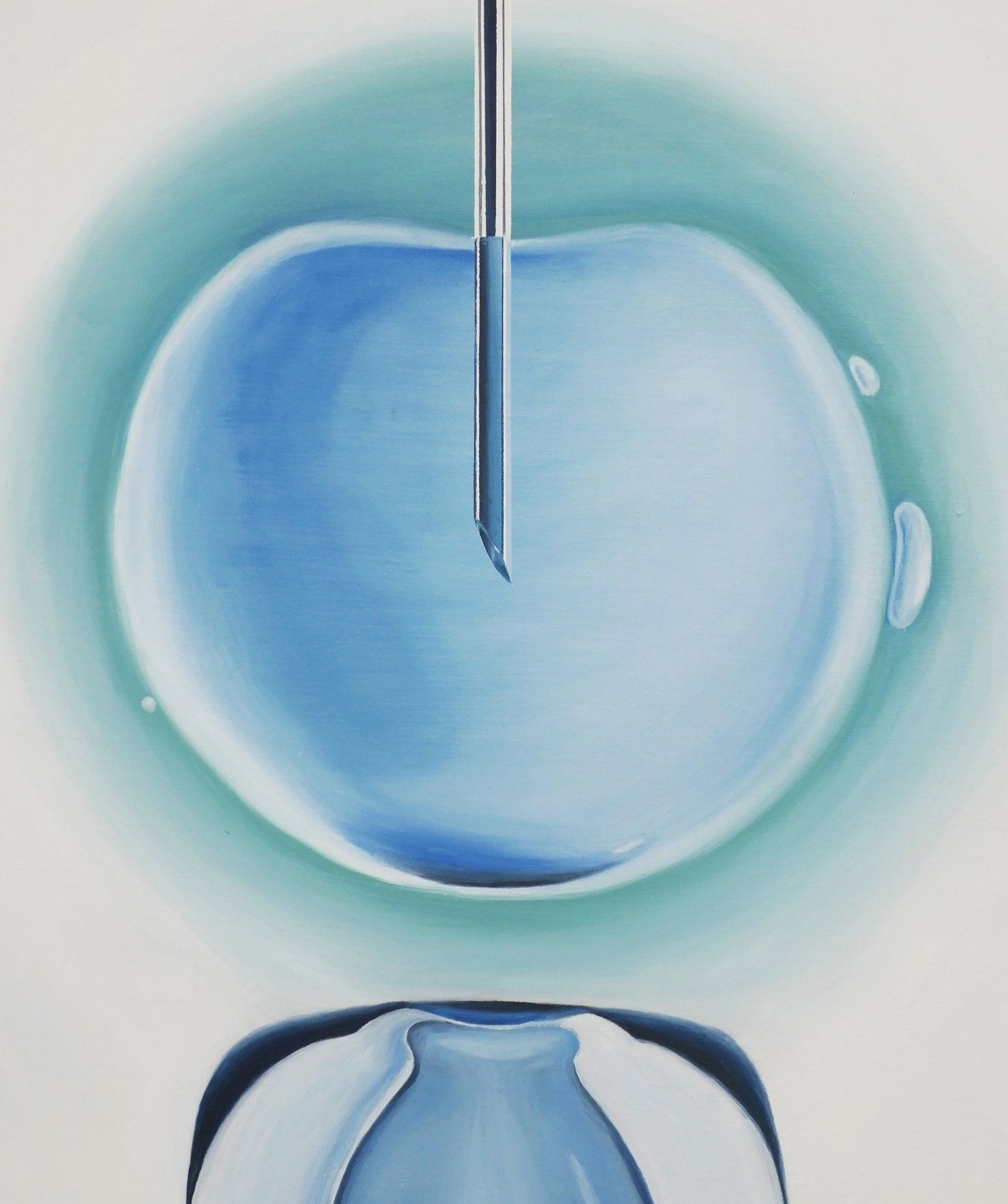
Tan Mu describes the mRNA technology as "a continuation of my long-standing interest in genetic codes, but now embedded within an urgent social reality." The connection to her earlier work on genetics is not incidental. The paintings in the Chromosomes series, the IVF painting, and the Embryo paintings all investigate the intersection of biological code and human life, the way that microscopic structures, DNA strands, chromosomes, fertilized eggs, carry information that determines the shape of an entire organism. The mRNA vaccine is the most recent and the most dramatic example of this intersection. The RNA is a code. The lipid nanoparticle is the delivery system. The human cell is the decoder. The protein is the output. The immune response is the result. The entire process is a transaction between a code and a body, a sequence of instructions and a system that reads those instructions and acts on them. The painting presents this transaction as a visual event: a luminous form in a glass container, held in darkness, radiating light. The luminosity is the code made visible. The darkness is the context that gave the code its significance. Without the pandemic, without the isolation and the death toll and the social rupture, the vial would be a vial. With the pandemic, it became the most important object in the world, and the painting records this transformation by giving the vial the visual treatment that the most important object in the world would receive: centered, isolated, luminous, and held in a darkness that is the visual equivalent of the year that preceded it.
Mark Rothko's No. 14 (1960), now in the San Francisco Museum of Modern Art, consists of three horizontal bands of color: a wide upper band of warm orange, a narrow middle band of dark red, and a wide lower band of dark brown or near-black. The bands are painted on a large canvas, approximately 290 by 268 centimeters, and they fill the viewer's field of vision at normal viewing distance, producing an experience of immersion in color that Rothko described as the closest he could come to expressing basic human emotions: tragedy, ecstasy, doom. The edges of the bands are soft, brushed, and blurred, so that the orange does not end at a hard line but dissolves into the dark red, and the dark red dissolves into the brown, and the brown dissolves into the darkness at the bottom of the canvas. The painting does not depict light. It generates light. The orange band appears to emit its own luminescence, not because it is painted in a bright color, but because the surrounding darkness pushes the warmth forward and makes it the source of the only light in the composition. The viewer's eye goes to the orange first and stays there, because the orange is where the light is, and the darkness around it is where the light is not.
The structural parallel with Vaccine is not one of color or scale. Rothko's painting is nearly three meters wide and dominated by warm oranges and reds. Tan Mu's painting is 36 centimeters tall and dominated by gold and black. The parallel is in the relationship between the luminous form and the dark ground, and in the way that relationship produces the experience of light emerging from darkness, of significance emerging from context, of something small and warm and concentrated appearing against something large and dark and undifferentiated. In Rothko, the luminous band fills most of the canvas. In Tan Mu, the luminous form occupies roughly a third of the vertical space and a quarter of the horizontal space. The difference in proportion is the difference between the subject of the painting and the context of the subject. Rothko's subject is the experience of color, which fills the viewer's field of vision and leaves no room for anything else. Tan Mu's subject is the experience of significance, which occupies a small portion of the visual field but dominates the emotional field entirely. The vial is small. The context is large. The vial is bright. The context is dark. The vial is the thing that matters. The context is everything else that was happening when the vial became the thing that mattered. The darkness in Vaccine is not an aesthetic choice. It is the year 2020 rendered as paint. The isolation, the uncertainty, the social rupture, the death toll, the lockdowns, the separation from family and friends, the daily press conferences, the rising numbers on the dashboard: all of this is the darkness that surrounds the vial, and the vial is the small bright object that emerged from it, the 0.3 milliliters of liquid that contained the possibility of ending it.
Nick Koenigsknecht, writing about Tan Mu's 2025 Vienna exhibition, describes the submarine cables that cross the ocean floor as "hagiographic objects," devotional artifacts that carry more than information, that carry meaning, faith, and the accumulated weight of human expectation. The term applies to the vial in Vaccine with a precision that the word "symbol" does not capture. A symbol stands for something else. A hagiographic object is something else. The vial is not a symbol of hope. It is hope, compressed into 0.3 milliliters and sealed in glass. It is not a symbol of science. It is science, the accumulated knowledge of virology, immunology, lipid chemistry, and mRNA technology, materialized in a form that can be injected into a human arm. It is not a symbol of collective resolve. It is collective resolve, the product of thousands of scientists, clinical trial participants, logistics experts, and government regulators working across borders and time zones to produce a medical intervention in less than a year. The vial contains all of these things. It is not a representation of them. It is them. The painting treats the vial the way a hagiographic painting treats a relic: as an object that is itself the thing it signifies, not a reference to it but an instance of it, a fragment of the sacred made present in a specific time and place for a specific community of believers.
The semi-abstract treatment of the vial is the painting's registration of the transition from the literal to the symbolic and back again. The vial is recognizable. Its shape, its proportions, and its glow are immediately identifiable as the shape, proportions, and glow of the vaccine vials that circulated through every news broadcast and social media platform in 2021. But the vial is also abstract. It is stripped of branding, labeling, and clinical context. It floats in a dark void without a shelf, a refrigerator, a healthcare worker, or a patient. It exists in the space between recognition and interpretation, between the literal object and the symbolic container, between the pharmaceutical product and the cultural artifact. Tan Mu describes this space as the place where meaning accumulates around objects over time. "Abstraction does not erase reality for me," she says. "It allows me to question how meaning accumulates around objects over time." The vial accumulated meaning throughout 2020 and 2021. It accumulated political meaning when governments competed for access. It accumulated social meaning when communities debated mandates. It accumulated emotional meaning when people received their first dose and felt relief for the first time in months. The painting records this accumulation by presenting the vial as both a specific object and a luminous form, both a glass container with a rubber stopper and a source of light in a dark field, both a pharmaceutical product and a hagiographic object, both the thing that ended the pandemic and the thing that the pandemic made meaningful.
The glow that radiates from the vial's interior is the painting's most deliberate departure from visual reality. A vaccine vial does not glow. It contains a clear or slightly opalescent liquid that is stored at ultralow temperatures and administered at room temperature. The glow is not a property of the liquid. It is a property of the painting's relationship to the liquid. The painting makes the vial luminous because the vial was luminous in 2021, not with physical light but with the light of significance, the light of being the object that everyone was looking at, waiting for, talking about, and hoping for. The glow is the visual equivalent of the collective attention that was directed at the vial during that year. The darkness is the visual equivalent of everything else that was happening while that attention was being directed. Together, the glow and the darkness produce the same relationship that Rothko produces with his orange band and his dark ground: a concentrated source of warmth and significance that emerges from a surrounding field of cold indifference, a small bright thing that matters against a large dark field that does not, a vial that contains everything, held in a year that contained nothing but waiting.