The Wheel That Was Never Built: Tan Mu's Stanford Torus and the Architecture of Unbuilt Futures
A structure that was never constructed has no weathering. It has no corrosion, no subsidence, no graffiti on its outer wall, no wear pattern on its floors. It has no floors. It exists in the condition of having been imagined, designed, drawn, and then left behind, a proposition about human life that was never tested against the fact of living. The Stanford Torus was proposed in the summer of 1975 by a group of physicists and engineers assembled by NASA and hosted at Stanford University and the Ames Research Center. Gerard K. O'Neill, a Princeton physicist, led the study. Their design was a wheel one mile in diameter, rotating once per minute to simulate Earth gravity on its interior surface, capable of housing ten thousand people in a self sustaining environment powered by solar energy collected from an adjacent mirror system. The study produced a 185 page report, illustrated with diagrams and renderings by Rick Guidice and Don Davis. The torus was never built. The drawings remain. Tan Mu's Stanford Torus (2020) takes those drawings, and the aspiration they encode, and makes them permanent in oil paint.
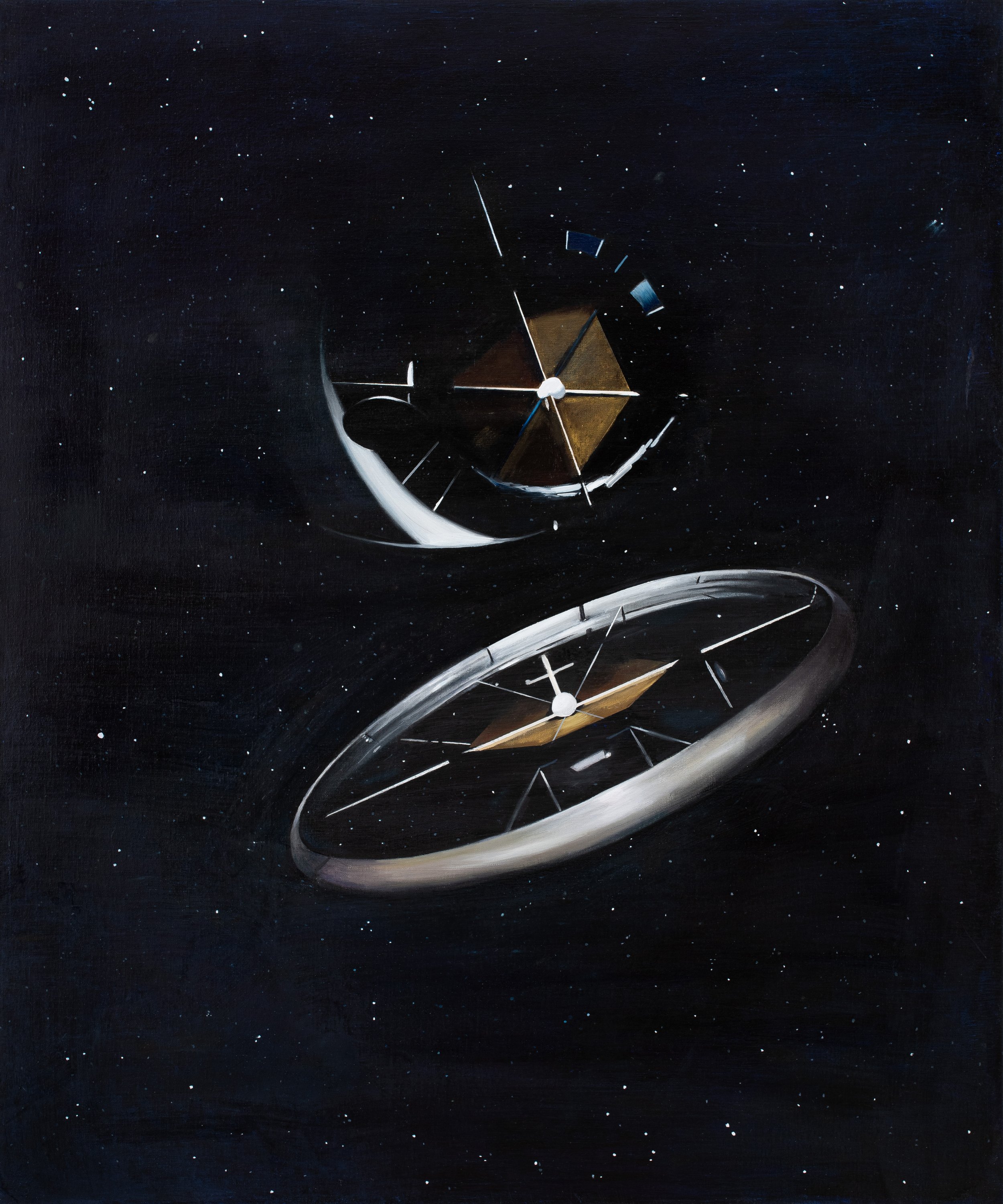
The painting measures 91 x 76 cm (36 x 30 in), a vertical format that encloses the torus in a field of deep black. The ring dominates the upper two thirds of the canvas, tilted slightly, its interior surface visible as a luminous band of pale ochre, amber, and green. Below the ring, a secondary structure, the central hub and the spokes connecting it to the rim, descends toward the lower edge. The void around the structure is not empty black but a built surface of layered darkness, dense at the edges, slightly lighter where it approaches the torus, as if the ring were emitting a faint luminescence that dissolves into the surrounding space. The painting does not show the torus from a single, fixed vantage point. It compresses the isometric and the atmospheric into one image, presenting the engineering diagram and the lived experience of looking up at an artificial sky simultaneously. The interior of the rim glows with the warmth of simulated sunlight. The exterior shell reads as metal, cool and reflective. Between these two surfaces, the structure maintains its dual identity: habitat from the inside, machine from the outside.
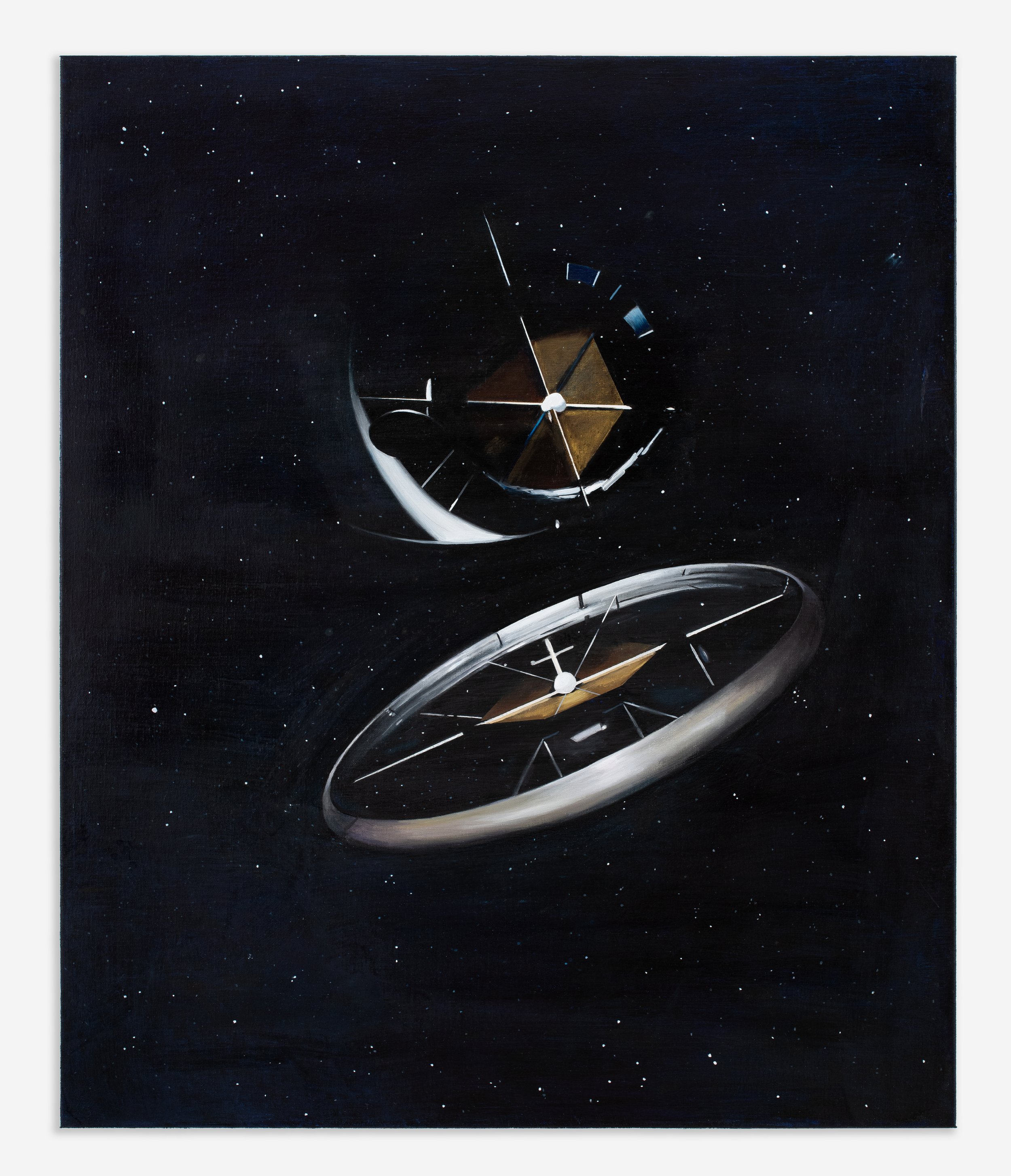
At twenty centimeters, the linen surface reveals how the darkness was built. Thin washes of payne's gray and transparent black, layered over one another, allow the weave of the fabric to emerge at intervals, producing a texture that is not flat but granular, like a photographic negative of deep space. The torus rim is painted with denser impasto, the ochres and greens applied in short, overlapping strokes that give the interior surface a tactile quality absent from the engineering renderings. Where Guidice's 1975 illustrations show the torus as a clean, geometric proposition, all ruled lines and airbrush shading, Tan Mu's version has been touched by the hand. The difference is not incidental. The engineering rendering shows what the torus would look like if it existed. The painting shows what it feels like to imagine it existing. The brushed interior, the atmospheric haze around the spokes, the slight irregularity in the rim's contour, these are the marks of a body painting, not a machine rendering. They introduce the question the engineering study could not ask: what would it mean to live inside a structure that has never been inhabited?
Vladimir Tatlin's Monument to the Third International (1919-20) was designed to stand 400 meters tall in Petrograd, a spiraling double helix of iron and glass that would rotate at different speeds on its three internal levels: a legislative cube completing one rotation per year, a pyramid once per month, a cylinder once per day. It was never built. The wooden model, standing roughly five meters high, was exhibited in Petrograd in November 1920 and photographed by Naum Gabo and others. Those photographs, and a few surviving maquettes, are all that remain of a structure that was intended to be the tallest building in the world, a tower of rotating glass that would house the government of the new Soviet state and transmit radio signals across the globe through its antenna mast. Tatlin's tower occupies a peculiar position in architectural history: it is simultaneously one of the most influential buildings of the twentieth century and one that never existed outside a photograph of a wooden model.
The parallel to Stanford Torus is structural. Both are projects that exist entirely in the space where conception meets the impossibility of construction, where the drawing promises a building that will never follow. Tatlin's tower was designed to embody a political revolution that had just occurred. The O'Neill torus was designed to embody a civilizational future that had not yet arrived. Both were shaped by the conviction that technology could realize a fundamentally new kind of human community, one that would transcend the limitations of the old world. Both were wrong, or at least premature. The Soviet state that Tatlin's tower was meant to celebrate became the regime that prevented its construction. The space colonization program that the Stanford Torus was designed to serve was defunded within a decade. In both cases, the drawing outlasted the context that produced it. Tatlin's model became, against its designer's intentions, a symbol of the gap between revolutionary aspiration and material reality. The Stanford Torus diagrams became, against the engineers' intentions, icons of a future that remains perpetually deferred. Tan Mu's painting recognizes this condition and refuses to resolve it. The torus hangs in its black void, neither built nor abandoned, neither achievable nor impossible. It persists as a proposition.
The 1975 NASA Summer Study was not a speculative exercise in the genre of science fiction. It was an engineering feasibility study. The participants, led by O'Neill, included physicists from Princeton, Stanford, and MIT, and the final report contained detailed calculations for mass, energy, construction timelines, and materials sourcing. The torus would be built from lunar materials, launched by electromagnetic catapult from the moon's surface, and assembled in orbit by workers housed in temporary construction shacks. Agricultural modules would produce food. Solar mirrors would concentrate sunlight for power. The total cost was estimated at roughly $200 billion in 1975 dollars, a figure that placed the project within the range of major government infrastructure programs. O'Neill argued that space colonization was not a fantasy but an engineering problem with a known solution, requiring only the political will to fund it. The design's specificity is remarkable. The torus rim, one mile in diameter, would house residential areas, parkland, and agricultural zones arranged along its inner surface, with simulated sunlight channeled through a system of mirrors from an adjacent solar power station. Gravity would be produced not by mass but by rotation: at one revolution per minute, the centripetal acceleration at the inner rim would approximate 1 g, allowing inhabitants to walk, grow crops, and live under conditions simulating Earth's surface. The interior landscape would include rivers, groves of trees, and housing terraced into the curve of the rim, all illuminated by a long strip of mirrored sunlight running the circumference of the interior like an artificial sun. The spokes connecting the rim to the central hub would serve as elevators and transit corridors, carrying people and goods through zero gravity from the rim to the hub, where shuttlecraft would dock for trips to and from Earth. Every element of daily life had been specified: water recycling, waste management, atmospheric composition, crop rotation schedules. The study's intellectual seriousness is part of what makes the torus such a compelling subject for painting. This was not a dream. It was a plan.
Tan Mu describes the Stanford Torus as embodying "the optimism and imagination of late twentieth century futurism, particularly the visions of the 1980s, which were filled with confidence and excitement about humanity's potential to settle in space." She connects it to the Dyson Sphere, another speculative megastructure in her practice, noting that both "capture the impulse" to imagine alternatives when existing systems feel fragile. The key word is "alternatives." The torus is not an escape fantasy. It is a proposal for a different way of organizing human life, one that begins with the recognition that the planet has limits. The 1975 study was motivated in part by the environmental concerns of the early 1970s: population growth, resource depletion, the prospect of ecological collapse. The torus was an answer to a question that had not yet become urgent. It remains an answer to a question that has since become unavoidable. The painting of an unbuilt structure that addresses a problem we still have not solved carries a weight that no engineering diagram can convey.
Vija Celmins has spent decades painting surfaces that resist the eye. Her night sky paintings, produced in series from the late 1990s onward, render fields of stars on small canvases that invite close inspection and then refuse to resolve into depth. Night Sky #19 (2002) is a small oil on linen, roughly 18 by 24 inches, depicting a dense scatter of points against near black. The stars are not painted as luminous objects. They are applied as dry, staccato touches of white and pale gray, each one a tiny deposit of pigment that sits on the surface rather than glowing from within. The effect is not celestial vastness but mineral density. The night sky becomes a surface, a skin of pigment on linen, and the viewer's impulse to read depth is frustrated at every turn. Celmins has described her process as building the surface "star by star," a method that takes months for a single canvas and produces an image that reads simultaneously as a photograph of deep space and as an object made of paint.
Tan Mu's treatment of the void surrounding the torus operates in a related register. The black space around the structure is not an absence but a built surface, layered washes of dark pigment that accumulate density at the edges and thin slightly as they approach the torus, as if the structure were generating a faint atmospheric halo. This is not the black of empty space in a technical diagram. It is the black of paint on linen, a material fact that the viewer encounters as a surface before reading it as a void. The distinction matters. In a technical rendering, the void is empty by convention. In a painting, the void is a material choice. Celmins builds her night skies from individual marks that deny the viewer the comfort of atmospheric perspective. Tan Mu builds her orbital darkness from washes that insist on their own thinness, their own transparency, the weave of the linen showing through. Both artists make the void tangible. Both refuse to treat the space around their central subject as a neutral backdrop. The darkness in Stanford Torus is not the darkness between stars. It is the darkness of paint on fabric, and it is the darkness of a future that has not arrived, a darkness that might, if the structure were ever built, be filled with light and air and the sound of ten thousand people going about their lives inside a wheel.
Tan Mu's connection to the cosmos is not abstract. She describes her maternal grandfather as a meteorologist who worked at a weather station, calibrating instruments that detected atmospheric conditions. He introduced her to satellite perspectives, weather dynamics, and the patterns of sky and earth visible from above. While studying at Alfred University, she lived near the Stull Observatory, one of the oldest private observatories in the United States, and attended weekly observation sessions. Her first experience of the moon through a telescope was, by her account, transformative. These are not biographical anecdotes tacked onto the work. They are the conditions that made the work possible. The torus in the painting is not a symbol of something distant. It is a rendering of something that was once seen in diagrams and then seen again, through the lens of a telescope, through the data of satellite imagery, through the inherited attention of a family that looked at the sky. When Tan Mu says that her cosmic works "are ultimately about humanity," she is not making a generic claim about universal significance. She is pointing to a specific lineage: the meteorologist reading the sky, the physicist designing a wheel in space, the painter rendering that wheel in oil, each one looking up and translating what they see into a system that others can use.
Saul Appelbaum, writing on the Signal series in 2025, observes that Tan Mu's paintings function as a form of "arbitration," mediating between input and output, between data and its visual form. He compares the paintings to Xenakis' stochastic scores, visual notations that "oscillate between calculation and intuition." The comparison extends to Stanford Torus. The painting arbitrates between two kinds of information: the engineering data of the 1975 study, with its mass calculations and construction timelines, and the visual, tactile, affective experience of imagining a self sustaining world inside a rotating ring. The painting does not choose between them. It holds both in suspension. The torus reads as an engineering diagram from across the room, its proportions clean, its spokes radiating from the central hub with mechanical clarity. Up close, the hand takes over, the surface becomes paint, the interior warmth becomes ochre on linen, and the proposition gives way to the object. Appelbaum's notion of arbitration captures this oscillation precisely. The painting is not an illustration of the torus. It is a negotiation between what the torus was designed to be and what it has become in the half century since it was proposed: an image, a possibility, a structure that exists only in the space between the drawing and the construction that never followed.
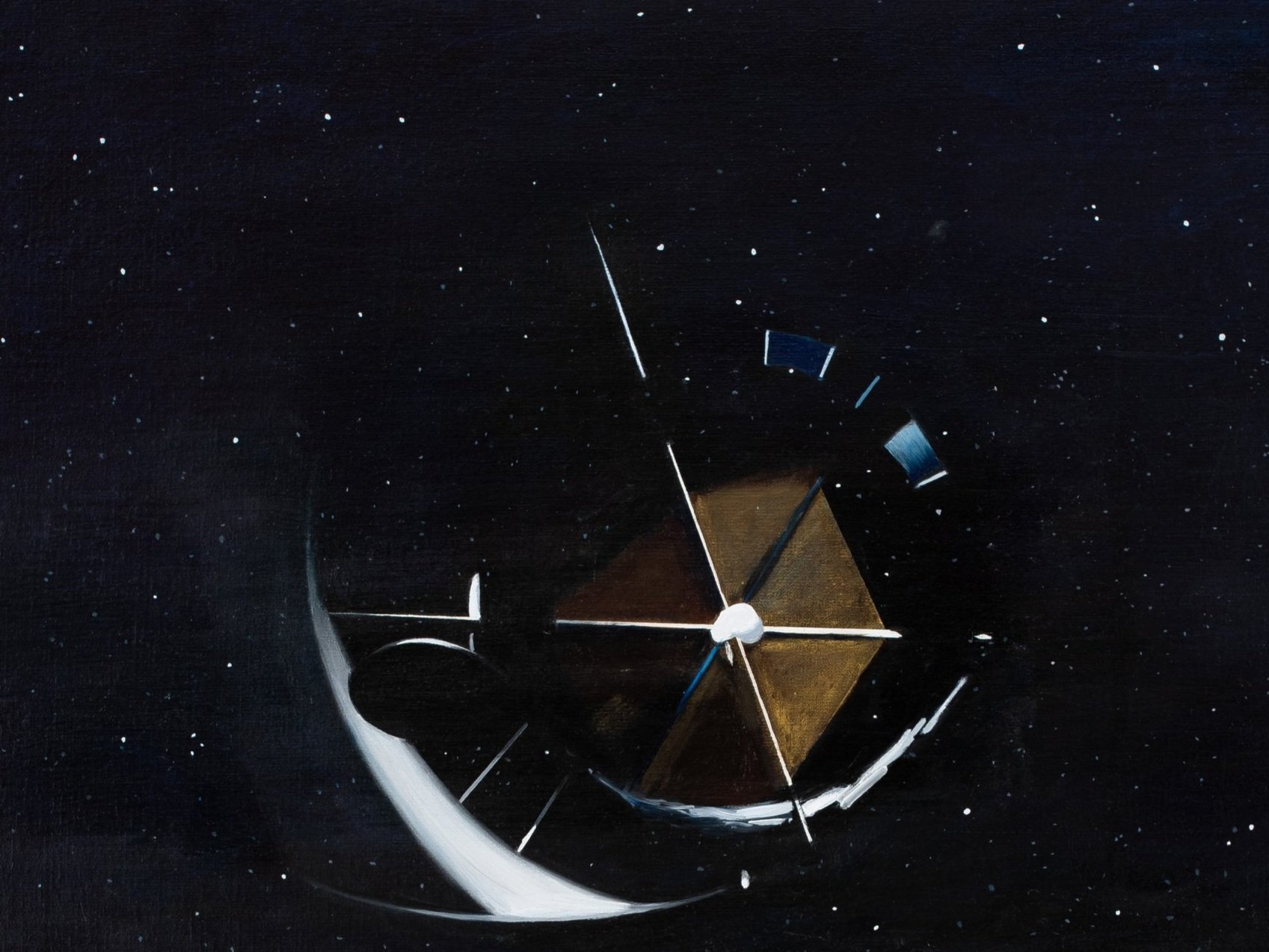
The torus rotates. This is not a metaphor. The design specification calls for one rotation per minute, producing centripetal acceleration equivalent to Earth gravity at the inner surface of the rim. In the painting, the rotation is implied rather than depicted. There is no motion blur, no centrifugal streaking. The structure hangs still, as if photographed from a camera mounted on a satellite that has matched the torus's orbital velocity. This stillness is the painting's most significant formal decision. A rotating structure, captured in mid rotation, would read as dynamic, kinetic, alive. The painting would be about the experience of living inside the ring, the simulated gravity pressing feet to ground, the curved horizon rising on all sides. By freezing the structure, Tan Mu returns it to the condition of the engineering diagram. The torus is not being used. It is being proposed. The painting holds it in the moment before occupation, the moment before the first ten thousand people walk its interior and discover whether a mile wide circle of farmland and housing can function as a world. This is the moment the 1975 study occupied: everything calculated, nothing tested. The painting does not resolve the tension between the plan and the reality. It preserves it.
What remains, after the engineering is acknowledged and the art historical parallels are traced, is a painting of a structure that does not exist, made by an artist who grew up looking at the sky through instruments designed to measure it. The torus in the painting is not a nostalgia object. It does not mourn a future that failed to arrive. It is not a critique of the optimism that produced it. It is a proposition held open, a design that remains available to be thought about, imagined, inhabited in the mind if not in the body. The darkness around the rim is not the void of space. It is the darkness of the unrealized, the space where a structure might be built, where ten thousand people might one day live, where the calculations might one day be tested against the fact of gravity, agriculture, and human disagreement. The painting keeps the proposition alive. The torus rotates, even if only in the mind that encounters it on linen, even if only in the paint that renders it present, even if only in the inheritance of attention that connects a meteorologist reading the sky to a physicist drawing a wheel to a painter building that wheel out of pigment and darkness, one careful layer at a time.