The Crowd That Became the Camera: Tan Mu's Minneapolis and the Merger of Witness and Broadcast
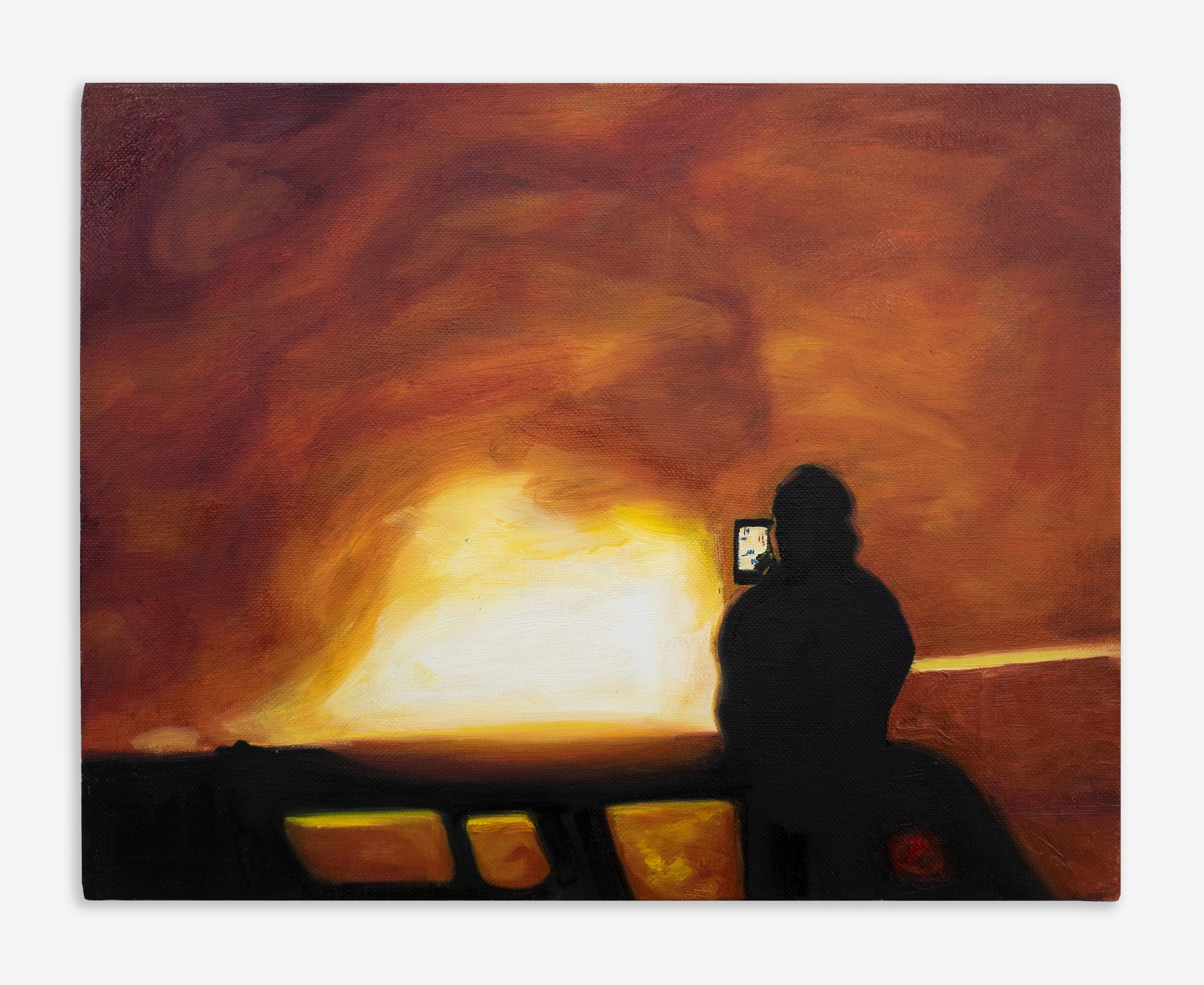
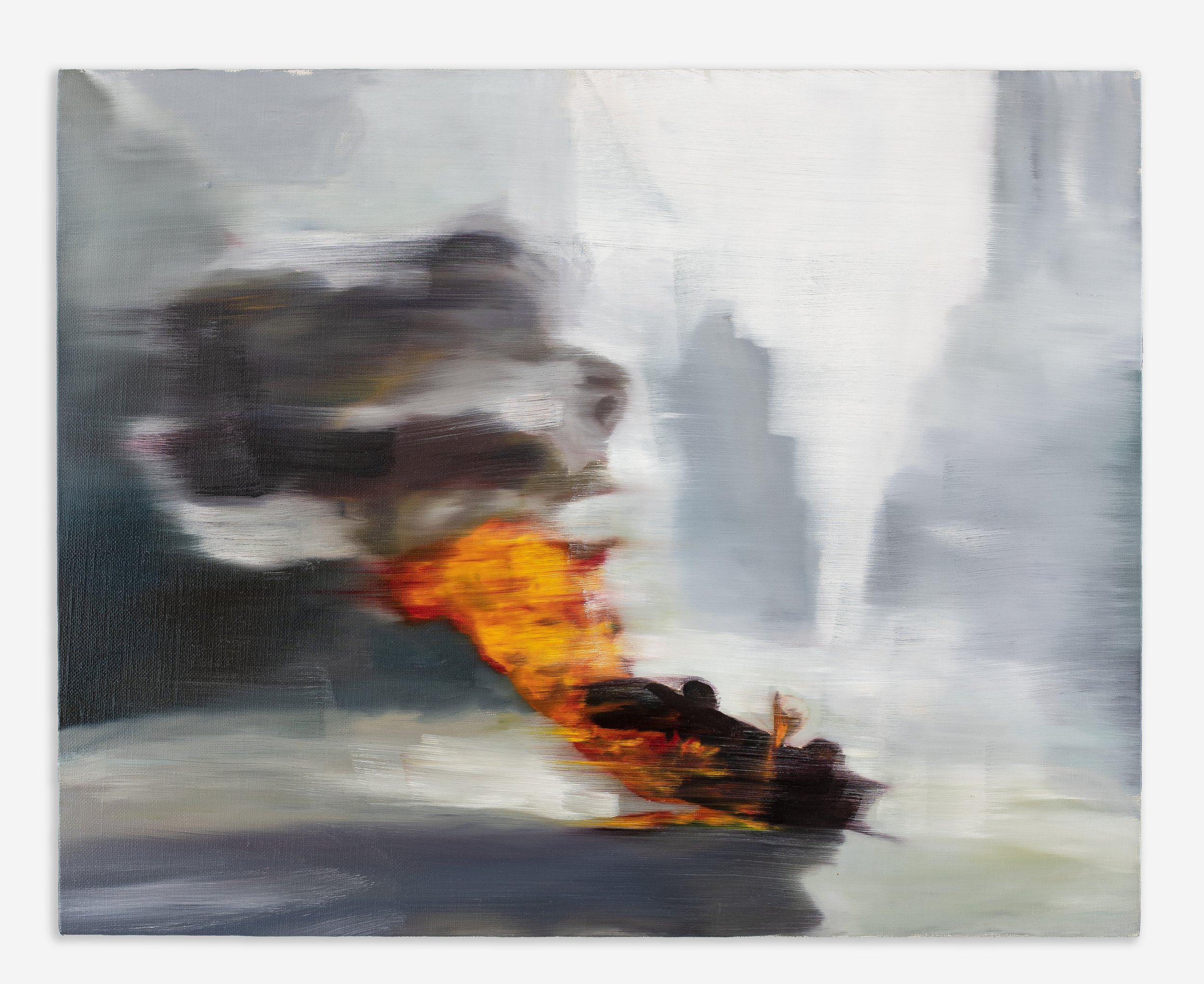
On May 28, 2020, a surveillance video from outside the Third Precinct police station in Minneapolis showed a man walking calmly toward a burning building, holding his phone at arm's length, recording the fire. He was not fleeing. He was not trying to extinguish the flames. He was not shouting or gesturing for help. He was doing what millions of people did that week: pointing a camera at an event that was also a signal, something that would circulate as footage, as content, as evidence, as a compressed file traveling through fiber optic cables to screens in every time zone. The fires in Minneapolis after the killing of George Floyd were not just fires. They were images before they were events, and the people standing near them were not just witnesses but broadcast units, each phone a transmitter converting heat and smoke into data. Minneapolis (2020) is a painting of this conversion. It shows a figure holding a phone toward a burning car at night, the screen of the device a rectangle of white light against the orange of the flames, the dark mass of surrounding figures reduced to silhouettes. The painting does not moralize this gesture. It records it, and in recording it, makes visible something that the endless stream of footage from that week could not: the structural identity of witnessing and transmitting in a society where every phone is a broadcast tower and every crowd is a network.
The painting is oil on linen, 27.9 x 35.6 cm (11 x 14 in), a small format that places the viewer close to the surface. At this scale, the scene reads as a night photograph might: a central conflagration casting orange light across a group of figures, their faces indistinct, their attention directed toward the fire and toward their screens. The dominant color is a deep, sooty black that fills the upper two thirds of the canvas, punctuated by the amber and vermillion of the burning car and the cool white of the phone screen. The fire is not rendered in the high chromatic saturation of news footage. It is painted in restrained strokes, the orange mixed with umber and Payne's gray, producing a flame that reads as hot but not theatrical. The car beneath the flames is a dark mass, its shape implied by a few horizontal strokes of burnt umber, the metal absorbing light where the fire releases it. Around the central group, additional silhouettes recede into the darkness, some with arms raised, some holding devices, their numbers suggested by a scattering of small bright points, phone screens and camera flashes, that punctuate the black like stars in a reversed constellation. This detail, visible only at close range, extends the crowd beyond the frame, implying that the scene continues in every direction, a network of recorders surrounding the event like a perimeter of lenses. This is not a spectacle. It is an event that has already begun to be processed, already halfway between experience and documentation. The phone screen, a small rectangle of near white in the lower register, is the brightest point in the composition. It outshines the fire. In the painting's visual hierarchy, the device that transmits the event takes precedence over the event itself. This is not an accident of composition. It is the painting's argument.
At arm's length, the linen shows through in the darker passages. The black is not a solid field but a built surface of thin washes, each allowing the weave to emerge at the edges of brushstrokes, giving the night sky a granularity that reads as photographic noise or the compression artifacts of a video file viewed on a small screen. The figures are painted in broad strokes of dark pigment over this ground, their silhouettes defined less by outline than by the absence of detail. Faces are suggested with two or three touches of a lighter tone, features dissolved. The phone screen, by contrast, is painted with a tighter mark, a small rectangle of opaque titanium white that sits on the surface rather than receding into it. The difference in handling is deliberate. The phone is the one object in the painting that is fully present, fully resolved, fully legible. Everything else, the fire, the crowd, the car, the street, is in a state of partial dissolution, as if the act of recording has already begun to convert the physical world into data, stripping it of detail, compressing it into a format optimized for transmission. The painting's material logic enacts its argument: the phone is solid because it is the instrument of conversion. Everything else is becoming signal.
Francisco de Goya's The Third of May 1808 (1814) establishes the foundational image of a crowd confronting state violence. The painting depicts the execution of Spanish civilians by Napoleonic troops on the Principe Pio hill outside Madrid. The central figure, a laborer in a white shirt, throws his arms wide, palms forward, in a gesture that simultaneously surrenders, protests, and presents his body as a target. His white shirt catches the light of a lantern placed on the ground by the soldiers, illuminating him while the firing squad remains in shadow. The lantern is the painting's key instrument. It does not simply provide visibility. It selects. It illuminates the victim and conceals the executioners, producing a moral clarity that the historical record could not supply. The light source is not neutral. It is the painter's judgment made visible.
In Minneapolis, the phone screen replaces Goya's lantern. Both are artificial light sources. Both illuminate the scene. But they illuminate differently. Goya's lantern reveals the victim to the viewer. The phone screen in Tan Mu's painting reveals the scene to the network. The light does not fall on the crowd; it emanates from the device the crowd holds. The shift from lantern to screen is not merely technological. It is structural. In Goya, the witness is the painter, standing outside the frame, composing the scene for a viewer who will encounter it years later in a museum. In Minneapolis, the witness is inside the frame, holding the device, simultaneously experiencing the event and converting it into a format that will circulate beyond the frame. The painter's position has been absorbed into the crowd. There is no outside. The act of seeing and the act of transmitting have become the same gesture, performed by the same hand, at the same moment. Goya could paint the Third of May after the fact, from a position of retrospective moral authority. Tan Mu's Minneapolis is painted during the event, or rather, it is painted from inside the logic of the event, where the distinction between being present and being online has collapsed.
Tan Mu describes a shift in human instinct that Minneapolis captures. The primal drive to extinguish a fire, she observes, has been replaced by the reflex to record it on a smartphone and share it on social media. This observation is not a lament. It is a description of a behavioral transformation that occurred in the space of a few years and became inescapable during the events of 2020. The pandemic forced social interaction onto screens. The protests that followed George Floyd's killing on May 25, 2020, were documented in real time by the people participating in them. Drones, body cameras, security cameras, and thousands of phones produced a density of footage that no single editorial process could curate. The protests existed simultaneously as physical events and as data streams. To be in the street was also to be online, to be a transmitter as well as a participant. The phone did not document the protests after the fact. It was the medium through which the protests occurred. Without the phone, the protests would not have spread to other cities with the speed and coordination they achieved. The broadcast was the protest. The footage was the event. The distinction that Goya could draw, between the event and its representation, between the fire and the painting of the fire, no longer holds when the representation is produced in real time by the people inside the event itself.
Jeff Wall's Mimic (1982) is a photographic tableau that depicts a scene on a Vancouver sidewalk: a white couple walking past an Asian man, the woman linked to the man's arm, the Asian man walking alone, and the white man raising his middle finger in a gesture of racial contempt directed at the other man's back. The image is a staged photograph, lit and composed with the precision of a history painting, every element in its calculated place. Wall produced it in a studio, constructed the scene from scratch, and presented it as a large transparency in a light box, a format that gives it the luminosity and scale of a cinema screen. The photograph reads as a documentary capture of a street encounter, but it is a construction. The real event it depicts never happened. Wall invented it, rehearsed it, lit it, and photographed it, producing an image that functions as evidence of something that did not occur. The tension Mimic creates, holding the document and the construction in suspension, staging the real and the fabricated as if they were interchangeable, is the same tension Minneapolis inhabits, though from the opposite direction.
Wall builds a document from a fiction. Tan Mu builds a document from a document. The source material for Minneapolis is a photograph or a video still from the 2020 protests, a piece of documentary footage that shows a real event occurring at a specific time and place. The painting translates this footage into oil on linen, a medium associated with the composition of scenes rather than their capture. But the translation does not add fiction. It removes compression. The phone screen in the painting is not a symbolic rectangle. It is a rendering of a specific piece of hardware at a specific moment, held at a specific angle, by a person who exists in the footage. The fire is not a generic conflagration. It is a specific car burning on a specific street in Minneapolis on a specific night. What the painting adds is not invention but duration. The footage scrolled past in seconds. The painting holds the moment still. Where Wall's Mimic makes the viewer question whether the scene is real, Tan Mu's Minneapolis makes the viewer question what it means that the scene was already real and already a broadcast at the same time. The phone in the painting is not recording something that will later become content. The phone is the condition under which the event is experienced. The broadcast is not after the fact. The broadcast is the fact.
The format of the painting, 27.9 x 35.6 cm, is roughly the size of a tablet held in landscape orientation. This is not an arbitrary measurement. It reproduces the dimensions of the device through which the event was first seen by most of the people who saw it. The painting does not hang on the wall at a scale that commands the room. It sits at a scale that requires the viewer to approach, to lean in, to occupy the same proximity that one would have to a screen. The painting's size reproduces the conditions of its reception. It is not a mural of a public event. It is a handheld image of a handheld image. The smallness of the canvas is not modesty. It is accuracy. The event that Minneapolis depicts was not experienced on a grand scale. It was experienced on screens, in fragments, in compressed video files that loaded in seconds and scrolled past in the time it takes to lift a thumb. The painting holds the fragment at the scale at which it was originally seen.
The pandemic lockdowns that preceded the protests had already established the screen as the primary surface of social life. For months, human contact had been routed through video calls, social media feeds, and messaging apps. The screen was not a new technology inserted into an otherwise continuous social fabric. It was the fabric itself, the only surface through which contact, conversation, and solidarity were possible. When the protests began, the transition from pandemic isolation to collective street action did not involve setting the screen aside. It involved picking it up and pointing it outward. The same device that had connected people in isolation now connected them in the street, but the logic of the connection was continuous. The phone that streamed a video call during lockdown was the phone that streamed a protest during the uprising. The companion work, Philadelphia (2020), shares the format, the palette, and the structural logic: a night scene, a crowd, a source of artificial light, the fusion of physical presence and digital mediation. Together, the two paintings form a diptych of the American summer of 2020, each showing a different city, a different configuration of the same conditions: isolation and collective outcry, pandemic and protest, the screen as the membrane through which all experience passed. But Minneapolis carries a specific weight. It is the city where George Floyd was killed. The burning car in the painting is not an abstract symbol of civil unrest. It is a factual element of the footage that circulated from the Third Precinct on May 27, 2020, the night the building was set ablaze and the surrounding streets filled with people, many of whom were recording. The painting's refusal to identify the city by name in its title, using only "Minneapolis," is characteristic of Tan Mu's practice. She titles her works by subject and date, not by event. The specificity is in the image, not the label. The viewer who recognizes the reference finds the event. The viewer who does not finds a figure holding a screen toward a fire, which is also a complete encounter with the painting's argument.
Li Yizhuo, writing on Tan Mu's broader practice in 2022, observed that the canvases "do not aim at diagnosing the modern spectacles from a distance. They conjure up a kind of vitality and depth of their own." The observation is precise in relation to Minneapolis. The painting does not diagnose the condition of mediated experience from an external vantage. It occupies that condition from the inside. The phone screen in the composition is not a symbol of mediation added to an otherwise direct encounter. It is the instrument through which the encounter occurs. There is no version of the scene without the screen. The crowd that gathered outside the Third Precinct on the night of May 27, 2020, was not a crowd that later documented itself. It was a crowd that was documenting itself from the first moment, a crowd that understood its own presence as data to be transmitted, a crowd whose collective action and collective broadcast were the same activity performed by the same bodies at the same time. The painting holds this condition open for inspection, not as a critique but as a description, the way a specimen holds a biological process still enough to be examined.
The fire in Minneapolis will not be extinguished by the figure holding the phone. This is not because the figure is indifferent. It is because the gesture of holding the phone has replaced the gesture of reaching for water. The instinct to record has not been added to the instinct to act. It has displaced it. The painting does not judge this displacement. It renders it visible. The white rectangle of the phone screen sits in the composition as the brightest element, brighter than the fire, brighter than any face in the crowd, because it is the surface through which the event is being processed. The screen is not a window onto the world. It is the world's surface, the membrane where heat becomes data, where presence becomes signal, where the street becomes content. The painting holds the moment of conversion still, long enough to see that the crowd did not lose its instinct to act. The crowd discovered that acting and transmitting were the same gesture, performed by the same hand, at the same time, and that the phone, not the fire extinguisher, was the instrument that the moment required.