The Dot That Answered Back: Tan Mu's OXO and the Screen That Learned to Speak
In 1952, a doctoral student at the University of Cambridge wrote a program that allowed a human being to play tic-tac-toe against a computer. Alexander Shafto Douglas was researching human-computer interaction for his thesis, and he needed a demonstration that a machine could accept input from a person, process it according to rules, and display the result on a screen. He chose tic-tac-toe because the rules were simple enough to implement on the EDSAC, the Electronic Delay Storage Automatic Calculator that had been operating in Cambridge since 1949. The game was called OXO. It ran on a cathode-ray tube display that showed a grid of illuminated dots, and the player controlled a cursor using a rotary dial. The computer processed the input, calculated its optimal move, and updated the display. The entire cycle, from human input to machine response to visual feedback, took a fraction of a second. This was the first time a person had played a game against a computer on a screen. The screen answered back. The screen learned to speak.
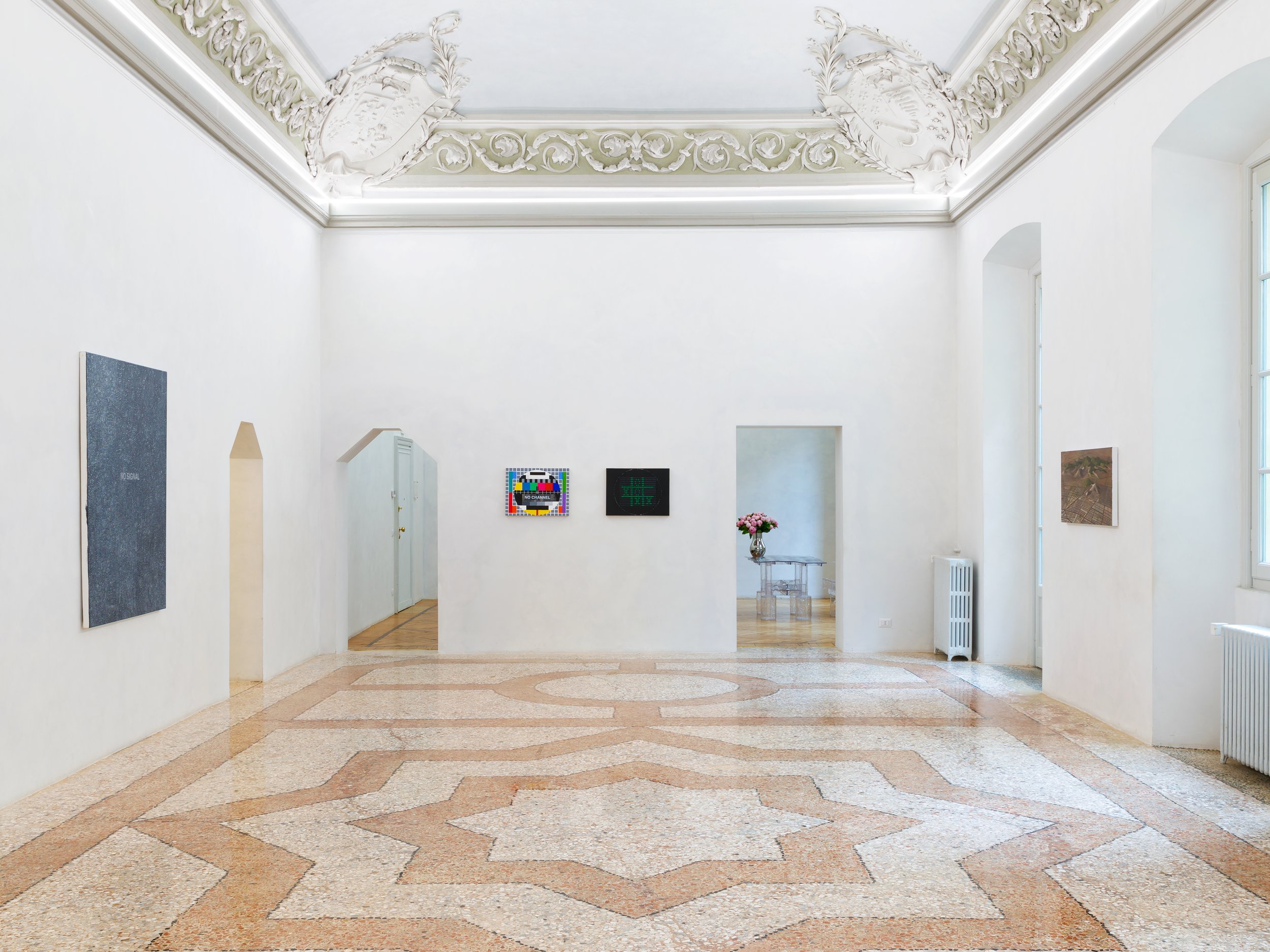
Tan Mu's OXO (2021) is an oil painting of that screen. It is not a painting of a tic-tac-toe game in progress, with X marks and O marks arrayed on a grid. It is a painting of the display itself: the green phosphor dots on a dark ground, the grid lines formed by aligned points of light, the cursor positions that mark the player's available moves. The painting measures 46 x 61 cm (18 x 24 in), a horizontal format that echoes the proportions of an early CRT monitor. The composition is centered on a three-by-three grid rendered in pale green dots against a near-black background, with additional dots marking the cursor positions at the grid intersections. The grid glows. The dots are not flat circles of uniform color. They are built from concentric applications of pale green, chartreuse, and a thin outer ring of yellow-green that gives each point a slight halo, the phosphor bloom that early CRT displays produced when the electron beam struck the screen's luminous coating. This bloom is the painting's most important material detail. It is the visual signature of a specific technology at a specific moment, and it connects the painted image to its source with a precision that no photograph could replicate. A photograph of a CRT display flattens the bloom into a smear of green light. The painting rebuilds it, dot by dot, as a structure of overlapping hues that produce the effect of luminosity through accumulation rather than transparency.
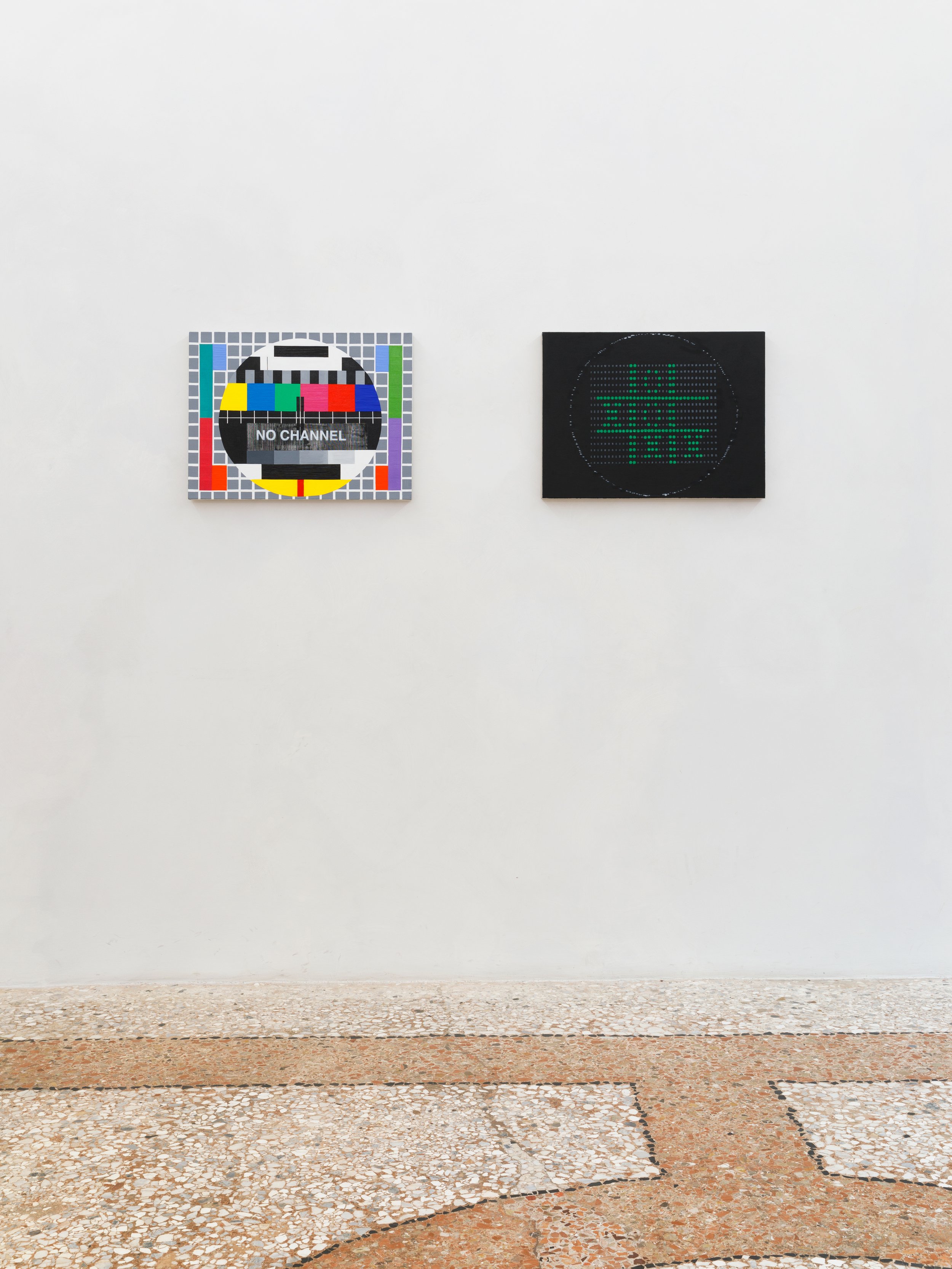
At close range, the surface reveals its construction. The dark ground is built from thin washes of Payne's gray and transparent black over linen, the weave visible in the spaces between the dots, giving the background a faint texture that reads as the slightly uneven surface of an old CRT glass. The green dots themselves are painted with a small brush, each one a tight cluster of three or four strokes that build from a darker interior to a lighter rim, producing the impression of a point of light radiating outward. The background is not a uniform black but a composite of dark greens and blues that shift subtly from edge to edge, warmer near the center where the grid's glow would illuminate its surroundings on an actual CRT, cooler at the periphery where the screen's light falls off. This chromatic variation is invisible from across the room, where the background reads as a single dark tone, but it becomes apparent at reading distance, rewarding the viewer who steps forward and confirming that the painting has been constructed from observation, not from a schematic. The linen weave shows through the thinnest passages, giving the dark areas a faintly textured quality that distinguishes them from the smoother, more opaque dots. This difference in surface quality enacts the difference between the screen's emissive areas and its non-emissive areas: where the phosphor is active, the surface is dense and bright; where it is inactive, the surface thins and reveals the substrate beneath. The result is not a pixel pattern printed onto canvas but a field of luminous points that feel as though they are emitting light from within the paint film. This is the painting's argument: the screen is not a neutral surface. It is an active agent. It generates light, it responds to input, it displays the results of calculation. The dots in OXO are not decorative. They are the traces of a machine that has been taught to produce visible output in response to human action. The painting makes this agency visible by rendering the phosphor bloom in oil paint, a medium associated with the depiction of light on surfaces for six centuries, and using it to depict a surface that generates its own light. The transfer is precise and knowing. The medium of reflected light meets the medium of emitted light, and the painting occupies the gap between them.
Piet Mondrian's grid paintings of the 1920s and 1930s reduced the canvas to a system of vertical and horizontal lines bounding fields of primary color and white. Composition with Red, Blue and Yellow (1930) is among the most familiar: a square canvas divided by thick black lines into rectangles of varying proportions, three of them filled with red, blue, and yellow, the rest left white. The composition is governed by what Mondrian called "the universal," a rational order that transcends individual perception and arrives at the fundamental structure of visual reality. The grid is not a representation of anything. It is the thing itself, the basic architecture of the visible world stripped of naturalistic detail and reduced to its structural essentials. Every element in a Mondrian grid painting is placed according to a logic of proportion and balance that the viewer is meant to perceive as necessary, not arbitrary.
Tan Mu's OXO presents a grid that operates under a different logic but with a comparable claim to universality. The three-by-three tic-tac-toe grid is one of the simplest possible structures: nine positions, eight winning lines, a finite state space that can be mapped in its entirety. It is, in mathematical terms, a solved game. Every possible move has been calculated, and every game played optimally results in a draw. The grid is not arbitrary. It is the minimal structure required for the game to function. Three rows and three columns are the smallest dimensions that allow for strategic play. Two rows would be trivial. Four would be complex. Three is the threshold. The OXO grid is therefore not a visual composition chosen for aesthetic effect. It is the minimum viable architecture of a logical system. Mondrian arrived at his grids through a process of progressive reduction, stripping naturalistic elements until only the structure remained. Douglas arrived at the OXO grid through a process of functional constraint, building the simplest possible visual representation that would allow a game to be played on a CRT. Both reductions produce grids. Both grids claim universality. But Mondrian's grid claims the universality of visual order. The OXO grid claims the universality of logical structure. Tan Mu's painting holds both claims in suspension. The dots glow with the same precision that Mondrian's lines divide, and the viewer is left to consider whether the beauty of the grid lies in its proportions or in its logic.
The EDSAC on which OXO ran was one of the first stored-program computers. It operated from a room in Cambridge, filling several racks with vacuum tubes, its memory stored in mercury delay lines, its input via paper tape, its output via a cathode-ray tube that displayed results as patterns of illuminated dots. Douglas chose tic-tac-toe not because the game was interesting in itself but because it demonstrated that a machine could engage in a rule-governed interaction with a human being in real time. The computer's move was calculated. The display was updated. The human responded. The cycle repeated. This was the beginning of what would later be called the user interface: a system that accepts input, processes it, and presents output in a format the human can read. The rotary dial that the player used to select a position on the grid was not a mouse, a keyboard, or a touch screen. It was a telephone dial, adapted to a new purpose. The player dialed a number, the computer calculated its move, and the screen refreshed. The entire apparatus was crude by contemporary standards. But it established a principle that has governed every subsequent interface design: the machine must respond to the human's action by changing what is displayed on the screen. The screen is not a static surface. It is a dynamic partner in a conversation. Every swipe, tap, click, and scroll that a person makes on a device today descends from this original cycle of input, calculation, and display.
Tan Mu connects OXO to a broader network of works in her practice. She describes visual parallels between the circular design of the birth control pill packaging, the structure of logic circuits, and the form of embryos, noting that "this resemblance intrigued me because it reveals an underlying connection between technology, biology, and human intervention." The observation extends naturally to OXO. The circular pill packaging, with its monthly dose arranged around a central hub, echoes the rotary dial of the EDSAC input device. The logic circuit, with its pathways of signal and gate, echoes the grid of the tic-tac-toe board. The embryo, with its first cell divisions proceeding according to a predetermined program, echoes the game's finite state space. These parallels are not decorative coincidences. They are structural homologies, different systems that converge on similar geometric forms because they share similar constraints: the need to distribute information in a compact, legible format; the need to route signals along defined paths; the need to execute a program of development or calculation according to fixed rules. The painting of the OXO grid is therefore not a painting of a game. It is a painting of a structure that appears wherever information, logic, and constraint intersect.
Nam June Paik's TV Buddha (1974) places a sculpture of a seated Buddha in front of a closed-circuit television camera and a monitor. The Buddha watches himself on the screen. The screen watches the Buddha. The loop is infinite and self-enclosing: the statue observes its own image, transmitted in real time by a technology that was not available when the sculpture was carved, and the technology presents the sculpture as a live video feed, transforming a static religious object into a dynamic electronic signal. Paik's work is often described as a meditation on surveillance, narcissism, or the spiritual displacement caused by electronic media. These readings are valid but partial. The deeper operation of TV Buddha is the feedback loop: the observer becomes the observed, the signal returns to its source, and the circuit closes. The Buddha is not watching television. The Buddha is being television. The screen is not showing the Buddha. The screen is being the Buddha, in the sense that it is the surface on which the Buddha's presence is made visible and through which the Buddha's gaze is directed back at itself.
OXO constructs a similar loop, though the terms are different. The player dials a position on the grid. The screen displays the move. The player sees the result. The computer calculates its response. The screen updates. The player sees the new state. The cycle continues until the game ends. The player is not watching the screen from outside the system. The player is inside the system, a component of the feedback loop that includes the rotary dial, the computer's logic unit, the CRT display, and the human eye and hand. Paik's Buddha sits in front of a screen that reflects its image. Douglas's player sits in front of a screen that reflects the state of a game. In both cases, the screen is not a window onto a separate world. It is a mirror that returns the viewer's action in a transformed state. The player makes a move. The screen makes a move back. The game is not between the player and the computer. The game is between the player and the screen, and the screen is the surface where the exchange becomes visible. Tan Mu's painting holds this surface still, removing the time dimension of the game and presenting the grid in a state of potential, before any move has been made, when all nine positions are equally possible and the screen is waiting for the first input. It is the state Paik's Buddha would see if the monitor were turned on but no signal were being sent: a screen ready to receive, a surface ready to reflect, a system ready to respond.
Nick Koenigsknecht, writing in the BEK Forum catalog, observes that while looking at technology, "are we not looking at ourselves? Therefore perhaps these works function more as self portraits, rather than depictions of external, scientific milestones." The observation applies to OXO with particular force. The painting is not a depiction of a machine. It is a depiction of the surface on which the machine and the human met for the first time as equals in a rule-governed exchange. The grid is the architecture of that meeting. The dots are the traces of the phosphor that made the meeting visible. The green glow is the light that the machine produced to communicate its response. Tan Mu describes the evolution of gaming from OXO's "simple pixelated imagery" to contemporary "immersive, multi-sensory environments" as a trajectory of expanding perception, and she is correct. But the painting does not depict the end of that trajectory. It depicts the beginning. It depicts the moment when the screen first answered back, when a dot of green light on a cathode-ray tube signaled that a calculation had been completed and a move had been made, when the machine spoke for the first time in a language the human could read. The grid in OXO is not a picture of a game. It is a portrait of the first conversation, the moment when the screen became a surface for dialogue and the dot became a word in a language that seventy years later the entire world speaks.