The Channels That Carry Thought: Tan Mu's Logic Circuit and the Body in the Machine
In September 1960, two engineers at Fairchild Semiconductor introduced the first production version of a planar integrated circuit flip-flop element. Isy Haas and Lionel Kattner had found a way to etch multiple transistors, resistors, and the connections between them onto a single chip of silicon, replacing the discrete components and hand-soldered wires that had made earlier computers room-sized assemblies of vacuum tubes and copper. The device was called the Micrologic F element. It measured roughly one millimeter across. It contained a single logic gate, a circuit that could toggle between two states, on and off, zero and one, and it could do this switching at a rate that made the vacuum tube computers of the previous decade seem stationary. The integrated circuit did not merely shrink the computer. It changed what a computer could be. Within a decade, the same technology that produced the Micrologic F would produce the chips that guided the Apollo guidance computer, the chips that ran the first minicomputers, and eventually the chips that made the personal computer possible. The logic circuit is the atom of the digital age. Everything that computes, from the microwave timer to the neural network, descends from the principle Haas and Kattner demonstrated: that logical operations can be etched in silicon, that thought can be materialized as architecture.
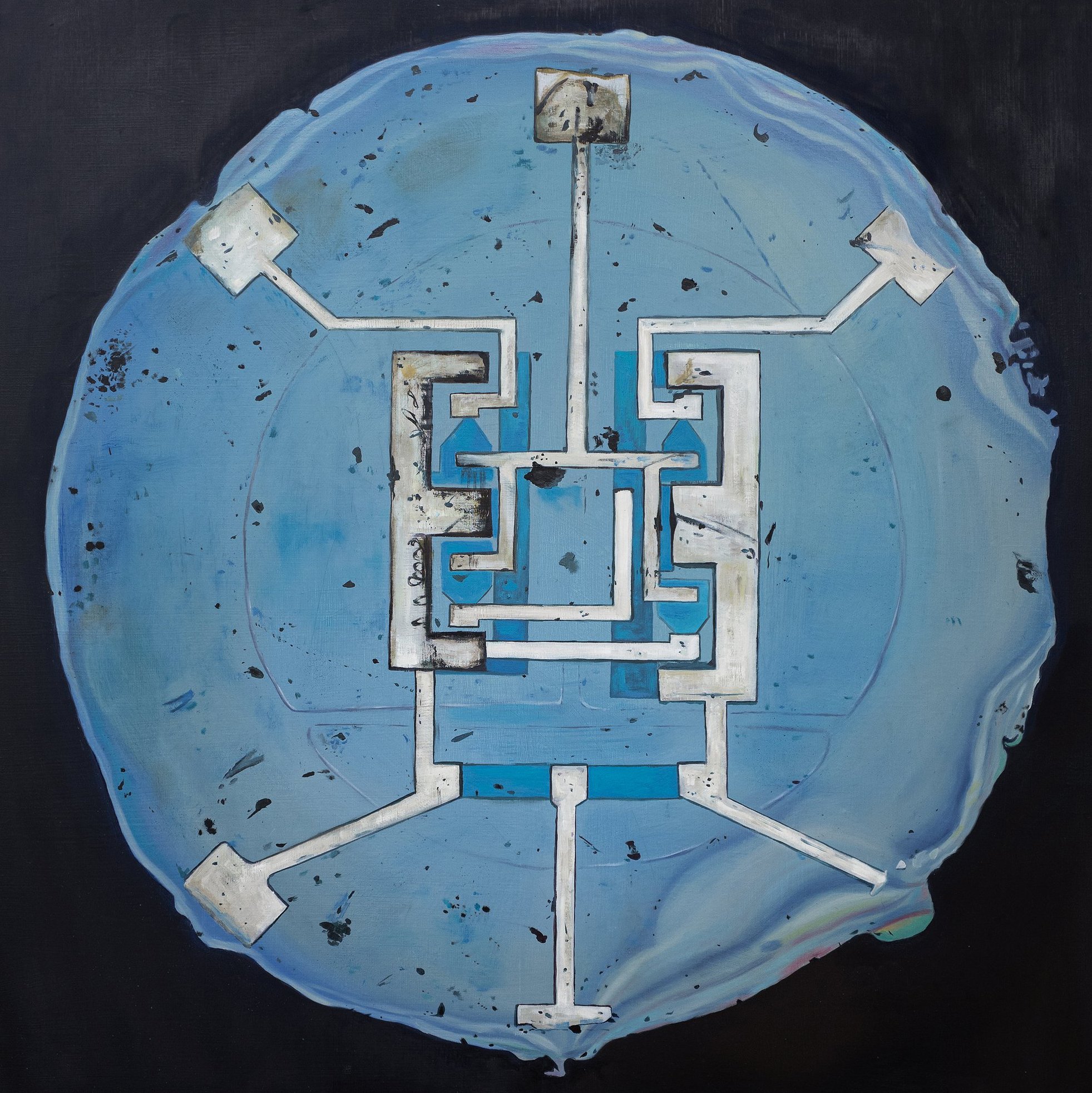
Tan Mu's Logic Circuit (2022) is an oil painting on linen, 76 x 76 cm, a square format that mirrors the geometry of the chip itself. The composition is centered on a prominent circle, rendered in dark blues and near-black tones, with irregular blue edges that bleed outward into the surrounding field. Inside the circle, precise lines and geometric shapes, rectangles, channels, nodes, suggest the etched pathways and contact points of an integrated circuit viewed under magnification. The circle is not a perfect geometric form. Its border mottles and breaks, patches of lighter blue interrupting the dark ground, the way a silicon wafer develops surface irregularities after chemical etching. These irregularities are not painterly accidents. They correspond to a specific material process: the deep channels etched into the back of a silicon wafer after corrosion, filled with non-conductive epoxy resin, a detail that Tan Mu describes directly in her account of the work. The painting does not present an idealized schematic of a logic circuit. It presents a circuit that has been through the physical process of manufacture, a circuit that bears the marks of its own making.
The surrounding field is a warm off-white, suggesting the surface of the silicon wafer or the substrate on which the circuit is fabricated. At arm's length, the field reads as a single tone. At close range, it reveals a subtle modulation, areas of thinner and thicker application, faint traces of underpainting in gray and raw umber that give the surface a slight warmth and depth. The contrast between the circle's dark interior and the light ground produces the effect of a wafer die photographed under a metallurgical microscope, the circuit pattern floating in a field of polished silicon. The lines inside the circle are painted with a precision that recalls technical illustration, but their edges are not mechanically sharp. At magnification, each line shows the slight feathering of a brush dragged across linen, a reminder that the hand made these marks, not a photolithographic process. The nodes at the intersections of lines are built from small, dense touches of darker pigment, concentrated points where the circuit's logic is concentrated into a single contact. These nodes are the painting's points of greatest visual weight, the places where the eye lands and lingers, the places where the circuit makes its decisions.
Charles Sheeler's Classic Landscape (1931) presents the Ford Motor Company's River Rouge plant as a composition of geometric volumes under a clear sky. The smokestacks, water towers, conveyors, and storage silos are arranged with the formality of a classical temple, their verticals and horizontals echoing the proportions of a Palladian facade. Nothing in the painting moves. There are no workers, no vehicles, no smoke. The plant is empty, still, and immaculate, a machine for production presented as a machine for viewing. Sheeler photographed the Rouge extensively before painting it, and the painting's austerity derives from the camera's way of organizing the world into clean edges and controlled values. The photograph crops. The painting idealizes. But the idealization is not sentimental. Sheeler does not soften the industrial landscape or make it picturesque. He clarifies it. He removes everything that is not structural and presents what remains as architecture. The Rouge is not a factory. It is a temple. The smokestacks are columns. The conveyors are entablatures. The logic of the factory, its systematic arrangement of processes and materials, becomes the logic of the composition.
Tan Mu's Logic Circuit applies a comparable logic to a different kind of machine. Where Sheeler found classical order in the industrial landscape of the Rouge, Tan Mu finds it in the micro-architecture of the integrated circuit. The square format, the centered circle, the precise internal lines, the contrast between the etched pathways and the surrounding substrate, all of these elements are organized with the same formal rigor that Sheeler brought to the smokestacks and conveyors of Dearborn. But where Sheeler's painting removes the human presence from the factory, Tan Mu's painting reintroduces it through the hand. The irregular edges of the circuit's circle, the feathered borders of the internal lines, the slight variations in the density of the nodes, these are marks of the painting process, the trace of a body making decisions about where to place pigment on linen. Sheeler's Rouge is a factory without workers. Tan Mu's circuit is a chip with a painter inside it. The hand that etches the pathways is not a machine. It is a human hand, and its presence in the circuit's architecture insists that the logic of the chip, no matter how abstract it appears, was designed by a body, fabricated by a process, and can be painted by a person who understands it well enough to reproduce its structure in oil.
The logic circuit is not a metaphor. It is a physical device that performs a specific function. At its most basic, a logic gate takes one or more binary inputs and produces a single binary output according to a rule: AND, OR, NOT, XOR. These rules can be combined to perform any computation. A flip-flop, the type of circuit Haas and Kattner produced, stores a single bit of information by toggling between two stable states. It is the fundamental unit of digital memory. Without it, there is no storage, no processing, no computation. The fabrication process that produces these circuits is itself a study in imposed order. A silicon ingot is grown from a seed crystal, sliced into wafers, polished to a mirror finish, coated with photoresist, exposed to ultraviolet light through a mask that defines the circuit pattern, developed, etched with hydrofluoric acid, doped with phosphorus or boron to alter electrical conductivity, and then layered with metal interconnects that link the individual transistors into functional circuits. Each step in this sequence must be performed with a precision measured in nanometers. A single speck of dust on a wafer can destroy an entire chip. The clean rooms where these processes occur are among the most controlled environments ever constructed by human beings, filtered air, antistatic flooring, full-body suits, because the logic that the circuit enforces is so fragile that it can be disrupted by a particle smaller than a red blood cell. This is the paradox of the logic circuit: it is the most robust conceptual framework ever devised for processing information, and it is manufactured in an environment so delicate that a breath can destroy it. Tan Mu's painting of this component is a painting of the foundation layer of digital technology, the substrate on which every subsequent layer of abstraction, from the operating system to the social network, is constructed. The composition centers on the circuit's geometry because that geometry is not decorative. It is functional. Every line in the painting corresponds to a pathway through which an electrical signal passes. Every node corresponds to a junction where a decision is made. The painting presents the circuit's visual logic as its actual logic, the form of the thing as the content of the thing, the architecture of thought as it exists at the level of etched silicon.
Tan Mu connects the logic circuit to a network of biological and technological parallels that extends across her practice. She describes a visual resemblance among the circular design of birth control pill packaging, the structure of logic circuits, and the form of embryos, noting that "this resemblance intrigued me because it reveals an underlying connection among technology, biology, and human intervention." The observation is not decorative. It identifies a structural homology: different systems converge on similar geometric forms because they share similar constraints. The pill pack distributes doses in a circular format because the format is compact and legible. The logic circuit arranges pathways in a bounded geometry because silicon area is expensive and signal paths must be minimized. The embryo divides according to a program that produces a blastocyst, a ring of cells surrounding a fluid-filled cavity, because the circular form distributes mechanical stress equally and allows uniform nutrient access. The circle is not a symbol. It is a solution that different systems have arrived at independently, a form that emerges whenever the constraints of distribution, connection, and growth intersect.
Agnes Martin spent four decades making paintings that consist entirely of horizontal and vertical lines drawn in graphite on white or near-white grounds. Untitled #10 (2001), one of her last works, presents a square canvas divided by faint graphite lines into a grid of equal rectangles. The lines are drawn by hand, using a ruler, but they are not mechanical. Each one bears the slight variation of pressure, the infinitesimal tremor, that distinguishes a hand-drawn line from a printed one. The grid is perfect in conception and imperfect in execution, and the imperfection is the source of its warmth. Martin wrote that her paintings were about "freedom, innocence, happiness," and that the grid was not a representation of anything but an evocation of emotional states that could not be named. The lines, she said, were not lines. They were "the flight of the mind."
Martin's grids have been read as meditations on solitude, purity, and the sublime. They have also been read as exercises in minimalism, reductions of painting to its essential elements of line, color, and surface. Both readings are correct, and both miss what is most specific about the work: the fact that each line was drawn by a person sitting in front of a canvas, holding a graphite pencil, pulling it across the surface at a speed and pressure that no machine could replicate exactly. The grid is a system, but the system is enacted by a body. Martin's hand trembled slightly as she drew. Her pencil caught on the weave of the canvas. Her lines are not the lines of a plotter or a printer. They are the lines of a person who made a decision, each time, about where to begin, how hard to press, and when to stop. The grid is the structure. The hand is the content.
The lines inside Tan Mu's circuit are not flights of the mind. They are pathways for electrical signals. But they share with Martin's grids a quality that is easy to overlook: they were made by a hand. The logic circuit in a chip is produced by photolithography, a process that uses light to transfer a pattern onto a photosensitive surface. The pattern itself is designed by engineers, but the etching is performed by chemicals and light, not by a human hand. Tan Mu's painting reverses this process. She takes the result of a photolithographic procedure and reproduces it by hand, in oil paint, on linen. Each line, each node, each channel is painted individually, with a brush, by a person who has studied the circuit's structure and decided how to translate it into pigment. The result is a circuit that has been through a different kind of fabrication: not chemical etching but manual construction, not photolithography but painting. The painting does not idealize the circuit. It re-embodies it. It takes the logic that was abstracted into silicon and returns it to the body, not as a metaphor but as a physical act, the hand moving across the surface, placing each line where it belongs, following the same logic that the original designers followed when they laid out the mask for the photolithographic process, but doing it with a brush instead of a mask, with paint instead of photoresist, with linen instead of silicon.
Danni Shen, writing on Tan Mu's broader practice, observes that her paintings "serve as a kind of witness to human socio-technological histories," and that the biological works extend this witnessing to the body's own history. Logic Circuit extends the witnessing further, to the history of the machine that has become indistinguishable from the body that made it. Tan Mu describes her childhood participation in classes on flight model construction and circuit design as the origin of her understanding of "the logic of patterns and principles governing the physical world: fluid mechanics, mathematical calculations, blueprints." The painting is not a nostalgic reference to these childhood lessons. It is their continuation. The logic that she learned in a classroom as a child, the logic of patterns that repeat, of signals that follow prescribed paths, of systems that process input according to rules, is the same logic that governs the circuit she has painted. The painting is a record of a person who learned the logic of circuits as a child and has now spent years translating that logic into paint, each line a decision, each node a concentration of meaning, each irregular edge a record of the physical process that produced the circuit and the physical process that produced the painting.
The circle at the center of Logic Circuit is not a perfect circle. It mottles, bleeds, and breaks. Its border is the record of corrosion, the trace of a chemical process that eats into material and leaves it scarred. Inside this circle, the lines of the circuit run their prescribed paths with precision, connecting node to node, gate to gate, input to output. The tension between the irregular border and the precise interior is the painting's central argument. The logic circuit is a device that imposes order on disorder, that channels the flow of electrons through defined pathways, that makes decisions according to rules. But the material in which it is etched, the silicon, is not orderly. It is a crystal grown from molten sand, cut into wafers, polished, doped with impurities, and then etched by acid. The process of making a chip is a process of imposing human intention on a material that resists, corrodes, and deviates. The painting records both sides of this encounter: the precision of the pathways and the resistance of the material. It shows the circuit not as a diagram but as a thing that has been made, and in showing the making, it shows the body inside the machine, the hand that drew the pattern, the acid that etched the channels, the sand that became the crystal that became the substrate on which the logic of the digital age was written. Every pathway on that circuit carries a signal. Every signal is a decision. Every decision was designed by a person who learned, at some point in their life, that the world operates according to rules, and that the rules can be followed, bent, or broken, but they cannot be ignored. The circuit works because its pathways are etched into a material that does not care about logic. The painting works because its pathways are painted by a hand that does.