The Cargo That Remembers: Tan Mu's Containers and the Weight of Passage
Tan Mu's maternal great-grandfather spent years traveling between China and Korea as a maritime trader during the Republican era. His work involved not only the exchange of goods but the movement of culture and ideas, the transfer of languages, habits, recipes, and loyalties that occurs whenever a person crosses a border with a hold full of merchandise and returns with a hold full of something else. During World War II, his journeys were interrupted. He was forced to remain in Korea, where he became part of the overseas Chinese community before eventually returning to China later in life. This transnational experience shaped the family's identity and, through them, the artist who would grow up in Yantai, a port city on the Yellow Sea, watching container ships load and unload at the harbor where her parents worked. Containers (2021) is a painting of a stack of shipping containers seen from a highway in New Jersey, but the genealogy that produced it begins in a harbor on the other side of the Pacific, with a great-grandfather who moved goods and ideas across water, and a granddaughter who learned to see those goods as carriers of information, memory, and cultural connection.
The painting is oil on linen, 76 x 91 cm (30 x 36 in), a horizontal format that accommodates the composition's two registers: the highway in the foreground and the stacked containers in the middle distance. The road occupies the lower third of the canvas, rendered as a strip of dark asphalt that recedes toward the containers and disappears behind them. The road surface is built from thin washes of Payne's gray and raw umber over the linen ground, the weave showing through in places to give the asphalt a granular texture that reads as the coarse grain of a real highway, the kind of surface that vibrates under tires and reflects the gray light of an overcast sky. The center line is a single broken stripe of pale yellow, applied in short, even strokes that suggest the standardized rhythm of highway markings. On either side of the road, the shoulders and embankments are suggested by a narrow band of muted green and brown, the colors of roadside vegetation in late autumn or early spring, the seasons when the vegetation is present but subdued, not yet in full growth and not yet dead.
Above the road, the containers rise in stacked rows, simplified rectangles of saturated color: cadmium red, ultramarine blue, Naples yellow, a deep forest green, a burnt sienna, a pale teal. Each container is rendered as a flat plane of a single hue, the identifying marks, corporate logos, registration numbers, and safety certifications all removed. Tan Mu describes this reduction as deliberate: "By minimizing detail, I wanted to shift attention away from individual objects and toward their collective meaning." The result is a field of colored rectangles that reads simultaneously as a row of shipping containers and as a composition of abstract color blocks arranged in a loose grid. The colors are not decorative. They correspond to the standard palette of container livery used by major shipping lines, the Maersk blue, the Evergreen green, the Hapag-Lloyd orange, the CMA CGM red. Tan Mu has not invented the palette. She has extracted it from the visual reality of container yards and freight depots, where the variety of colors is a byproduct of corporate identity, not aesthetic choice. The painting makes this accidental chromatic variety into a compositional principle, organizing the containers by hue and density rather than by the logistics of actual stacking, producing a rhythm of color that the eye follows across the surface the way a crane follows a container from ship to stack.
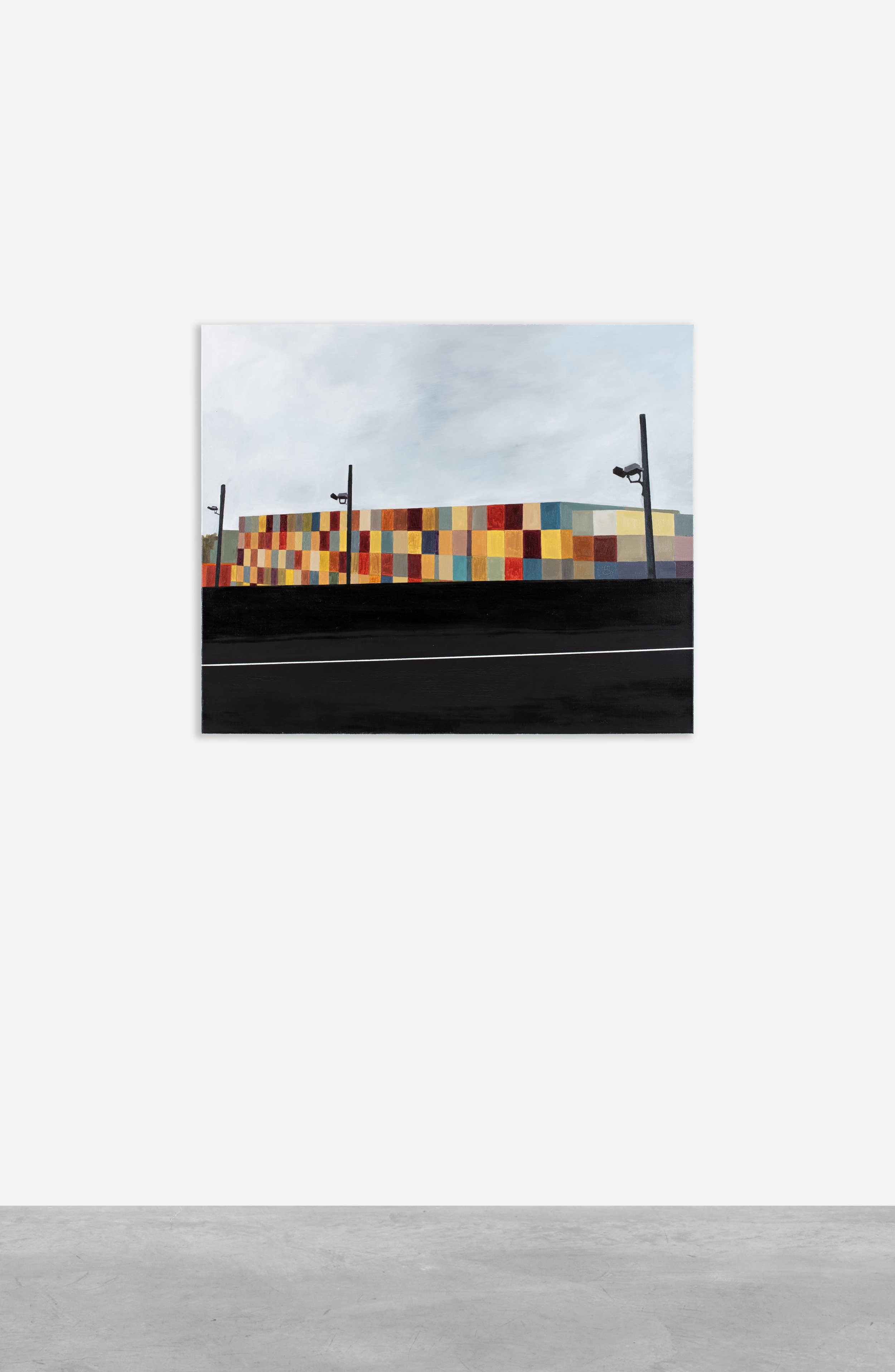
The sky above the containers is a flat, overcast expanse of gray-white, painted in thin horizontal strokes that give the cloud cover a slight directional pull, as if the air were moving steadily from left to right, carrying weather across the landscape. The absence of direct sunlight means that the containers are not modeled by shadow. They are lit by diffused light, the kind of light that eliminates strong contrasts and reduces three-dimensional objects to their surface colors. This lighting condition is characteristic of the American Northeast in the months when the sky is low and the light is even, and it is also characteristic of the industrial landscape, where the architecture of shipping and logistics, the cranes, the gantries, the rows of stacked steel boxes, is designed to be seen in all weather conditions, not illuminated for aesthetic effect. The painting's light is the light of function, the light under which work is done, the light that makes all objects equally visible and equally important. Nothing in the composition is singled out by a spotlight or a shadow. The road, the containers, the sky all receive the same even illumination, the same absence of dramatic emphasis. At close range, the edges of the containers reveal themselves as deliberately softened. The boundaries between adjacent blocks of color are not hard lines but zones of transition where one hue meets another across a millimeter of blended pigment. This softening gives the stack a slight atmospheric quality, as though the containers were seen through a thin haze of distance or humidity, the kind of haze that accumulates over port yards and highway embankments where diesel exhaust mingles with morning fog. The overall effect is not photographic precision but painted memory, the way a scene looks when it has been absorbed, considered, and reconstructed from recollection and source material in combination.
Edward Hopper's Approaching a City (1946) presents a view from a train window or an elevated highway, looking toward the edge of a city that has not yet been reached. The road and the railroad tracks run parallel to the picture plane, leading the eye toward a cluster of buildings that loom in the middle distance, their windows dark, their forms blunt and unadorned. There are no people visible. The city is empty, or rather, it is in a state of anticipation: the viewer is approaching, but the city has not yet acknowledged the arrival. The painting's title describes its condition: approach, not arrival. The city is still ahead. The road is still running. The viewer is in transit, between one place and another, and the city they are approaching is a collection of forms that has not yet resolved into a human habitation. Hopper's highway paintings, Approaching a City, Highway (1956), and several others, are studies in the condition of passage, the state of being in movement through a landscape that is neither origin nor destination but the space in between.
Tan Mu's Containers occupies a similar condition. The viewer is on a highway, looking at a row of containers, in between departure and arrival. The road is the connective tissue that makes the scene possible. Without the road, there is no vantage point. Without the road, the containers are inert objects in a yard. The road transforms them into objects in passage, goods that are moving, things that have been shipped and are about to be shipped again. The composition insists on this condition of transit. The road enters the frame from the lower right, runs toward the center, and disappears behind the containers. The containers are stacked in rows that suggest a yard, a holding area, a place where goods pause between legs of a journey. The sky above is the sky of a landscape that is being traversed, not inhabited. There is no horizon in the distance, no skyline, no destination. There is only the road, the containers, and the weather, the three elements that constitute the experience of industrial passage. Hopper's paintings of American roads and towns are often read as expressions of isolation or alienation, but their deeper subject is the structure of passage: the way the built environment presents itself to a viewer in motion, the way a city announces itself from a distance, the way the road mediates between the traveler and the place they have not yet reached. Tan Mu's Containers adds a specific layer to this structure. The containers are not buildings. They are not permanent structures. They are temporary residents of a landscape that has been organized around their movement. They will be loaded onto a ship, transported across an ocean, and unloaded at another port. The highway that carries the viewer past them is part of the same system of movement that the containers themselves are part of. The road and the containers are not adjacent to each other. They are elements of the same network, the same system of passage that Hopper could see forming in the American landscape of the 1940s and 1950s and that Tan Mu can see in its fully developed, global form, where every highway leads to a port and every port receives containers from every other port on the planet.
The pandemic supply chain crisis of 2020 and 2021 is the immediate context for Containers. Tan Mu describes the painting as emerging from the global supply chain disruptions that caused goods to stack up at ports, chip shortages to stall automotive production, and food insecurity to spread across regions that depended on imported grain. The photographs she took while driving on a New Jersey highway became the basis for the composition. She also contacted her regular shipping company to access their promotional stock images, combining personal observation with corporate documentation, two forms of seeing the same object from two different positions within the same system. The artist who ships her own work across oceans is also the artist who watches the containers from the highway. The two positions, the participant and the observer, are the same person, and the painting is produced from the overlap of these perspectives. The containers in the painting are not in motion. They are stacked, waiting, held in a state of suspended transit that corresponds to the condition of the global economy during the pandemic: goods existed, but they could not move; containers were full, but they could not be unloaded; ships were at anchor outside ports, but they could not dock. The painting captures this suspension. The road is empty. No trucks are visible. The containers are stacked, not loaded. The sky is overcast, a lid of diffused light that presses down on the scene without illuminating it. The painting is not a document of a crisis. It is a document of a pause, the moment between movement and stagnation, the instant when the system that circulates goods around the planet stops and the goods become visible as objects rather than as flows.
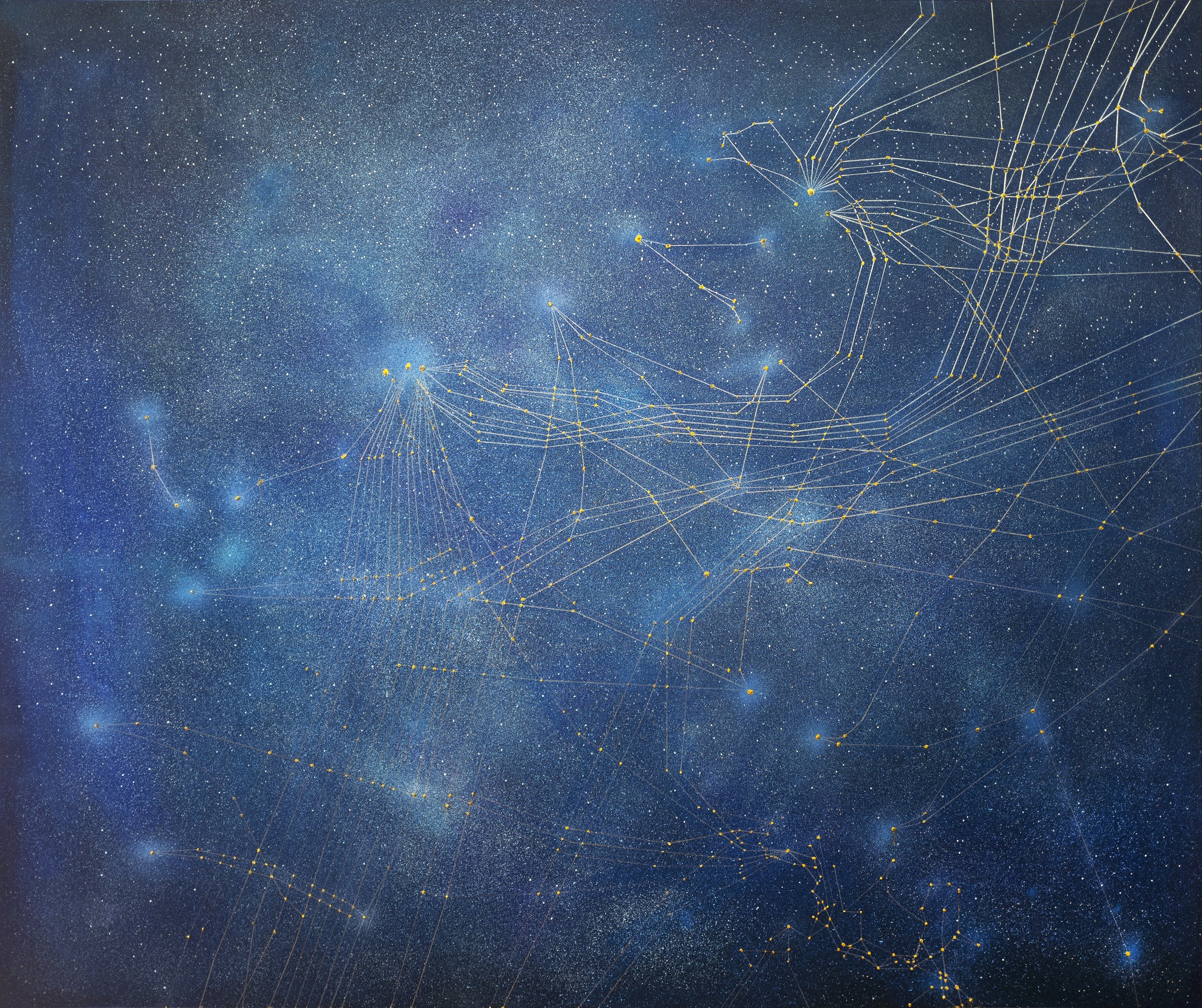
Tan Mu connects the containers to a broader inquiry into the movement of information. In her account, containers carry "not merely goods but information and technology," and the disruption of their movement makes visible the connection among transportation, communication, and innovation that is normally hidden by the efficiency of the system. A container of semiconductors is a container of information in physical form. A container of pharmaceuticals is a container of biological knowledge that has been condensed into pills and vials. A container of textiles is a container of cultural practice, the fabrics and garments that carry the identity of a region into the markets of another. When the containers stop moving, the information stops flowing. The chips do not arrive. The medicines do not reach the patients. The clothes do not reach the shelves. The painting makes this connection visible by removing the identifying marks from the containers and reducing them to colored blocks. The specific contents are unknown. What is known is that each color represents a different kind of cargo, a different stream of goods and information flowing through the same standardized steel box. The painting does not need to identify the contents. It needs only to show that the contents are varied, that the same container shape carries different kinds of meaning, and that the disruption of the flow affects all of these meanings simultaneously. This insight connects Containers to Tan Mu's Signal series, which examines submarine fiber optic cables, the physical infrastructure that carries the world's data across ocean floors. The containers above the water and the cables below it are part of the same system: the movement of materials and the movement of information are not parallel processes but aspects of a single circulation, and when one stops, the other feels the constriction.
Andreas Gursky's photographs of container ports and shipping terminals, particularly his large-scale images of the ports of Salerno and Singapore, present the logistics landscape from an elevated vantage that transforms the industrial yard into a field of organized color. The containers read as pixels, as units in a grid, as data points in a visual database of global trade. Gursky's photographs are often described as mapping the infrastructure of globalization, and this description is accurate but incomplete. The photographs also document a specific condition of looking: the aerial view, the perspective from which the human scale disappears and the system scale becomes visible. From above, the individual container is a colored rectangle among millions of colored rectangles. The crane is a line among lines. The ship is a shape among shapes. The human worker, when visible at all, is a speck. The aerial view makes the system legible, but it does so at the cost of eliminating the individual object and the individual experience. Gursky's Salerno port photographs, taken from a vantage that collapses the entire harbor into a single visual field, produce an image of staggering complexity and order, thousands of containers arranged in rows so precise they appear to have been laid out by a single designer rather than by the cumulative effect of thousands of independent shipping decisions. The photograph's perspective converts the chaos of logistics into the order of composition, the way a map converts the disorder of a coastline into a legible line.
Tan Mu's Containers refuses the aerial view. The painting is composed from the perspective of the road, the view from the driver's seat or the passenger's window, the vantage of a person moving through the landscape at ground level. This is not an oversight. It is a deliberate choice that reconnects the containers to the body that perceives them. The viewer of Containers is not above the system. The viewer is inside it, on the highway, passing the stacked boxes on the way to somewhere else. The viewer is the great-grandfather on the ship, the parent at the port, the artist in the studio, the consumer at the store, all of whom are participants in the same network of movement that the containers represent. Yiren Shen, writing on Tan Mu's practice in 2025, observes that her paintings "conjure up a kind of vitality and depth of their own" by refusing to diagnose the modern spectacle from a distance. Containers enacts this refusal. It does not survey the logistics landscape from above. It passes through it at eye level, from the road, in the company of the containers, at the speed of a car on a highway, which is also the speed of a ship at sea, which is also the speed of a memory arriving from a harbor on the other side of the world, where a great-grandfather loaded his goods and set sail for a port he would not leave for years, carrying in his hold the materials of a culture that would outlast the interruption and continue to circulate, in containers, on ships, on highways, in the blood of his descendants, one of whom would grow up watching those ships and grow up to paint them, standing in her studio, remembering the harbor and the road and the stacked boxes and the sky above them, all the same color, all the same weather, all the same passage.