The Gap That Remains: Tan Mu's Dolly and the Blur Where Memory Meets the Copy
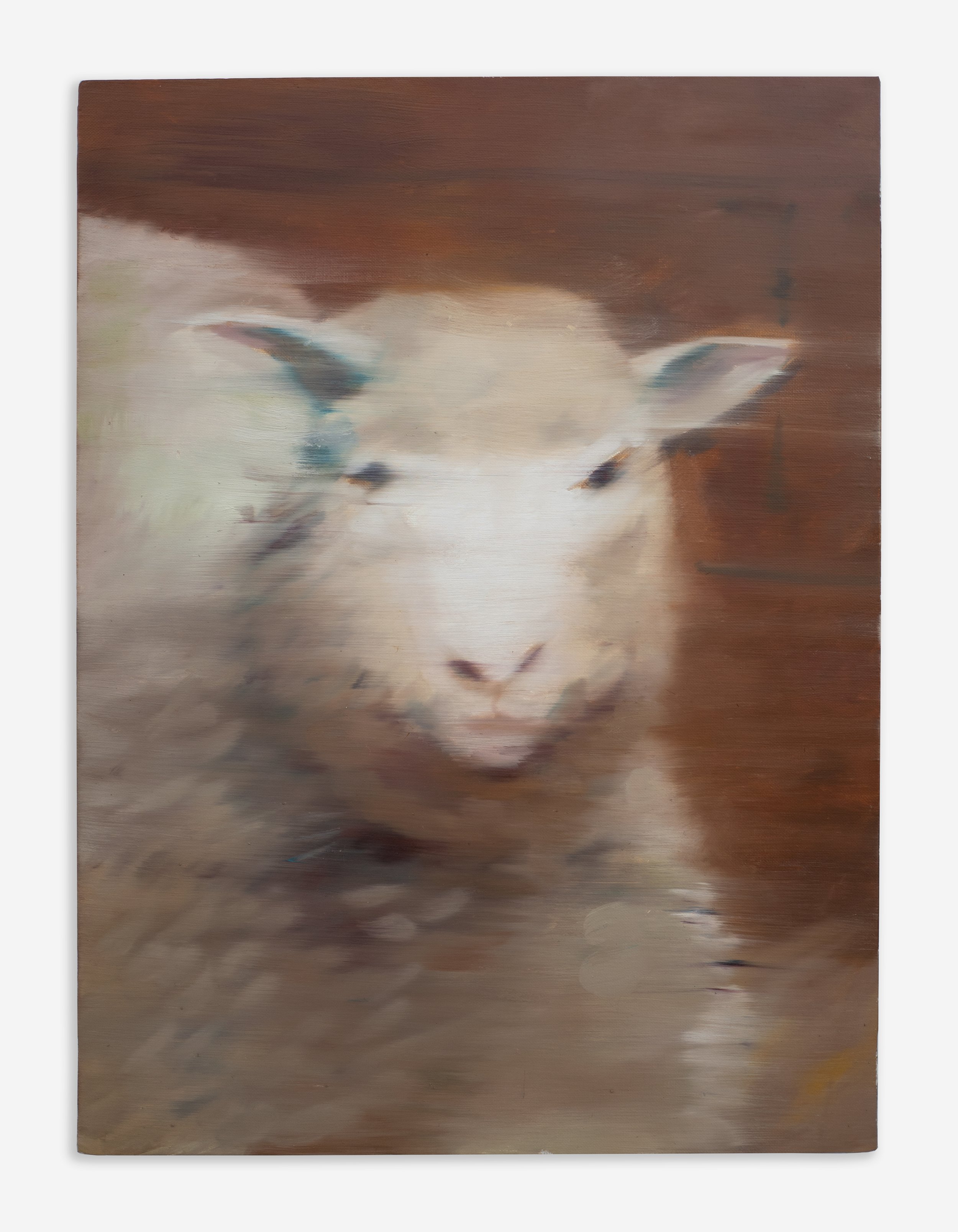
Dolly the sheep was born on July 5, 1996, at the Roslin Institute outside Edinburgh. She was the first mammal to be cloned from an adult somatic cell, a Finn Dorset ewe's mammary gland cell inserted into an enucleated egg and brought to term by a surrogate mother. The announcement, made seven months later in the journal Nature, triggered a worldwide reaction that mixed astonishment with alarm. If a sheep could be cloned from an adult cell, the reasoning went, a human could be too. The ethical debates that followed consumed talk shows, editorial pages, and legislative chambers across the globe. Tan Mu was five years old when Dolly was born. She describes her memory of the event as vague but formative, a moment when the news reached her through adult conversation and media coverage and lodged itself in her consciousness as a question about how life is constructed and where the boundaries of technology might lie. That question has stayed with her. Dolly (2021) is a painting of that question, rendered in blur.
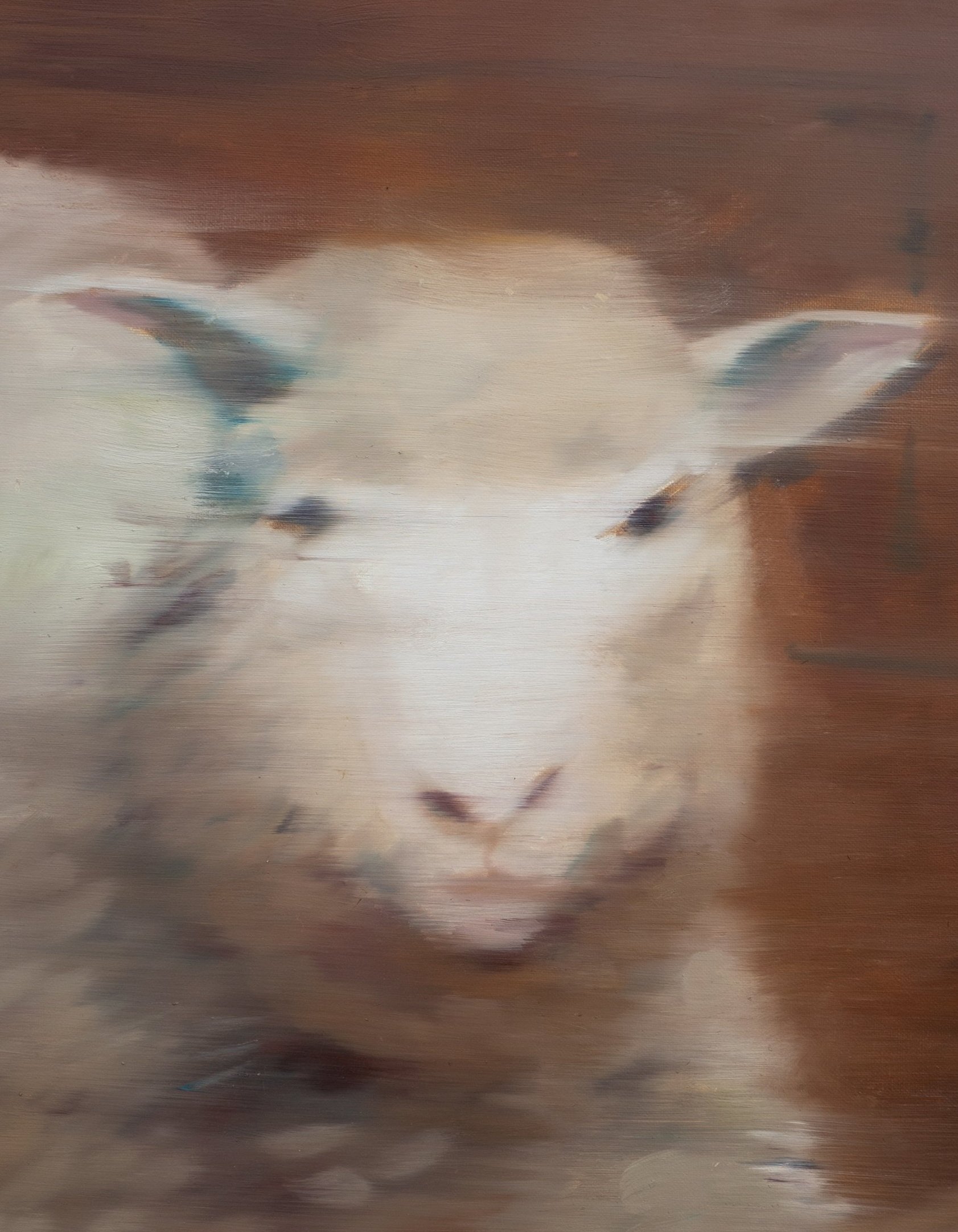
The painting is oil on linen, 61 x 45.7 cm (24 x 18 in), a vertical format that presents the sheep's head and upper body against a ground of warm white and pale yellow. The figure is not sharp. The entire surface is painted in a technique of soft focus, where edges dissolve into the surrounding color and forms are suggested rather than delineated. The sheep's face occupies the center of the canvas, its eyes two dark smudges that read as eyes only because of their position relative to the nose and the ears, which emerge from the blur as curved shapes of slightly darker tone. The wool is a field of pale cream and warm white, built from short, overlapping strokes of varying density that produce a surface resembling the texture of fleece seen through moisture or through a lens that has not quite focused. The background is not a separate color field but an extension of the same warm tonality, a slightly more yellowed white that fades into the edges of the linen, giving the painting the quality of an image that is still forming or has already begun to dissolve.
At arm's length, the blur reads as a photographic effect, the kind of soft focus that a cheap camera or a shaking hand produces when the subject is not quite in register. At close range, the blur reveals itself as a painterly decision. Each stroke is deliberate. The soft edges are not the result of an unfocused source image projected onto the canvas and traced. They are produced by a hand that has chosen to place pigment at a specific point and then pull it outward, thinning the paint as it moves away from the center of the form, creating a gradient that dissolves the boundary between the sheep and the ground. This is not the blur of a camera. It is the blur of a painter who has studied the blur of a camera and has chosen to reconstruct it, stroke by stroke, in a medium that does not blur by default but must be made to blur through the deliberate manipulation of paint. Tan Mu describes the blur as "a visual metaphor for memory," and she connects it to the gap between the image she held in her mind and the historical documentation she found when she revisited the story years later. "The image I held in my mind did not fully match historical documentation," she writes. "That gap between memory and reality fascinated me."
Francis Bacon's Study after Velázquez's Portrait of Pope Innocent X (1953) is one of the most recognizable blurred portraits in twentieth-century painting. Bacon took Velázquez's 1650 portrait of the Pope, one of the most precisely rendered faces in the history of Western art, and smeared it. The face in Bacon's version is a mass of dragged pigment, the features displaced, the eyes reduced to dark streaks, the mouth a vertical slash that reads as a scream or a howl. The papal vestments remain, their white and red still legible, but the face that should occupy them has been erased and reconstituted as a catastrophe of paint. The blur in Bacon is not a failure of focus. It is an act of violence against the portrait tradition, a refusal to grant the sitter the clarity that portraiture has always promised. Velázquez painted the Pope with the full authority of his position, the authority of a man who could command the world's greatest painter to render his face with perfect fidelity. Bacon paints the Pope as if the face could not hold together, as if the authority that Velázquez rendered so confidently had collapsed into a howl.
Tan Mu's blur operates in a different register. The sheep in Dolly is not screaming. It is not in pain. It is not being violated by the painter's hand. The blur is gentle, almost tender, the kind of softening that occurs when a memory is recalled after many years and the sharp edges of the original experience have been worn down by time and retelling. Where Bacon's blur is an assault on portraiture, Tan Mu's blur is a reproduction of the condition of remembering. The sheep is not distorted. It is diffused. The eyes are not screams. They are eyes seen through the haze of recollection, still recognizable as eyes, still positioned where eyes should be, but lacking the precision that a photograph or a sharply focused painting would provide. This is not the portrait of a specific sheep. It is the portrait of a memory of a sheep, a memory that has been carried for twenty-five years, from the moment when a five-year-old child heard the news of the first cloned mammal and stored the image in a place where images lose their edges and retain only their general shape, their warmth, their location, their emotional weight.
The scientific facts of Dolly's creation are precise. The mammary cell was taken from a six-year-old Finn Dorset ewe. The nucleus of that cell, containing the complete DNA of the donor, was inserted into an enucleated egg cell from a Scottish Blackface ewe. The egg was stimulated with an electric pulse, began to divide, and was implanted in a surrogate mother, also a Scottish Blackface, who carried the pregnancy to term. Dolly was born 148 days later. She was genetically identical to the Finn Dorset ewe. She was, in the language of genetics, a somatic cell nuclear transfer. She was, in the language of journalism, a clone. She was, in the language of a five-year-old child hearing the news on television or from adult conversation, a sheep that was exactly the same as another sheep, which raised questions that the child could not yet formulate but could feel: if something can be exactly the same as something else, what makes it different? What makes it itself? What makes it unique?
Dolly was euthanized on February 14, 2003, at the age of six and a half, roughly half the normal lifespan of a Finn Dorset sheep. The cause was a progressive lung disease called ovine pulmonary adenocarcinoma, a condition common in sheep kept indoors for extended periods. She had also been suffering from arthritis in her left hip and knee since the age of five, a condition that her keepers at the Roslin Institute attributed to her genetic origins. The shorter telomeres that she inherited from her six-year-old donor were not the direct cause of her early death, but they became the focus of scientific debate about whether cloning accelerates aging at the cellular level. Subsequent research on other cloned animals produced mixed results. Some clones showed normal telomere length, suggesting that the reprogramming process can reset the cellular clock. Others, like Dolly, showed signs of premature aging. The scientific community has not reached a definitive conclusion on whether cloning shortens lifespan. What is clear is that the clone is not a perfect copy. The process of somatic cell nuclear transfer introduces variables that the original genome does not account for: the age of the donor cell, the health of the surrogate mother, the conditions of gestation, the epigenetic markers that are reset or retained during reprogramming. Each of these variables produces a difference between the original and the copy, a difference that is not visible in the DNA sequence but that manifests in the life of the organism. The question of uniqueness is the question that Dolly's existence posed to the world, and it is the question that Tan Mu's painting poses to the viewer. Dolly was genetically identical to her donor, but she was not identical in every way. Her coat color was the same, her DNA was the same, but her telomeres, the protective caps at the ends of chromosomes, were shorter than those of a sheep her age, because they were inherited from a six-year-old donor. She aged faster than a normal sheep. She developed arthritis at a young age. She contracted a lung disease that is common in sheep kept indoors. She was euthanized at the age of six and a half, half the normal lifespan of a Finn Dorset. She was not a perfect copy. She was a copy with differences that mattered, differences that were consequences of the process that produced her. The clone is never identical to the original. The gap between the original and the copy is not an absence. It is a presence. It is the space where the process of replication leaves its mark, where the conditions of manufacture produce effects that are not part of the template but are part of the result. The blur in Tan Mu's painting is the visual equivalent of this gap. It is the space where the memory does not match the documentation, where the copy does not match the original, where the process of reproducing an image introduces a degree of uncertainty that cannot be eliminated.
Gerhard Richter's blurred photo-paintings of the 1960s and 1970s, and his later October 18, 1977 series (1988), establish the most sustained meditation on the blur in post-war European painting. Richter's method was to project a photograph onto a canvas, paint it with precise fidelity, and then drag a dry brush across the still-wet surface, smearing the paint and producing the effect of a photograph that has been slightly defocused. The result hovers in the space painting shares with photography, in the territory where the hand-made meets the machine-made, where the specific dissolves into the general. Richter has described the blur as a way of making the painting "more equal," of preventing any one area from dominating the viewer's attention, of producing an image that is "not a statement but a question." The blur, for Richter, is not a failure of representation. It is a strategy for producing uncertainty, for holding the image in a state of suspension where meaning has not yet crystallized.
Tan Mu's blur shares this strategy but applies it to a different subject and a different kind of uncertainty. Richter's blurred faces are faces taken from newspapers and family albums, images that already exist in the public or private record and that the blur removes from the realm of documentation into the realm of painting. Tan Mu's blurred sheep is not a document. It is a memory. The source image, whether a photograph from the Roslin Institute press release or a composite drawn from media coverage, is already at one remove from the event. The painting is at a second remove. It is not a painting of Dolly. It is a painting of a memory of Dolly, filtered through twenty-five years of time, through the lens of a child's understanding, through the media's representation, through the ethical debates that surrounded the announcement, through the scientific papers that followed, through the knowledge that Dolly lived a short life and died prematurely, through the adult artist's reflection on what it means to exist as a copy in a world that values originals. Each of these filters introduces a degree of distortion, a degree of blur, and the painting accumulates these distortions in its surface, producing an image that is not Dolly as she was but Dolly as she is remembered, which is to say, Dolly as she is understood, which is to say, Dolly as she exists in the gap between the fact of her existence and the meaning that has been assigned to it.
Tan Mu describes cloning as a subject that connects to her broader interest in "processes such as cell division, replication, and the logic that governs life itself." She frames the relationship between the body and consciousness as one of hardware and software, the body functioning as the physical substrate and consciousness as the operating system that runs on it. This framing is characteristic of her practice, which treats biological and technological systems as variations on the same structural principles. But Dolly is not a diagram of these principles. It is a painting of a sheep that was also a symbol, a mammal that was also a milestone, a living creature that was also a provocation, and the blur is the technique that allows the painting to hold all of these registers at once without collapsing into any single one. The painting does not ask whether cloning is right or wrong. It asks what it looks like to remember something that changed the world, from the vantage point of someone who was five years old when it happened and who has spent the intervening decades thinking about what it means for a copy to be a copy, for a memory to be inaccurate, for an image to be blurred, and for a sheep to stand in for all the questions that follow from the decision to make life from a template rather than from a meeting of two cells.
Saul Appelbaum, writing on Tan Mu's practice in 2025, observes that her paintings function as "arbitration," mediating input and output, data and visual form. The term applies to Dolly with a precision that other works in the series do not invite. The painting arbitrates photograph and memory, document and recollection, original and copy. It does not resolve the arbitration. It holds it open. The blur is the visual evidence of the arbitration, the trace of the process by which raw data, the photograph, the news report, the scientific paper, the childhood memory, is converted into painted form. The conversion is not transparent. Information is lost in the process, just as information is lost in the process of cloning, just as information is lost in the process of remembering. The clone is not the original. The memory is not the event. The painting is not the photograph. The blur marks the distance between each of these pairs, and the distance is not a defect. It is the condition under which the copy exists, the memory persists, and the painting becomes something other than a document of what Dolly looked like. It becomes a document of what it feels like to remember Dolly, to hold an image that has been carried for decades and to discover that the image does not match the source, that the memory has drifted, that the blur is not a flaw in the representation but the representation itself, the only form adequate to a subject that exists in the space where the original and the copy cannot be told apart, where the fact and the memory diverge, and where the sheep, standing in the middle of this divergence, looks out from a surface that refuses to render her with the clarity she never possessed, because she was never just a sheep. She was also a question, and questions do not have sharp edges.