The Pattern That Ate the Words: Tan Mu's Privacy 1 and the Language That Exists Only to Erase
A privacy protection stamp is a small roller, two or three inches wide, that you press across a document to deposit a band of ink over the text you want to hide. The ink is dark, the pattern is dense, and the result is a stripe of printed characters and symbols that covers whatever lies beneath it with a decorative lattice of meaningless marks. The stamp does not erase. It obscures. The text is still there, under the ink, legible if you hold the page up to a strong light or photograph it and adjust the contrast, but at normal reading distance, the pattern does its work: the personal information, the account number, the address, the social security number, becomes a smear of ink that the eye reads as texture rather than data. The privacy stamp is a tool of negation that produces its own visual language, a language of decorative marks that exist only to destroy the language of the document they cover. It is a form of writing that has no content, no syntax, no semantics, no referent. Its only function is to make other writing illegible. Tan Mu's Privacy 1 (2021) is a painting made with this tool.
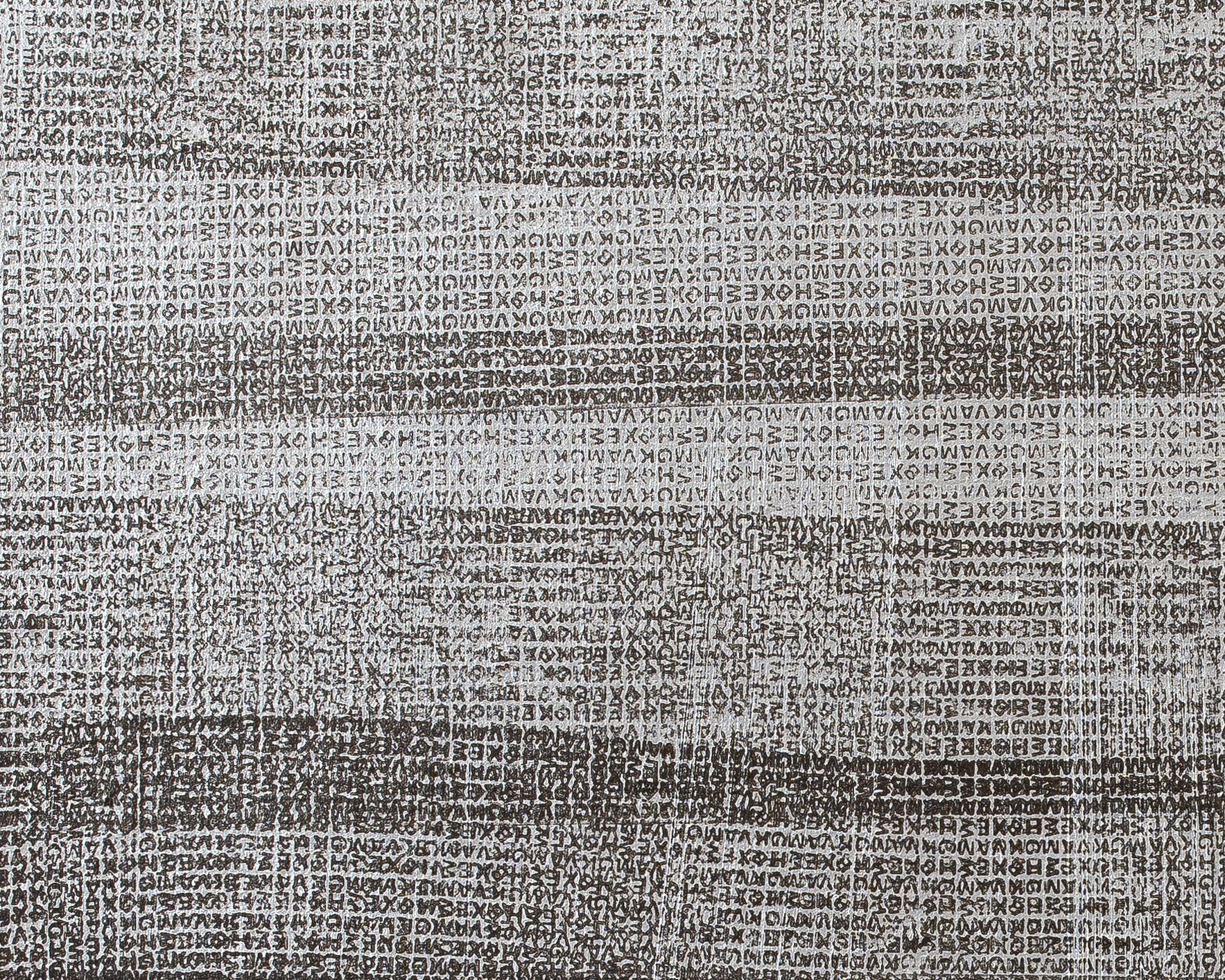
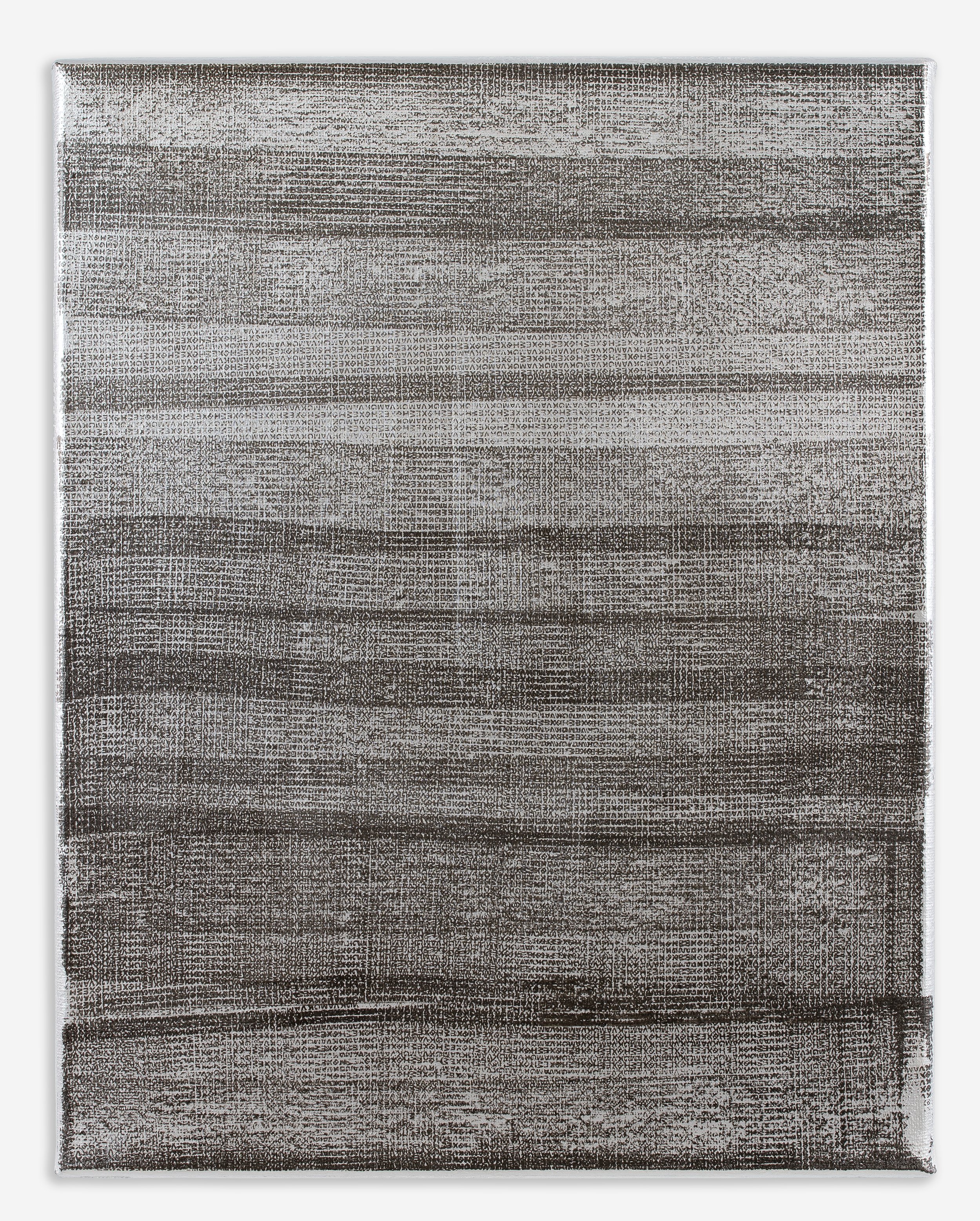
The painting is acrylic and ink on linen, 36 x 28 cm (14 x 11 in), a vertical format that matches the proportions of a document or a certificate. The surface is built in two layers. The first is a ground of gold acrylic, applied to the linen in a wash that settles into the weave and produces a luminous, slightly uneven field that catches ambient light and reflects it in directions that shift as the viewer moves. The gold is warm, not metallic, closer to the ochre of old manuscript illumination than to the flash of gilding. At close range, the gold ground reveals its own complexity. The acrylic has settled into the linen weave unevenly, pooling in the interstices of the fabric and skipping the ridges of the horizontal threads. This produces a subtle striation that runs parallel to the weave, giving the gold a directional quality that shifts as the viewer moves around the painting. In some areas, the gold is thin enough that the warm brown of the linen shows through, producing a tonal variation that ranges from bright lemon gold at the thickest passages to a muted amber where the linen absorbs the medium. These variations are not accidental. They are the result of a controlled wash technique, where the acrylic is diluted to different consistencies and applied in passes that build the gold surface gradually, each pass adding a layer of luminosity while preserving the transparency of the ones beneath it. The result is a ground that feels luminous rather than reflective, warm rather than flashy, a gold that reads as material rather than metallic. The second layer is the ink, applied with the privacy stamp itself, rolled across the surface in repeated passes that build up a dense pattern of overlapping characters. The stamp Tan Mu used is the same kind of roller stamp that offices and households use to obscure personal information before discarding documents. It deposits a pattern of uppercase letters, numbers, and decorative symbols in a band that is wide enough to cover a line of text. Against the gold ground, the dark ink produces a contrast that is sharp at the edges of each stamped band and soft where the ink has spread slightly into the absorbent acrylic surface. The ink is not a pure black. It is a composite of dark gray and near-black, the same color that office stamps produce, a color designed for maximum contrast against the white paper of financial documents. On the gold ground, the effect is different. The dark ink against warm gold produces a visual vibration that is insistent, the eye drawn to the contrast and then pulled across the surface by the rhythmic repetition of the stamped bands, following the rows of characters as they accumulate and overlap. In the painting, these bands are not applied in orderly rows. They overlap, intersect, and accumulate in some areas more than others, producing a surface that is dense and dark in the lower register and more open and legible near the top, where the gold ground shows through the gaps in the pattern.
At three meters, the surface reads as an abstract composition: a vertical field of gold crossed by horizontal bands of dark ink, the bands varying in width and density, the overall effect suggesting a palimpsest, a page that has been written over so many times that no individual line of text can be isolated. At thirty centimeters, the individual characters become legible. The letters of the privacy stamp are recognizable: H, E, X, O, M, K, and various symbols that resemble asterisks, checkmarks, and geometric shapes. They are not random. They are the characters that the manufacturer of the stamp chose to include in its pattern, characters selected for their visual density and their ability to overlap without creating recognizable words. The stamp is designed to produce a pattern that looks like writing but is not writing, a pattern that occupies the visual space of language without carrying its content. The painting preserves this paradox. From across the room, the surface is a composition of gold and black, decorative and rhythmic. Up close, it is a field of characters that cannot be read because they were never meant to be read. They are the alphabet of concealment, the vocabulary of a language whose only purpose is to make other languages disappear.
Xu Bing's Book from the Sky (1987-91) consists of four volumes and a set of hand-printed scrolls containing approximately four thousand characters that look like Chinese but are not. Xu spent four years carving each character into individual woodblocks, printing them on traditional Chinese paper, and binding them into volumes that resemble Song dynasty books. The installation, when exhibited, fills a room with hanging scrolls and open books, all printed with characters that appear to be legible but that resist every attempt at reading. The viewer approaches the text with the expectation of comprehension, the trained habit of a literate person encountering written language, and the expectation is denied. The characters are not code. They are not cipher. They are not a secret language with a key. They are forms that occupy the visual and structural position of Chinese characters, with radicals, strokes, and components that correspond to the architecture of real characters, but they have been invented from scratch, each one unique, none of them corresponding to any character in any dictionary. Xu has described the work as a meditation on the nature of reading, on the authority of the printed word, and on the moment when the reader realizes that what looks like language is not language at all.
Tan Mu's Privacy 1 inverts this operation. Xu Bing's characters are meaningless forms that look like meaningful writing. Tan Mu's characters are meaningful forms, real letters of the Latin alphabet, real numerals, real symbols, that have been arranged into a pattern whose sole purpose is to prevent meaningful writing from being read. Xu Bing's characters are empty signifiers, signs without referents. Tan Mu's characters are full signifiers that have been deployed in the service of emptying other signs of their meaning. Both works occupy the space where writing and visual pattern intersect, but they approach it from opposite directions. Xu Bing starts from nothing and creates the appearance of something. Tan Mu starts from something, the real letters of a real stamp, and creates a pattern that reduces the something to nothing. The stamp's characters are not empty. They are the letters H, E, X, O, M, K. But their arrangement, their density, their purpose is to make other letters disappear. The privacy stamp is a machine for producing visual noise, and the painting is a record of that noise, preserved on gold linen, hung on a wall, where it is no longer performing its function of concealment but is instead being looked at, examined, and read as a composition of marks that were designed to prevent reading.
The privacy protection stamp is a product of the late twentieth and early twenty-first centuries, a period in which the volume of personal information circulating on paper documents, bank statements, medical records, tax forms, utility bills, became large enough that the risk of identity theft and data exposure required a simple, inexpensive countermeasure. The stamp is the countermeasure. It costs a few dollars, requires no power source, and can be applied in seconds by anyone who can roll a cylinder across a page. It is a low-technology solution to a problem that has since been partially addressed by high-technology means: shredding, cross-cut shredding, incineration, digital encryption, secure data storage. But the stamp persists because it is immediate, portable, and irreversible once applied. The ink soaks into the paper fibers and bonds with them. The text beneath the stamp is not gone, but it is no longer accessible to the naked eye at reading distance. The stamp produces a condition of partial legibility: the information is present but not readable, visible but not comprehensible, there but not there. This condition of partial legibility has a legal dimension. In the United States, the Fair Credit Reporting Act and the Gramm-Leach-Bliley Act require financial institutions to protect consumer data, and the stamp is one of the tools that institutions use to comply with these requirements before discarding paper records. In the European Union, the General Data Protection Regulation imposes even stricter standards for data protection, and while the stamp alone does not satisfy these standards for electronic data, it remains in use for physical documents that contain personal information. The stamp sits at the intersection of regulation and practice, a small object that mediates the legal obligation to protect information and the practical need to dispose of it. This condition, of data that exists but cannot be used, of text that is present but inaccessible, is the condition that Privacy 1 makes permanent. The painting takes a tool designed for temporary use, apply, discard, and turns it into a permanent composition, a work of art that will be looked at for as long as it exists, a pattern that was meant to be glanced at and ignored and will now be examined and interpreted.
Christopher Wool's Apocalypse Now (1988) is a large aluminum panel bearing the words "SELL HOUSE SELL CAR SELL BIKE" in black stenciled letters, with some letters cropped by the edge of the panel and others compressed into a single continuous string that fills the surface from edge to edge. The words are drawn from Francis Ford Coppola's 1979 film, spoken by a character who has descended into madness, and the painting transmits them without punctuation, without spacing, without any of the visual cues that make written language easy to parse. The viewer must read the text, separate the words, and assemble the meaning from a surface that resists the assembly. Wool's stenciled text paintings of the late 1980s and early 1990s took the tools of industrial sign painting, the stencil, the enamel, the roller, and applied them to the vocabulary of painting, producing works that are both text and image, both legible and resistant, both communicative and obstructive. The words are real. They can be read. But the conditions of their presentation, the lack of spacing, the compression of letters, the cropping at the edges, the impersonal stencil font, make the act of reading slower and more deliberate than it would be if the same words were set in a book. This slowing down is the painting's argument. Wool forces the viewer to confront the materiality of language, the way that the appearance of text, its font, its spacing, its surface, its scale, shapes the experience of reading. A word set in a book is read quickly and unconsciously. The same word stenciled across a six-foot aluminum panel, cropped and compressed, is read slowly and with effort. The word has not changed. The conditions of its presentation have. And the conditions of presentation are what the painting makes visible.
Tan Mu's Privacy 1 extends this logic to its terminal point. Wool's text can be read, with effort. Tan Mu's text cannot be read, because it is not text. It is the pattern that a stamp produces when it is applied to conceal text. The letters in the painting are real letters, but they are not arranged to form words. They are arranged to form a barrier, a screen, a layer of visual interference that sits on top of whatever information the document might once have carried. The painting takes this barrier and mounts it on gold linen, transforming a tool of negation into an object of contemplation. The viewer who approaches the painting looking for meaning in the stamped characters will not find it, because the characters were not designed to carry meaning. They were designed to prevent meaning from being carried. The viewer who steps back and sees the gold ground shining through the gaps in the pattern will see a composition, a field of dark marks on a luminous surface, a visual rhythm produced by the repetition of a mechanical tool across a hand-prepared ground. The painting holds these two modes of seeing in suspension. It is a document that has been redacted into a composition, a text that has been stamped into a pattern, a tool of concealment that has been preserved as an object of aesthetic attention.
Tan Mu describes her philosophical orientation as an extension of ge wu zhi zhi, the Confucian principle of investigating things to extend knowledge, examining and discerning objects of various scales and conditions. The stamp in Privacy 1 is an object that has been investigated with this kind of attention. It is a small, cheap, mass-produced tool that most people use without looking at the pattern it produces. Tan Mu has looked at the pattern. She has applied it to a surface that makes it visible, gold linen that reflects light through the gaps, and she has built up the pattern in layers that produce variations in density and transparency, making the stamp's mechanical repetition look like the result of deliberate composition. The stamp, investigated in this way, reveals itself as a carrier of visual information that no one intended to produce. The manufacturer designed the pattern to be dense enough to conceal. Tan Mu has revealed that the pattern is also dense enough to compose, that the characters in the stamp, chosen for their ability to fill space and overlap without forming words, are also characters that can be arranged on a surface to produce a rhythm, a visual tempo, a field of marks that the eye follows as it would follow a line of text, except that there is no line of text, there is only the pattern, the stamp, the language that exists only to erase, preserved on gold linen, where it will never be asked to conceal anything again.
Li Yizhuo, writing on Tan Mu's practice, observes that the canvases "conjure up a kind of vitality and depth of their own" rather than diagnosing modern spectacles from a distance. Privacy 1 conjures its vitality from the stamp's own pattern, from the characters that were designed to be seen through and not seen, from the gold ground that turns a tool of negation into a surface of luminous presence, from the small format that holds the composition at the scale of the document it was meant to protect. The painting does not argue about privacy. It does not take a position on data protection or identity theft. It investigates a tool, a small roller stamp that costs a few dollars and sits in a desk drawer, and it finds in that tool a visual language that is simultaneously meaningless and dense, decorative and destructive, a language that produces pattern by preventing communication, a language that erases by writing, a language that turns personal information into visual noise, and visual noise into a composition that glows on a wall, where the noise is no longer noise but the record of a tool that was never meant to be looked at and now cannot be looked away from, because it has been placed on gold linen, at the scale of a document, in a room where people come to look, and the looking is the act that the stamp was designed to prevent, and the painting is the act that makes the prevention visible, and the visibility is the thing that the privacy stamp, that small roller in a desk drawer, was never designed to produce.