The Form That Visibility Takes: Tan Mu's Twenty Thousand Leagues Under the Seas and the Painting of the Invisible
On January 15, 2022, the Hunga Tonga Hunga Ha'apai volcano erupted with a force that registered on seismographs around the world and produced an ash plume that reached 58 kilometers into the atmosphere. The eruption severed the single submarine cable that connected Tonga to the global internet, cutting the nation off from international communication for five weeks. For those five weeks, a country of 106,000 people existed in informational isolation, unable to confirm the fate of relatives overseas, unable to coordinate relief efforts with international agencies, unable to send or receive the messages, video calls, financial transfers, and news reports that constitute participation in the modern world. The cable that had been cut was not a satellite link or a radio transmitter. It was a fiber optic strand, roughly the diameter of a garden hose, lying on the ocean floor, carrying data as pulses of light through glass thinner than a human hair. When it broke, the connection did not degrade. It ceased. The event made visible, through its absence, a system that had been invisible by design. Tan Mu's Twenty Thousand Leagues Under the Seas (2023) is a painting of that system, and of the invisibility that is its operating condition.
The painting is oil on linen, 182 x 152 cm (72 x 60 in), the largest format in Tan Mu's submarine cable series to date. The composition presents a section of ocean viewed from directly above, the cable network rendered as luminous lines of teal, cyan, and pale blue against a field of deep marine black that graduates to dark navy near the edges. The cables trace paths across the surface in curves and angles that follow the contours of actual submarine cable routes, the arcs corresponding to the geography of coastlines, the junctions to the branching points where cables from different regions converge at landing stations. The lines are not uniform in width or brightness. They vary in intensity, some blazing with a nearly white core of pale turquoise, others fading to a thin trace of blue-gray, as if the signal they carry is stronger in some passages and weaker in others. The variation is not random. It corresponds to the density of traffic on the cables, the number of wavelengths multiplexed through a single fiber, the volume of data flowing through each strand at any given moment. The painting does not represent the ocean floor as a topographic map. It represents the data flowing through the cables as a topographic event, a landscape of light on a ground of darkness.
At arm's length, the surface reveals the method. The dark field is built from multiple layers of transparent ultramarine and Payne's gray, each wash thin enough to allow the linen weave to register as a faint texture beneath, giving the ocean surface a granularity that reads as the slight turbidity of deep water viewed from above. The cable lines are painted in short, overlapping strokes of a bright teal mixed with a touch of zinc white, each stroke laid with a small brush that tracks the path of the cable segment by segment, producing a line that is not mechanically smooth but hand-drawn, alive with the slight variations in pressure and direction that distinguish a painted line from a printed one. Where cables intersect, the upper cable is painted over the lower, creating a visual hierarchy that corresponds to the actual layering of cables on the ocean floor, where newer routes are laid across older ones, sometimes crossing, sometimes running parallel for hundreds of kilometers before diverging toward different landing points. The intersections produce small nodes of increased brightness where two luminous lines overlap, producing the effect of a network junction, a hub where data from multiple sources converges before being routed to its destination.
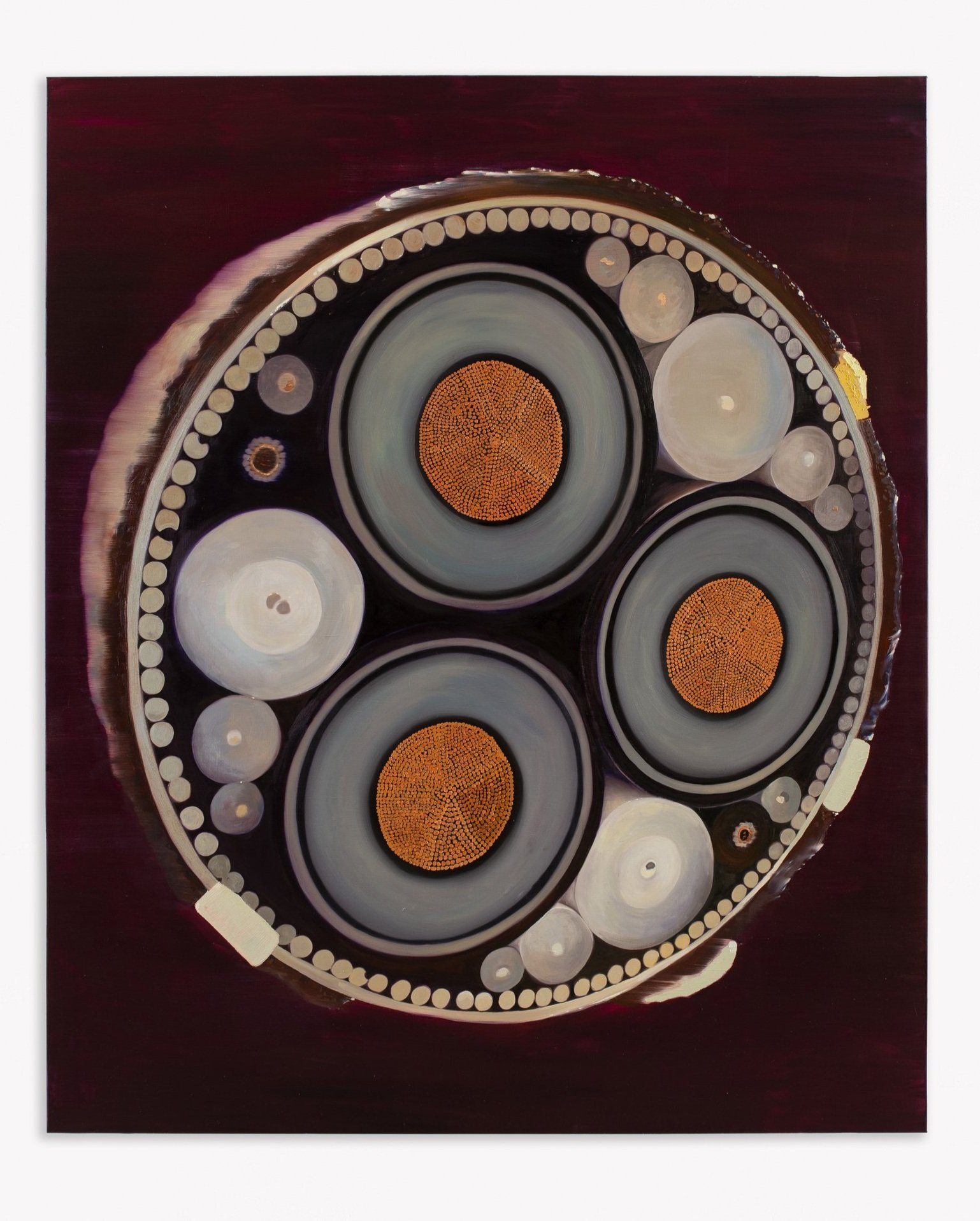
Caspar David Friedrich's The Sea of Ice (1823-24) presents a shipwreck barely visible among towering slabs of pack ice that have crushed the wooden hull and thrust its broken timbers upward at angles that suggest the violence of the compression. The ship, the HMS Griper, is a fragment of splintered wood trapped in a landscape that has destroyed it. The ice slabs dominate the composition, their edges sharp, their surfaces catching a cold, diffused light that gives the scene an otherworldly clarity. The sky above is a low, leaden gray that presses down on the ice field without providing warmth or illumination. There is no human figure in the painting. The ship is the only evidence that people were ever present, and it is wreckage. Friedrich's painting is often read as a meditation on the sublime power of nature and the insignificance of human endeavor in the face of geological force. But it is also a painting about what is not visible. The ocean, the medium in which the ship was traveling and through which the ice formed, is present only as an absence, a dark gap among the ice slabs that suggests depth without showing it. The water is not the subject. The ice is the subject. The water is what lies beneath the ice, what the ice conceals, what the viewer knows is there but cannot see.
Tan Mu's submarine cable paintings invert this relationship. In Twenty Thousand Leagues Under the Seas, the ocean is the visible field, rendered in deep blues and blacks that extend to the edges of the canvas. The cables, which lie on the ocean floor at depths of thousands of meters, are the subject, and they are shown as luminous lines traced across the surface of the water as if the viewer could see through the entire depth of the sea and watch the data flowing in real time. This is not what the ocean looks like. It is what the ocean would look like if the cables were visible, if the data were luminous, if the infrastructure that carries 99 percent of intercontinental data traffic were as apparent as the waves on the surface. Friedrich painted what the ice conceals by showing the ice itself, the surface that covers the depth. Tan Mu paints what the ocean conceals by making the invisible visible, by rendering the cables as lines of light on a field of darkness, by transforming the ocean floor into a map of human connection that can be seen from above, the way a satellite sees the earth, the way a god might see the ocean floor, the way the painting allows the viewer to see what no human eye has ever seen in its totality: the entire network, simultaneously, as a single luminous structure.
The submarine cables that carry the world's data are, by design, invisible. They are laid on the ocean floor at depths ranging from a few hundred meters on continental shelves to over eight kilometers in the deep ocean basins. They are not marked on navigational charts, their exact routes are considered sensitive information by the telecommunications companies that own them, and their landing stations, the facilities where the cables come ashore and connect to terrestrial networks, are unmarked buildings in coastal industrial zones. The invisibility is not accidental. It is a security measure. Cables have been cut intentionally in the past, by governments, by fishing vessels, by parties with interests in disrupting communication. The less visible the infrastructure, the more secure it is. But invisibility comes at a cost. A system that is invisible is a system that is not thought about. The cables that carry every email, every video call, every financial transaction, every military communication, every social media post that crosses an ocean are not part of the public imagination. They are not discussed in schools, not marked on maps, not acknowledged in the way that satellites or cell towers are. Most people assume that international data travels by satellite. In fact, satellites carry less than one percent of intercontinental data traffic. The remaining 99 percent travels through submarine fiber optic cables, thin strands of glass encased in layers of protective armor, lying on the seabed in the dark, carrying pulses of laser light that encode the world's information at speeds measured in terabits per second. When the Tonga cable broke, the first response from most of the world was not alarm but confusion. What cable? The cable that connects Tonga to the internet. There is a cable? Yes, there is a cable. It is on the ocean floor. It has been there since 2013. It carries all of Tonga's international data. It is the only connection the country has to the rest of the world. And when it broke, the country disappeared from the global conversation for five weeks. The repair ship had to travel from Papua New Guinea, a journey of several days, and the repair itself required lifting the cable from the ocean floor, splicing the broken ends, and laying it back down, a process that took additional weeks. During those weeks, the people of Tonga communicated through what few satellite links were available, at vastly reduced bandwidth and increased cost. The event made the cable visible through its absence, the way a bone becomes visible when it breaks through the skin.
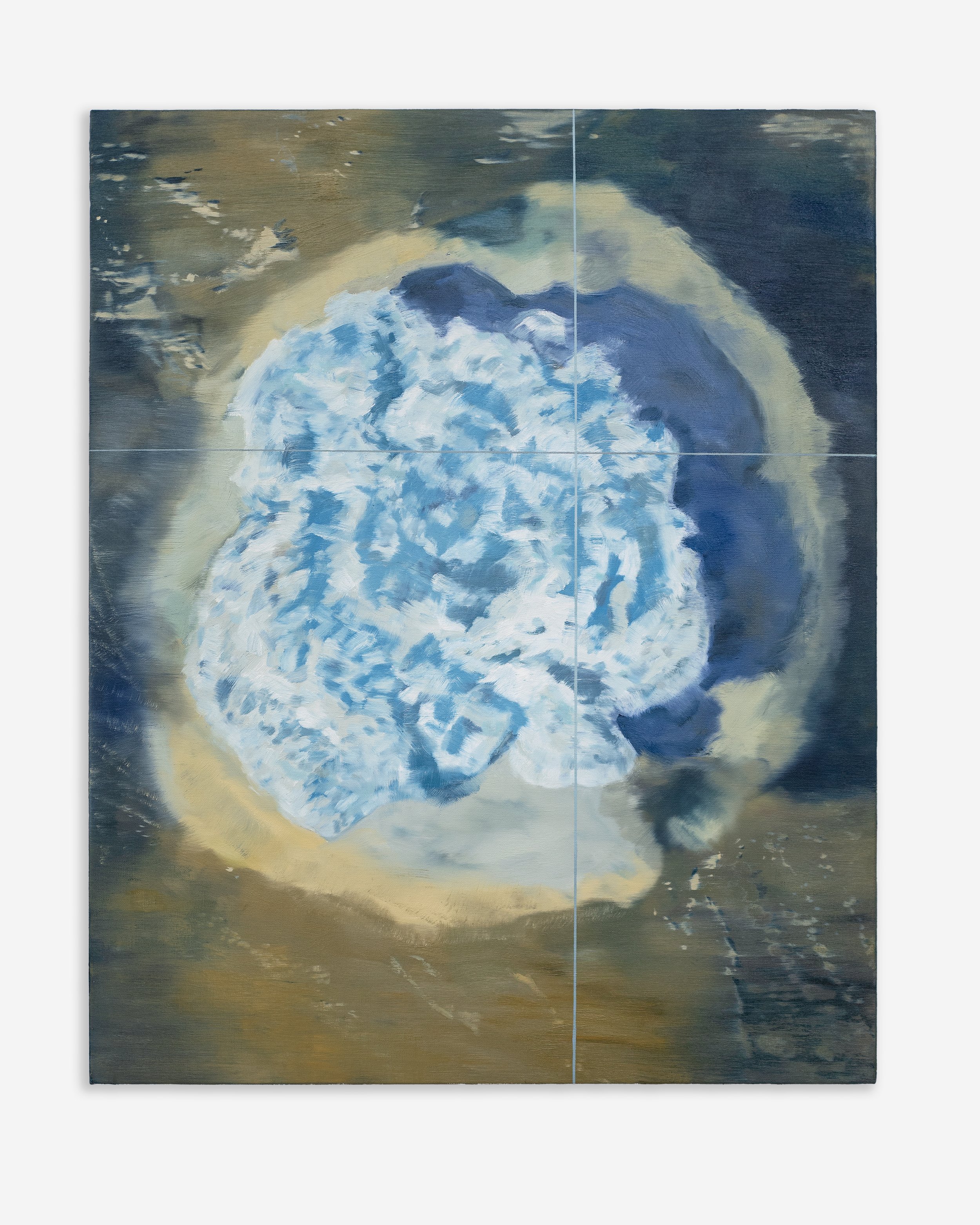
Mark Rothko's late paintings, the dark canvases of 1969 and 1970, reduce the color field to two or three horizontal bands of near-black and deep plum, applied in thin washes over dark grounds. These works were made for the Rothko Chapel in Houston, though they were not all installed there, and they represent the most extreme reduction of Rothko's decades-long project of using color as a vehicle for emotional and spiritual experience. Black on Gray (1969) is a large canvas, roughly six feet tall, divided into a dark upper rectangle and a lighter lower rectangle by a thin horizontal line that reads as a horizon or a seam. The upper field is built from layers of black and deep violet, so thinly applied that the weave of the canvas emerges at the edges, producing a surface that is not flat but atmospheric, as if the darkness were not a color but a condition of the air, a darkness that light could enter but not dispel. The lower field is slightly lighter, a dark gray that reads as twilight or deep water, a transitional tone that connects the upper darkness to the edge of the frame without resolving into either. These paintings were among the last Rothko completed before his death in February 1970. They have been read as meditations on mortality, on the approach of darkness, on the dissolution of the color field into the monochrome that precedes or follows perception. They are also paintings about luminosity emerging from darkness, about the way a thin line of lighter tone can structure an entire composition, about the capacity of a surface that is almost entirely dark to hold and emit light.
Twenty Thousand Leagues Under the Seas operates in a related register. The field of the painting is almost entirely dark, a deep marine black that covers most of the 182 x 152 cm surface. The cables are the luminous lines that structure the composition, the thin traces of teal and cyan that emerge from the darkness and trace paths across it. They are the Rothko line, the horizon, the seam, the luminous thread that gives the darkness its shape and its meaning. Without the cables, the painting would be a field of black, a void without structure. With the cables, it becomes a network, a system of connections that transforms the void into a space of passage, a space where data flows, where messages travel, where human presence moves from one point to another through a medium that conceals it. Rothko's late paintings hold light in darkness. Tan Mu's cable paintings hold data in darkness. The light in Rothko is the light of perception, the capacity of the eye to register contrast and find form in the near-absence of illumination. The light in Twenty Thousand Leagues is the light of fiber optic cables, the capacity of glass to carry pulses of data through thousands of kilometers of ocean, a light that is not visible to the eye but is rendered visible by the painting, a light that becomes form because the painter has decided to make it form.
Tan Mu describes undersea cables as "an externalized nervous system," a phrase that connects the cables to the biological network of neurons that carries signals through the body. The metaphor is precise and structural. The nervous system is not visible from the outside. It lies beneath the skin, inside the body, carrying information that the conscious mind does not perceive until something goes wrong, until a signal is interrupted, until a connection is lost. The submarine cables are not visible from the surface of the ocean. They lie on the floor, beneath kilometers of water, carrying data that the users of the internet do not perceive until the cable is cut and the connection is lost. The painting makes this parallel visible by rendering the cables as luminous lines that resemble neural pathways, a network of branching connections that covers the canvas the way the nervous system covers the body, comprehensively, redundantly, with multiple routes to the same destination. The redundancy is critical. Submarine cable networks are designed with backup routes, not because the cables are expected to fail, but because they do fail, regularly, cut by fishing trawls, anchors, earthquakes, and volcanic eruptions, and the data must find another path to its destination. The painting's network shows this redundancy in its branching, in the way that some lines converge at junctions and then diverge again, offering multiple paths through the same field. The Tonga cable was a single point of failure. The networks shown in this painting, with their multiple routes and redundant paths, are designed to prevent that kind of isolation. But redundancy is not immunity. It is a hedge against the known risks, not a defense against the unknown ones. The volcano that cut the Tonga cable was an unknown risk. The painting does not show the risk. It shows the network, the system, the structure that carries everything and is itself carried by nothing, lying on the ocean floor in the dark, where no one can see it, where it continues to pulse with the data of the entire world, until it stops. Danni Shen, writing on Tan Mu's practice in 2024, observes that the paintings "do not aim at diagnosing the modern spectacles from a distance. They conjure up a kind of vitality and depth of their own." Twenty Thousand Leagues Under the Seas conjures the vitality of the cables by making them luminous, by giving them a visual presence that they do not have in the physical world, by transforming the invisible infrastructure of global connection into a composition of light on darkness that the viewer can see and follow and trace across the surface of the canvas the way data traces across the surface of the ocean floor, invisible, essential, and carrying, in every pulse of light, the full weight of human presence, the messages and images and voices and financial transfers and military communications and love letters and emergency broadcasts that pass through the cable every second, all of them invisible, all of them essential, all of them represented by a line of teal on a field of black that the viewer can now see, because the painter has decided to make the invisible visible, and the visible, once seen, cannot be unseen.