The Star That Became a Chip: Tan Mu's Antimony and the Element That Traveled from Supernova to Semiconductor
Isaac Newton spent more time on alchemy than on physics. This is not a footnote to his biography; it is the central fact of his intellectual life. Of the roughly ten million words he wrote, approximately a million were devoted to alchemical experiments, a body of work so extensive that the economist John Maynard Keynes, cataloguing Newton's papers at Cambridge in 1936, declared that Newton was "not the first of the age of reason" but "the last of the magicians." Among the substances Newton investigated most closely was antimony, a metalloid that alchemists prized for its capacity to separate gold from base metals. He called the purified form "Regulus of antimony," and in one experiment, after producing a particularly lustrous crystalline specimen, he named it "Regulus XIV antimony," associating it with the star Regulus in the constellation Leo. The connection was not metaphorical. Newton believed that metals corresponded to celestial bodies, that the structure of the heavens was legible in the structure of matter, and that antimony, with its bright, star-like crystals, carried a signature of the cosmic order he was trying to read. He was wrong about the correspondences, but he was right about the stars. Antimony is produced in supernovae. The element that Newton weighed in his laboratory at Cambridge had been forged in the collapse of a massive star, ejected into the interstellar medium at velocities approaching the speed of light, and eventually incorporated into the dust cloud that coalesced into the solar system four and a half billion years ago. Every atom of antimony on Earth arrived here by way of a stellar explosion.
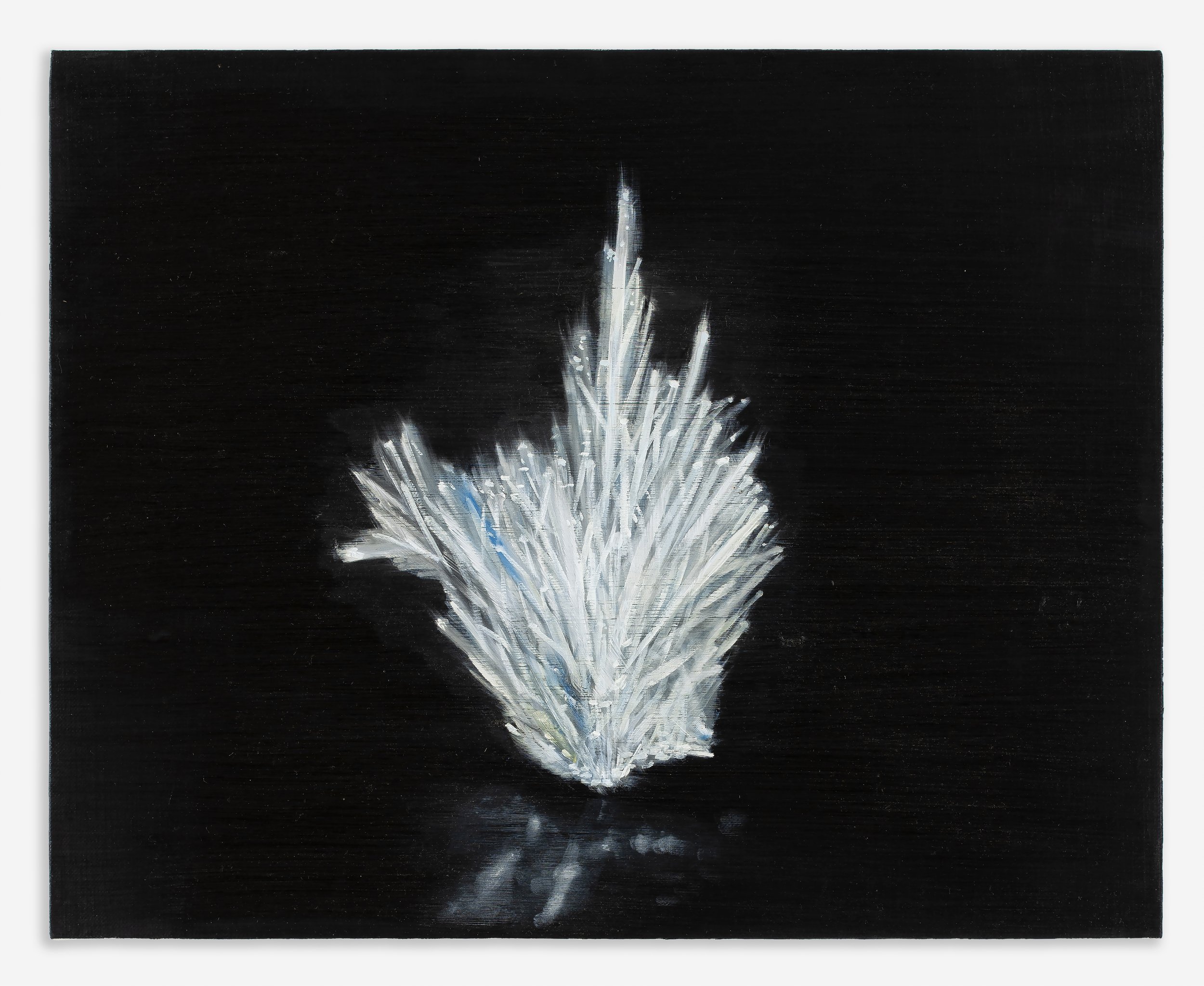
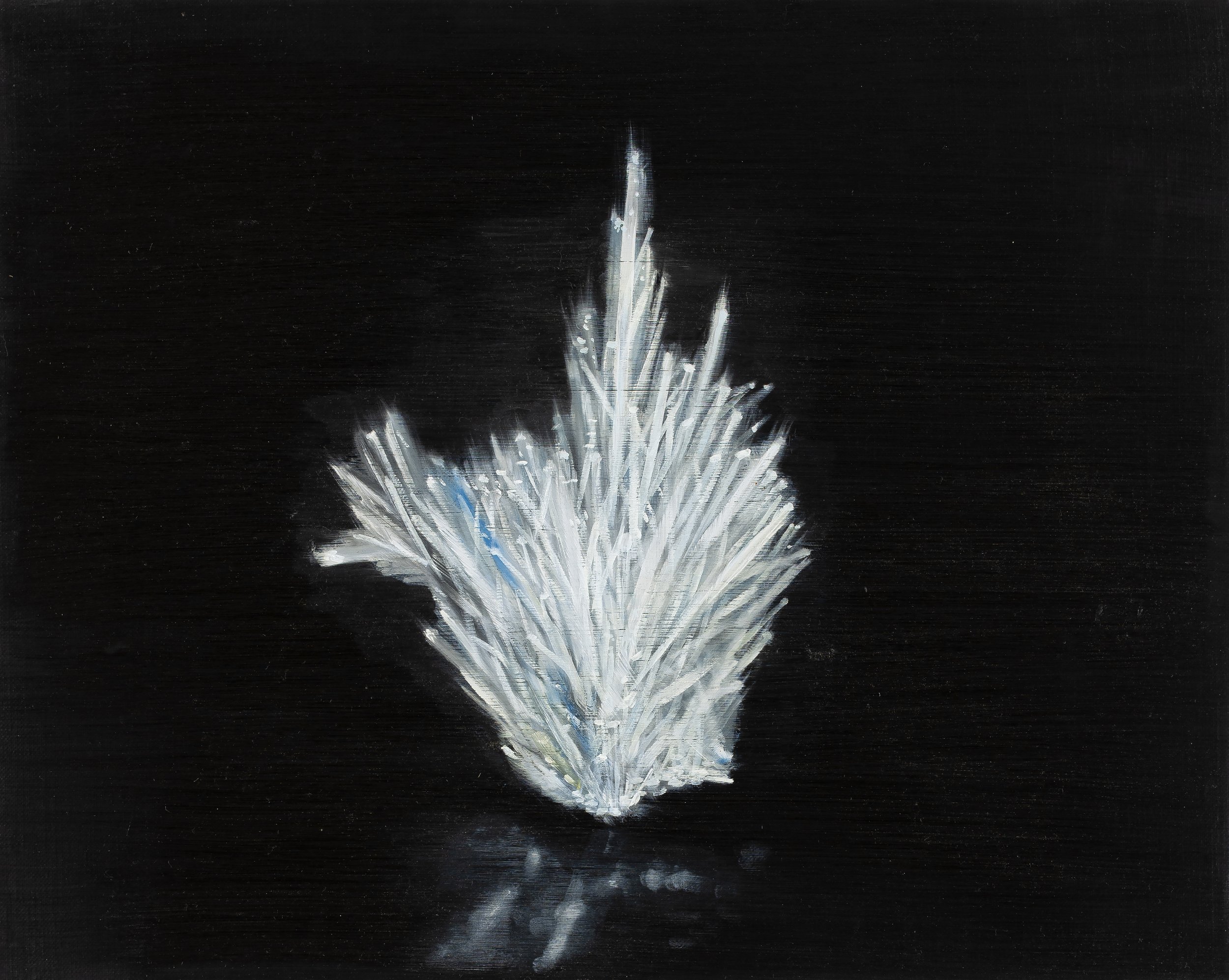
Oil on linen, 16 x 20 inches, 40.6 x 50.8 cm. The dimensions are intimate, the format of a study or a personal devotional panel, the kind of size a painter chooses when the subject demands proximity rather than spectacle. The linen is prepared with a dark ground, and the paint sits on that ground in thin, precise layers that allow the weave of the fabric to register at the edges of the forms, a texture that becomes visible only when the viewer steps close enough to see the individual threads pressing through the pigment. The subject is centered and isolated. There is no landscape behind it, no laboratory bench beneath it, no hand holding it up to the light. The crystal structure of antimony occupies the middle of a field that is entirely black, not the black of an absence but the black of a ground that has been built up from layers of pigment until it absorbs light and returns nothing, a void that functions as Tan Mu describes it: "an infinite void, intensifying the contrast and bringing out the material's intricate details." The crystal itself radiates outward from a central point. Its branches are sharp, angular, and crystalline, the kind of geometry that occurs when atoms arrange themselves in a lattice according to the laws of thermodynamics rather than the preferences of a draftsman. The colors are silvery white, pale gold, and a cold blue-white that catches the light differently depending on the viewing angle, a property that antimony actually possesses and that Tan Mu has rendered with a fidelity that suggests she studied the mineral under magnification before committing it to paint. The surface has a metallic sheen that distinguishes it from the matte darkness of the ground. The painting asks to be looked at closely, at arm's length, where the distinction between the crystal's geometry and the painter's hand becomes a productive uncertainty.
At two meters, the crystal resolves into a configuration of sharp branches and angular facets, a mineralogical map of a substance that forms in trigonal crystal systems. At thirty centimeters, the branches dissolve into brushmarks, each one a decision about pressure, direction, and the amount of paint loaded onto the bristle. The black ground shows through in the thinnest passages, and the linen weave emerges as a grid of horizontal and vertical lines that structures the entire surface from below, an armature that the viewer cannot unsee once it has been noticed. The contrast between the crystal's radiance and the ground's absorption is the painting's structural engine. Without the black, the crystal would be a mineral illustration, an image of something rather than an encounter with it. With the black, the crystal becomes an event, a sudden emergence of form out of formlessness, a star born out of darkness, which is precisely what antimony is.
Joseph Beuys spent the decades after the Second World War making objects from materials he considered carriers of energy and memory: felt, fat, honey, copper, sulfur. His Fond III (1979), a room-scale installation at the Museo Madre in Naples, presents rows of copper plates mounted on wooden bases, each plate polished to a warm gleam, arranged in a grid that suggests both a laboratory and a chapel. Copper, for Beuys, was a conductor: of heat, of electricity, of the social energy he called "social sculpture." It was a material that carried information across distances, that connected bodies and systems, that made visible the invisible currents running through human society. The copper plates in Fond III are not symbols of conductivity. They are conductivity made visible, conductivity installed in a room where viewers can walk among the plates and feel the charge that the material carries, not as an electrical current but as an aesthetic and conceptual force. Beuys's material philosophy held that every substance contained latent energy that could be released through artistic intervention, and that the artist's task was to make that energy legible to a viewer who had been trained to see materials as inert. His famous Plight (1985), the installation at the Centre Pompidou in Paris where the walls of an entire gallery were lined with felt to create a room of absolute acoustic deadness, made the same argument with a different material: felt absorbs sound, stores it, and refuses to release it, and the experience of standing in a room where sound goes to die is an experience of a material's latent property becoming an aesthetic event.
Tan Mu's Antimony makes a comparable argument with a different substance and a different method. Where Beuys installed copper plates in a gallery and relied on the viewer's encounter with the physical material to release its conceptual charge, Tan Mu paints antimony on linen and relies on the representational precision of the image to make the element's properties legible. The painting does not contain antimony. It contains an image of antimony. But the image is so specific in its rendering, so precise in its color and its geometry, that it functions as a kind of surrogate for the material itself, a representation that carries enough information about the element's visual properties to activate the same chain of associations that the physical mineral would. The crystal's branching structure, its silvery lustre, its angular sharpness: these are the properties that make antimony useful as a semiconductor dopant and a flame retardant, and they are the properties that Newton found so compelling that he named a specimen after a star. The painting holds all of these associations in suspension, on a surface that is 16 by 20 inches, small enough to hold in the hands like a manuscript page, which is appropriate, because the history of antimony is a history that runs through manuscripts: alchemical treatises, Newton's private laboratory notes, modern semiconductor patents. The painting is a page in that history, rendered in oil and linen instead of ink and paper.
The science is this. Antimony, atomic number 51, sits on the periodic table between tin and tellurium, in the zone where metals shade into nonmetals and acquire properties of both. It is a metalloid, which means it can conduct electricity under some conditions and resist it under others, a property that makes it indispensable to the semiconductor industry. Antimony trioxide is used as a flame retardant in plastics, textiles, and electronics. Antimony is doped into silicon wafers to create n-type semiconductors, the building blocks of the diodes and transistors that make modern computing possible. A smartphone contains roughly 0.017 grams of antimony. The global supply chain for antimony runs from mines in China, Russia, and Tajikistan through smelters and refiners to the fabrication plants where silicon wafers are doped with antimony at concentrations measured in parts per billion. The element that Newton handled in his Cambridge laboratory as an alchemical mystery is now embedded in every chip that runs every server that processes every transaction on the internet. The transformation is not a metaphor. It is a material fact. The same atoms that Newton named after a star are now distributed across the surface of the planet in quantities so large that the United States Geological Survey tracks them as a critical mineral, and so small in any single device that they are effectively invisible.
Tan Mu describes antimony as a substance that "has played an important role in the history of alchemy and has strong connections to figures such as Newton, as well as to astronomy and early scientific inquiry." She describes its transformation from "a mysterious alchemical material to a critical component in modern science and industry" as the subject of the work, and she is precise about what this transformation reveals: "not only technological progress but also the evolution of human knowledge and our changing understanding of nature and the cosmos." The painting enacts this transformation visually. The crystal on the black ground occupies the same position that a specimen would occupy in a naturalist's cabinet, the kind of cabinet that Newton's contemporaries kept, where minerals were arranged alongside astrolabes and dried plants and stuffed birds in a taxonomy that made no distinction between the celestial and the terrestrial because the correspondences between them were assumed to be real. The black ground is the void out of which the crystal emerges, and it is also the ground of a scientific illustration, the neutral background against which a specimen is displayed for identification and study. The painting refuses to choose between these readings. It is a naturalist's cabinet and a supernova remnant and a semiconductor wafer, all at once, because antimony is all of these things, and the painting's refusal to isolate one reading from the others is its argument.
Wassily Kandinsky's Composition VII (1913) is a painting of cosmic forces rendered at the scale of the individual mark. The canvas, nearly two meters square, is dense with intersecting forms: arcs, spirals, lines that vibrate between geometric precision and gestural freedom, patches of color that range from the saturated to the translucent. Kandinsky had spent the previous two years developing his theory of the spiritual in art, and Composition VII is the painting where that theory achieved its most ambitious realization. He described the individual forms in his paintings as "individual living beings" whose relationships to one another constituted the painting's meaning, and he compared these relationships to the relationships between celestial bodies in a cosmos governed by forces that were simultaneously physical and spiritual. The dark passages in Composition VII are not absences. They are forces acting against the colored forms, pushing them apart or drawing them together, creating the tension that gives the composition its dynamism. The painting operates at two scales simultaneously: the scale of the individual mark, where each brushstroke is a decision about color and pressure and direction, and the scale of the cosmic analogy, where the marks become planets, stars, and forces in a system that is too large to be seen whole but too structured to be random.
Tan Mu's Antimony operates at a similar double scale, though it does so through compression rather than expansion. Where Kandinsky filled a two-meter canvas with hundreds of marks, Tan Mu isolates a single form on a surface that is 40.6 by 50.8 centimeters. The crystal is one mark, not hundreds. The black ground is one mark, not dozens of interacting forces. The compression produces a different kind of intensity. The viewer is not asked to navigate a field of competing forms. The viewer is asked to look at one thing and see everything that it contains: the supernova that produced the element, the alchemist who weighed it, the physicist who named it after a star, the semiconductor engineer who doped it into silicon, the painter who committed it to linen. Each of these histories is present in the crystal, and the painting's format, small enough to be held, intimate enough to be studied, mirrors the format of the objects that carry these histories: the manuscript page, the microscope slide, the chip wafer. Kandinsky's cosmic analogy required a large canvas because the cosmos is large. Tan Mu's cosmic analogy requires a small one because the element is small, and the histories it carries are concentrated in its atoms, the way a star's energy is concentrated in the moment of its collapse.
Tan Mu connects Antimony explicitly to her painting Silicon (2021, 2023), noting that both works are "grounded in the physical and applied properties of the element itself." The connection is structural. Silicon is the substrate of modern computation, the material from which microchips are cut and etched. Antimony is the dopant that is introduced into silicon at trace concentrations to modify its electrical properties. Without antimony, the silicon wafer cannot function as a semiconductor. The two elements are inseparable in the manufacturing process, and Tan Mu's decision to paint both of them, as separate works on separate canvases, is a decision to honor their separability, the fact that they come from different places and different histories, antimony from a star's collapse and silicon from the fusion that powers every main-sequence star in the universe, and that they meet only in the fabrication plant, where one is introduced into the other in quantities so small they can barely be measured, and the result is a chip that carries the entire internet. The painting Antimony holds this meeting in suspension. The crystal on the black ground is the element before it enters the silicon, before it becomes a dopant, before it loses its crystalline identity and becomes an impurity in another material's lattice. It is antimony in its own form, the form that Newton recognized as star-like, the form that alchemists prized for its metallic lustre, the form that makes the periodic table entry for atomic number 51 a visual object as well as a chemical one.
The black ground is the decision that makes the painting work. Tan Mu has described it as "an infinite void" that "intensifies the contrast and brings out the material's intricate details," and she has connected it to antimony's "dual nature," its history as both an alchemical substance and a technological material. The ground is also the space of stellar nucleosynthesis, the void between stars where elements are synthesized and expelled, and it is the space of the laboratory, the dark background against which a mineral specimen is displayed, and it is the space of the semiconductor, the silicon wafer's dark surface into which the dopant is introduced. The black is all of these spaces at once, and the crystal emerges from it the way antimony emerges from a supernova: suddenly, radiantly, with a geometry that looks like a star because it was made by a star, or more precisely, by the same forces that make stars, forces that operate at scales too large and too small for the eye to see but that can be rendered visible by a painter who has studied the mineral and understood that its crystalline structure is not an ornament but a record of the thermodynamic processes that produced it.
Li Yizhuo, writing on Tan Mu's practice in 2025, observed that her paintings "conjure up a kind of vitality and depth of their own" rather than diagnosing modern spectacles from a distance. Antimony conjures a vitality that is specific to its material. The crystal is not a representation of vitality. It is a representation of the conditions under which vitality becomes possible: the nucleosynthesis that produced the carbon, nitrogen, and oxygen that constitute living organisms, and the antimony that, doped into silicon, makes possible the computers that model those same processes. The painting does not illustrate the science. It registers the visual properties of a substance that the science has identified as critical, and it places those properties on a ground that makes them legible, the way a dark sky makes stars legible, the way a dark ground in a naturalist's cabinet makes a mineral specimen legible, the way a dark substrate in a fabrication plant makes a semiconductor circuit legible. Each of these contexts, astronomical, alchemical, and technological, requires the same visual condition: a dark background against which a small, luminous form can be seen. The painting provides this condition and, in providing it, makes the argument that antimony's significance is not limited to any one of these contexts but extends across all of them, connecting the star that produced it to the chip that uses it, the alchemist who named it to the engineer who needs it, the crystal on the canvas to the crystal in the supernova remnant, in a chain of material memory that the painting holds open and the viewer is invited to trace, from the void to the star, from the star to the earth, from the earth to the laboratory, from the laboratory to the device, from the device back to the painting, where the crystal sits on its black ground, radiating, as it has always radiated, since before there were eyes to see it or names to call it by.